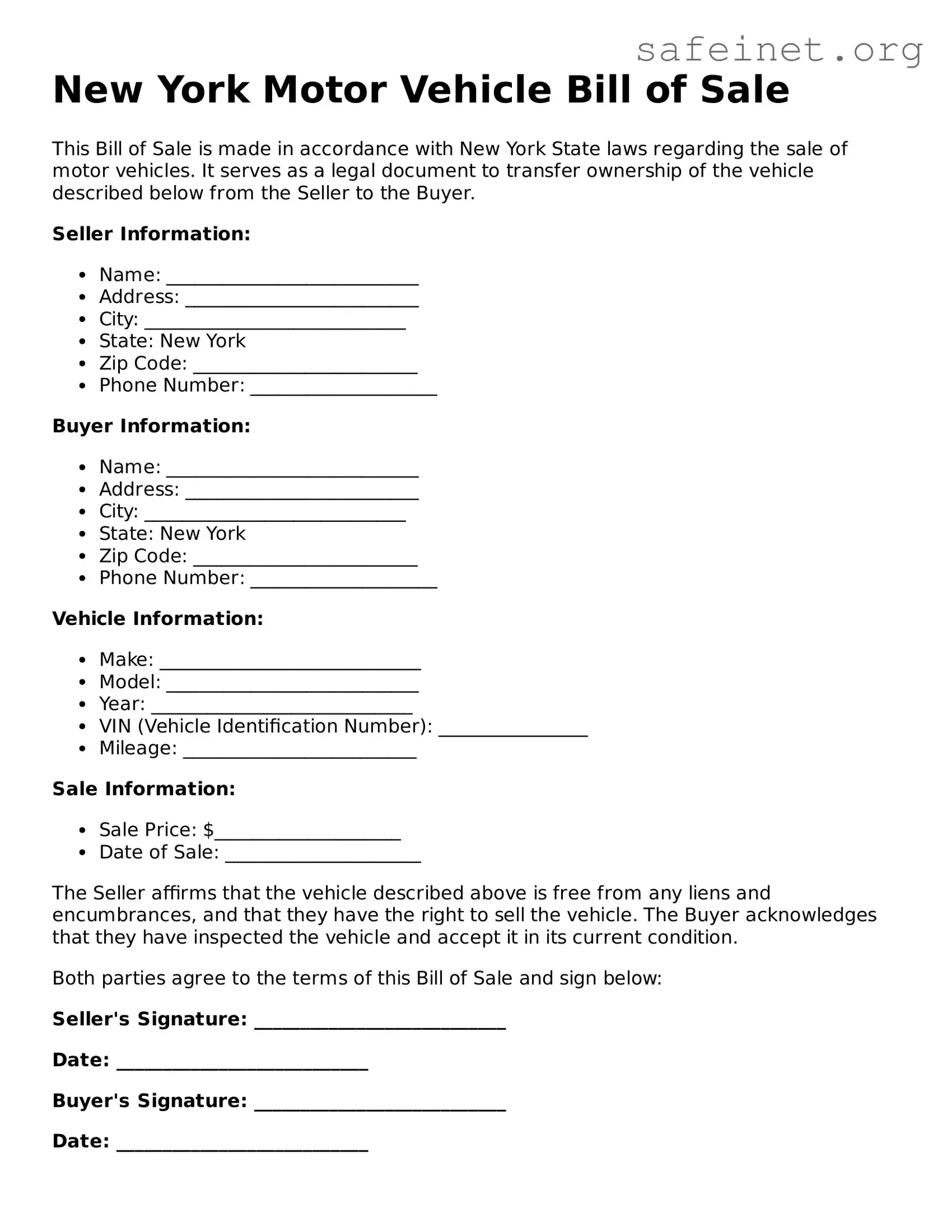
The New York Motor Vehicle Bill of Sale form serves as a crucial document in the transfer of ownership for motor vehicles within the state. This form captures essential details about the transaction, including the names and addresses of both the seller and buyer, the vehicle's identification number (VIN), make, model, year, and odometer reading at the time of sale. It also outlines the purchase price and any conditions related to the sale. By providing a clear record of the transaction, the Bill of Sale helps protect both parties involved, ensuring that the seller is released from any future liabilities associated with the vehicle and that the buyer has proof of ownership. Additionally, the form may be required for registration purposes with the New York Department of Motor Vehicles, making its accurate completion vital for a smooth transfer process. Understanding the components and significance of this form is essential for anyone involved in buying or selling a vehicle in New York.
New York Motor Vehicle Bill of Sale
This Bill of Sale is made in accordance with New York State laws regarding the sale of motor vehicles. It serves as a legal document to transfer ownership of the vehicle described below from the Seller to the Buyer.
Seller Information:
Buyer Information:
Vehicle Information:
Sale Information:
The Seller affirms that the vehicle described above is free from any liens and encumbrances, and that they have the right to sell the vehicle. The Buyer acknowledges that they have inspected the vehicle and accept it in its current condition.
Both parties agree to the terms of this Bill of Sale and sign below:
Seller's Signature: ___________________________
Date: ___________________________
Buyer's Signature: ___________________________
Date: ___________________________
This document serves as a record of the transaction and should be retained by both parties for their records.
| Fact Name | Description |
|---|---|
| Purpose | The New York Motor Vehicle Bill of Sale form is used to document the sale of a vehicle between a buyer and a seller. |
| Governing Law | This form is governed by New York State Vehicle and Traffic Law. |
| Required Information | Essential details include the vehicle identification number (VIN), make, model, year, and the sale price. |
| Signatures | Both the buyer and the seller must sign the form to validate the transaction. |
| Record Keeping | It's important for both parties to keep a copy of the Bill of Sale for their records and future reference. |
Filling out the New York Motor Vehicle Bill of Sale form is a straightforward process that requires attention to detail. After completing the form, ensure that all necessary signatures are obtained. This step is crucial for the transfer of ownership and to avoid any potential disputes in the future.
What is a New York Motor Vehicle Bill of Sale?
A New York Motor Vehicle Bill of Sale is a legal document that records the transfer of ownership of a motor vehicle from one party to another. It includes essential details such as the vehicle's make, model, year, Vehicle Identification Number (VIN), and the sale price. This document is important for both the buyer and seller as it serves as proof of the transaction.
Do I need a Bill of Sale to register my vehicle in New York?
Yes, a Bill of Sale is typically required when registering a vehicle in New York. It provides evidence of the sale and helps establish the buyer's ownership. When registering the vehicle, you may need to present the Bill of Sale along with other documents, such as the title and proof of identity.
What information is required on the Bill of Sale?
The Bill of Sale must include specific information, such as the names and addresses of both the buyer and seller, the vehicle's description (including make, model, year, and VIN), the sale price, and the date of the transaction. Both parties should sign the document to validate the sale.
Can I create my own Bill of Sale?
Yes, you can create your own Bill of Sale as long as it contains all the necessary information required by New York state law. However, using a standard form can simplify the process and ensure that you include all relevant details. Many online resources provide templates that you can customize.
Is the Bill of Sale required if I receive the vehicle as a gift?
While it is not legally required to have a Bill of Sale for gifted vehicles, it is still advisable to create one. A Bill of Sale can help clarify the transfer of ownership and provide documentation for registration purposes. It can also protect both parties in case of future disputes.
What should I do if the vehicle has a loan or lien?
If the vehicle has a loan or lien, it is essential to address this before completing the sale. The seller must pay off the loan to clear the title, or the buyer should be aware of the lien and negotiate accordingly. The Bill of Sale should indicate any existing liens to inform the buyer of their responsibilities.
Where can I obtain a New York Motor Vehicle Bill of Sale form?
You can obtain a New York Motor Vehicle Bill of Sale form from various sources, including the New York Department of Motor Vehicles (DMV) website, local DMV offices, or online legal form providers. Ensure that the form you use complies with New York state requirements.
Failing to include the correct vehicle identification number (VIN). This number is crucial for identifying the vehicle and must match the title.
Not providing accurate buyer and seller information. Ensure that names, addresses, and contact details are complete and correct.
Leaving out the sale price. The bill of sale must clearly state the amount paid for the vehicle.
Not signing the document. Both the buyer and seller must sign the bill of sale for it to be valid.
Using an outdated version of the form. Always check for the latest version to ensure compliance with current regulations.
Failing to include the date of sale. This is important for both parties for record-keeping purposes.
Not indicating whether the vehicle is sold as-is. Clearly state the condition of the vehicle to avoid future disputes.
Omitting the odometer reading. This information is necessary for tracking mileage and potential fraud.
Not keeping a copy for personal records. Both parties should retain a copy of the signed bill of sale for their records.
The New York Motor Vehicle Bill of Sale form is a critical document for transferring ownership of a vehicle. However, several other forms and documents are often required or recommended to complete the transaction smoothly. Below is a list of these documents, each serving a unique purpose in the process.
Each of these documents plays an essential role in the vehicle transfer process in New York. Ensuring that all necessary paperwork is completed accurately can help avoid complications and delays during the transaction.
The New York Motor Vehicle Bill of Sale form is quite similar to a standard sales receipt. Both documents serve as proof of a transaction between a buyer and a seller. A sales receipt typically includes details like the date of the sale, the items purchased, and the amount paid. Just like the bill of sale, it confirms that the buyer has received the item and the seller has received payment. This document can be important for record-keeping and may be required for warranty claims or returns.
Another document that resembles the Motor Vehicle Bill of Sale is the title transfer form. This form is crucial when ownership of a vehicle changes hands. It provides essential information such as the vehicle identification number (VIN), the names of the buyer and seller, and the date of the transfer. Like the bill of sale, the title transfer form is necessary for the new owner to register the vehicle in their name, ensuring that all legal ownership records are updated accordingly.
A purchase agreement is also similar to the Motor Vehicle Bill of Sale. This document outlines the terms of the sale, including the price, payment method, and any conditions agreed upon by both parties. While the bill of sale serves as a final confirmation of the transaction, the purchase agreement is often used during the negotiation phase. Both documents help protect the interests of the buyer and seller, providing a clear understanding of the transaction's details.
The odometer disclosure statement is another related document. This form is required in many states when selling a vehicle, as it records the vehicle's mileage at the time of sale. Similar to the bill of sale, it aims to prevent fraud by ensuring that buyers are aware of the vehicle's history. Both documents contribute to transparency in the transaction, helping buyers make informed decisions about their purchases.
The vehicle registration form also shares similarities with the Motor Vehicle Bill of Sale. While the bill of sale confirms the sale, the registration form is used to officially register the vehicle with the state. It typically requires information from the bill of sale, such as the buyer's and seller's details and the vehicle's VIN. Both documents are essential for legal ownership and compliance with state regulations.
A warranty deed is another document that can be compared to the Motor Vehicle Bill of Sale, though it typically applies to real estate transactions. Like a bill of sale, a warranty deed serves as proof of ownership transfer. It guarantees that the seller has the right to sell the property and that the buyer receives clear title. Both documents protect the interests of the parties involved and provide a legal record of the transaction.
The lease agreement for a vehicle is also somewhat similar. While it does not transfer ownership, it outlines the terms of leasing a vehicle, including payment amounts and duration. Both the lease agreement and the bill of sale establish a legal relationship between the parties involved. They ensure that both the lessor and lessee understand their rights and responsibilities, fostering transparency in the transaction.
Lastly, the insurance policy declaration page can be likened to the Motor Vehicle Bill of Sale. This document outlines the coverage details for a vehicle and is often required when registering a vehicle. While the bill of sale confirms the sale, the insurance declaration provides proof that the vehicle is insured, which is a critical step in the ownership process. Both documents play vital roles in ensuring that the vehicle is legally owned and protected.
When filling out the New York Motor Vehicle Bill of Sale form, it's essential to be thorough and accurate. Here are some important dos and don'ts to keep in mind:
By following these guidelines, you can help ensure a smooth transaction and avoid potential issues down the line.
The New York Motor Vehicle Bill of Sale form is an essential document for anyone buying or selling a vehicle in the state. However, several misconceptions can lead to confusion. Below are five common misunderstandings about this form, along with clarifications.
Many people believe that a Bill of Sale is only required for transactions involving dealerships. In reality, even private sales benefit from having this document. It provides proof of the transaction and protects both parties in case of disputes.
While notarization adds an extra layer of security, it is not a requirement for the New York Motor Vehicle Bill of Sale. The form can be valid without a notary, as long as both parties sign it.
This is a common misunderstanding. Both the buyer and the seller should sign the Bill of Sale to ensure that both parties acknowledge the terms of the sale. This signature requirement helps to confirm the agreement.
Some assume that the Bill of Sale is only applicable for used cars. However, it can also be used for new vehicles, providing a record of the sale regardless of the vehicle's age.
Even if a vehicle is already registered, a Bill of Sale is still important. It serves as proof of ownership transfer and is often required for registration updates or title transfers.
Understanding these misconceptions can help ensure that the process of buying or selling a vehicle in New York is smooth and legally sound. Always consider consulting with a professional if there are any uncertainties.
When filling out and using the New York Motor Vehicle Bill of Sale form, there are several important points to keep in mind. Here are five key takeaways: