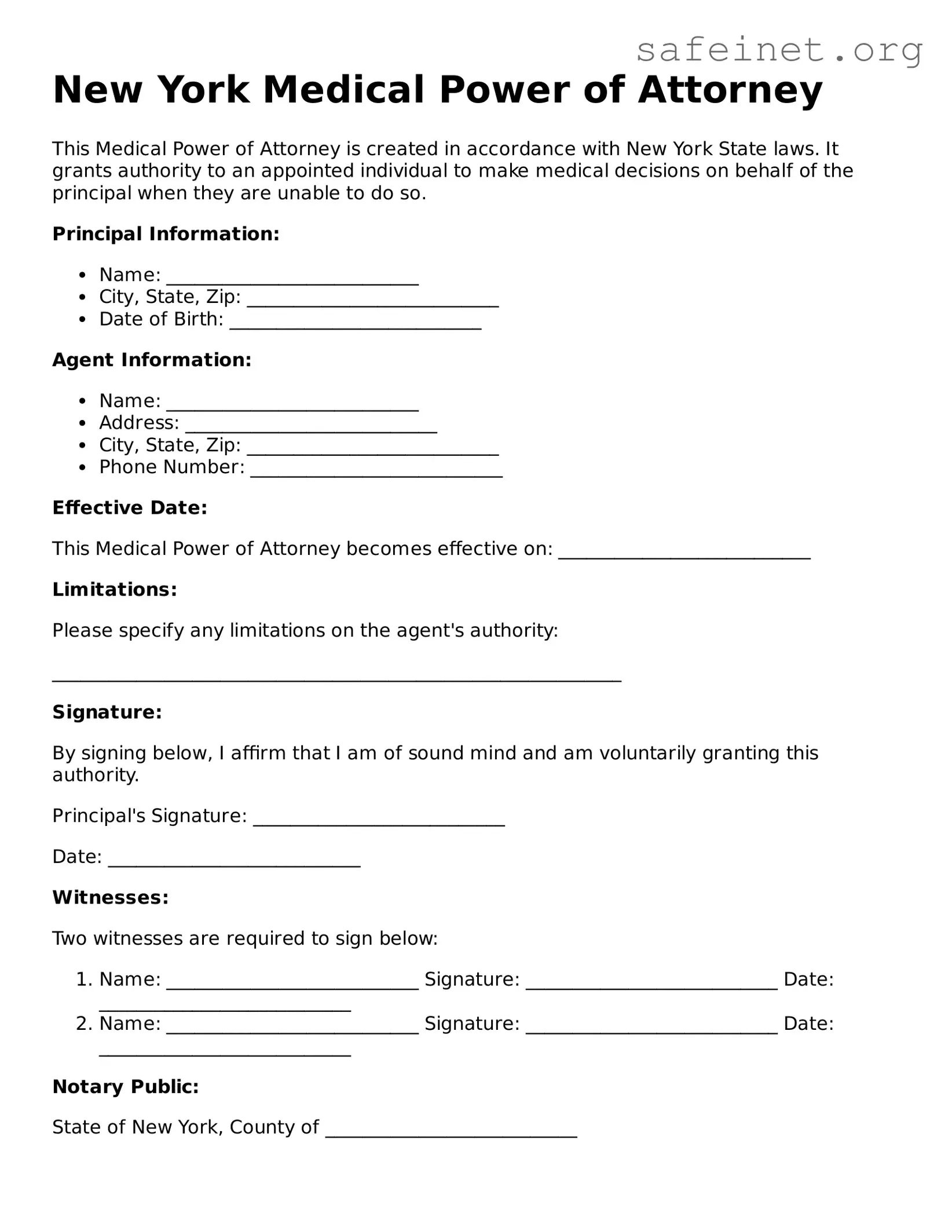
In the fast-paced world of healthcare, having a clear plan for medical decision-making is essential. The New York Medical Power of Attorney form serves as a crucial tool for individuals seeking to designate a trusted person to make healthcare decisions on their behalf when they are unable to do so. This form not only empowers your chosen representative, often referred to as a healthcare agent, but also ensures that your medical preferences are honored. Key aspects of the form include the ability to specify your wishes regarding treatment options, the authority granted to the agent, and the circumstances under which the agent can act. Additionally, the form requires the signatures of both the principal and witnesses, ensuring that the document is legally binding and recognized by healthcare providers. By understanding the intricacies of this form, individuals can take proactive steps to safeguard their health choices and ensure that their values are respected in times of medical crisis.
New York Medical Power of Attorney
This Medical Power of Attorney is created in accordance with New York State laws. It grants authority to an appointed individual to make medical decisions on behalf of the principal when they are unable to do so.
Principal Information:
Agent Information:
Effective Date:
This Medical Power of Attorney becomes effective on: ___________________________
Limitations:
Please specify any limitations on the agent's authority:
_____________________________________________________________
Signature:
By signing below, I affirm that I am of sound mind and am voluntarily granting this authority.
Principal's Signature: ___________________________
Date: ___________________________
Witnesses:
Two witnesses are required to sign below:
Notary Public:
State of New York, County of ___________________________
On this _____ day of __________, 20____, before me, a Notary Public, personally appeared ___________________________, known to me to be the person whose name is subscribed to this document, and acknowledged that they executed the same.
Notary Public Signature: ___________________________
My Commission Expires: ___________________________
| Fact Name | Description |
|---|---|
| Definition | The New York Medical Power of Attorney allows individuals to designate someone to make healthcare decisions on their behalf. |
| Governing Law | This form is governed by the New York State Public Health Law. |
| Eligibility | Any adult who is of sound mind can create a Medical Power of Attorney in New York. |
| Agent Requirements | The appointed agent must be at least 18 years old and cannot be the individual’s healthcare provider. |
| Durability | The Medical Power of Attorney remains effective even if the principal becomes incapacitated. |
| Revocation | The principal can revoke the Medical Power of Attorney at any time, as long as they are competent. |
| Witnesses | The form must be signed in the presence of two witnesses who are not related to the principal. |
| Notarization | Notarization is not required for the New York Medical Power of Attorney, but it can add an extra layer of validity. |
| Health Care Decisions | The agent can make decisions about medical treatment, including end-of-life care, as specified in the document. |
| Access to Records | The agent is allowed to access the principal’s medical records to make informed decisions. |
Filling out the New York Medical Power of Attorney form is an important step in ensuring that your healthcare preferences are honored. Once you have completed the form, you will need to ensure it is properly signed and witnessed to be legally valid. Below are the steps to guide you through the process of filling out the form.
What is a New York Medical Power of Attorney?
A New York Medical Power of Attorney is a legal document that allows an individual, known as the principal, to appoint someone else, referred to as the agent or healthcare proxy, to make medical decisions on their behalf. This is particularly important in situations where the principal is unable to communicate their wishes due to illness or incapacity. The appointed agent is responsible for ensuring that the principal’s healthcare preferences are honored.
Who can be appointed as an agent in a Medical Power of Attorney?
In New York, any competent adult can be appointed as an agent. This can include family members, friends, or trusted individuals. It is essential to choose someone who understands your values and preferences regarding medical treatment. The agent must be willing to take on this responsibility and should be someone you trust to act in your best interest.
How does one create a Medical Power of Attorney in New York?
To create a Medical Power of Attorney in New York, the principal must fill out a specific form, which can often be obtained from healthcare providers or legal resources. The form must clearly state the principal's wishes and designate the agent. After completing the form, it should be signed by the principal in the presence of at least one witness who is not the agent. In some cases, notarization may also be required to ensure its validity.
Can the Medical Power of Attorney be revoked?
Yes, the principal has the right to revoke a Medical Power of Attorney at any time, as long as they are still competent to make decisions. To revoke the document, the principal should notify the agent and any relevant healthcare providers. It is advisable to create a new document if the principal wishes to appoint a different agent or change their healthcare preferences.
What happens if I do not have a Medical Power of Attorney?
If an individual does not have a Medical Power of Attorney and becomes incapacitated, medical decisions may be made by family members or, in some cases, by the court. This can lead to confusion and disagreements among family members regarding the appropriate course of action. Having a Medical Power of Attorney in place helps ensure that your healthcare wishes are respected and reduces the burden on loved ones during difficult times.
Is a Medical Power of Attorney the same as a Living Will?
No, a Medical Power of Attorney and a Living Will are not the same, although they can complement each other. A Medical Power of Attorney focuses on appointing an agent to make healthcare decisions, while a Living Will outlines specific wishes regarding medical treatment in certain situations, such as end-of-life care. Many people choose to have both documents to provide comprehensive guidance for their healthcare preferences.
Not specifying the agent clearly. It is crucial to provide the full name and contact information of the person designated to make medical decisions.
Failing to sign and date the form. Without a signature and date, the document may be considered invalid.
Not having the form witnessed or notarized. New York law requires that the Medical Power of Attorney be signed in the presence of a witness or a notary.
Using vague language. Clearly stating the powers granted to the agent helps avoid confusion during critical moments.
Neglecting to discuss wishes with the agent. It's essential to have an open conversation about medical preferences before filling out the form.
Overlooking the need for updates. Life changes, such as a change in health or relationships, may require revisions to the document.
Not providing copies to relevant parties. Ensure that the agent, family members, and healthcare providers have copies of the completed form.
Ignoring state-specific requirements. Each state may have unique rules regarding the Medical Power of Attorney, so it’s important to follow New York’s specific guidelines.
The New York Medical Power of Attorney form allows individuals to designate someone to make healthcare decisions on their behalf if they become unable to do so. Along with this important document, several other forms and documents are often utilized to ensure comprehensive planning for medical and legal matters. Here’s a list of some commonly associated documents.
Having these documents in place can provide peace of mind, ensuring that healthcare decisions align with personal values and preferences. It is important to review and update these documents regularly to reflect any changes in circumstances or wishes.
The New York Health Care Proxy is a document that allows an individual to appoint someone to make medical decisions on their behalf if they become unable to do so. Similar to the Medical Power of Attorney, the Health Care Proxy specifically focuses on healthcare decisions. It ensures that the appointed agent can communicate the individual’s wishes regarding medical treatment, including life-sustaining measures, in accordance with their values and preferences.
The Living Will is another important document that outlines an individual’s wishes regarding medical treatment in scenarios where they are unable to communicate. While the Medical Power of Attorney designates an agent to make decisions, the Living Will provides specific instructions about the types of medical care the individual does or does not want. This can include preferences about resuscitation efforts, pain management, and end-of-life care.
A Durable Power of Attorney is a broader document that grants someone the authority to make financial and legal decisions on behalf of another person. While the Medical Power of Attorney focuses solely on healthcare, the Durable Power of Attorney can cover a wide range of matters, including property management and financial transactions. This document remains effective even if the individual becomes incapacitated, similar to how a Medical Power of Attorney remains valid when medical decisions need to be made.
The Advance Directive is a comprehensive term that encompasses both the Living Will and the Health Care Proxy. It serves as a guide for healthcare providers and family members regarding an individual’s preferences for medical treatment. Like the Medical Power of Attorney, it aims to ensure that a person’s healthcare choices are respected, even if they cannot voice those choices themselves.
The Do Not Resuscitate (DNR) order is a specific directive that instructs healthcare providers not to perform CPR if a patient stops breathing or their heart stops beating. While the Medical Power of Attorney allows an agent to make a variety of healthcare decisions, a DNR focuses solely on resuscitation efforts. It is often used in conjunction with other advance care planning documents to provide clear guidance on a patient’s wishes.
The Physician Orders for Life-Sustaining Treatment (POLST) form is similar to the Medical Power of Attorney in that it is designed to communicate a patient’s preferences for medical treatment. However, POLST is a medical order signed by a physician, which makes it actionable by healthcare providers. It details specific treatments a patient wishes to receive or forgo, ensuring that their preferences are honored in emergency situations.
The Mental Health Care Proxy allows an individual to appoint someone to make decisions regarding their mental health treatment if they become incapacitated. Similar to the Medical Power of Attorney, this document is focused on healthcare decisions, but it specifically addresses mental health issues, ensuring that the appointed agent can advocate for the individual’s preferences in that area.
The Guardianship document is a legal arrangement where a court appoints an individual to make decisions for someone who is unable to do so. This can include medical, financial, and personal decisions. While the Medical Power of Attorney allows an individual to choose their agent, guardianship is typically established through a court process. Both serve to protect the interests of individuals who cannot make decisions for themselves.
The Authorization for Release of Health Information form allows individuals to grant permission for their medical records to be shared with specific people or organizations. While this document does not provide decision-making authority like the Medical Power of Attorney, it is essential for ensuring that the appointed agent can access necessary medical information to make informed decisions on behalf of the individual.
Finally, the Declaration of Guardian for Minor Children is a document that allows parents to designate a guardian for their children in the event they become incapacitated. While this document is aimed at the care of minors, it shares similarities with the Medical Power of Attorney in that it involves making decisions on behalf of another individual. Both documents are crucial for ensuring that one’s wishes are honored when they cannot advocate for themselves.
When filling out the New York Medical Power of Attorney form, it is essential to approach the process with care and attention to detail. The following guidelines outline key actions to take and avoid:
When it comes to the New York Medical Power of Attorney form, several misconceptions can lead to confusion. Understanding the truth behind these myths is essential for making informed decisions about your healthcare. Here are seven common misconceptions:
Myth 1: A Medical Power of Attorney is the same as a Living Will.
While both documents deal with healthcare decisions, a Medical Power of Attorney specifically designates someone to make decisions on your behalf, whereas a Living Will outlines your wishes regarding medical treatment.
Myth 2: Only elderly people need a Medical Power of Attorney.
People of all ages can benefit from having this document. Accidents and unexpected health issues can happen to anyone, making it important to have a plan in place.
Myth 3: A Medical Power of Attorney is only necessary if you are terminally ill.
This is not true. A Medical Power of Attorney is useful in any situation where you may be unable to communicate your healthcare wishes, regardless of your current health status.
Myth 4: The person I appoint can only make decisions if I am incapacitated.
While the appointed person typically makes decisions when you are unable to do so, they can also help guide your care even if you are temporarily unable to communicate your wishes.
Myth 5: A Medical Power of Attorney can override my healthcare preferences.
The appointed individual must follow your wishes as outlined in your Living Will or any other directives you have provided. They cannot make decisions that contradict your stated preferences.
Myth 6: You can only have one Medical Power of Attorney.
While it’s common to appoint one person, you can designate multiple individuals. Just ensure that their roles and responsibilities are clearly defined to avoid confusion.
Myth 7: Once signed, a Medical Power of Attorney cannot be changed.
This is incorrect. You can revoke or update your Medical Power of Attorney at any time, as long as you are of sound mind. It’s important to keep your documents current to reflect your wishes.
By addressing these misconceptions, you can better understand the importance of the New York Medical Power of Attorney form and ensure that your healthcare preferences are respected.
When filling out and using the New York Medical Power of Attorney form, it is essential to keep several key points in mind. Understanding these can help ensure that your wishes regarding medical treatment are respected and that your designated agent can act on your behalf effectively.
By keeping these takeaways in mind, individuals can navigate the process of creating a Medical Power of Attorney in New York with greater confidence and clarity.