When couples decide to live apart but are not ready to pursue divorce, a New York Marital Separation Agreement can be an essential tool for outlining their rights and responsibilities. This legally binding document addresses various aspects of the couple's relationship, including the division of property, financial support, and child custody arrangements. By clearly defining these terms, the agreement helps prevent misunderstandings and disputes during the separation period. It serves as a roadmap for both parties, ensuring that each individual's needs are considered and met. Additionally, the agreement can include provisions for health insurance, tax implications, and any other relevant matters that may arise during the separation. Understanding the significance of this form is crucial for anyone navigating the complexities of marital separation in New York.
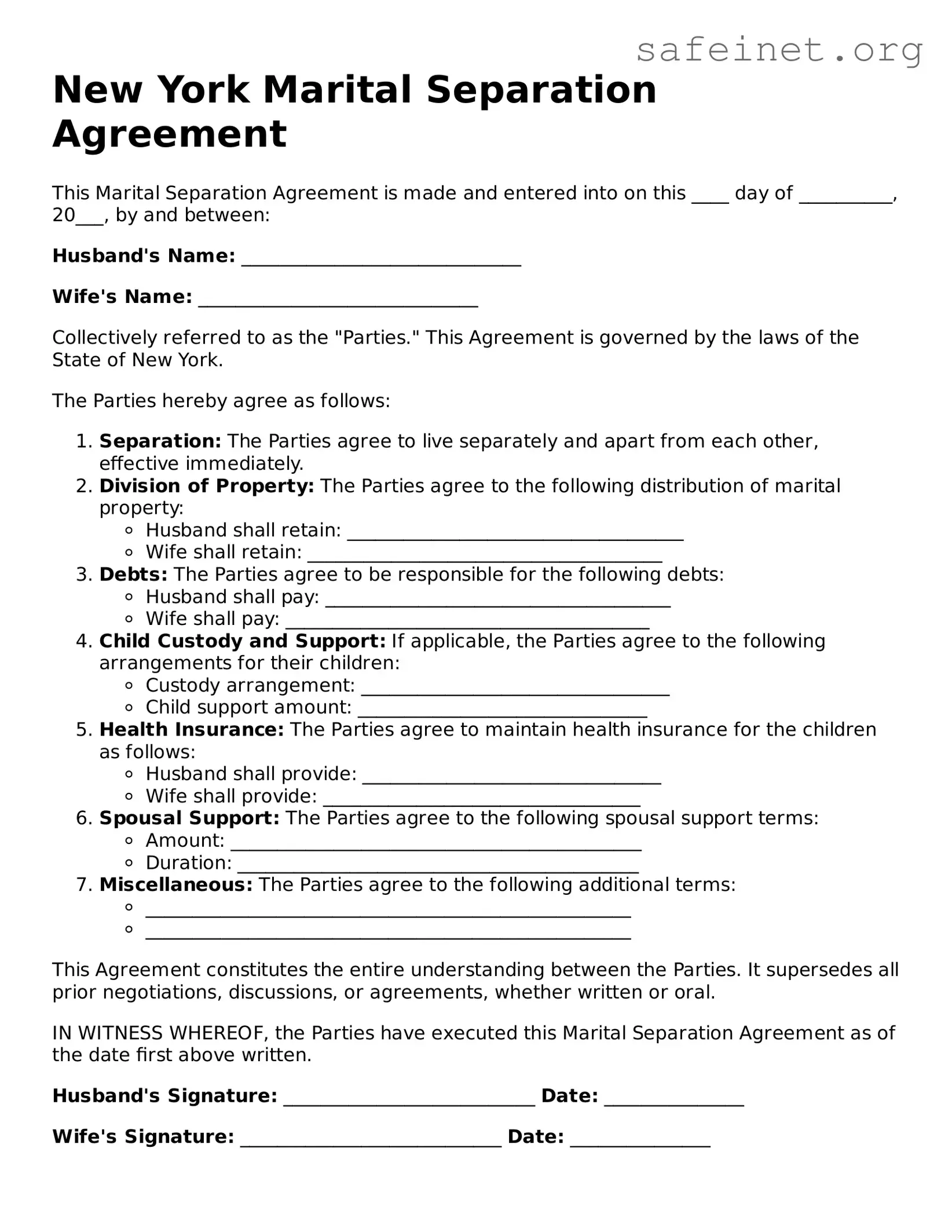
New York Marital Separation Agreement
This Marital Separation Agreement is made and entered into on this ____ day of __________, 20___, by and between:
Husband's Name: ______________________________
Wife's Name: ______________________________
Collectively referred to as the "Parties." This Agreement is governed by the laws of the State of New York.
The Parties hereby agree as follows:
This Agreement constitutes the entire understanding between the Parties. It supersedes all prior negotiations, discussions, or agreements, whether written or oral.
IN WITNESS WHEREOF, the Parties have executed this Marital Separation Agreement as of the date first above written.
Husband's Signature: ___________________________ Date: _______________
Wife's Signature: ____________________________ Date: _______________
| Fact Name | Description |
|---|---|
| Purpose | The New York Marital Separation Agreement form outlines the terms of separation between spouses, covering issues like property division, child custody, and support obligations. |
| Governing Laws | This agreement is governed by New York Domestic Relations Law, specifically sections related to separation and divorce. |
| Legal Status | While the agreement is not a divorce decree, it can be used as a basis for divorce proceedings and may influence court decisions. |
| Enforceability | The terms of the agreement are enforceable in court, provided both parties have signed and the agreement complies with state laws. |
After obtaining the New York Marital Separation Agreement form, you will need to complete it carefully. This form outlines the terms of your separation and ensures both parties understand their rights and responsibilities. Follow these steps to fill it out correctly.
Once completed, both parties should keep a copy for their records. It’s advisable to consult with a legal professional to ensure all aspects of the agreement are clear and enforceable.
What is a New York Marital Separation Agreement?
A New York Marital Separation Agreement is a legal document that outlines the terms of a couple's separation. It addresses important issues such as property division, child custody, and support obligations. This agreement allows both parties to clarify their rights and responsibilities while living separately, without necessarily going through a divorce immediately.
Is a Marital Separation Agreement legally binding?
Yes, a properly executed Marital Separation Agreement is legally binding in New York. Once both parties sign the agreement, it becomes enforceable in court. However, it's essential that both parties fully understand the terms and conditions before signing, as the agreement will govern their legal rights during the separation period.
Do I need a lawyer to create a Marital Separation Agreement?
While it is not legally required to have a lawyer draft your Marital Separation Agreement, it is highly advisable. A lawyer can help ensure that the agreement is comprehensive and fair, protecting your rights and interests. They can also provide guidance on New York laws that may affect your situation.
What should be included in a Marital Separation Agreement?
A comprehensive Marital Separation Agreement typically includes provisions regarding the division of assets and debts, child custody and visitation arrangements, child support, spousal support, and health insurance. It may also address how to handle future disputes and any other relevant issues that arise from the separation.
Can a Marital Separation Agreement be modified?
Yes, a Marital Separation Agreement can be modified if both parties agree to the changes. It's important to document any modifications in writing and have both parties sign the amended agreement. If there are significant changes in circumstances, such as a change in income or living arrangements, a modification may be necessary to reflect those changes.
How does a Marital Separation Agreement affect divorce proceedings?
A Marital Separation Agreement can simplify the divorce process by establishing the terms of separation in advance. When the couple decides to proceed with divorce, the agreement can serve as a foundation for the divorce settlement. However, it is essential to note that a separation agreement does not automatically lead to divorce; the couple must file for divorce separately.
What happens if one party violates the Marital Separation Agreement?
If one party violates the terms of the Marital Separation Agreement, the other party may seek legal remedies. This could involve going to court to enforce the agreement or to seek damages for any losses incurred due to the violation. Courts generally take these agreements seriously, and violations can lead to legal consequences.
Is a Marital Separation Agreement the same as a divorce?
No, a Marital Separation Agreement is not the same as a divorce. A separation agreement allows couples to live apart while still legally married. In contrast, a divorce is the legal dissolution of the marriage. Couples may choose separation as a first step before deciding whether to proceed with divorce.
How long does it take to create a Marital Separation Agreement?
The time it takes to create a Marital Separation Agreement can vary significantly depending on the complexity of the issues involved and how well the parties communicate. If both parties are in agreement on most terms, the process may be relatively quick. However, if there are disputes or complicated financial matters, it may take longer to reach a satisfactory agreement.
Failing to include all necessary personal information. Make sure to list full names, addresses, and any other relevant details for both parties.
Not clearly defining the terms of separation. Ambiguities can lead to misunderstandings later on. Be specific about what each party is responsible for.
Overlooking the division of assets. It’s crucial to itemize all property, including bank accounts, real estate, and personal belongings.
Ignoring debts. Both parties should acknowledge any debts and agree on how they will be handled.
Neglecting to address child custody and support. If children are involved, outline custody arrangements and financial responsibilities clearly.
Using vague language. Avoid terms that can be interpreted in multiple ways. Clarity is key to preventing disputes.
Not consulting legal advice. Many people skip this step, but having a professional review the agreement can prevent future complications.
Forgetting to date the agreement. A date is essential for establishing when the terms were agreed upon.
Failing to have the agreement notarized. This adds an extra layer of authenticity and can be important if disputes arise.
Not keeping copies. Both parties should retain signed copies of the agreement for their records.
A Marital Separation Agreement is a significant document that outlines the terms of a couple's separation. In New York, several other forms and documents are often utilized in conjunction with this agreement to ensure a comprehensive understanding of the separation process. Below is a list of some commonly used documents that may accompany the Marital Separation Agreement.
Each of these documents plays a crucial role in the separation process, helping to clarify expectations and responsibilities for both parties. Having a well-prepared set of documents can facilitate smoother negotiations and promote a more amicable separation experience.
The New York Marital Separation Agreement is similar to a Divorce Settlement Agreement. Both documents outline the terms of a couple’s separation or divorce, including asset division, child custody, and support arrangements. While a Marital Separation Agreement can be used when couples choose to live apart without ending their marriage, a Divorce Settlement Agreement finalizes the divorce process. Both documents aim to provide clarity and reduce conflict by clearly stating each party's rights and responsibilities.
Another related document is the Separation Agreement. This is often used in various states, including New York, to formalize the terms under which a couple will separate. Like the Marital Separation Agreement, it addresses issues such as property division, alimony, and child custody. However, the Separation Agreement can be a precursor to divorce, allowing couples to establish their separation terms before deciding to end the marriage legally.
The Parenting Plan is also similar, particularly when children are involved. This document specifically focuses on the care and custody of children after separation. It outlines visitation schedules, decision-making responsibilities, and other parenting issues. While a Marital Separation Agreement may include these elements, a Parenting Plan dives deeper into the specifics of co-parenting, ensuring that children's needs are prioritized.
A Cohabitation Agreement shares some similarities as well. While this document is typically used by unmarried couples living together, it serves to outline the rights and responsibilities of each partner regarding shared property and finances. Like a Marital Separation Agreement, it aims to clarify expectations and reduce disputes, although it does not address divorce or legal separation since the couple is not married.
Finally, a Postnuptial Agreement is another document that bears resemblance. This agreement is created after marriage and can address asset division, debt responsibilities, and other financial matters, much like a Marital Separation Agreement. While it does not specifically pertain to separation or divorce, it can serve as a tool for couples to agree on financial arrangements, potentially easing the process if they later decide to separate or divorce.
When filling out the New York Marital Separation Agreement form, it is essential to approach the process with care and attention. Below are some important do's and don'ts to consider:
When it comes to the New York Marital Separation Agreement form, several misconceptions can lead to confusion for those considering or undergoing a separation. Here are nine common misunderstandings:
A marital separation agreement is not a divorce. Instead, it outlines the terms of separation, such as asset division and child custody, but does not legally end the marriage.
While many couples with children use this agreement to address custody and support, it is also beneficial for couples without children to clarify financial matters and property division.
This agreement does not need to be filed with the court to be valid. It is a private contract between the parties, although having it notarized can enhance its enforceability.
In fact, couples can modify the agreement later if both parties consent. Changes can be made to reflect new circumstances or agreements.
Some couples may choose to separate for a period without intending to divorce. The agreement can provide clarity and structure during this time.
While the agreement can be legally binding, both parties must voluntarily sign it, and it should be clear and fair to be enforceable in court.
Both parties should ideally be involved in the creation of the agreement. This ensures that it reflects the interests and needs of both individuals.
While not legally required, consulting with an attorney can help ensure that the agreement is comprehensive and protects each party’s rights.
While the agreement can address many issues, it may not cover all aspects of a marriage, such as future spousal support or certain debts, unless specifically included.
Understanding these misconceptions can help individuals navigate their options more effectively and make informed decisions regarding their separation.
When navigating the New York Marital Separation Agreement form, it is essential to keep several key points in mind. Understanding these takeaways can help ensure a smoother process.