In the bustling financial landscape of New York, securing a loan often requires a clear and comprehensive understanding of the legal documents involved. The New York Loan Agreement form serves as a crucial tool for both lenders and borrowers, outlining the terms and conditions of the loan arrangement. This form typically includes essential details such as the loan amount, interest rate, repayment schedule, and any collateral involved. Additionally, it addresses the responsibilities of both parties, including payment obligations and consequences for default. By clearly defining these aspects, the Loan Agreement helps to minimize misunderstandings and protect the interests of everyone involved. Understanding this form is vital for anyone looking to navigate the complexities of borrowing and lending in New York.
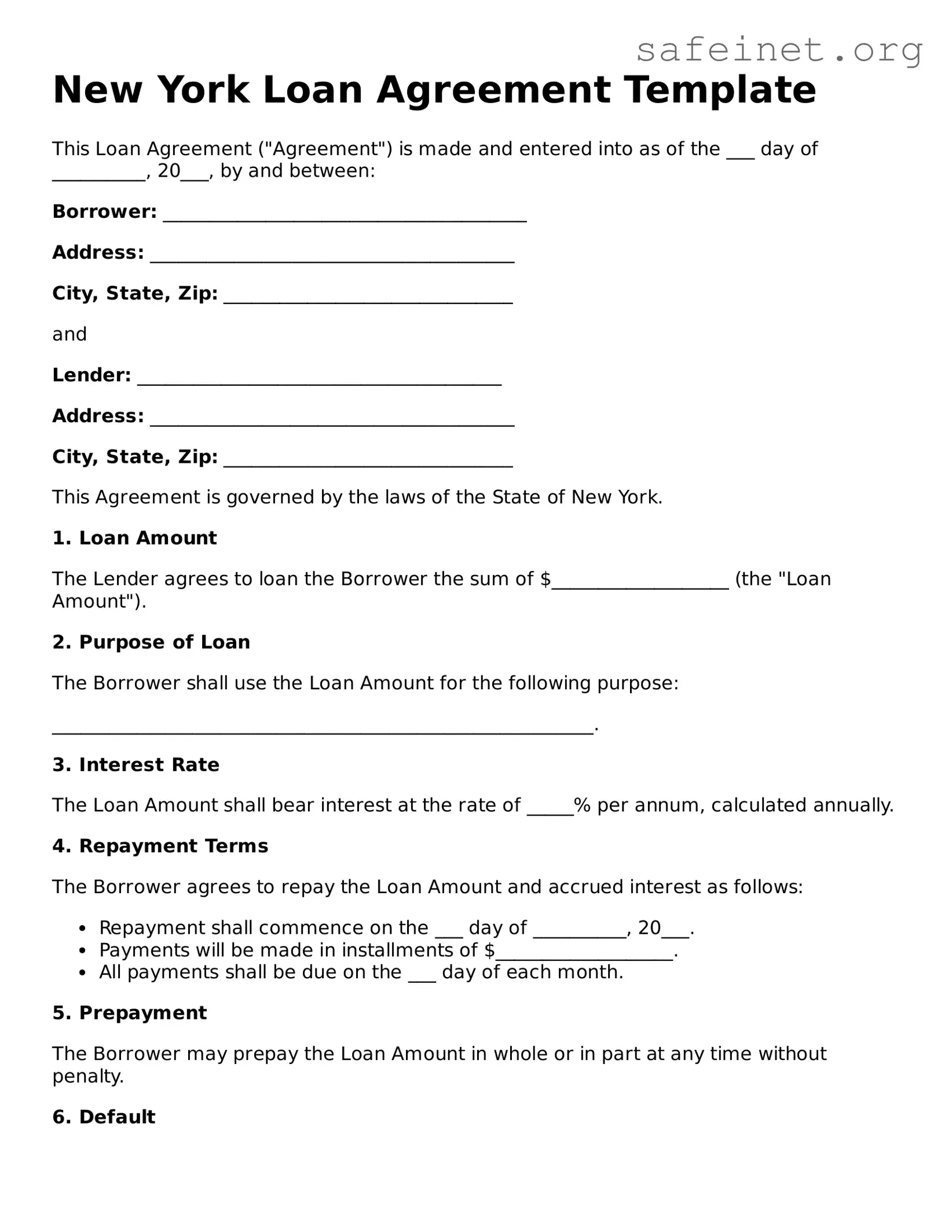
New York Loan Agreement Template
This Loan Agreement ("Agreement") is made and entered into as of the ___ day of __________, 20___, by and between:
Borrower: _______________________________________
Address: _______________________________________
City, State, Zip: _______________________________
and
Lender: _______________________________________
Address: _______________________________________
City, State, Zip: _______________________________
This Agreement is governed by the laws of the State of New York.
1. Loan Amount
The Lender agrees to loan the Borrower the sum of $___________________ (the "Loan Amount").
2. Purpose of Loan
The Borrower shall use the Loan Amount for the following purpose:
__________________________________________________________.
3. Interest Rate
The Loan Amount shall bear interest at the rate of _____% per annum, calculated annually.
4. Repayment Terms
The Borrower agrees to repay the Loan Amount and accrued interest as follows:
5. Prepayment
The Borrower may prepay the Loan Amount in whole or in part at any time without penalty.
6. Default
If the Borrower fails to make any payment when due, the Lender may declare the entire Loan Amount and accrued interest immediately due and payable.
7. Governing Law
This Agreement shall be governed by and construed in accordance with the laws of the State of New York.
8. Signatures
IN WITNESS WHEREOF, the parties hereto have executed this Loan Agreement as of the date first above written.
Borrower Signature: ___________________________
Date: ______________________________________
Lender Signature: ____________________________
Date: ______________________________________
| Fact Name | Description |
|---|---|
| Purpose | The New York Loan Agreement form outlines the terms and conditions under which a loan is granted between a lender and a borrower. |
| Governing Law | This agreement is governed by the laws of the State of New York. |
| Loan Amount | The form specifies the exact amount of money being loaned, ensuring clarity for both parties. |
| Interest Rate | The interest rate applicable to the loan is detailed, providing transparency regarding the cost of borrowing. |
| Repayment Terms | Repayment terms, including the schedule and method of payment, are clearly outlined to avoid confusion. |
| Default Conditions | The agreement describes what constitutes a default, helping both parties understand their rights and obligations. |
| Signatures | Both the lender and borrower must sign the document, making it legally binding once executed. |
| Amendments | Any amendments to the agreement must be made in writing and signed by both parties to be valid. |
After obtaining the New York Loan Agreement form, you will need to complete it accurately. This ensures that all parties involved understand the terms of the loan. Follow the steps below to fill out the form correctly.
What is a New York Loan Agreement form?
A New York Loan Agreement form is a legal document that outlines the terms of a loan between a lender and a borrower. It specifies the amount borrowed, the interest rate, repayment schedule, and other important conditions. This form helps both parties understand their rights and obligations regarding the loan.
Who needs a Loan Agreement?
Anyone who is lending money or borrowing money in New York should consider using a Loan Agreement. This includes individuals, businesses, and organizations. Having a formal agreement helps prevent misunderstandings and provides legal protection for both parties.
What information is included in a Loan Agreement?
A Loan Agreement typically includes the names and addresses of the lender and borrower, the loan amount, interest rate, repayment terms, and any collateral involved. It may also cover late fees, default conditions, and any other specific terms agreed upon by both parties.
Is a Loan Agreement legally binding?
Yes, a properly executed Loan Agreement is legally binding in New York. Both parties must agree to the terms and sign the document for it to be enforceable. It’s important to ensure that the agreement complies with state laws to avoid any issues later on.
Do I need a lawyer to create a Loan Agreement?
While it’s not mandatory to have a lawyer draft a Loan Agreement, it can be helpful, especially for larger loans or complex terms. A lawyer can ensure that the agreement is legally sound and meets all necessary requirements. For simpler loans, many people successfully use templates available online.
What happens if the borrower defaults on the loan?
If the borrower defaults, the lender may take legal action to recover the owed amount. The Loan Agreement should outline the steps the lender can take in case of default, which may include charging late fees, accelerating the loan, or pursuing legal remedies.
Can the Loan Agreement be modified after it is signed?
Yes, a Loan Agreement can be modified, but both parties must agree to the changes. It’s best to document any modifications in writing and have both parties sign the updated agreement to avoid confusion in the future.
Is it necessary to notarize the Loan Agreement?
Notarization is not required for a Loan Agreement to be valid in New York. However, having the document notarized can add an extra layer of security and credibility, especially if disputes arise later.
What if I have questions about specific terms in the Loan Agreement?
If you have questions about specific terms, it’s advisable to consult a legal professional. They can provide clarity on legal language and help ensure that you fully understand your rights and obligations under the agreement.
Where can I find a template for a New York Loan Agreement?
Templates for New York Loan Agreements can be found online on legal websites, or you can visit your local library for resources. Ensure that any template you use is up-to-date and complies with New York state laws.
Failing to provide accurate personal information. Many people overlook the importance of entering their full legal name, address, and contact details correctly. This can lead to delays or complications in the loan process.
Not including the correct loan amount. Borrowers sometimes miscalculate or misstate the amount they wish to borrow. This mistake can affect the terms of the agreement.
Ignoring the interest rate details. Some individuals do not pay close attention to the interest rate specified in the agreement. Understanding how this rate affects total repayment is crucial.
Overlooking repayment terms. Borrowers may not fully read or understand the repayment schedule. Missing this information can lead to unexpected payment dates and amounts.
Neglecting to check for additional fees. Many loan agreements include various fees, such as origination or processing fees. Failing to account for these can lead to financial surprises later on.
Not signing the document. It may seem obvious, but some individuals forget to sign or date the agreement. Without a signature, the document is not legally binding.
Rushing through the review process. Many borrowers do not take the time to thoroughly read the entire agreement. This can result in missing critical information that may impact their financial future.
When entering into a loan agreement in New York, several other forms and documents often accompany the primary agreement. Each of these documents serves a specific purpose, ensuring clarity and protection for all parties involved. Below is a list of commonly used documents that complement the New York Loan Agreement.
Understanding these documents can significantly enhance the borrowing experience, ensuring that all parties are on the same page. Each form plays a vital role in protecting both the lender and the borrower throughout the loan process.
The New York Loan Agreement form shares similarities with a Promissory Note, which is a written promise to pay a specified amount of money at a certain time. Both documents establish the borrower’s obligation to repay the lender. However, while a Loan Agreement outlines the terms of the loan, including interest rates and repayment schedules, a Promissory Note focuses primarily on the borrower's promise to repay. This makes the Promissory Note a more straightforward document, often used for smaller loans or personal loans.
Another document akin to the Loan Agreement is the Mortgage Agreement. This document secures the loan with collateral, typically real estate. Like the Loan Agreement, it details the terms of the loan, including the amount borrowed and the repayment schedule. The key difference lies in the fact that a Mortgage Agreement grants the lender the right to take possession of the property if the borrower defaults, adding an extra layer of security for the lender.
The Security Agreement is also similar to the Loan Agreement. It outlines the terms under which collateral is provided to secure a loan. Both documents detail the obligations of the borrower, but the Security Agreement specifically focuses on the assets pledged as collateral. This document is crucial for lenders, as it provides them with rights to the collateral in the event of default.
A Credit Agreement is another document that shares features with the Loan Agreement. This type of agreement is often used in business financing and outlines the terms under which a lender will extend credit to a borrower. Both documents include repayment terms and interest rates, but the Credit Agreement may also include provisions for ongoing credit availability, making it more flexible for businesses that need access to funds over time.
The Lease Agreement bears some resemblance to the Loan Agreement, particularly when it comes to the obligations of the parties involved. Both documents specify terms regarding payments and responsibilities. However, a Lease Agreement is typically used for renting property rather than borrowing money. While it outlines payment schedules and conditions, it does not involve a loan in the traditional sense, but rather a rental arrangement.
The Installment Agreement is another document that aligns closely with the Loan Agreement. It allows borrowers to repay a loan in a series of scheduled payments over time. Both documents detail the payment structure, including the total amount owed and the payment intervals. The Installment Agreement is often used for larger purchases, like vehicles or appliances, making it similar in function to a Loan Agreement.
A Line of Credit Agreement is also comparable to the Loan Agreement. This document allows borrowers to access funds up to a specified limit, similar to a credit card. Both agreements outline repayment terms and interest rates. However, while a Loan Agreement typically involves a lump sum, a Line of Credit provides flexibility, allowing borrowers to withdraw funds as needed and repay them over time.
The Personal Loan Agreement is another document that bears similarities to the Loan Agreement. It is specifically tailored for individual borrowers seeking to secure a loan for personal use. Both documents outline the terms of the loan, including the amount borrowed and repayment terms. However, the Personal Loan Agreement often includes provisions specific to individual borrowers, such as income verification and credit checks.
Lastly, the Business Loan Agreement is akin to the Loan Agreement but is specifically designed for business entities. This document outlines the terms of borrowing for business purposes, including repayment schedules and interest rates. While both agreements share similar structures, the Business Loan Agreement may include additional clauses relevant to business operations, such as the use of funds and financial reporting requirements.
When filling out the New York Loan Agreement form, it's important to be careful and thorough. Here are some things you should and shouldn't do:
This is not true. The form can be used for loans of various sizes, whether small or large. It is designed to accommodate different borrowing needs.
While notarization can add an extra layer of authenticity, it is not a requirement for all loan agreements in New York. The agreement is valid as long as both parties sign it.
Although they are related, they serve different purposes. A loan agreement outlines the terms of the loan, while a promissory note is a promise to repay the loan.
This is incorrect. Parties can negotiate and modify the terms of the agreement, but any changes should be clearly documented and signed by both parties.
While the signed agreement is binding, parties can agree to amend the terms later. This requires mutual consent and should be documented properly.
This is a common misunderstanding. The agreement is designed to protect the interests of both parties, outlining rights and responsibilities for each side.
While legal advice can be beneficial, it is not mandatory. Many people successfully complete the form on their own, provided they understand the terms involved.
When filling out and using the New York Loan Agreement form, it is essential to keep several key points in mind. Below are important takeaways to ensure a smooth process.
By keeping these takeaways in mind, both lenders and borrowers can navigate the Loan Agreement process more effectively.