The New York Independent Contractor Agreement form serves as a crucial document for establishing the terms of the working relationship between a business and an independent contractor. This agreement outlines essential elements such as the scope of work, payment terms, and the duration of the contract, ensuring that both parties have a clear understanding of their rights and responsibilities. Additionally, it addresses issues like confidentiality, intellectual property rights, and termination clauses, which can protect the interests of both the contractor and the hiring entity. By defining these parameters, the agreement helps to mitigate potential disputes and provides a framework for resolving any issues that may arise during the course of the engagement. The form is particularly important in New York, where labor laws can be complex, and compliance with state regulations is essential for avoiding legal complications. Overall, the Independent Contractor Agreement is not merely a formality; it is a foundational document that lays the groundwork for a successful and legally sound working relationship.
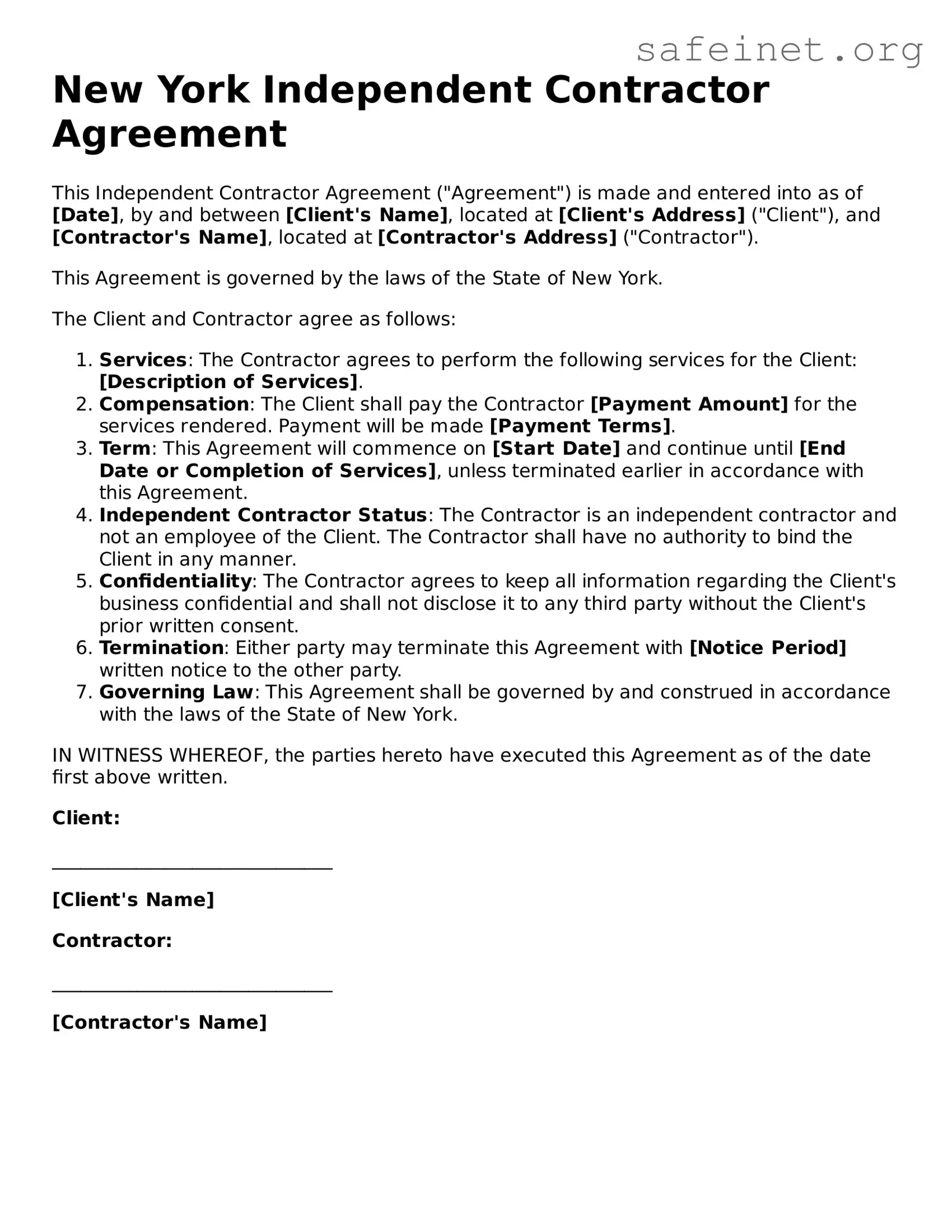
New York Independent Contractor Agreement
This Independent Contractor Agreement ("Agreement") is made and entered into as of [Date], by and between [Client's Name], located at [Client's Address] ("Client"), and [Contractor's Name], located at [Contractor's Address] ("Contractor").
This Agreement is governed by the laws of the State of New York.
The Client and Contractor agree as follows:
IN WITNESS WHEREOF, the parties hereto have executed this Agreement as of the date first above written.
Client:
______________________________
[Client's Name]
Contractor:
______________________________
[Contractor's Name]
| Fact Name | Description |
|---|---|
| Definition | The New York Independent Contractor Agreement outlines the terms between a contractor and a client. |
| Purpose | This agreement clarifies the relationship, responsibilities, and expectations of both parties. |
| Governing Law | New York State laws govern the agreement, ensuring compliance with local regulations. |
| Payment Terms | It specifies how and when the contractor will be compensated for their services. |
| Scope of Work | The agreement details the specific tasks and responsibilities assigned to the contractor. |
| Duration | It often includes the start and end dates of the contractor's engagement. |
| Termination Clause | The agreement may outline conditions under which either party can terminate the contract. |
| Confidentiality | It may include provisions to protect sensitive information shared during the engagement. |
| Liability | The agreement may address liability issues, clarifying responsibilities for damages or losses. |
| Independent Status | It reaffirms the contractor's status as an independent entity, not an employee of the client. |
To complete the New York Independent Contractor Agreement form, gather the necessary information about the contracting parties and the terms of the agreement. This form outlines the relationship between the contractor and the client, ensuring clarity and mutual understanding of the work to be performed.
After filling out the form, review it carefully to ensure all information is accurate. Both parties should keep a copy for their records once signed.
What is an Independent Contractor Agreement in New York?
An Independent Contractor Agreement is a legal document that outlines the terms of a working relationship between a business and an independent contractor. It clarifies the roles, responsibilities, and expectations for both parties. This agreement helps protect the rights of both the contractor and the hiring party by specifying the nature of the work and payment terms.
Why is it important to have an Independent Contractor Agreement?
Having an Independent Contractor Agreement is crucial for several reasons. It provides clear guidelines on what is expected from both parties, reducing the risk of misunderstandings. Additionally, it helps establish the contractor's status, ensuring that they are not classified as an employee, which can have tax and legal implications for both sides.
What should be included in the Independent Contractor Agreement?
The agreement should include essential details such as the scope of work, payment terms, deadlines, confidentiality clauses, and termination conditions. It may also cover intellectual property rights and any specific requirements related to the project. Ensuring these elements are clearly outlined can prevent disputes down the line.
Can an Independent Contractor Agreement be modified after it is signed?
Yes, an Independent Contractor Agreement can be modified after it is signed. However, any changes should be documented in writing and agreed upon by both parties. This helps maintain clarity and ensures that everyone is on the same page regarding the updated terms.
What are the tax implications for independent contractors in New York?
Independent contractors in New York are responsible for paying their own taxes, including self-employment tax. They typically receive a 1099 form from the hiring party instead of a W-2 form. It’s important for contractors to keep track of their income and expenses to accurately report their earnings to the IRS.
Is it necessary to have a lawyer review the Independent Contractor Agreement?
While it is not strictly necessary, having a lawyer review the agreement can be beneficial. A legal professional can help ensure that the document complies with state laws and adequately protects your interests. This is especially important if the work involves complex tasks or significant financial investment.
What happens if there is a dispute over the Independent Contractor Agreement?
If a dispute arises, the first step is often to refer back to the agreement to understand the terms. Many agreements include a dispute resolution clause, which may outline steps for mediation or arbitration. If the issue cannot be resolved amicably, it may be necessary to seek legal advice or take the matter to court.
Incomplete Information: Failing to provide all required details can lead to delays or issues in the agreement. Ensure that names, addresses, and contact information are fully filled out.
Incorrect Classification: Misunderstanding the difference between an independent contractor and an employee can result in misclassification. This can have legal and financial implications for both parties.
Omitting Terms of Payment: Not clearly stating payment terms can create confusion later. Specify the payment amount, schedule, and method to avoid misunderstandings.
Ignoring State-Specific Requirements: Each state may have specific regulations that affect the agreement. It is crucial to be aware of New York's particular requirements to ensure compliance.
When entering into a New York Independent Contractor Agreement, several other documents may also be necessary to ensure clarity and legal compliance. These documents help define the relationship between the contractor and the client, outline responsibilities, and protect both parties' interests. Here are some commonly used forms and documents:
Using these documents in conjunction with the New York Independent Contractor Agreement can create a more comprehensive understanding of the working relationship. This approach minimizes potential disputes and ensures a smoother collaboration between the contractor and the client.
The Freelance Agreement is similar to the New York Independent Contractor Agreement in that both documents outline the terms of engagement between a client and a contractor. They specify the scope of work, payment terms, and deadlines. Like the Independent Contractor Agreement, the Freelance Agreement often includes clauses regarding confidentiality and ownership of work produced. This document is particularly common in creative industries, where freelancers provide specific services on a project basis.
The Consulting Agreement serves a similar purpose by defining the relationship between a consultant and a client. It details the services to be provided, compensation, and duration of the engagement. Both agreements emphasize the independent nature of the contractor's work and often include provisions for termination. The Consulting Agreement may also address intellectual property rights, similar to the Independent Contractor Agreement.
The Service Agreement is another document that parallels the New York Independent Contractor Agreement. It outlines the services to be rendered, payment structure, and responsibilities of both parties. The Service Agreement typically includes terms related to liability and indemnification, which may also be found in the Independent Contractor Agreement. Both documents aim to clarify expectations and protect the interests of the parties involved.
The Non-Disclosure Agreement (NDA) shares similarities in protecting sensitive information. While it does not directly govern the working relationship, it is often used alongside the Independent Contractor Agreement. Both documents aim to safeguard proprietary information and trade secrets. The NDA specifies the obligations of the contractor regarding confidentiality, similar to how the Independent Contractor Agreement addresses the handling of sensitive data in the course of work.
The Partnership Agreement differs in that it establishes a formal business relationship between two or more parties. However, it shares some characteristics with the Independent Contractor Agreement, such as outlining roles, responsibilities, and profit-sharing arrangements. Both documents aim to clarify the expectations of each party, though the Partnership Agreement typically involves a deeper level of commitment and collaboration than an independent contractor relationship.
The Employment Contract is another document that, while fundamentally different, shares the aspect of defining a working relationship. It outlines the terms of employment, including job responsibilities, compensation, and benefits. Unlike the Independent Contractor Agreement, the Employment Contract typically establishes an employer-employee relationship, which includes additional obligations such as tax withholding and benefits. However, both documents aim to provide clarity and legal protection for the parties involved.
The Letter of Agreement is often used for simpler arrangements and shares similarities with the Independent Contractor Agreement in its purpose. It outlines the basic terms of a working relationship, including scope of work and payment. While it may not cover as many details as the Independent Contractor Agreement, the Letter of Agreement serves to confirm the understanding between the parties and can be legally binding if properly executed.
The Work for Hire Agreement is closely related to the Independent Contractor Agreement, particularly in creative fields. It specifies that the work produced by the contractor is owned by the client upon completion. Both documents emphasize the independent status of the contractor while addressing ownership rights. The Work for Hire Agreement is especially important in situations where intellectual property is created, ensuring that the client retains full rights to the work.
The Project Agreement is another document that resembles the Independent Contractor Agreement, as it outlines the specific terms related to a particular project. It includes details such as deliverables, timelines, and payment structures. Both agreements serve to clarify the expectations and responsibilities of the parties involved. The Project Agreement is often used for short-term engagements, while the Independent Contractor Agreement may cover a broader range of services over a longer duration.
When filling out the New York Independent Contractor Agreement form, it's important to follow certain guidelines. Here are some do's and don'ts to consider:
Misconceptions about the New York Independent Contractor Agreement can lead to confusion and potential legal issues. Here are seven common misconceptions, clarified for better understanding.
This is false. While verbal agreements can be valid, a written contract provides clear terms and protects both parties. It outlines expectations, payment terms, and responsibilities.
This is not true. Independent contractors can vary widely in their services, expertise, and the nature of their work. Each agreement should be tailored to the specific contractor and the work being performed.
Many people believe that the terms of an Independent Contractor Agreement are set in stone. In reality, independent contractors can and should negotiate terms that reflect their value and the specifics of the project.
This is a misconception. Independent contractors are responsible for their own taxes, including self-employment tax. Employers do not withhold taxes for independent contractors as they do for employees.
This is incorrect. Agreements can be amended if both parties agree to the changes. It’s essential to document any modifications in writing to avoid future disputes.
This is misleading. While independent contractors do not have the same protections as employees, they still have rights under contract law. They can seek legal recourse if the terms of the agreement are violated.
This is not universally true. Some independent contractors may negotiate for certain benefits or perks as part of their agreement, depending on the nature of their work and the relationship with the client.
Understanding these misconceptions can help both independent contractors and clients create better agreements and foster more productive working relationships.
When engaging an independent contractor in New York, using the Independent Contractor Agreement form is essential. Here are some key takeaways to keep in mind:
Using this form correctly can help create a smooth working relationship and protect the interests of both parties involved.