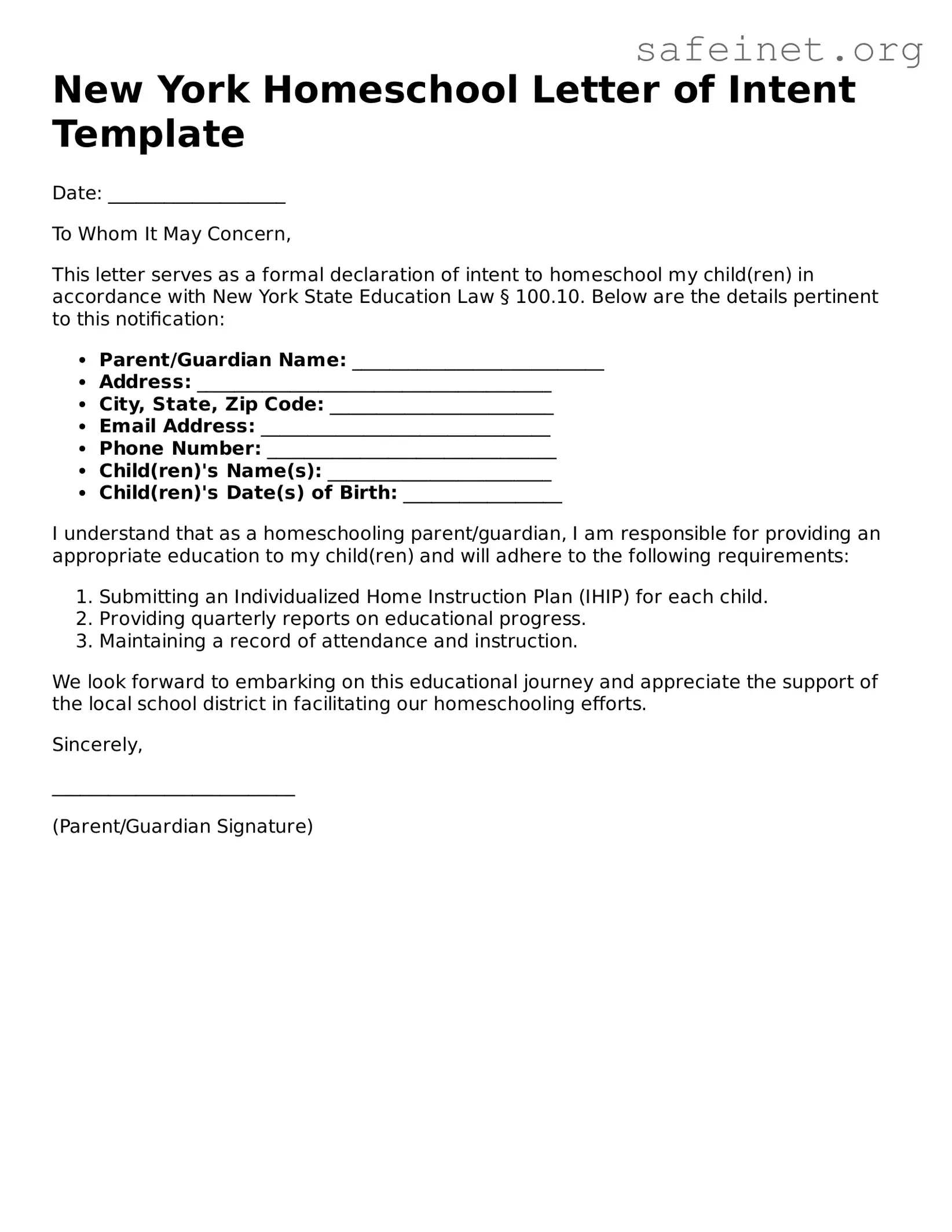
For families considering homeschooling in New York, the Homeschool Letter of Intent form is a crucial first step in the process. This form notifies the local school district of your intention to educate your child at home. It must include essential details such as the names and ages of the children being homeschooled, as well as the educational program you plan to follow. Submitting this letter is not just a formality; it establishes your commitment to providing a structured learning environment tailored to your child's needs. The form also initiates the district's role in overseeing your educational plan, ensuring compliance with state regulations. Understanding the requirements and implications of this letter can help you navigate the homeschooling journey with confidence.
New York Homeschool Letter of Intent Template
Date: ___________________
To Whom It May Concern,
This letter serves as a formal declaration of intent to homeschool my child(ren) in accordance with New York State Education Law § 100.10. Below are the details pertinent to this notification:
I understand that as a homeschooling parent/guardian, I am responsible for providing an appropriate education to my child(ren) and will adhere to the following requirements:
We look forward to embarking on this educational journey and appreciate the support of the local school district in facilitating our homeschooling efforts.
Sincerely,
__________________________
(Parent/Guardian Signature)
| Fact Name | Description |
|---|---|
| Purpose | The New York Homeschool Letter of Intent form is used by parents to officially notify the local school district of their intention to homeschool their children. |
| Governing Law | This form is governed by New York Education Law § 3204, which outlines the requirements for homeschooling in the state. |
| Submission Timeline | Parents must submit the Letter of Intent at least 14 days before the start of the school year or within 14 days of withdrawing a child from public school. |
| Content Requirements | The form must include the names and ages of the children being homeschooled and the educational plan for the year. |
| Annual Review | Parents are required to submit an annual assessment of their child's progress to the local school district as part of the homeschooling process. |
| Notification of Changes | If there are any changes in the homeschooling arrangement, such as a change in address or educational plan, parents must notify the school district promptly. |
Once you have your New York Homeschool Letter of Intent form ready, you'll need to fill it out accurately. This form is essential for notifying the school district of your intent to homeschool your child. Follow these steps to complete the form correctly.
After submitting the form, you will receive a confirmation from the school district. Make sure to keep an eye out for any additional requirements or communications from them regarding your homeschooling plan.
What is the New York Homeschool Letter of Intent form?
The New York Homeschool Letter of Intent form is a document that parents or guardians must submit to the local school district when they choose to homeschool their children. This form serves as a formal notification to the district that the family is opting out of the traditional school system. It outlines the intent to provide a home education and must be submitted annually for each child being homeschooled.
Who needs to submit the Letter of Intent?
Any parent or guardian who decides to homeschool their child in New York must submit the Letter of Intent. This requirement applies to children who are of compulsory school age, typically between the ages of 6 and 16. If a family has multiple children, a separate letter is needed for each child. This ensures that the school district is aware of each child's educational status.
When should the Letter of Intent be submitted?
The Letter of Intent should be submitted to the local school district at the beginning of the school year, typically by July 1st. However, if a family decides to start homeschooling mid-year, they should submit the form as soon as they make that decision. Timely submission is crucial to avoid any potential issues with the school district regarding the child’s educational status.
What happens after submitting the Letter of Intent?
After the Letter of Intent is submitted, the school district will acknowledge receipt of the form. Parents are not required to wait for approval before starting their homeschooling program. However, they must comply with New York's homeschooling regulations, including submitting an Individualized Home Instruction Plan (IHIP) and annual assessments. Keeping good records of the child’s educational progress is also essential for compliance with state laws.
Filling out the New York Homeschool Letter of Intent form can be a straightforward process, but many families make common mistakes that can lead to delays or complications. Here are four mistakes to watch out for:
Many parents forget to provide all required details. This includes the child's full name, date of birth, and address. Omitting any of this information can result in the form being rejected.
Another frequent error is not signing the form correctly. Both parents or guardians must sign if applicable. If the form is unsigned, it cannot be processed.
Some families miss the submission deadline. The form must be submitted by a specific date to ensure compliance with state regulations. Late submissions can lead to complications in homeschooling plans.
While the Letter of Intent is primarily for notifying the state of your intent to homeschool, some parents forget to include a brief outline of their educational plans. This can raise questions and lead to further inquiries.
By being aware of these common pitfalls, families can navigate the process more smoothly and ensure their homeschooling journey begins on the right foot.
When you decide to homeschool in New York, submitting the Homeschool Letter of Intent is just the first step. Several other important forms and documents will help you navigate the homeschooling process smoothly. Here’s a concise list of essential documents that often accompany the Letter of Intent.
By preparing these documents alongside your Homeschool Letter of Intent, you can ensure compliance with New York State regulations and create a structured educational experience for your child. Stay organized and proactive to make your homeschooling journey successful.
The New York Homeschool Letter of Intent form is similar to the Educational Plan form required in many states for homeschooling families. Both documents serve as formal notifications to the local education authorities that a parent or guardian intends to educate their child at home. The Educational Plan typically outlines the curriculum and educational goals for the academic year, ensuring that the educational approach aligns with state requirements. This document may also require details on subjects to be taught and methods of assessment, thereby providing a comprehensive overview of the homeschooling strategy.
Another document that parallels the New York Homeschool Letter of Intent is the Notice of Intent to Homeschool form, commonly used in various states. Like the Letter of Intent, this notice informs the school district of the parent’s decision to homeschool. It often includes similar information, such as the child’s name, age, and the educational philosophy the parent intends to follow. The key difference lies in the terminology and specific requirements set by different states, but both documents aim to establish a formal record of the homeschooling decision.
The Affidavit of Intent to Homeschool is another comparable document. This affidavit serves as a sworn statement by the parent or guardian declaring their intention to homeschool their child. While the New York Homeschool Letter of Intent may not require an affidavit, some states necessitate a signed declaration that affirms the parent’s commitment to provide an education at home. Both documents emphasize the seriousness of the homeschooling commitment and may involve legal implications if the educational standards are not met.
In addition, the Curriculum Outline is a document that shares similarities with the Homeschool Letter of Intent. While the Letter of Intent typically announces the intent to homeschool, the Curriculum Outline details the specific subjects and materials that will be used throughout the year. This document is crucial for demonstrating compliance with educational standards and may be requested by local education authorities to ensure that the child receives a comprehensive education. Both documents work together to provide a clear picture of the homeschooling plan.
The Annual Assessment Report is another document that bears resemblance to the New York Homeschool Letter of Intent. While the Letter of Intent is submitted at the beginning of the homeschooling journey, the Annual Assessment Report is typically filed at the end of the academic year. It summarizes the educational progress made by the child and often includes standardized test results or a portfolio of the child’s work. Both documents play a role in maintaining accountability and ensuring that educational benchmarks are met.
Finally, the Homeschool Registration Form is akin to the New York Homeschool Letter of Intent. In many states, this registration form must be completed to officially register a child for homeschooling. It usually requires similar information, such as the child’s name, age, and the parent’s contact information. While the Homeschool Letter of Intent serves as a notification of intent, the Registration Form solidifies the status of the child as a homeschooled student within the educational system. Both documents are essential for establishing a legal framework for homeschooling.
When filling out the New York Homeschool Letter of Intent form, it is important to follow specific guidelines to ensure your submission is correct and complete. Here are ten things you should and shouldn't do:
Many people have misunderstandings about the New York Homeschool Letter of Intent form. Here are four common misconceptions:
Filling out and using the New York Homeschool Letter of Intent form is an important step for families who choose to homeschool their children. Here are some key takeaways to keep in mind:
Completing this form correctly helps ensure a smooth homeschooling experience in New York.