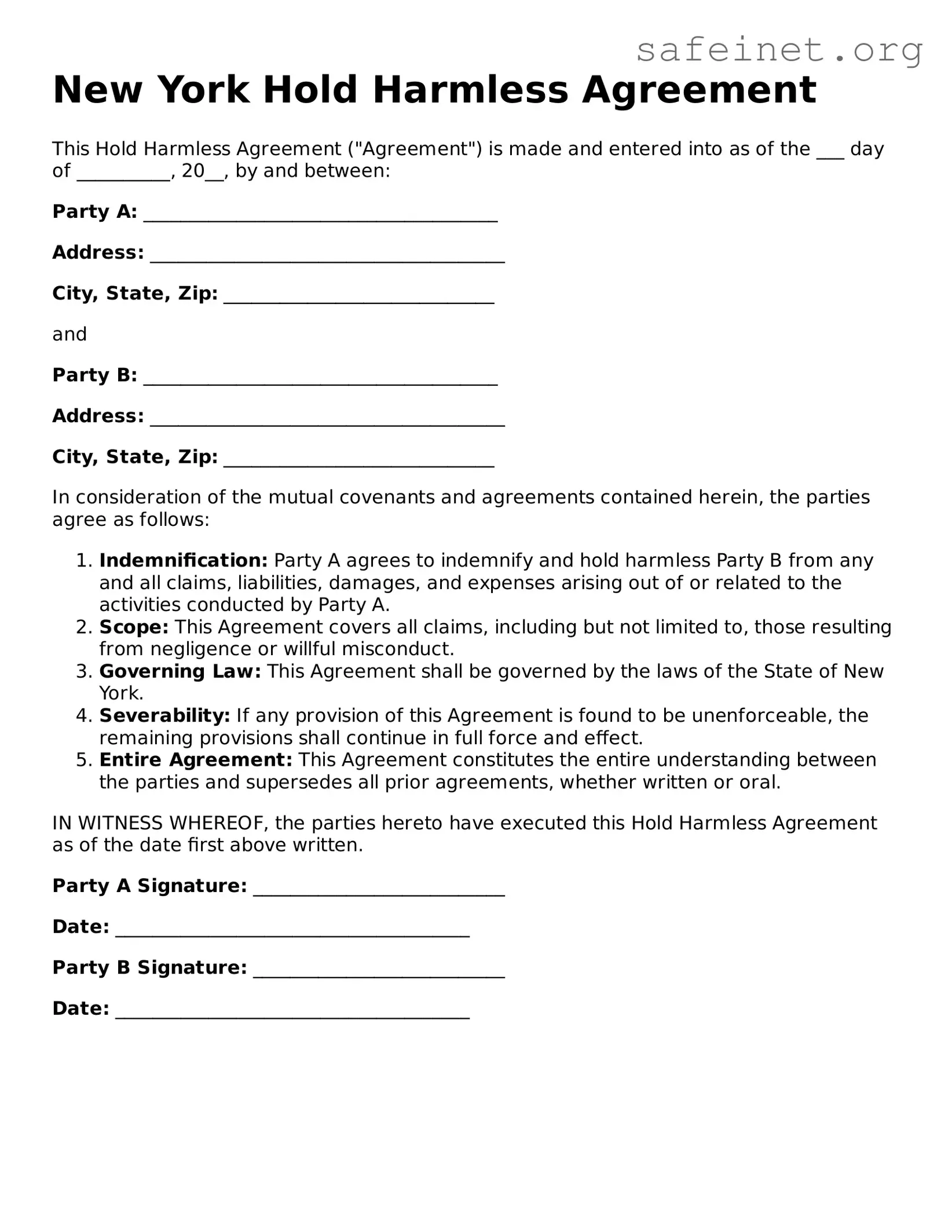
The New York Hold Harmless Agreement form serves as a crucial legal tool in various transactions and activities, particularly in situations involving potential risks and liabilities. This form is designed to protect one party from legal claims or financial losses that may arise as a result of another party's actions or negligence. By signing this agreement, individuals or organizations agree to assume responsibility for any injuries or damages that may occur, effectively shielding the other party from liability. The Hold Harmless Agreement is often used in contexts such as construction projects, events, and recreational activities, where the risk of accidents is inherent. It is important to understand that this agreement not only outlines the responsibilities of the parties involved but also establishes the terms under which liability is waived. Clarity and specificity in the language of the agreement are essential to ensure that all parties fully comprehend their rights and obligations. Additionally, the enforceability of the agreement can depend on various factors, including the circumstances under which it was signed and the jurisdiction in which it is applied. Understanding these aspects can help individuals and organizations navigate the complexities of liability and risk management effectively.
New York Hold Harmless Agreement
This Hold Harmless Agreement ("Agreement") is made and entered into as of the ___ day of __________, 20__, by and between:
Party A: ______________________________________
Address: ______________________________________
City, State, Zip: _____________________________
and
Party B: ______________________________________
Address: ______________________________________
City, State, Zip: _____________________________
In consideration of the mutual covenants and agreements contained herein, the parties agree as follows:
IN WITNESS WHEREOF, the parties hereto have executed this Hold Harmless Agreement as of the date first above written.
Party A Signature: ___________________________
Date: ______________________________________
Party B Signature: ___________________________
Date: ______________________________________
| Fact Name | Description |
|---|---|
| Definition | A Hold Harmless Agreement is a legal document that protects one party from liability or claims arising from specific activities or events. |
| Purpose | The primary purpose is to ensure that one party agrees not to hold the other liable for any damages or injuries that may occur. |
| Common Use | These agreements are often used in construction contracts, rental agreements, and event planning. |
| New York Specifics | In New York, Hold Harmless Agreements must be clear and specific to be enforceable. |
| Governing Law | New York General Obligations Law governs the enforceability of Hold Harmless Agreements in the state. |
| Mutual vs. Unilateral | These agreements can be mutual (both parties agree) or unilateral (one party assumes all risk). |
| Indemnification | Indemnification clauses may be included, requiring one party to compensate the other for losses incurred. |
| Limitations | Some limitations exist; for instance, they cannot protect against gross negligence or willful misconduct. |
| Legal Advice | It is advisable to seek legal advice before signing a Hold Harmless Agreement to understand its implications fully. |
Completing the New York Hold Harmless Agreement form is a straightforward process. Once you have filled it out, you can proceed with your intended agreement or contract. This form helps clarify responsibilities and protections for all parties involved.
What is a New York Hold Harmless Agreement?
A Hold Harmless Agreement is a legal document used to protect one party from liability or claims that may arise from a specific activity or event. In New York, this agreement typically outlines that one party agrees not to hold the other party responsible for any damages, injuries, or losses that may occur. It is commonly used in various situations, including rental agreements, construction contracts, and event planning.
Who typically uses a Hold Harmless Agreement in New York?
This type of agreement is often utilized by landlords, contractors, event organizers, and businesses. For instance, a landlord may require tenants to sign a Hold Harmless Agreement to protect against claims resulting from accidents on the property. Similarly, contractors may use it to shield themselves from liability related to work performed on a job site.
What should be included in a Hold Harmless Agreement?
A comprehensive Hold Harmless Agreement should include the names of the parties involved, a clear description of the activity or event, and the specific liabilities being waived. It should also outline the duration of the agreement and any conditions under which it may be terminated. Additionally, it is advisable to include a clause regarding indemnification, which specifies that one party will compensate the other for any losses incurred.
Is a Hold Harmless Agreement enforceable in New York?
Yes, Hold Harmless Agreements are generally enforceable in New York, provided they are drafted clearly and comply with state laws. However, certain limitations may apply. For example, an agreement may not protect a party from liability arising from their own negligence or willful misconduct. It is essential to consult with a legal professional to ensure the agreement is valid and enforceable.
Do I need a lawyer to create a Hold Harmless Agreement?
Failing to provide complete information. Individuals often leave out crucial details such as names, addresses, or specific dates. This omission can lead to confusion and potential legal issues.
Not understanding the implications of the agreement. Many people sign without fully grasping what they are agreeing to. This can result in unintended liability or a lack of protection.
Inaccurate descriptions of activities. When filling out the form, it is essential to clearly describe the activities involved. Vague or unclear descriptions can undermine the effectiveness of the agreement.
Neglecting to read the fine print. Important clauses or conditions may be hidden in the fine print. Skipping this step can lead to unexpected consequences later on.
A New York Hold Harmless Agreement is a crucial document that protects one party from liability for certain actions or events. However, it is often accompanied by other forms and documents that serve various purposes in legal and contractual relationships. Below is a list of related documents commonly used alongside the Hold Harmless Agreement.
Each of these documents plays a vital role in establishing clear terms and protecting the interests of all parties involved. Understanding their purpose can help ensure that agreements are comprehensive and legally sound.
The Indemnity Agreement is closely related to the Hold Harmless Agreement. Both documents serve to protect one party from legal liability for actions or negligence of another. In an Indemnity Agreement, one party agrees to compensate the other for any losses or damages incurred. This can include legal fees, which makes it a more comprehensive tool for risk management in various business transactions.
The Waiver of Liability is another document that shares similarities with the Hold Harmless Agreement. It typically requires a participant in an activity to relinquish their right to sue for injuries or damages that may occur. While the Hold Harmless Agreement is often used in contractual relationships, the Waiver of Liability is frequently employed in recreational or sporting contexts, emphasizing the participant's acceptance of risk.
The Release of Liability document also resembles the Hold Harmless Agreement in that it protects one party from claims arising from specific activities. This document is often signed before engaging in potentially risky activities, such as extreme sports or recreational events. By signing, individuals acknowledge the risks involved and agree not to hold the other party responsible for any resulting injuries.
The Liability Insurance Policy, while not a contract between two parties, serves a similar purpose by providing financial protection against claims. It can cover legal fees and damages that arise from accidents or negligence. In many cases, businesses will require Hold Harmless Agreements in conjunction with Liability Insurance Policies to ensure comprehensive coverage against potential liabilities.
The Service Agreement can also be compared to the Hold Harmless Agreement. Often, service providers include indemnification clauses within their contracts to protect themselves from liabilities arising during the provision of services. This ensures that clients cannot hold them accountable for certain risks, aligning closely with the intentions of a Hold Harmless Agreement.
The Partnership Agreement may incorporate Hold Harmless provisions to clarify the responsibilities and liabilities among partners. This document outlines the terms of the partnership and can include clauses that protect one partner from the actions of another. Such provisions help to define the extent of liability and ensure that partners understand their financial and legal responsibilities.
The Construction Contract often contains Hold Harmless clauses to protect contractors from claims related to construction activities. These agreements are essential in the construction industry, where accidents can occur frequently. By including such provisions, contractors can mitigate their risk and clarify liability among various parties involved in a project.
The Rental Agreement can also include Hold Harmless language, particularly in situations where property is leased for events or activities. This protects the property owner from claims arising from injuries that occur on the premises. By signing the Rental Agreement, tenants acknowledge the risks and agree not to hold the owner liable for certain incidents.
Finally, the Employment Agreement may contain Hold Harmless provisions to protect employers from claims related to employee actions. This document outlines the terms of employment and can specify that employees assume responsibility for their actions while performing job duties. Such clauses help to clarify liability and protect the employer from potential lawsuits stemming from employee conduct.
When filling out the New York Hold Harmless Agreement form, it is essential to approach the process with care. Here are nine important dos and don'ts to consider:
When it comes to the New York Hold Harmless Agreement form, several misconceptions often arise. Understanding these can help you navigate the legal landscape more effectively. Here’s a breakdown of some common misunderstandings:
Many believe that signing a Hold Harmless Agreement means they are free from any responsibility. However, this is not always the case. The agreement typically only covers specific situations and may not shield you from gross negligence or willful misconduct.
Individuals often think that only companies need this type of agreement. In reality, anyone engaging in activities that could pose risks, such as renting a venue or participating in events, may benefit from a Hold Harmless Agreement.
Some people assume that a Hold Harmless Agreement is set in stone. In fact, parties can negotiate terms before signing. Changes can be made as long as both parties agree.
There is a misconception that a Hold Harmless Agreement acts like insurance. While it can provide some level of protection, it does not replace the need for insurance coverage, which addresses different types of risks.
Many think that these agreements only benefit the party requiring the hold harmless clause. In some cases, both parties can be protected, depending on how the agreement is drafted.
Some believe that Hold Harmless Agreements lack legal weight. However, if properly drafted and executed, these agreements can be enforceable in a court of law.
People often think that signing this agreement means they don’t need to conduct their own research or take precautions. In reality, due diligence is still crucial to minimize risks.
By clarifying these misconceptions, individuals and businesses can make more informed decisions when considering a Hold Harmless Agreement in New York.
When dealing with the New York Hold Harmless Agreement form, several key points should be kept in mind to ensure clarity and legal effectiveness. Below are some essential takeaways:
By keeping these takeaways in mind, individuals and organizations can navigate the complexities of the Hold Harmless Agreement with greater confidence and understanding.