In the bustling landscape of legal documentation, the New York General Power of Attorney form stands as a crucial tool for individuals seeking to delegate authority to another person. This form allows you to appoint an agent, also known as an attorney-in-fact, who can make decisions on your behalf regarding financial matters and other important affairs. It encompasses a wide range of powers, from managing bank accounts and real estate transactions to handling tax matters and business operations. Importantly, the form can be tailored to fit specific needs, allowing for both broad and limited powers. Understanding the implications of this document is essential, as it empowers your chosen representative to act in your best interest, especially during times when you may be unable to do so yourself. Furthermore, it is important to note that the General Power of Attorney can be revoked or modified at any time, providing flexibility and control over your affairs. With the right knowledge, individuals can navigate this legal instrument with confidence, ensuring that their wishes are honored and their interests protected.
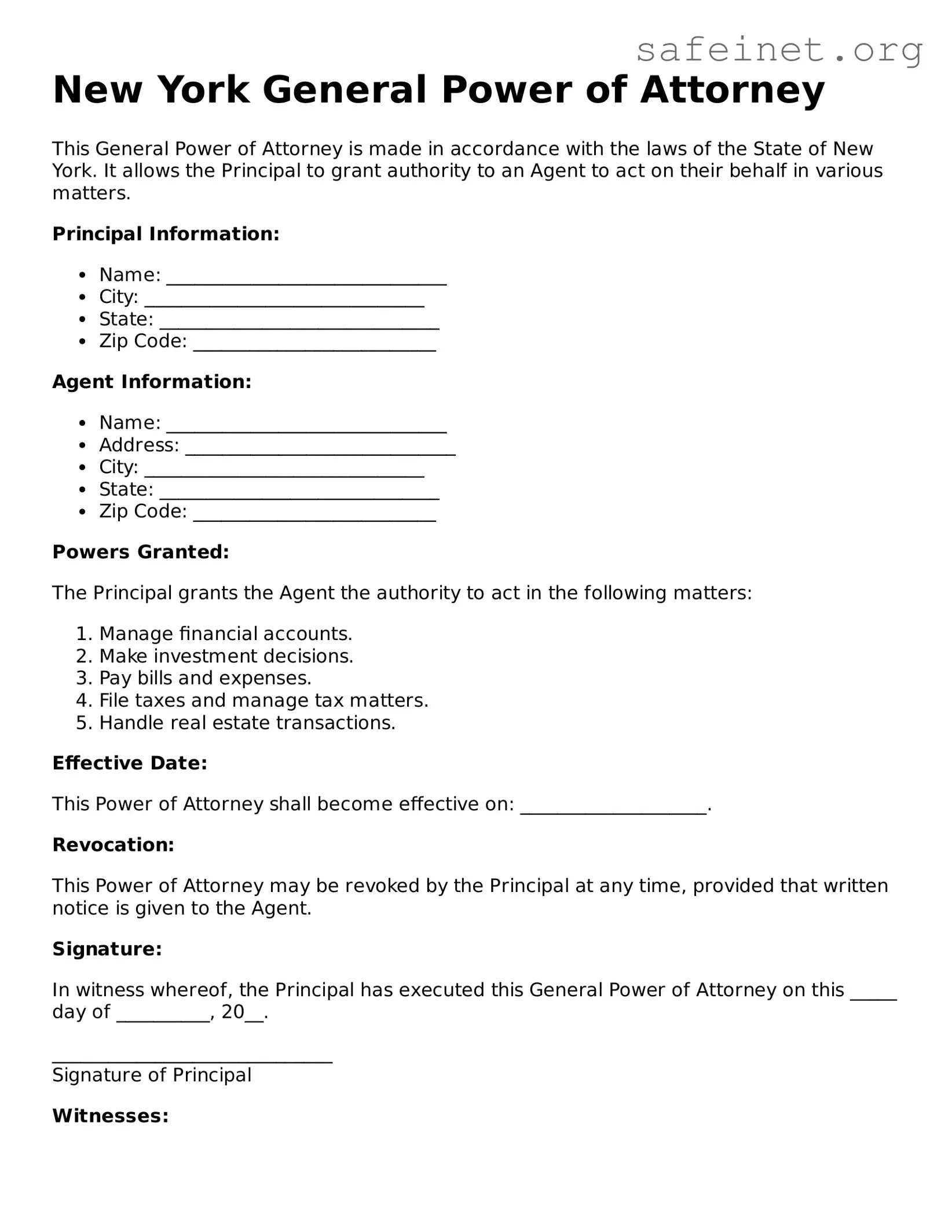
New York General Power of Attorney
This General Power of Attorney is made in accordance with the laws of the State of New York. It allows the Principal to grant authority to an Agent to act on their behalf in various matters.
Principal Information:
Agent Information:
Powers Granted:
The Principal grants the Agent the authority to act in the following matters:
Effective Date:
This Power of Attorney shall become effective on: ____________________.
Revocation:
This Power of Attorney may be revoked by the Principal at any time, provided that written notice is given to the Agent.
Signature:
In witness whereof, the Principal has executed this General Power of Attorney on this _____ day of __________, 20__.
______________________________
Signature of Principal
Witnesses:
Witness 1: ______________________________
Witness 2: ______________________________
| Fact Name | Description |
|---|---|
| Purpose | The New York General Power of Attorney form allows an individual (the principal) to grant authority to another person (the agent) to act on their behalf in financial matters. |
| Governing Law | This form is governed by the New York General Obligations Law, specifically Article 5, Title 15. |
| Durability | The General Power of Attorney can be made durable, meaning it remains effective even if the principal becomes incapacitated. |
| Revocation | The principal can revoke the General Power of Attorney at any time, as long as they are mentally competent to do so. |
Filling out the New York General Power of Attorney form is an important step in designating someone to act on your behalf in financial matters. Once you have completed the form, you will need to ensure it is signed and witnessed properly to make it valid. Here’s how to fill out the form step-by-step.
After completing these steps, make copies of the signed form for your records and provide a copy to your agent. It’s also wise to keep the original in a safe place. This ensures that both you and your agent have access to the document when needed.
What is a General Power of Attorney in New York?
A General Power of Attorney is a legal document that allows one person, known as the "principal," to appoint another person, called the "agent," to make decisions and act on their behalf. This can include handling financial matters, managing property, and making legal decisions. It is important for the principal to choose someone they trust, as the agent will have significant authority.
Why might someone need a General Power of Attorney?
People often use a General Power of Attorney to ensure that their financial and legal affairs are managed if they become unable to do so themselves. This could be due to illness, injury, or absence. Having this document in place can help avoid complications and ensure that someone is available to make decisions when needed.
What powers does a General Power of Attorney grant to the agent?
The agent can be granted a wide range of powers, including managing bank accounts, paying bills, filing taxes, buying or selling property, and making investment decisions. The specific powers can be tailored to the principal's needs, and the principal can choose to limit or expand the authority granted to the agent.
Does a General Power of Attorney need to be notarized?
Yes, in New York, a General Power of Attorney must be signed by the principal and notarized. This means that a notary public must witness the principal's signature. This requirement helps ensure the document is valid and can be used effectively.
Can a General Power of Attorney be revoked?
Yes, a principal can revoke a General Power of Attorney at any time, as long as they are mentally competent. To revoke it, the principal should provide written notice to the agent and any relevant third parties. It is advisable to also create a new power of attorney if the principal wishes to appoint someone else.
What happens if the principal becomes incapacitated?
If the principal becomes incapacitated, the General Power of Attorney remains in effect unless it has been revoked. The agent can continue to act on the principal's behalf, making decisions and managing affairs as outlined in the document. This is one reason why having a General Power of Attorney is important for planning ahead.
Can a General Power of Attorney be used for health care decisions?
No, a General Power of Attorney does not cover health care decisions. For medical and health care decisions, a separate document called a Health Care Proxy is needed. This allows an agent to make medical decisions if the principal is unable to communicate their wishes.
Is there a specific form that must be used for a General Power of Attorney in New York?
New York does have a statutory form for a General Power of Attorney, which is recommended but not mandatory. Using the statutory form ensures that the document meets state requirements and is more likely to be accepted by financial institutions and other entities.
How long does a General Power of Attorney last?
A General Power of Attorney remains in effect until the principal revokes it, the principal dies, or a court invalidates it. If the principal becomes incapacitated, the power of attorney can still be valid, allowing the agent to act on the principal's behalf.
Can multiple agents be appointed under a General Power of Attorney?
Yes, a principal can appoint multiple agents in a General Power of Attorney. They can choose to have the agents act together or separately. However, it is important to clearly outline how decisions will be made to avoid confusion and potential conflicts.
Not specifying the powers granted. It's essential to clearly outline what powers the agent will have. Without this clarity, there may be confusion about what actions the agent can take on your behalf.
Failing to date the document. A date is crucial for establishing when the power of attorney becomes effective. Without a date, it may lead to disputes or questions about its validity.
Not signing the form correctly. The principal must sign the document in the presence of a notary public. If this step is overlooked, the document may not be legally binding.
Choosing an unreliable agent. Selecting someone without considering their reliability or judgment can lead to significant issues. It’s important to choose someone you trust completely.
Ignoring state-specific requirements. Each state has its own rules regarding power of attorney forms. Not adhering to New York's specific requirements can render the document invalid.
Not discussing the arrangement with the agent. Open communication about the powers granted and the expectations can prevent misunderstandings later on.
Neglecting to review the form regularly. Life circumstances change, and so do needs. Regularly reviewing and updating the power of attorney ensures it remains relevant.
Forgetting to include alternate agents. Life is unpredictable. Naming an alternate agent can provide a backup in case the primary agent is unable to act.
Assuming the power of attorney is permanent. A general power of attorney can be revoked at any time, but many people forget to communicate this revocation effectively.
When dealing with a General Power of Attorney (GPOA) in New York, it’s essential to understand that this document often works in conjunction with other legal forms and documents. Each of these documents serves a specific purpose and can help ensure that your financial and legal affairs are managed according to your wishes. Here’s a list of commonly used documents alongside the GPOA:
Understanding these documents and their roles can help you create a comprehensive plan for managing your affairs. It’s always wise to consult with a legal professional to ensure that your documents are properly executed and reflect your intentions accurately.
The New York General Power of Attorney form is similar to the Durable Power of Attorney. While both documents allow an individual to designate someone else to make decisions on their behalf, the key difference lies in durability. A Durable Power of Attorney remains effective even if the person who created it becomes incapacitated. This means that the appointed agent can continue to act in the best interest of the individual, ensuring that financial and legal matters are managed without interruption during periods of incapacity.
Another document that shares similarities with the General Power of Attorney is the Limited Power of Attorney. This form grants authority to an agent, but the powers are restricted to specific tasks or situations. For example, an individual might use a Limited Power of Attorney to allow someone to handle a real estate transaction while retaining control over other aspects of their affairs. This specificity can provide peace of mind, as it limits the agent's authority to only what is necessary.
The Medical Power of Attorney also bears resemblance to the General Power of Attorney, though it focuses specifically on healthcare decisions. With a Medical Power of Attorney, a person designates someone to make medical decisions on their behalf if they become unable to do so. This document is crucial for ensuring that an individual’s health care preferences are honored, especially in critical situations where immediate decisions are necessary.
A Revocable Living Trust is another document that parallels the General Power of Attorney. While a General Power of Attorney allows an agent to manage financial affairs, a Revocable Living Trust can hold assets and provide instructions on how they should be managed and distributed. This type of trust can be altered or revoked during the creator's lifetime, offering flexibility. It can also help avoid probate, making the transfer of assets smoother for beneficiaries after the individual passes away.
Lastly, the Advance Healthcare Directive is akin to the General Power of Attorney in that it allows individuals to express their healthcare wishes. This document combines a living will and a Medical Power of Attorney, providing guidance on medical treatment preferences and designating an agent to make decisions if the individual is unable to communicate. This ensures that personal values and choices regarding health care are respected, even in challenging circumstances.
When filling out the New York General Power of Attorney form, it's essential to be careful and informed. Below is a list of things to do and avoid to ensure the process goes smoothly.
Many people have misunderstandings about the New York General Power of Attorney form. Here are six common misconceptions and clarifications for each:
This is not true. The power granted is specific to the terms outlined in the document. The principal can limit the agent's authority to certain tasks or decisions.
A General Power of Attorney becomes invalid if the principal becomes incapacitated unless it has been designated as a durable power of attorney. It’s important to clarify this distinction.
While there are few restrictions, the chosen agent must be at least 18 years old and mentally competent. It's crucial to select someone trustworthy.
In New York, the General Power of Attorney must be signed in the presence of a notary public to be legally binding. However, it also requires witnesses if it involves real estate transactions.
This form can be customized. The principal can tailor it to fit specific needs, allowing for a range of powers from financial decisions to property management.
A General Power of Attorney can be revoked at any time, but it’s best to do so in writing. Informing the agent and any relevant institutions is also advisable to avoid confusion.
Filling out and using the New York General Power of Attorney form can be straightforward, but it’s essential to understand its implications. Here are some key takeaways:
By keeping these points in mind, you can navigate the process of creating and using a General Power of Attorney more effectively.