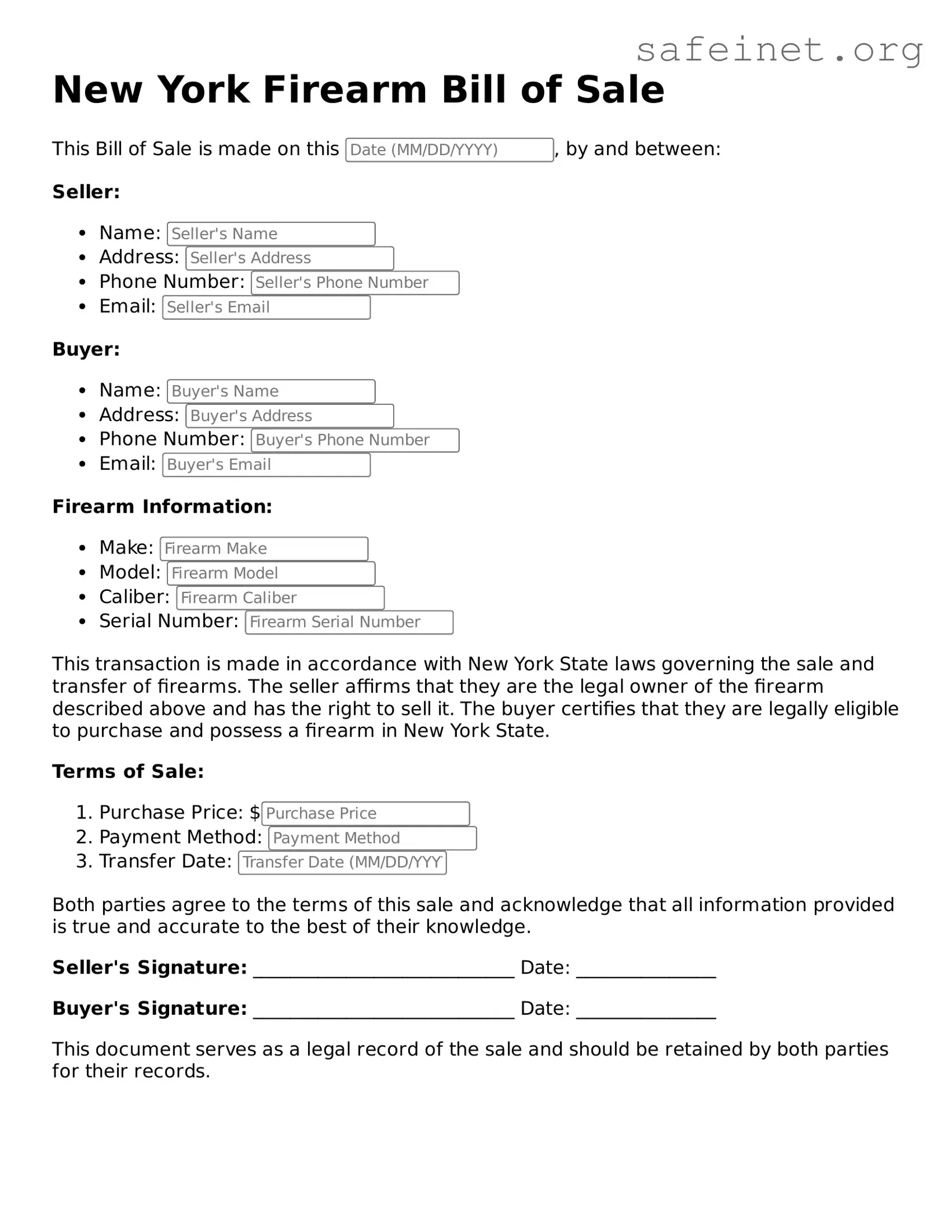
The New York Firearm Bill of Sale form serves as a critical document in the transfer of firearm ownership within the state. This form outlines essential details, including the identities of both the seller and buyer, as well as the specifics of the firearm being sold, such as its make, model, and serial number. It is designed to ensure that the transaction is conducted legally and transparently, providing a record that can be referenced in the future. Both parties must sign the document, indicating their agreement to the terms of the sale. Additionally, the form may require the seller to confirm that they are legally permitted to sell the firearm, thereby safeguarding against unlawful transactions. Proper completion of this form is vital for compliance with state regulations, as it helps to establish a clear chain of ownership and can assist in the prevention of illegal firearm sales.
New York Firearm Bill of Sale
This Bill of Sale is made on this , by and between:
Seller:
Buyer:
Firearm Information:
This transaction is made in accordance with New York State laws governing the sale and transfer of firearms. The seller affirms that they are the legal owner of the firearm described above and has the right to sell it. The buyer certifies that they are legally eligible to purchase and possess a firearm in New York State.
Terms of Sale:
Both parties agree to the terms of this sale and acknowledge that all information provided is true and accurate to the best of their knowledge.
Seller's Signature: ____________________________ Date: _______________
Buyer's Signature: ____________________________ Date: _______________
This document serves as a legal record of the sale and should be retained by both parties for their records.
| Fact Name | Details |
|---|---|
| Purpose | The New York Firearm Bill of Sale form documents the sale of a firearm between a seller and a buyer. |
| Governing Law | The sale of firearms in New York is governed by New York Penal Law § 400. |
| Parties Involved | The form requires information from both the seller and the buyer, including names and addresses. |
| Firearm Description | A detailed description of the firearm must be included, such as make, model, and serial number. |
| Age Requirement | Both parties must be at least 21 years old to legally complete the sale of a firearm. |
| Background Check | A background check is required for the buyer before the sale can be finalized. |
| Signatures | Both the seller and the buyer must sign the form to validate the transaction. |
| Record Keeping | It is advisable for both parties to keep a copy of the Bill of Sale for their records. |
| Legal Implications | Filling out this form does not guarantee legal protection; compliance with all local, state, and federal laws is essential. |
Once you have the New York Firearm Bill of Sale form ready, you can proceed to fill it out. This form is essential for documenting the sale of a firearm between a buyer and a seller. Ensuring that all information is accurate and complete is crucial for both parties involved.
What is a New York Firearm Bill of Sale form?
The New York Firearm Bill of Sale form is a document used to record the sale or transfer of a firearm between two parties. This form serves as proof of the transaction and includes important details such as the names of both the buyer and seller, the description of the firearm, and the date of the sale. It helps ensure that both parties have a clear record of the transaction, which can be important for legal and ownership purposes.
Is a Firearm Bill of Sale required in New York?
While New York law does not explicitly require a Bill of Sale for all firearm transactions, it is highly recommended. This form provides a written record of the sale, which can protect both the buyer and seller in case of future disputes or legal issues. Additionally, certain local laws or regulations may require documentation for firearm transfers, so it’s always a good idea to check local requirements.
What information is typically included in the form?
A standard New York Firearm Bill of Sale form usually includes the following information: the names and addresses of both the buyer and seller, the date of the transaction, a detailed description of the firearm (including make, model, and serial number), and the purchase price. Both parties should sign and date the form to validate the transaction.
Can I create my own Bill of Sale form?
Yes, you can create your own Bill of Sale form as long as it includes all necessary information. However, it’s important to ensure that the form meets any specific requirements set by New York law. Using a template or a standardized form can help ensure that you don’t miss any critical details.
Do I need to have the Bill of Sale notarized?
Notarization is not a requirement for a Firearm Bill of Sale in New York. However, having the document notarized can add an extra layer of security and legitimacy to the transaction. This can be particularly useful if there are any disputes regarding the sale in the future.
What should I do with the completed Bill of Sale?
Once the Bill of Sale is completed and signed by both parties, each party should keep a copy for their records. The seller should retain a copy as proof of the transfer, while the buyer should keep their copy as evidence of ownership. It’s wise to store these documents in a safe place, as they may be needed for future reference or legal matters.
Incomplete Information: Many individuals fail to provide all necessary details. This includes missing the buyer's or seller's full name, address, or contact information. Ensure that every field is filled out completely to avoid delays.
Incorrect Identification: Some people do not provide accurate identification details. It's crucial to include a valid driver's license number or state ID. Double-check that the information matches the identification presented.
Omitting Signatures: A common mistake is forgetting to sign the form. Both the buyer and seller must sign to validate the transaction. Without signatures, the document is not legally binding.
Not Keeping Copies: Failing to make copies of the completed form is a significant oversight. Both parties should retain a copy for their records. This can help resolve any disputes that may arise in the future.
When transferring ownership of a firearm in New York, several other forms and documents may be necessary or helpful in addition to the Firearm Bill of Sale. Each of these documents serves a specific purpose in ensuring that the transaction is legal and properly recorded.
Having these documents ready can help ensure a smooth and legal transfer of firearm ownership. It is always advisable to check local laws and regulations to ensure compliance with all requirements.
The New York Firearm Bill of Sale form shares similarities with the Vehicle Bill of Sale. Both documents serve as proof of transfer of ownership from one party to another. They typically include details such as the buyer's and seller's names, addresses, and signatures. Additionally, both forms often require a description of the item being sold—whether it’s a firearm or a vehicle—along with any relevant identification numbers, such as a vehicle identification number (VIN) for cars or a serial number for firearms. This ensures that the transaction is documented and can be referenced in the future if needed.
Another document that parallels the Firearm Bill of Sale is the Personal Property Bill of Sale. This form is used for the sale of personal items, which can range from electronics to furniture. Like the Firearm Bill of Sale, it includes essential details about the buyer and seller, as well as a description of the item being sold. Both documents aim to protect the interests of both parties by providing a clear record of the transaction, thus minimizing potential disputes over ownership or condition of the item sold.
The Lease Agreement is also similar in function to the Firearm Bill of Sale, though it pertains to the rental of property rather than the sale of goods. Both documents establish a formal agreement between parties, outlining the terms of the transaction. In a Lease Agreement, details such as the duration of the lease, payment terms, and responsibilities of each party are clearly defined. Similarly, the Firearm Bill of Sale specifies the terms of the sale, including payment details and any conditions related to the transfer of ownership.
The Gift Receipt is another document that shares characteristics with the Firearm Bill of Sale. While a Gift Receipt does not involve a monetary transaction, it serves to document the transfer of ownership of an item. Both documents require the names and signatures of the parties involved, ensuring that there is a clear record of the change in ownership. This can be particularly important for items like firearms, where legal ownership is critical for compliance with regulations.
Lastly, the Promissory Note can be compared to the Firearm Bill of Sale in that both documents involve a commitment between parties. A Promissory Note outlines the terms of a loan, including repayment schedules and interest rates. In contrast, the Firearm Bill of Sale details the sale of a firearm, including the agreed-upon price and conditions of the sale. Both documents serve to protect the rights of the parties involved by providing a written record of the agreement, thereby reducing the likelihood of misunderstandings or disputes.
When filling out the New York Firearm Bill of Sale form, it is crucial to follow specific guidelines to ensure compliance with the law. Below is a list of things to do and avoid during this process.
Things You Should Do:
Things You Shouldn't Do:
The New York Firearm Bill of Sale form is often misunderstood. Here are six common misconceptions:
Filling out and using the New York Firearm Bill of Sale form is an important step in the process of transferring firearm ownership. Here are some key takeaways to keep in mind:
Following these steps can help ensure a smooth and legal transfer of firearm ownership in New York.