Creating a comprehensive employee handbook is essential for any business operating in New York. This document serves as a vital resource for both employers and employees, outlining key policies, procedures, and expectations within the workplace. A well-structured employee handbook addresses various topics, including workplace conduct, anti-discrimination policies, and employee benefits. It also covers important information about attendance, leave policies, and disciplinary procedures. By clearly defining these elements, the handbook fosters a positive work environment and helps to prevent misunderstandings. Furthermore, it ensures compliance with state and federal laws, protecting both the employer and the employee. A thoughtfully crafted handbook not only communicates the company culture but also serves as a guide for navigating the complexities of employment in New York.
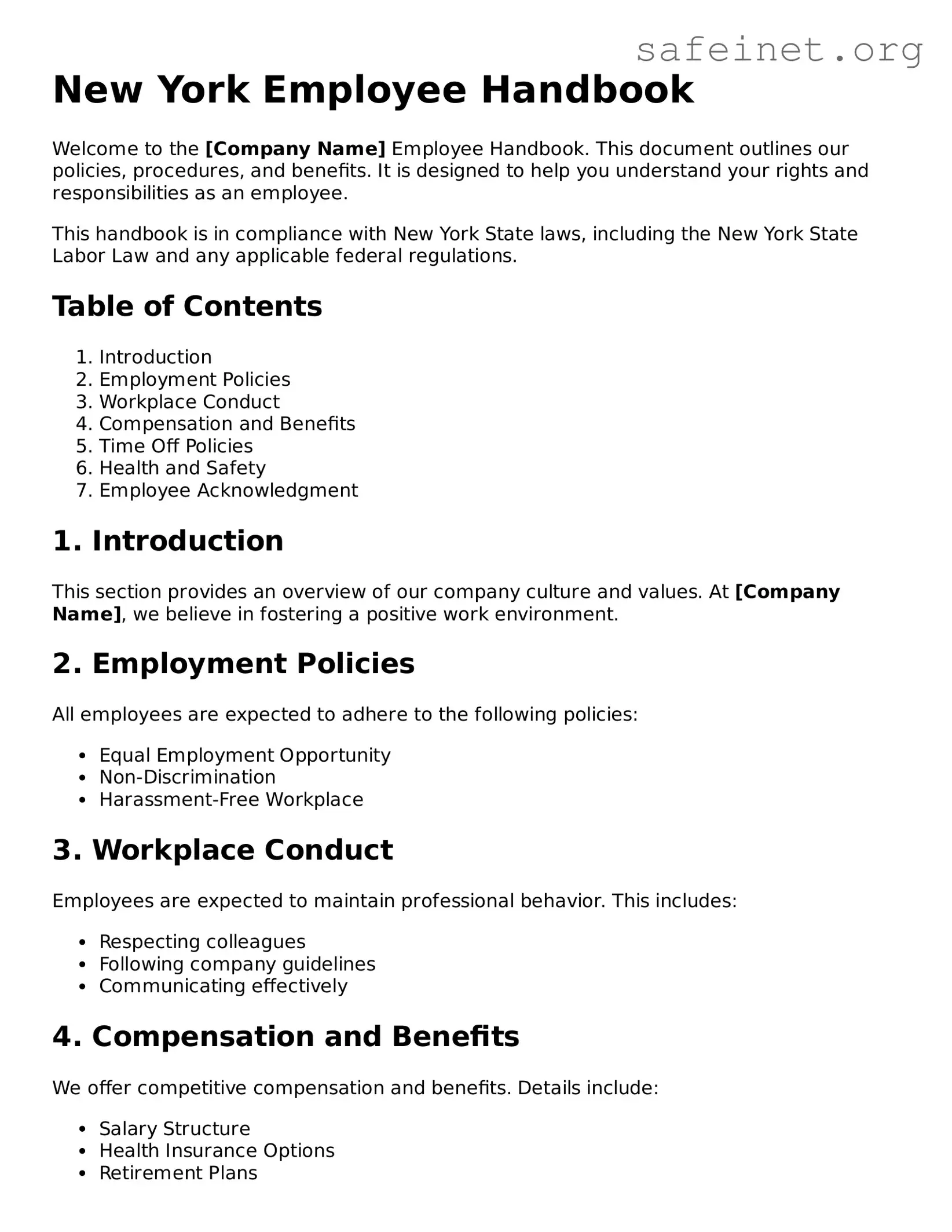
New York Employee Handbook
Welcome to the [Company Name] Employee Handbook. This document outlines our policies, procedures, and benefits. It is designed to help you understand your rights and responsibilities as an employee.
This handbook is in compliance with New York State laws, including the New York State Labor Law and any applicable federal regulations.
Table of Contents
1. Introduction
This section provides an overview of our company culture and values. At [Company Name], we believe in fostering a positive work environment.
2. Employment Policies
All employees are expected to adhere to the following policies:
3. Workplace Conduct
Employees are expected to maintain professional behavior. This includes:
4. Compensation and Benefits
We offer competitive compensation and benefits. Details include:
5. Time Off Policies
Employees are entitled to various forms of leave, including:
6. Health and Safety
Your health and safety are our priority. We follow all state and federal safety regulations. Employees should:
7. Employee Acknowledgment
By signing below, you acknowledge that you have received and read the [Company Name] Employee Handbook.
Employee Name: [Employee Name]
Signature: [Employee Signature]
Date: [Date]
| Fact Name | Description |
|---|---|
| Purpose | The New York Employee Handbook serves as a guide for employees, outlining company policies, procedures, and expectations. |
| Legal Requirement | While not legally required, having an employee handbook can help protect employers from legal disputes by clearly communicating policies. |
| Governing Laws | New York State Labor Law and federal laws, such as the Fair Labor Standards Act, govern employment practices and policies included in the handbook. |
| Content Recommendations | It is advisable to include sections on anti-discrimination policies, workplace safety, and employee benefits in the handbook. |
| Distribution | Employers should distribute the handbook to all employees and obtain signed acknowledgments to ensure understanding of the policies. |
Completing the New York Employee Handbook form is essential for ensuring that you understand your rights and responsibilities as an employee. Follow these steps carefully to fill out the form accurately and promptly.
What is the New York Employee Handbook form?
The New York Employee Handbook form is a document that outlines the policies, procedures, and expectations for employees working in New York. It serves as a guide for both employers and employees, helping to clarify workplace rules and regulations.
Why is an Employee Handbook important?
An Employee Handbook is crucial because it sets clear guidelines for behavior and performance. It helps ensure that all employees understand their rights and responsibilities, which can reduce misunderstandings and conflicts in the workplace.
Who should have access to the Employee Handbook?
All employees should have access to the Employee Handbook. It’s essential for new hires to receive a copy during their onboarding process, and existing employees should have easy access to it as well, whether in print or digital format.
What topics should be included in the Employee Handbook?
The Employee Handbook should cover a range of topics, including company policies, employee benefits, workplace conduct, anti-discrimination policies, leave policies, and procedures for reporting grievances. Each section should be clear and concise to ensure understanding.
How often should the Employee Handbook be updated?
It’s advisable to review and update the Employee Handbook at least annually. Changes in laws, company policies, or workplace culture may necessitate updates. Keeping the handbook current ensures that it remains a relevant resource for employees.
Can an Employee Handbook be legally binding?
While an Employee Handbook is not a contract, certain provisions may be considered binding if they create enforceable rights. It’s essential to include disclaimers that clarify the handbook is not a contract and that the company reserves the right to change policies at any time.
How should employees acknowledge receipt of the Employee Handbook?
Employers should require employees to sign an acknowledgment form confirming they have received and understood the Employee Handbook. This form can be kept on file to provide evidence that employees were informed of the policies.
What should an employer do if an employee violates a policy outlined in the Handbook?
If an employee violates a policy, the employer should follow the disciplinary procedures outlined in the Employee Handbook. Consistency in enforcement is key to maintaining fairness and upholding company standards.
Is it necessary to have a lawyer review the Employee Handbook?
While it’s not mandatory, having a lawyer review the Employee Handbook is highly recommended. A legal professional can help ensure that the handbook complies with state and federal laws, minimizing the risk of potential legal issues.
Where can I find a template for the New York Employee Handbook?
Templates for the New York Employee Handbook can be found online through various HR websites or legal resources. However, it’s important to customize any template to fit your specific business needs and legal requirements.
When completing the New York Employee Handbook form, individuals may encounter several common mistakes. Awareness of these pitfalls can help ensure accurate and effective submissions. Below is a list of four mistakes to avoid:
Omitting Required Information: Many people forget to fill in mandatory fields. This can delay processing and may require additional follow-up.
Providing Inaccurate Personal Details: Errors in names, addresses, or contact information can lead to miscommunication and complications in record-keeping.
Neglecting to Read the Handbook: Failing to review the employee handbook can result in misunderstandings about company policies and procedures.
Not Seeking Clarification: If there are questions about the form or its contents, not asking for help can lead to incomplete or incorrect submissions.
By being mindful of these mistakes, individuals can ensure that their forms are completed accurately and efficiently, facilitating a smoother onboarding process.
When developing a comprehensive employee handbook in New York, several other forms and documents are often utilized to ensure clarity and compliance with state and federal regulations. Each of these documents serves a specific purpose in the employer-employee relationship.
These documents, when used in conjunction with the employee handbook, create a well-rounded framework for managing employee relations and ensuring a positive work environment. Properly implemented, they contribute to a transparent and efficient workplace culture.
The New York Employee Handbook is similar to an Employee Policy Manual. Both documents outline the rules and expectations for employees within an organization. They serve as a guide to company culture and provide clarity on workplace behavior, dress codes, and attendance policies. While the handbook is often more general, the policy manual can delve deeper into specific procedures and protocols, making it a useful companion document.
Another similar document is the Employee Orientation Guide. This guide typically accompanies the employee handbook during onboarding. It introduces new hires to the company’s mission, values, and operational procedures. While the handbook provides comprehensive policies, the orientation guide focuses on helping employees acclimate to their new environment quickly.
The Code of Conduct is also closely related. This document outlines the ethical standards and expectations for employee behavior. It complements the employee handbook by providing specific examples of acceptable and unacceptable conduct. Both documents aim to foster a respectful and productive workplace, but the code of conduct often addresses more serious issues like harassment and discrimination.
In addition, the Employee Benefits Guide shares similarities with the employee handbook. It specifically details the benefits available to employees, such as health insurance, retirement plans, and paid time off. While the handbook provides an overview of company policies, the benefits guide focuses on the perks of employment, ensuring employees understand their entitlements and how to access them.
The Job Description document is another relevant piece. It outlines the responsibilities and expectations associated with specific roles within the company. While the employee handbook discusses general policies, job descriptions provide clarity on individual performance expectations, which helps employees understand their contributions to the organization.
The Workplace Safety Manual is also comparable. This document focuses on the safety protocols and procedures employees must follow to maintain a safe working environment. While the employee handbook may touch on safety, the workplace safety manual offers detailed guidelines and emergency procedures, ensuring employees are well-informed about their safety responsibilities.
The Performance Review Policy is similar as well. This document details how employee performance is evaluated and what criteria are used. While the employee handbook may reference performance expectations, the review policy provides specific information on the review process, timelines, and potential outcomes, helping employees understand how their work will be assessed.
Lastly, the Anti-Harassment Policy is an essential document that complements the employee handbook. It outlines the company’s stance on harassment and discrimination, detailing reporting procedures and consequences for violations. While the employee handbook provides a general overview of workplace conduct, the anti-harassment policy addresses a critical area of concern, ensuring employees feel safe and supported in their work environment.
When filling out the New York Employee Handbook form, it's important to approach the task with care. Here’s a list of ten things to keep in mind—five dos and five don'ts—to ensure your submission is accurate and effective.
By following these guidelines, you can navigate the process smoothly and ensure your information is submitted correctly. Remember, the goal is to create a clear and accurate record of your employment details.
Employee handbooks are essential for setting expectations and outlining policies within a workplace. However, several misconceptions surround the New York Employee Handbook form. Here are six common misunderstandings:
Many people believe that once an employee signs the handbook, it becomes a binding contract. In reality, most handbooks are considered guidelines and do not create contractual obligations unless explicitly stated.
Some think that every handbook must contain identical policies. However, policies can vary widely depending on the company’s culture, industry, and specific needs.
There is a belief that once an employee handbook is established, it doesn’t require updates. This is false; handbooks should be reviewed and updated regularly to reflect changes in laws and company policies.
Some assume that handbooks can address every situation that may arise. While they can provide guidance, not every scenario can be anticipated, and flexibility is often needed.
It’s a common belief that only large organizations need employee handbooks. In truth, even small businesses benefit from having clear policies to ensure consistency and compliance.
Many employees may think that reading the handbook is unnecessary. However, understanding the policies and procedures outlined in the handbook is crucial for their success and compliance within the company.
When filling out and utilizing the New York Employee Handbook form, there are several important points to keep in mind. These takeaways can help ensure that the process is smooth and effective for both employers and employees.
By keeping these key takeaways in mind, organizations can create an effective Employee Handbook that fosters a positive work environment and promotes understanding between employers and employees.