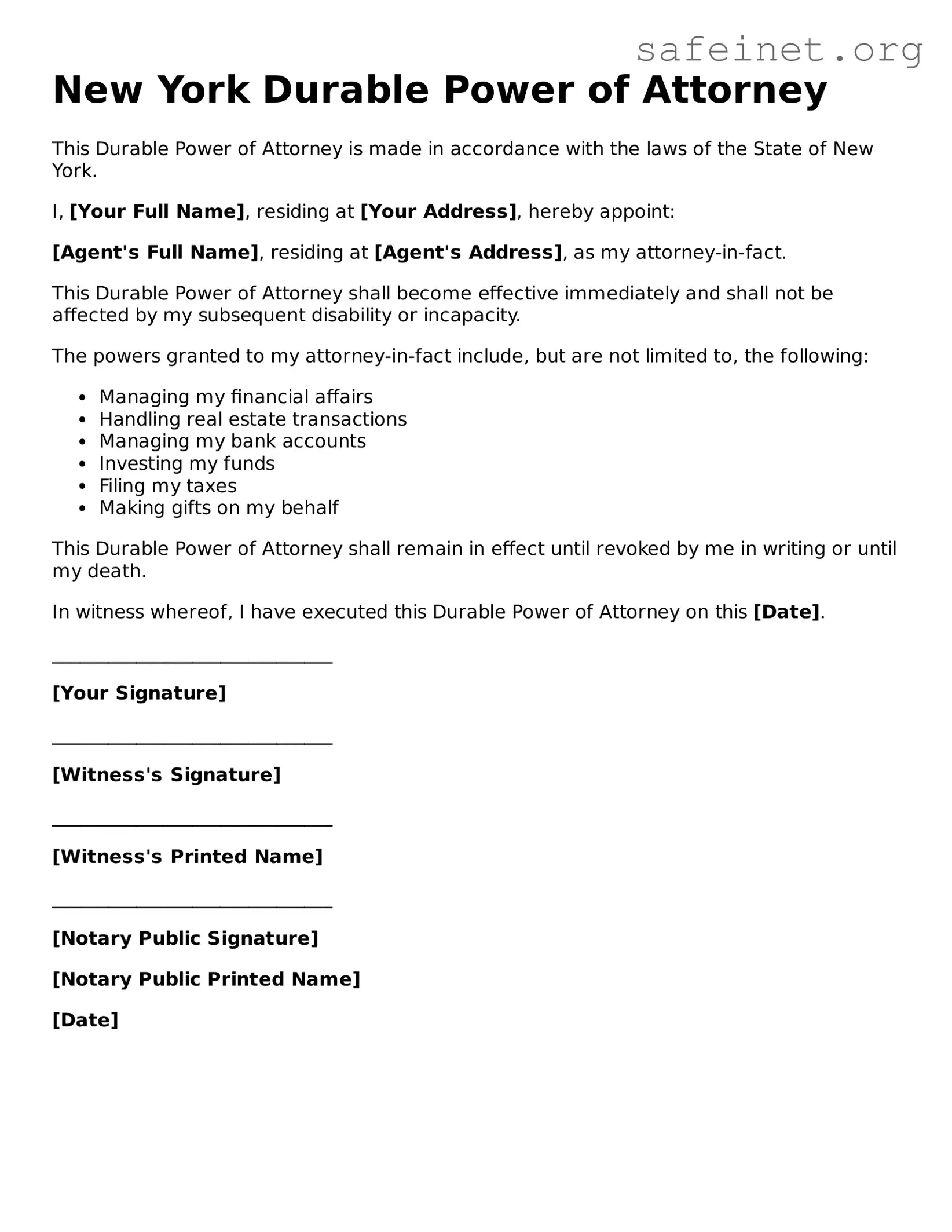
In New York, the Durable Power of Attorney form is a crucial legal document that empowers individuals to designate someone they trust to manage their financial and legal affairs in the event they become incapacitated. This form allows the appointed agent, often referred to as the attorney-in-fact, to make decisions on behalf of the individual, ensuring that their wishes are honored even when they are unable to communicate them. Key features of this document include the ability to specify which powers are granted, such as handling banking transactions, managing real estate, or making healthcare decisions. Additionally, the durable aspect of the power of attorney means that it remains effective even if the principal becomes mentally incompetent. Understanding the implications of this form is essential for anyone looking to safeguard their future and ensure their affairs are handled according to their preferences. By taking the time to complete and execute this document properly, individuals can provide peace of mind for themselves and their loved ones, knowing that their financial matters will be managed by someone they trust, regardless of unforeseen circumstances.
New York Durable Power of Attorney
This Durable Power of Attorney is made in accordance with the laws of the State of New York.
I, [Your Full Name], residing at [Your Address], hereby appoint:
[Agent's Full Name], residing at [Agent's Address], as my attorney-in-fact.
This Durable Power of Attorney shall become effective immediately and shall not be affected by my subsequent disability or incapacity.
The powers granted to my attorney-in-fact include, but are not limited to, the following:
This Durable Power of Attorney shall remain in effect until revoked by me in writing or until my death.
In witness whereof, I have executed this Durable Power of Attorney on this [Date].
______________________________
[Your Signature]
______________________________
[Witness's Signature]
______________________________
[Witness's Printed Name]
______________________________
[Notary Public Signature]
[Notary Public Printed Name]
[Date]
| Fact Name | Description |
|---|---|
| Definition | A Durable Power of Attorney allows an individual to appoint someone to make financial and legal decisions on their behalf, even if they become incapacitated. |
| Governing Law | The New York Durable Power of Attorney is governed by New York General Obligations Law, Section 5-1501 et seq. |
| Durability | This form remains effective even if the principal becomes mentally incapacitated, ensuring continuity in decision-making. |
| Agent Authority | The appointed agent can handle various tasks, including managing bank accounts, paying bills, and making investments. |
| Revocation | The principal can revoke the Durable Power of Attorney at any time, as long as they are mentally competent. |
| Signing Requirements | The form must be signed by the principal in the presence of a notary public and two witnesses to be valid. |
Filling out the New York Durable Power of Attorney form is an important step in designating someone to manage your financial affairs if you become unable to do so. After completing the form, it should be signed and notarized to ensure its validity. Below are the steps to help you fill out the form correctly.
What is a Durable Power of Attorney in New York?
A Durable Power of Attorney is a legal document that allows you to appoint someone to manage your financial and legal affairs on your behalf. This authority remains in effect even if you become incapacitated, meaning that the appointed agent can continue to act for you when you can no longer make decisions for yourself.
Who can be appointed as an agent under a Durable Power of Attorney?
You can choose any competent adult to be your agent. This can be a family member, friend, or even a professional, such as an attorney or accountant. It’s essential to select someone you trust, as they will have significant authority over your financial matters.
What powers can I grant to my agent?
You can customize the powers you grant to your agent. Common powers include managing bank accounts, paying bills, filing taxes, and buying or selling property. You can also limit the powers to specific tasks if you prefer. It’s crucial to clearly outline these powers in the document.
How do I create a Durable Power of Attorney in New York?
To create a Durable Power of Attorney, you must complete a specific form provided by New York State. This form must be signed by you in the presence of a notary public. Additionally, the agent you choose must also sign the form, acknowledging their acceptance of the role.
Can I revoke a Durable Power of Attorney?
Yes, you can revoke a Durable Power of Attorney at any time, as long as you are mentally competent. To do this, you should create a written revocation document and notify your agent. It’s also advisable to inform any financial institutions or parties that may have relied on the original document.
What happens if I become incapacitated and do not have a Durable Power of Attorney?
If you become incapacitated without a Durable Power of Attorney in place, your family may need to go through a court process to obtain guardianship. This can be time-consuming and costly. Having a Durable Power of Attorney in advance can help avoid this situation and ensure that your affairs are managed according to your wishes.
Is a Durable Power of Attorney the same as a Health Care Proxy?
No, a Durable Power of Attorney deals primarily with financial and legal matters, while a Health Care Proxy specifically addresses medical decisions. If you want someone to make health care decisions for you when you cannot, you will need to create a separate Health Care Proxy document.
Not specifying the powers granted: Many individuals fail to clearly outline the specific powers they wish to grant the agent. This can lead to confusion and potential disputes later on.
Inadequate witness signatures: The New York Durable Power of Attorney form requires signatures from two witnesses. Some people overlook this requirement, which can invalidate the document.
Using outdated forms: Individuals sometimes use older versions of the Durable Power of Attorney form. It is crucial to use the most current form to ensure compliance with state laws.
Not dating the document: Failing to include the date when the form is signed can create issues regarding its validity and effectiveness.
Neglecting to discuss the decision with the agent: It is a common mistake to appoint an agent without discussing the responsibilities and expectations with them. Clear communication can prevent misunderstandings in the future.
A New York Durable Power of Attorney form allows an individual to appoint someone else to manage their financial affairs. However, several other forms and documents often accompany this form to ensure comprehensive management of a person's affairs. Below is a list of some commonly used documents.
Utilizing these documents alongside a Durable Power of Attorney can create a comprehensive plan for managing financial and healthcare decisions. This proactive approach helps ensure that an individual’s preferences are honored and that their affairs are managed effectively in case of incapacity.
The New York Durable Power of Attorney form is similar to the General Power of Attorney. Both documents allow an individual, known as the principal, to designate another person, called the agent, to act on their behalf in financial matters. However, the key distinction lies in the durability of the authority granted. While a General Power of Attorney may become invalid if the principal becomes incapacitated, a Durable Power of Attorney remains effective even in such circumstances, ensuring that the agent can continue to manage the principal's affairs without interruption.
Another document akin to the Durable Power of Attorney is the Healthcare Proxy. This legal instrument allows an individual to appoint someone to make medical decisions on their behalf if they become unable to do so. Similar to the Durable Power of Attorney, the Healthcare Proxy empowers a designated person to act in the principal's best interests. However, the focus here is on health-related decisions rather than financial matters, highlighting the importance of having distinct documents for different areas of life management.
The Living Will is also comparable to the Durable Power of Attorney, albeit with a different focus. A Living Will allows individuals to express their wishes regarding medical treatment and end-of-life care. While the Durable Power of Attorney grants authority to an agent to make decisions, the Living Will serves as a clear directive for healthcare providers and family members about the principal's preferences. Both documents are essential for ensuring that one's wishes are honored during times of incapacity.
Similar to the Durable Power of Attorney is the Revocable Living Trust. This legal arrangement allows individuals to place their assets into a trust during their lifetime, which can then be managed by a trustee. Like the Durable Power of Attorney, a Revocable Living Trust can facilitate the management of assets if the individual becomes incapacitated. The primary difference is that a trust can also help avoid probate after death, while a Durable Power of Attorney does not have that effect.
The Financial Power of Attorney shares similarities with the Durable Power of Attorney, as both documents grant authority to an agent to handle financial matters. The Financial Power of Attorney may be more limited in scope, focusing specifically on financial transactions, whereas the Durable Power of Attorney can encompass a broader range of responsibilities. This distinction is crucial for individuals who wish to specify the extent of the authority they grant to their agents.
The Guardianship document is another related legal tool. While the Durable Power of Attorney allows an individual to choose someone to act on their behalf, a Guardianship is typically established through a court process when an individual is deemed incapable of managing their own affairs. Guardianship can provide a more structured approach to care and decision-making, but it often involves more oversight and can be more complex than simply appointing an agent through a Durable Power of Attorney.
The Advance Directive is also similar to the Durable Power of Attorney, as both documents serve to express an individual’s wishes in times of incapacity. An Advance Directive includes both a Living Will and a Healthcare Proxy, detailing preferences for medical treatment and appointing someone to make healthcare decisions. The Durable Power of Attorney, while focused on financial matters, complements these healthcare directives by ensuring that financial affairs are also managed according to the individual’s wishes.
Finally, the Will is a crucial document that, while not directly similar, serves as an important part of an individual's estate planning. A Will outlines how a person's assets should be distributed after their death. In contrast, the Durable Power of Attorney is effective during the individual’s lifetime, allowing for the management of affairs should they become incapacitated. Both documents are essential in ensuring that an individual’s wishes are respected, but they operate at different stages of life and under different circumstances.
When filling out the New York Durable Power of Attorney form, it is essential to approach the process with care. Here are some important dos and don'ts to keep in mind:
Understanding the New York Durable Power of Attorney form is essential for anyone considering this important legal document. Unfortunately, several misconceptions can lead to confusion. Here are seven common misunderstandings:
Many people believe that a Durable Power of Attorney is limited to financial decisions. In reality, it can also encompass healthcare decisions, depending on how it is drafted.
This is not true. A Durable Power of Attorney remains effective even if the person who created it becomes incapacitated. This is what distinguishes it from a regular Power of Attorney.
While you can choose anyone you trust, it is crucial to select someone responsible and capable of making decisions on your behalf. This choice should not be taken lightly.
Each Durable Power of Attorney can be tailored to fit your specific needs. It is important to customize the document to reflect your preferences and the powers you wish to grant.
While it is possible to draft a Durable Power of Attorney on your own, seeking legal advice can help ensure that the document complies with state laws and fully meets your needs.
This is not necessarily the case. A new Durable Power of Attorney does not automatically revoke older documents unless explicitly stated. It’s essential to clarify this in the new document.
You can revoke or amend your Durable Power of Attorney at any time, as long as you are mentally competent. Keeping your documents up to date is crucial for effective planning.
By understanding these misconceptions, you can make informed decisions regarding your Durable Power of Attorney. It is a powerful tool that, when used correctly, can provide peace of mind for you and your loved ones.
Filling out a Durable Power of Attorney (DPOA) form in New York is an important step in planning for your future. Here are key takeaways to keep in mind:
Understanding these points can help you navigate the process with confidence. Taking the time to fill out a Durable Power of Attorney form can provide peace of mind for you and your loved ones.