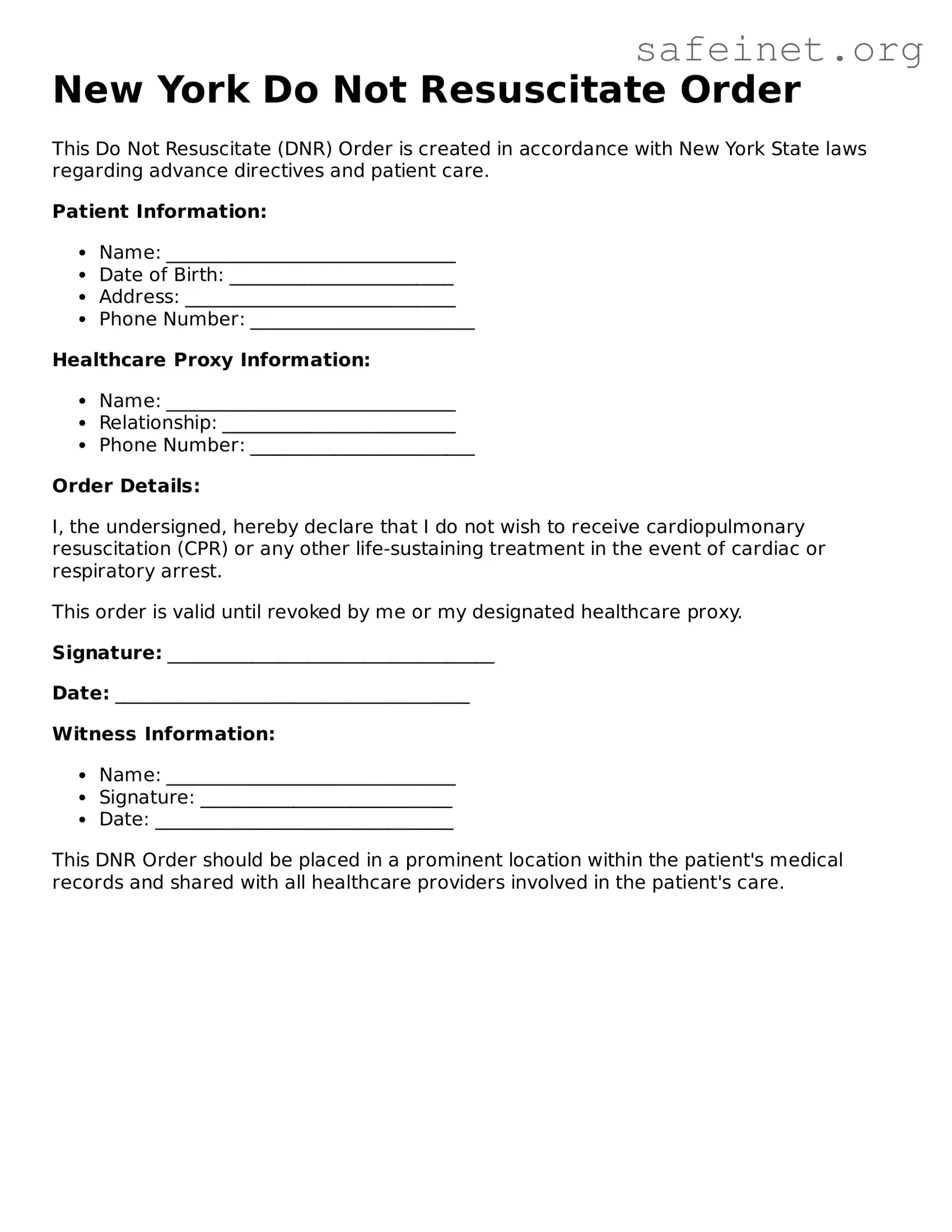
In the complex landscape of healthcare decisions, the New York Do Not Resuscitate (DNR) Order form plays a crucial role for patients and their families. This form provides a clear directive regarding a patient’s wishes concerning resuscitation efforts in the event of cardiac arrest or respiratory failure. It is designed to ensure that individuals who do not wish to receive cardiopulmonary resuscitation (CPR) can communicate their preferences effectively to healthcare providers. The DNR Order is not just a piece of paper; it carries significant weight in medical settings, guiding the actions of emergency responders and hospital staff. Completing this form requires careful consideration, as it involves discussions about end-of-life care and the values that inform those decisions. Importantly, the DNR Order must be signed by a physician and the patient or their legally authorized representative, ensuring that the wishes expressed are both understood and respected. By understanding the nuances of the DNR Order, patients can navigate their healthcare choices with greater confidence and clarity.
New York Do Not Resuscitate Order
This Do Not Resuscitate (DNR) Order is created in accordance with New York State laws regarding advance directives and patient care.
Patient Information:
Healthcare Proxy Information:
Order Details:
I, the undersigned, hereby declare that I do not wish to receive cardiopulmonary resuscitation (CPR) or any other life-sustaining treatment in the event of cardiac or respiratory arrest.
This order is valid until revoked by me or my designated healthcare proxy.
Signature: ___________________________________
Date: ______________________________________
Witness Information:
This DNR Order should be placed in a prominent location within the patient's medical records and shared with all healthcare providers involved in the patient's care.
| Fact Name | Description |
|---|---|
| Purpose | The New York Do Not Resuscitate (DNR) Order form allows individuals to refuse resuscitation efforts in the event of cardiac or respiratory arrest. |
| Governing Law | This form is governed by New York Public Health Law, specifically Article 29-B, which outlines patient rights regarding DNR orders. |
| Eligibility | Any adult who is competent can complete a DNR order. This includes individuals with terminal illnesses or those who wish to avoid aggressive medical interventions. |
| Signature Requirements | The form must be signed by the patient or their legally authorized representative, along with a physician's signature to validate the order. |
| Form Accessibility | The DNR order form is available through healthcare providers, hospitals, and the New York State Department of Health website. |
| Revocation | A DNR order can be revoked at any time by the patient or their representative, and this must be documented in the patient's medical record. |
| Hospital Protocol | Healthcare facilities must have protocols in place to honor DNR orders, ensuring that staff are trained to recognize and respect these directives. |
Filling out the New York Do Not Resuscitate Order form is an important step in expressing your healthcare wishes. Once you complete the form, it should be shared with your healthcare providers and kept in an accessible location. This ensures that your preferences are known and respected in medical situations.
What is a Do Not Resuscitate (DNR) Order in New York?
A Do Not Resuscitate Order is a legal document that instructs medical personnel not to perform cardiopulmonary resuscitation (CPR) if a patient’s heart stops beating or if they stop breathing. In New York, a DNR order is typically used by individuals with serious health conditions who wish to avoid aggressive resuscitation efforts that may not align with their wishes for end-of-life care.
Who can create a DNR Order in New York?
In New York, a DNR order can be created by a patient who is at least 18 years old and has the capacity to make healthcare decisions. If the patient is unable to make decisions, a legally authorized representative, such as a family member or a designated healthcare proxy, can create the order on their behalf. It is important that the individual creating the DNR order fully understands the implications of such a decision.
How is a DNR Order documented in New York?
To document a DNR order in New York, a specific form must be completed and signed by the patient or their representative, along with a physician. This form is often referred to as the New York State Do Not Resuscitate Order form. Once signed, the form should be kept in a place where it can be easily accessed by medical personnel, such as in the patient’s medical records or at their bedside.
Can a DNR Order be revoked?
Yes, a DNR order can be revoked at any time by the patient or their authorized representative. Revocation can be done verbally or in writing. It is essential to inform healthcare providers about the revocation to ensure that the patient's current wishes are honored. Keeping the DNR form up to date is crucial to avoid any confusion during medical emergencies.
What should I discuss with my healthcare provider regarding a DNR Order?
When considering a DNR order, it is important to have an open discussion with your healthcare provider. Topics to cover include your overall health condition, prognosis, and the potential outcomes of resuscitation efforts. Understanding the benefits and limitations of a DNR order can help you make an informed decision that aligns with your values and preferences for end-of-life care.
Failing to provide accurate personal information.
Individuals often overlook the importance of including their full name, address, and date of birth. This information is crucial for identification purposes.
Not having the form signed by a physician.
A common mistake is submitting the form without a physician's signature. This signature is necessary to validate the order.
Omitting the date of the order.
Some people forget to date the form. Without a date, the order may be considered invalid or outdated.
Neglecting to discuss the order with family members.
It's essential to communicate the decision with loved ones. Failing to do so can lead to confusion during a medical emergency.
Using outdated forms.
Individuals sometimes use older versions of the form. Always ensure you have the most current version to avoid complications.
Not keeping copies of the completed form.
People often forget to make copies for their records and for family members. Keeping copies ensures that everyone involved is aware of the wishes stated in the order.
When considering end-of-life care options, individuals often encounter various forms and documents that complement the New York Do Not Resuscitate (DNR) Order form. Each of these documents plays a vital role in ensuring that a person's healthcare preferences are respected and understood by medical professionals. Below is a list of five important forms that are commonly used alongside the DNR Order.
Understanding these documents is crucial for anyone navigating the complexities of healthcare decisions. They not only empower individuals to express their wishes but also ensure that those wishes are honored during critical moments. Having these forms in place can provide peace of mind to both patients and their loved ones.
The Advance Directive is a crucial document that outlines a person's preferences for medical treatment in the event they become unable to communicate their wishes. Similar to the New York Do Not Resuscitate Order, it serves to guide healthcare providers in making decisions that align with the individual's values and desires. While the DNR specifically addresses resuscitation efforts, the Advance Directive encompasses a broader range of medical interventions, including preferences for life-sustaining treatments and end-of-life care. This document ensures that a person's wishes are respected across various medical scenarios.
The Living Will is another important document that shares similarities with the New York Do Not Resuscitate Order. It explicitly details an individual's wishes regarding medical treatment in situations where they cannot express their preferences. Like the DNR, a Living Will can prevent unwanted medical interventions, ensuring that healthcare providers honor the individual's choices about life-sustaining measures. The key difference lies in the Living Will's broader focus on various medical treatments, not limited to resuscitation alone.
The Healthcare Proxy is a legal document that designates a specific individual to make medical decisions on behalf of someone who is unable to do so. This document complements the New York Do Not Resuscitate Order by allowing the appointed person to interpret and implement the individual's wishes regarding resuscitation and other medical treatments. While the DNR provides specific instructions about resuscitation, the Healthcare Proxy ensures that the individual's overall healthcare preferences are honored through a trusted representative.
The Physician Orders for Life-Sustaining Treatment (POLST) form is designed for individuals with serious illnesses or advanced age. It translates patient preferences into actionable medical orders, similar to the New York Do Not Resuscitate Order. POLST forms address a range of medical interventions, including resuscitation, and provide clear guidance to emergency responders and healthcare providers. This document is particularly beneficial in emergency situations, ensuring that the patient's wishes are followed promptly and accurately.
The Medical Power of Attorney grants someone the authority to make healthcare decisions on behalf of another person. This document is similar to the New York Do Not Resuscitate Order in that it ensures medical decisions align with the individual's wishes. While the DNR specifically addresses resuscitation, the Medical Power of Attorney covers a wider array of healthcare choices. This allows the appointed agent to act in the best interest of the individual, based on their known preferences, including those related to resuscitation efforts.
When filling out the New York Do Not Resuscitate Order form, it is important to approach the task with care and consideration. Here are six guidelines to follow:
Understanding the New York Do Not Resuscitate (DNR) Order form is essential for patients and their families. However, several misconceptions often cloud the reality of this important document. Here are seven common misunderstandings:
Clearing up these misconceptions can help patients and families make informed decisions about their healthcare preferences. Understanding the DNR process is vital for ensuring that a patient's wishes are honored at critical moments.
When considering a Do Not Resuscitate (DNR) Order in New York, it's important to understand the process and implications. Here are some key takeaways: