When navigating the complexities of divorce in New York, a Divorce Settlement Agreement form serves as a crucial document for both parties. This form outlines the terms of the divorce, addressing key issues such as property division, child custody, child support, and spousal support. By clearly defining the rights and responsibilities of each spouse, the agreement aims to minimize future disputes and provide a clear framework for post-divorce life. It is essential to ensure that all aspects of the marriage, including debts and assets, are thoroughly considered and documented. Additionally, the form must comply with New York state laws to be enforceable. Understanding the significance of this agreement can lead to a smoother transition into the next chapter of life, making it vital for individuals to approach it with careful consideration and clarity.
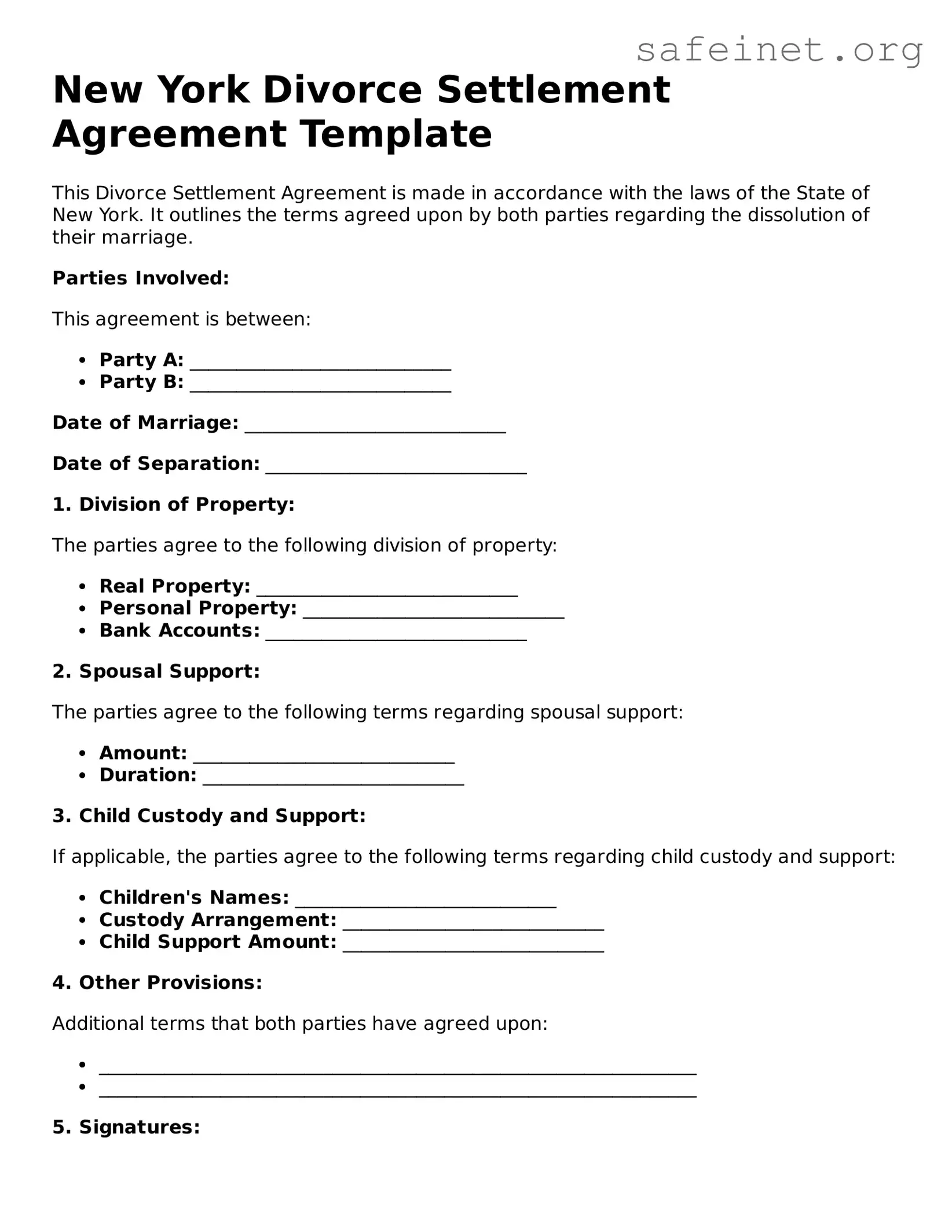
New York Divorce Settlement Agreement Template
This Divorce Settlement Agreement is made in accordance with the laws of the State of New York. It outlines the terms agreed upon by both parties regarding the dissolution of their marriage.
Parties Involved:
This agreement is between:
Date of Marriage: ____________________________
Date of Separation: ____________________________
1. Division of Property:
The parties agree to the following division of property:
2. Spousal Support:
The parties agree to the following terms regarding spousal support:
3. Child Custody and Support:
If applicable, the parties agree to the following terms regarding child custody and support:
4. Other Provisions:
Additional terms that both parties have agreed upon:
5. Signatures:
By signing below, both parties agree to the terms outlined in this Divorce Settlement Agreement.
Party A Signature: ____________________________ Date: ____________________________
Party B Signature: ____________________________ Date: ____________________________
This agreement is intended to be a complete and final resolution of all issues related to the divorce. It is advisable for both parties to seek independent legal advice before signing.
| Fact Name | Description |
|---|---|
| Purpose | The New York Divorce Settlement Agreement form outlines the terms agreed upon by both parties regarding the division of assets, debts, and other important matters during a divorce. |
| Governing Law | This form is governed by New York Domestic Relations Law, specifically sections related to divorce and marital property. |
| Mutual Agreement | Both parties must mutually agree to the terms included in the form for it to be valid and enforceable. |
| Asset Division | The form includes detailed provisions on how marital property and debts will be divided, ensuring clarity and fairness. |
| Child Custody | If children are involved, the form addresses custody arrangements, visitation rights, and child support obligations. |
| Spousal Support | Provisions for spousal support, also known as alimony, can be included in the agreement, detailing payment amounts and duration. |
| Legal Representation | While not required, it is highly recommended that both parties seek independent legal advice before signing the agreement. |
| Modification | After signing, the agreement can be modified only if both parties consent to the changes in writing. |
| Filing Requirement | The completed agreement must be filed with the court as part of the divorce proceedings to be legally binding. |
| Confidentiality | The contents of the agreement are generally confidential but may be disclosed in court if necessary. |
Completing the New York Divorce Settlement Agreement form is a crucial step in the divorce process. After filling out this form, parties will typically move forward with filing it in court, which will help finalize the terms of the divorce.
What is a New York Divorce Settlement Agreement?
A New York Divorce Settlement Agreement is a legal document that outlines the terms of a divorce between two parties. It covers issues such as property division, child custody, child support, and alimony. This agreement is essential for ensuring that both parties understand their rights and responsibilities following the divorce.
Do I need a lawyer to create a Divorce Settlement Agreement?
While it is not legally required to have a lawyer, it is highly recommended. A lawyer can help ensure that the agreement is fair and complies with New York laws. They can also help you understand your rights and provide guidance throughout the divorce process.
What happens if we cannot agree on the terms?
If you and your spouse cannot reach an agreement, you may need to go to court. A judge will then decide the terms of your divorce. This can be a lengthy and costly process, so it's often best to try to negotiate an agreement outside of court if possible.
Can I modify the Divorce Settlement Agreement later?
How long does it take to finalize a Divorce Settlement Agreement?
What should be included in the Divorce Settlement Agreement?
Your agreement should include details about the division of assets and debts, child custody arrangements, visitation schedules, child support amounts, and alimony. It's important to be thorough to avoid misunderstandings later on.
Is the Divorce Settlement Agreement legally binding?
Where can I find a Divorce Settlement Agreement form for New York?
Failing to provide complete information. Many individuals overlook the importance of filling in every required field. Incomplete forms can lead to delays or even rejections.
Not understanding the terms. Some people sign the agreement without fully grasping the implications of certain clauses. This can result in unintended consequences.
Ignoring tax implications. Individuals often forget to consider how divorce settlements can affect their taxes. This oversight can lead to unexpected financial burdens later on.
Overlooking asset division details. Many fail to clearly outline how assets will be divided. Ambiguities in this area can create disputes down the line.
Neglecting to include child support and custody arrangements. Parents sometimes leave out crucial details regarding child support payments and custody agreements, which can lead to complications in the future.
Not seeking legal advice. Some individuals choose to fill out the form without consulting a lawyer. This can result in mistakes that may have been avoided with professional guidance.
When navigating the divorce process in New York, several key documents often accompany the Divorce Settlement Agreement. Each of these forms plays a vital role in ensuring that the divorce proceedings are clear and legally binding. Below is a list of commonly used documents that can help facilitate a smoother transition during this challenging time.
Understanding these documents can provide clarity during the divorce process. By utilizing them effectively, individuals can work toward a resolution that respects their rights and needs, ultimately leading to a more equitable outcome.
The New York Divorce Settlement Agreement form shares similarities with the Separation Agreement. Both documents outline the terms of a couple's separation, including asset division, child custody, and support arrangements. While the Separation Agreement is typically used when a couple decides to live apart without formally filing for divorce, the Divorce Settlement Agreement formalizes these terms in the context of a divorce proceeding. Each document aims to provide clarity and structure to the couple’s new living arrangements.
Another document that resembles the Divorce Settlement Agreement is the Child Custody Agreement. This agreement focuses specifically on the arrangements for children following a divorce or separation. It details custody arrangements, visitation schedules, and child support obligations. While the Divorce Settlement Agreement covers a broader range of issues, the Child Custody Agreement zeroes in on the welfare of the children, ensuring their needs are prioritized during the divorce process.
The Property Settlement Agreement is also akin to the Divorce Settlement Agreement. This document specifically addresses the division of marital property and debts. Like the Divorce Settlement Agreement, it seeks to ensure that both parties understand their rights and responsibilities regarding shared assets. The Property Settlement Agreement can be part of the Divorce Settlement Agreement or stand alone, depending on the couple's circumstances.
Similarly, a Spousal Support Agreement often overlaps with the Divorce Settlement Agreement. This document outlines the terms of financial support one spouse will provide to the other after the divorce. While the Divorce Settlement Agreement may include spousal support provisions, a Spousal Support Agreement focuses solely on the financial aspects, ensuring that both parties are clear about the support obligations involved.
The Parenting Plan is another document that aligns with the Divorce Settlement Agreement. This plan details how parents will raise their children post-divorce, covering aspects such as education, healthcare, and extracurricular activities. While the Divorce Settlement Agreement encompasses broader issues, the Parenting Plan is specifically designed to address the day-to-day responsibilities and decision-making processes regarding the children.
Additionally, the Marital Settlement Agreement bears similarities to the Divorce Settlement Agreement. This document serves as a comprehensive outline of how a couple will resolve their marital issues, including property division, debt responsibility, and support arrangements. It is often used as a synonym for the Divorce Settlement Agreement, highlighting the need for clear communication and mutual agreement during the divorce process.
Lastly, the Mediation Agreement can be compared to the Divorce Settlement Agreement. This document is created when a couple seeks mediation services to resolve their divorce issues amicably. It reflects the terms agreed upon during mediation and can serve as the foundation for the final Divorce Settlement Agreement. Both documents aim to promote cooperation and understanding between the parties, making the divorce process smoother and less contentious.
When filling out the New York Divorce Settlement Agreement form, it’s important to follow some guidelines to ensure accuracy and completeness. Here’s a list of things you should and shouldn’t do:
Following these guidelines can help make the process smoother and ensure that your agreement is valid and enforceable.
When it comes to the New York Divorce Settlement Agreement form, many misconceptions can lead to confusion. Here are nine common misunderstandings:
This form is applicable to all divorcing couples, whether they have children or not. Child custody and support are just one aspect of the agreement.
Many believe that a Divorce Settlement Agreement must be complex. In reality, it can be straightforward if both parties agree on the terms.
While having legal assistance can be beneficial, individuals can draft their own agreements as long as they follow the necessary guidelines.
The agreement outlines the terms of the divorce, while the decree is the court's final approval of those terms.
Once signed and approved by the court, the agreement becomes legally binding. Both parties must adhere to its terms.
Agreements can be modified if both parties consent and the court approves the changes. Life circumstances can change, and so can the terms.
While financial issues are a major focus, the agreement can also address property division, spousal support, and other personal matters.
Even if both parties agree on terms, having a written agreement protects everyone’s rights and clarifies expectations.
Filing the Divorce Settlement Agreement is crucial, but it is just one part of the overall divorce process. Other steps must be completed for the divorce to be finalized.
When filling out and using the New York Divorce Settlement Agreement form, it is essential to consider several key points to ensure a smooth process. Below are important takeaways to keep in mind:
By keeping these takeaways in mind, individuals can navigate the Divorce Settlement Agreement process more effectively, leading to a more satisfactory resolution for both parties involved.