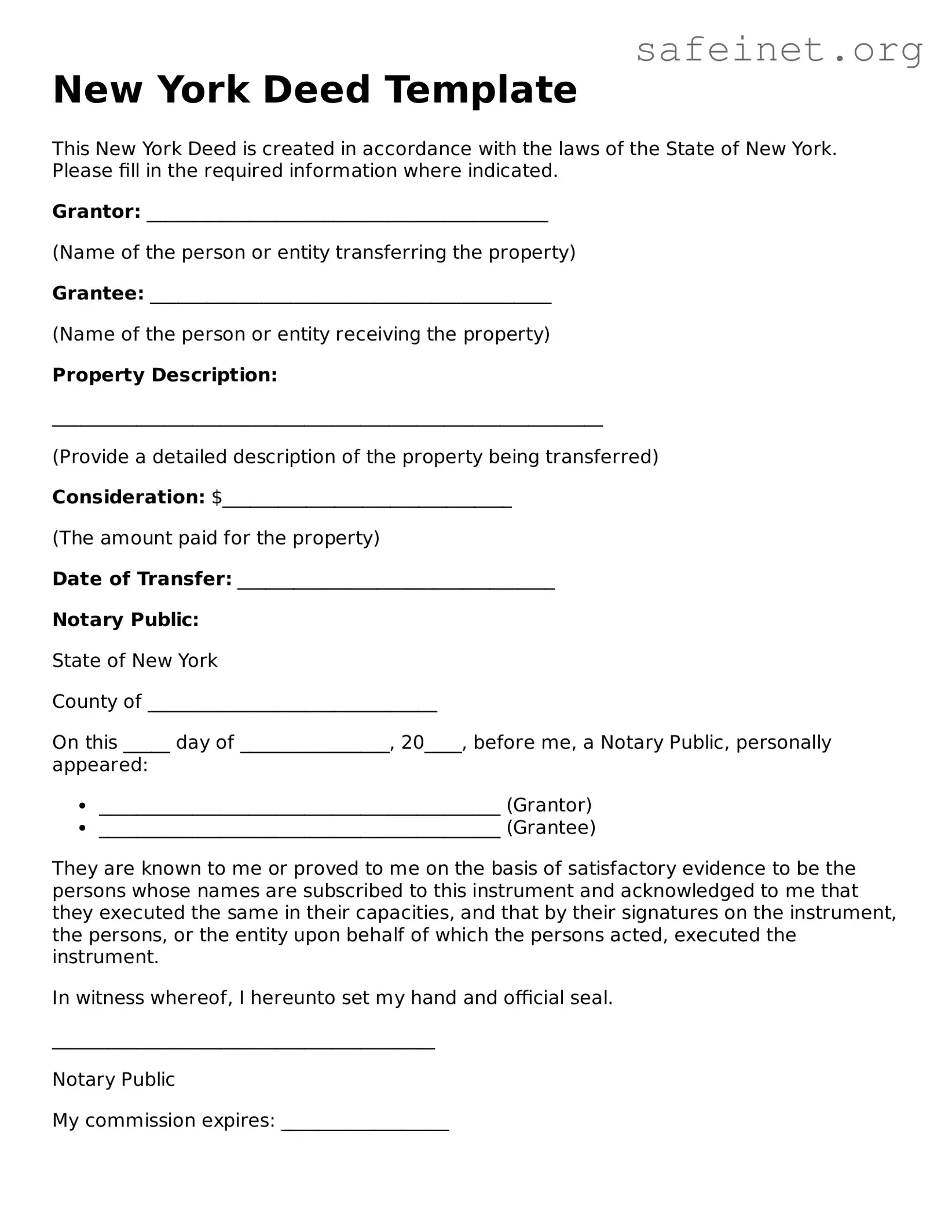
When it comes to transferring property ownership in New York, the New York Deed form plays a crucial role in ensuring that the transaction is legally binding and properly documented. This form is essential for both buyers and sellers, as it outlines the specifics of the property being transferred, including its legal description, the names of the parties involved, and the type of deed being used, such as a warranty deed or a quitclaim deed. Additionally, the form must be executed with the appropriate signatures and notarization, which adds an extra layer of authenticity to the transaction. It is important to note that the New York Deed form also requires the payment of transfer taxes, which can vary based on the property's value and location. Understanding these key elements is vital for anyone looking to navigate the complexities of real estate transactions in New York. By ensuring that all necessary information is accurately filled out, parties can avoid potential disputes and facilitate a smoother transfer of ownership.
New York Deed Template
This New York Deed is created in accordance with the laws of the State of New York. Please fill in the required information where indicated.
Grantor: ___________________________________________
(Name of the person or entity transferring the property)
Grantee: ___________________________________________
(Name of the person or entity receiving the property)
Property Description:
___________________________________________________________
(Provide a detailed description of the property being transferred)
Consideration: $_______________________________
(The amount paid for the property)
Date of Transfer: __________________________________
Notary Public:
State of New York
County of _______________________________
On this _____ day of ________________, 20____, before me, a Notary Public, personally appeared:
They are known to me or proved to me on the basis of satisfactory evidence to be the persons whose names are subscribed to this instrument and acknowledged to me that they executed the same in their capacities, and that by their signatures on the instrument, the persons, or the entity upon behalf of which the persons acted, executed the instrument.
In witness whereof, I hereunto set my hand and official seal.
_________________________________________
Notary Public
My commission expires: __________________
| Fact Name | Description |
|---|---|
| Type of Deed | In New York, the most common types of deeds are the Warranty Deed and the Quitclaim Deed. |
| Governing Law | The New York Real Property Law governs the use and requirements of deed forms in the state. |
| Signature Requirements | For a deed to be valid, it must be signed by the grantor and acknowledged before a notary public. |
| Recording | Deeds should be recorded with the county clerk's office to provide public notice of property ownership. |
Once you have the New York Deed form ready, it's time to fill it out accurately. Ensure that all required information is provided to avoid delays in processing. Follow these steps carefully to complete the form correctly.
What is a New York Deed form?
A New York Deed form is a legal document used to transfer ownership of real property from one party to another in the state of New York. It outlines the details of the transaction, including the names of the parties involved, the property description, and any conditions of the transfer. Various types of deeds exist, such as warranty deeds and quitclaim deeds, each serving different purposes in property transfers.
What information is required on a New York Deed form?
Essential information on a New York Deed form includes the names and addresses of the grantor (seller) and grantee (buyer), a legal description of the property, the date of the transfer, and the signature of the grantor. Depending on the type of deed, additional information may be necessary, such as any encumbrances or liens on the property.
How do I obtain a New York Deed form?
You can obtain a New York Deed form from various sources. Local county clerk offices often provide standard forms. Additionally, legal stationery stores, online legal services, and real estate professionals can supply the necessary forms. Ensure that the form you choose is appropriate for your specific transaction.
Do I need to have a lawyer to fill out a New York Deed form?
While it is not legally required to have a lawyer complete a New York Deed form, seeking legal assistance is advisable, especially for complex transactions. A lawyer can help ensure that the deed is filled out correctly and meets all legal requirements, reducing the risk of future disputes.
What is the process for recording a New York Deed?
To record a New York Deed, the completed and signed form must be submitted to the county clerk's office where the property is located. There may be a recording fee, and it is important to check if any additional documents, such as a property transfer tax form, are required. Recording the deed provides public notice of the ownership transfer.
Are there any taxes associated with transferring property in New York?
Yes, transferring property in New York may involve several taxes. The most common is the New York State Real Estate Transfer Tax, which is typically calculated based on the sale price of the property. Additionally, local municipalities may impose their own transfer taxes. It is important to consult with a tax professional to understand the specific obligations.
Can a New York Deed be revoked or changed after it is signed?
Once a New York Deed is signed and recorded, it generally cannot be revoked or changed unilaterally. However, the parties involved can agree to amend the deed or execute a new deed to correct any errors or change ownership terms. Legal advice is recommended for any changes to ensure compliance with state laws.
What happens if a New York Deed is not recorded?
If a New York Deed is not recorded, the transfer of ownership may not be recognized by third parties. This can lead to complications, such as disputes over property rights. Recording the deed protects the interests of the grantee and provides public notice of the ownership change.
Is there a time limit for recording a New York Deed?
While there is no strict time limit for recording a New York Deed, it is advisable to do so promptly after the transfer. Delaying the recording can lead to complications, especially if there are subsequent transactions involving the property. Timely recording helps to establish priority in ownership rights.
What should I do if I lose my New York Deed?
If a New York Deed is lost, it is recommended to obtain a certified copy from the county clerk’s office where the original deed was recorded. This copy serves as a valid document for legal purposes. Additionally, consider consulting with a legal professional for guidance on any implications related to the loss of the deed.
Inaccurate Property Description: One of the most common mistakes is failing to provide a complete and accurate description of the property being transferred. This includes not specifying the correct lot number, block number, or street address. A vague description can lead to confusion and potential legal issues down the line.
Incorrect Grantee Information: The name of the person or entity receiving the property (the grantee) must be spelled correctly and match the legal name on their identification. Errors in this section can delay the transfer process and may require additional paperwork.
Omitting Signatures: All necessary parties must sign the deed. Forgetting to include a signature can render the document invalid. Ensure that all individuals involved in the transaction have signed the deed before submission.
Not Notarizing the Document: In New York, a deed must be notarized to be legally binding. Failing to have the document notarized can lead to complications in property transfer. Always seek the services of a notary public to validate the signatures.
Ignoring Transfer Taxes: New York imposes transfer taxes on property transactions. Not accounting for these taxes can lead to unexpected costs. It’s essential to check the current rates and ensure that all required taxes are paid at the time of filing.
Filing in the Wrong County: Each county in New York has its own filing office for property deeds. Submitting the deed to the incorrect office can cause delays and potential legal issues. Always verify the appropriate county office where the deed should be filed.
When completing a property transaction in New York, several additional forms and documents may accompany the deed form to ensure all legal requirements are met. Each document serves a unique purpose in the process, helping to clarify ownership, tax obligations, and other essential details. Here is a list of common documents often used alongside the New York Deed form:
Each of these documents plays a critical role in the property transfer process, ensuring that all parties are informed and protected. Proper preparation and understanding of these forms can lead to a smoother transaction experience.
The New York Deed form shares similarities with a Quitclaim Deed. Both documents serve to transfer ownership of real property from one party to another. However, a Quitclaim Deed does not guarantee that the grantor has clear title to the property; it merely conveys whatever interest the grantor may have. This means that if there are any claims or liens against the property, the grantee assumes those risks. In contrast, a New York Deed typically includes warranties that provide more protection to the buyer regarding the title's validity.
Another document comparable to the New York Deed is the Warranty Deed. Like the New York Deed, a Warranty Deed offers assurances about the title, including the promise that the property is free from any encumbrances. This type of deed provides greater security for the grantee, as it guarantees that the grantor will defend the title against any claims. While both documents facilitate property transfer, the Warranty Deed emphasizes the grantor’s responsibility to ensure a clear title.
The Bargain and Sale Deed is also similar to the New York Deed. This type of deed transfers ownership but does not include any warranties about the title. It is often used in real estate transactions where the seller may not want to assume liability for any title issues. While it conveys property rights, it does not provide the same level of protection as a Warranty Deed or a New York Deed, which may include specific assurances about the property's title.
A Special Purpose Deed is another document that bears resemblance to the New York Deed. Special Purpose Deeds are often used in specific circumstances, such as transferring property in a divorce or to a trust. While they serve a unique purpose, they still function to transfer ownership of real estate. The key difference lies in the context and conditions under which these deeds are executed, rather than the fundamental purpose of property transfer.
Lastly, a Trustee's Deed is similar in that it involves the transfer of property, but it is executed by a trustee on behalf of a trust. This deed is often used in situations where a property is held in a trust and is being sold or transferred to a beneficiary. While the New York Deed is typically executed by an individual or entity transferring their interest, the Trustee's Deed represents the actions of a trustee, reflecting the fiduciary responsibilities involved in managing trust assets.
When filling out the New York Deed form, it’s essential to ensure that all information is accurate and complete. Here’s a list of things you should and shouldn’t do to make the process smoother.
By following these guidelines, you can help ensure that your New York Deed form is filled out correctly and efficiently.
Understanding the New York Deed form is essential for anyone involved in property transactions in the state. However, there are several misconceptions that can lead to confusion. Here are seven common misunderstandings:
By clarifying these misconceptions, individuals can better navigate the complexities of property ownership and transactions in New York.
When dealing with the New York Deed form, it’s essential to understand its purpose and how to complete it correctly. Here are some key takeaways to consider:
By keeping these points in mind, individuals can navigate the process of filling out and using the New York Deed form more effectively.