When facing the possibility of foreclosure, homeowners in New York may consider a Deed in Lieu of Foreclosure as a viable option to mitigate their financial burdens. This legal document allows a property owner to voluntarily transfer ownership of their property to the lender, effectively settling the mortgage debt without going through the lengthy and often costly foreclosure process. By using this form, homeowners can avoid the negative impact of foreclosure on their credit score and potentially negotiate more favorable terms with their lender. The process typically involves the homeowner providing the lender with a clear title to the property, which must be free of any liens or other encumbrances. Additionally, both parties may engage in discussions regarding any outstanding debts, ensuring that the transfer is mutually beneficial. Understanding the implications and requirements of the Deed in Lieu of Foreclosure is crucial for homeowners considering this path, as it can provide a fresh start and help them regain control over their financial situation.
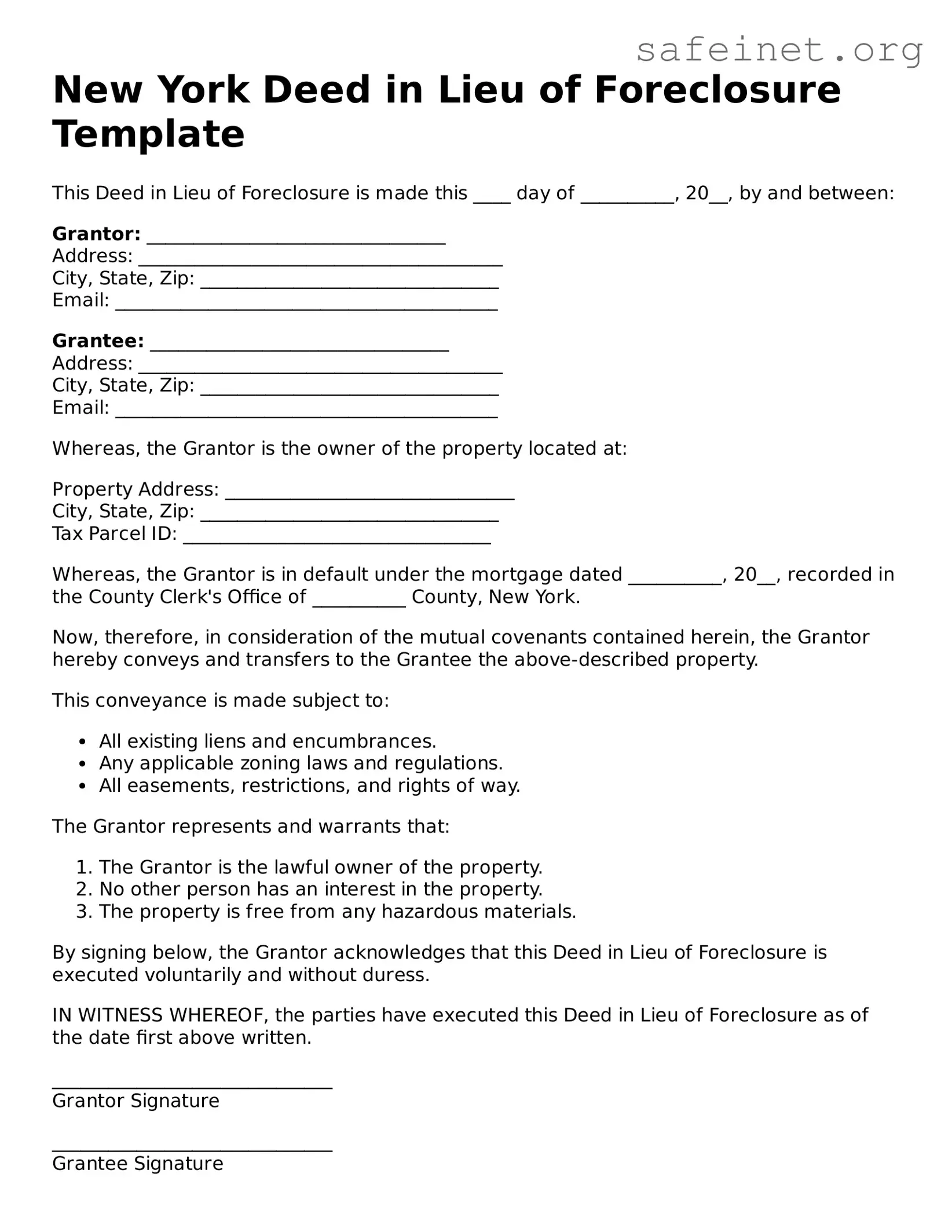
New York Deed in Lieu of Foreclosure Template
This Deed in Lieu of Foreclosure is made this ____ day of __________, 20__, by and between:
Grantor: ________________________________
Address: _______________________________________
City, State, Zip: ________________________________
Email: _________________________________________
Grantee: ________________________________
Address: _______________________________________
City, State, Zip: ________________________________
Email: _________________________________________
Whereas, the Grantor is the owner of the property located at:
Property Address: _______________________________
City, State, Zip: ________________________________
Tax Parcel ID: _________________________________
Whereas, the Grantor is in default under the mortgage dated __________, 20__, recorded in the County Clerk's Office of __________ County, New York.
Now, therefore, in consideration of the mutual covenants contained herein, the Grantor hereby conveys and transfers to the Grantee the above-described property.
This conveyance is made subject to:
The Grantor represents and warrants that:
By signing below, the Grantor acknowledges that this Deed in Lieu of Foreclosure is executed voluntarily and without duress.
IN WITNESS WHEREOF, the parties have executed this Deed in Lieu of Foreclosure as of the date first above written.
______________________________
Grantor Signature
______________________________
Grantee Signature
State of New York
County of ______________________
On this ____ day of __________, 20__, before me, a Notary Public, personally appeared ______________________, known to me to be the person who executed the foregoing instrument.
______________________________
Notary Public Signature
My Commission Expires: ________________
| Fact Name | Description |
|---|---|
| Definition | A Deed in Lieu of Foreclosure is a legal document where a borrower voluntarily transfers ownership of their property to the lender to avoid foreclosure proceedings. |
| Governing Law | In New York, the governing laws related to deeds in lieu of foreclosure are primarily found in the Real Property Actions and Proceedings Law (RPAPL). |
| Eligibility | Homeowners facing financial difficulties may be eligible for a deed in lieu if they are unable to keep up with mortgage payments and want to avoid foreclosure. |
| Benefits | This option can help borrowers avoid the lengthy and often costly foreclosure process, and it may also minimize damage to their credit score. |
| Process | The process typically involves negotiating with the lender, completing the necessary paperwork, and transferring the deed to the lender. |
| Impact on Credit | A deed in lieu of foreclosure can still negatively impact a borrower's credit score, but it may be less severe than a full foreclosure. |
| Tax Implications | Borrowers should be aware that transferring property through a deed in lieu could have tax implications, such as potential cancellation of debt income. |
After completing the New York Deed in Lieu of Foreclosure form, the next step involves submitting the document to the appropriate parties. This typically includes the lender and may require recording with the local county clerk's office. Ensure that all necessary parties are informed and that any additional documentation is provided as required.
What is a Deed in Lieu of Foreclosure?
A Deed in Lieu of Foreclosure is a legal document where a homeowner voluntarily transfers ownership of their property to the lender to avoid foreclosure. This option allows the borrower to walk away from the mortgage without the lengthy and often stressful foreclosure process.
Who can use a Deed in Lieu of Foreclosure?
Homeowners who are struggling to make mortgage payments and are facing foreclosure may consider this option. It is typically available to those who have fallen behind on their payments and want to avoid the negative impacts of foreclosure on their credit history.
What are the benefits of a Deed in Lieu of Foreclosure?
One of the main benefits is that it can help homeowners avoid the lengthy foreclosure process. It can also minimize damage to their credit score compared to a foreclosure. Additionally, it may allow the homeowner to walk away without owing any further money on the mortgage, depending on the agreement with the lender.
What are the potential downsides?
One downside is that the homeowner may still face tax implications. The IRS may consider the forgiven debt as taxable income. Furthermore, not all lenders accept deeds in lieu, so homeowners may need to negotiate with their lender. There may also be a waiting period before the homeowner can buy another home.
How does the process work?
The process typically begins with the homeowner contacting their lender to express interest in a Deed in Lieu of Foreclosure. The lender will review the homeowner’s financial situation and property value. If both parties agree, the homeowner will sign the deed, transferring ownership to the lender, and the lender may release the homeowner from the mortgage obligation.
Do I need legal assistance to complete a Deed in Lieu of Foreclosure?
While it is not required, seeking legal assistance can be beneficial. An attorney can help navigate the complexities of the process, ensure that the homeowner's rights are protected, and assist in understanding any potential tax implications.
Will a Deed in Lieu of Foreclosure affect my credit score?
Yes, a Deed in Lieu of Foreclosure will impact your credit score, but typically less severely than a foreclosure. While it will still be noted on your credit report, it may be viewed more favorably by future lenders compared to a formal foreclosure.
What should I do if my lender denies my request for a Deed in Lieu of Foreclosure?
If your lender denies your request, consider discussing alternative options with them, such as a loan modification or short sale. It may also be helpful to seek advice from a housing counselor or legal expert who can provide guidance based on your specific situation.
Failing to provide accurate property information. Ensure that the property address, legal description, and tax identification number are correct.
Not including all necessary signatures. All parties involved must sign the document. Missing signatures can lead to delays or rejection.
Overlooking the requirement for notarization. The deed must be notarized to be valid. Without this step, the document may not be accepted.
Neglecting to understand the implications of the deed. This action may have tax consequences and affect credit scores. Seek advice if unsure.
Using outdated forms. Always ensure that you are using the most current version of the Deed in Lieu of Foreclosure form to avoid complications.
Ignoring the need for a cover letter. A cover letter can clarify the intent and provide context, helping to facilitate the process.
A Deed in Lieu of Foreclosure is a legal process that allows a borrower to transfer ownership of their property to the lender to avoid foreclosure. While this document is crucial, several other forms and documents often accompany it to ensure the process runs smoothly and legally. Below is a list of important documents that may be used alongside the New York Deed in Lieu of Foreclosure.
Understanding these documents is essential for anyone navigating the Deed in Lieu of Foreclosure process. Each plays a vital role in protecting the rights of both the borrower and the lender, facilitating a smoother transition and minimizing potential disputes.
A mortgage modification agreement is a document that allows a borrower to change the terms of their existing mortgage. This can include adjustments to the interest rate, the length of the loan, or the monthly payment amount. Similar to a deed in lieu of foreclosure, this agreement is often used when a borrower is struggling to keep up with payments. Instead of facing foreclosure, the borrower may negotiate new terms that make it more manageable to stay in their home. Both documents aim to avoid the lengthy and costly process of foreclosure, providing a more amicable solution for both the borrower and the lender.
A short sale agreement is another document that shares similarities with a deed in lieu of foreclosure. In a short sale, a homeowner sells their property for less than the amount owed on the mortgage, with the lender's approval. Like a deed in lieu, a short sale can help the homeowner avoid foreclosure and its associated consequences. Both processes require cooperation between the borrower and the lender, and both can lead to a resolution that minimizes losses for the lender while providing the borrower with a fresh start.
A forbearance agreement is also comparable to a deed in lieu of foreclosure. This document allows a borrower to temporarily pause or reduce their mortgage payments due to financial hardship. The lender agrees to this arrangement, often with the understanding that the borrower will catch up on payments later. While a deed in lieu of foreclosure results in the borrower relinquishing their property, a forbearance agreement provides a way for them to retain ownership while working through their financial difficulties. Both documents aim to prevent foreclosure and provide a pathway for recovery.
Lastly, a bankruptcy filing can be seen as a related document to a deed in lieu of foreclosure. When individuals file for bankruptcy, they seek relief from their debts, which may include their mortgage. This legal process can halt foreclosure proceedings and provide the borrower with time to reorganize their finances. While a deed in lieu of foreclosure involves voluntarily giving up the property, bankruptcy can lead to various outcomes, including the possibility of keeping the home. Both options serve as mechanisms to address overwhelming debt and avoid the repercussions of foreclosure.
When filling out the New York Deed in Lieu of Foreclosure form, it's essential to approach the process carefully. Here are ten things to keep in mind:
By following these guidelines, you can navigate the process more smoothly and make informed decisions. Remember, being thorough and attentive can make a significant difference.
When considering a Deed in Lieu of Foreclosure in New York, many individuals harbor misconceptions that can lead to confusion or poor decision-making. Understanding these misconceptions can help property owners navigate this process more effectively.
Addressing these misconceptions can empower homeowners to make informed choices regarding their property and financial future.
When considering the New York Deed in Lieu of Foreclosure form, it's crucial to understand its implications and requirements. Here are key takeaways to keep in mind:
Taking these steps can help ensure a smoother transition and protect your interests during this process.