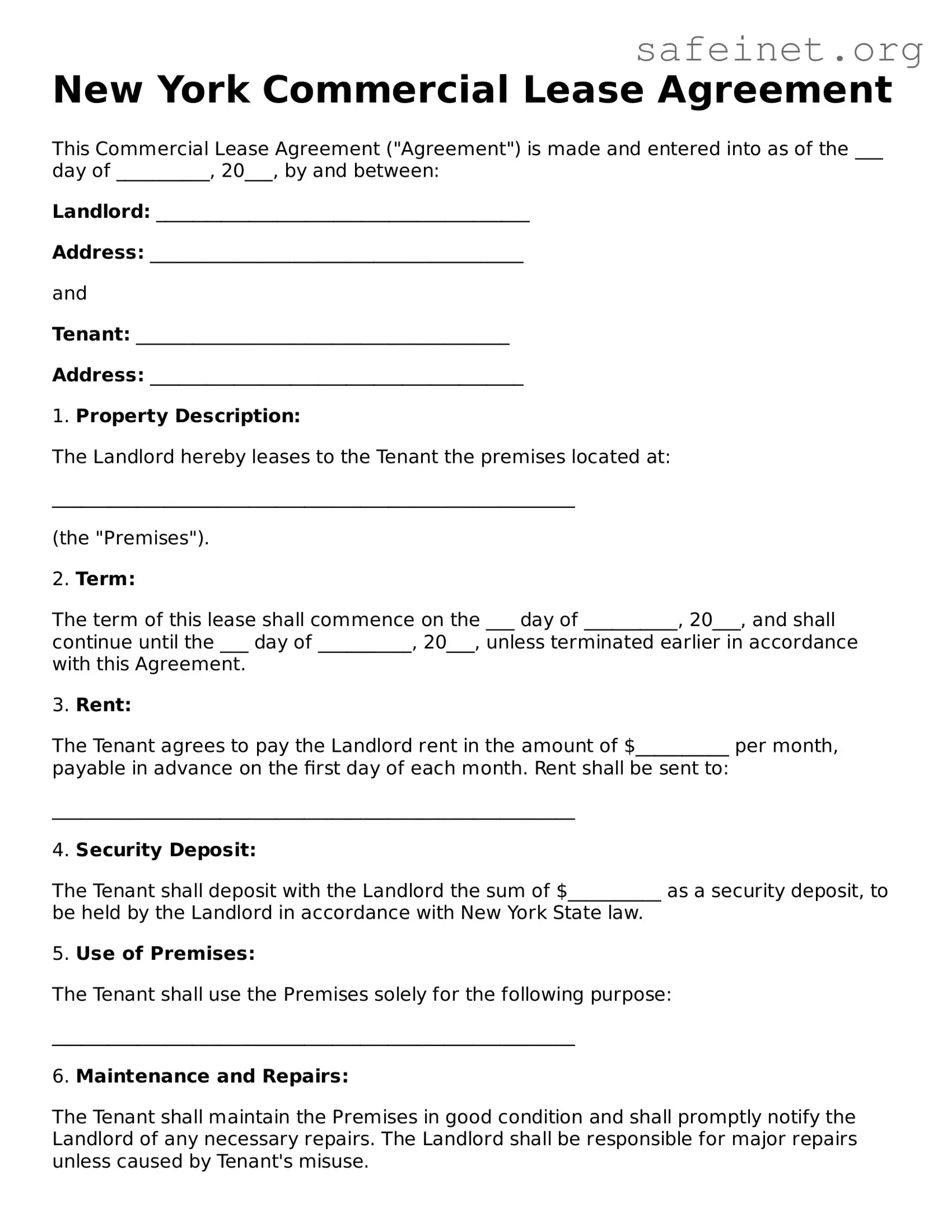
The New York Commercial Lease Agreement form serves as a vital document for landlords and tenants engaged in commercial property transactions. This agreement outlines the terms and conditions governing the rental of commercial space, ensuring clarity and protection for both parties involved. Key aspects of the form include the identification of the parties, detailed property descriptions, lease duration, and rental payment terms. Additionally, it addresses maintenance responsibilities, insurance requirements, and provisions for alterations to the property. By specifying the rights and obligations of each party, the lease aims to minimize disputes and provide a clear framework for the business relationship. Furthermore, it includes clauses related to default, termination, and renewal options, making it an essential tool for anyone entering into a commercial lease in New York.
New York Commercial Lease Agreement
This Commercial Lease Agreement ("Agreement") is made and entered into as of the ___ day of __________, 20___, by and between:
Landlord: ________________________________________
Address: ________________________________________
and
Tenant: ________________________________________
Address: ________________________________________
1. Property Description:
The Landlord hereby leases to the Tenant the premises located at:
________________________________________________________
(the "Premises").
2. Term:
The term of this lease shall commence on the ___ day of __________, 20___, and shall continue until the ___ day of __________, 20___, unless terminated earlier in accordance with this Agreement.
3. Rent:
The Tenant agrees to pay the Landlord rent in the amount of $__________ per month, payable in advance on the first day of each month. Rent shall be sent to:
________________________________________________________
4. Security Deposit:
The Tenant shall deposit with the Landlord the sum of $__________ as a security deposit, to be held by the Landlord in accordance with New York State law.
5. Use of Premises:
The Tenant shall use the Premises solely for the following purpose:
________________________________________________________
6. Maintenance and Repairs:
The Tenant shall maintain the Premises in good condition and shall promptly notify the Landlord of any necessary repairs. The Landlord shall be responsible for major repairs unless caused by Tenant's misuse.
7. Alterations:
The Tenant shall not make any alterations to the Premises without the prior written consent of the Landlord.
8. Insurance:
The Tenant shall maintain liability insurance covering the Premises and shall provide proof of such insurance to the Landlord upon request.
9. Termination:
Either party may terminate this Agreement by providing the other party with ___ days written notice prior to the intended termination date.
10. Governing Law:
This Agreement shall be governed by and construed in accordance with the laws of the State of New York.
IN WITNESS WHEREOF, the parties hereto have executed this Agreement as of the date first above written.
Landlord Signature: _______________________________
Date: _________________________________________
Tenant Signature: _______________________________
Date: _________________________________________
| Fact Name | Details |
|---|---|
| Governing Law | New York State law governs the Commercial Lease Agreement. |
| Parties Involved | The lease agreement includes the landlord and the tenant. |
| Lease Term | The duration of the lease can vary, typically ranging from one year to several years. |
| Rent Payment | Rent is usually paid monthly, but other arrangements can be specified. |
| Security Deposit | A security deposit is often required, typically equal to one or two months' rent. |
| Maintenance Responsibilities | The lease outlines which party is responsible for maintenance and repairs. |
Completing the New York Commercial Lease Agreement form is an important step in establishing a clear understanding between the landlord and tenant. It is essential to provide accurate information to ensure that both parties are protected and aware of their rights and responsibilities. Below are the steps to follow when filling out this form.
What is a New York Commercial Lease Agreement?
A New York Commercial Lease Agreement is a legal document that outlines the terms and conditions under which a landlord rents commercial property to a tenant. This agreement typically includes details such as the rental amount, lease duration, security deposit requirements, and the responsibilities of both parties. It serves to protect the rights of both the landlord and the tenant by clearly defining expectations and obligations.
What are the key components of a Commercial Lease Agreement?
The key components of a Commercial Lease Agreement generally include the following: the names of the parties involved, the description of the property, lease term, rental payment details, security deposit information, maintenance responsibilities, and terms regarding termination and renewal. Additional clauses may cover issues like subleasing, insurance requirements, and dispute resolution procedures. Each of these elements plays a crucial role in ensuring a clear understanding between the landlord and tenant.
How is rent typically structured in a Commercial Lease Agreement?
Rent in a Commercial Lease Agreement can be structured in various ways. It may be a fixed amount paid monthly or annually. Some leases include provisions for rent increases at specified intervals. Others may use a percentage rent structure, where the tenant pays a base rent plus a percentage of their sales. Understanding how rent is calculated and when it is due is essential for both parties to avoid disputes.
Can a Commercial Lease Agreement be modified after signing?
Failing to provide accurate property details. It is crucial to include the correct address and description of the leased premises. Omitting this information can lead to confusion and disputes later.
Neglecting to specify the lease term. The start and end dates of the lease should be clearly stated. Without these dates, both parties may have different expectations regarding the duration of the lease.
Overlooking the rent payment terms. It is important to outline the amount of rent, payment due dates, and acceptable payment methods. Incomplete information can result in missed payments and potential legal issues.
Not addressing maintenance responsibilities. The lease should clearly define who is responsible for repairs and maintenance of the property. This helps prevent misunderstandings about obligations.
Ignoring the inclusion of any additional fees. If there are costs associated with utilities, property taxes, or common area maintenance, these should be explicitly mentioned. Failure to do so can lead to unexpected expenses.
Forgetting to include termination clauses. It is essential to outline the conditions under which either party can terminate the lease. Without this information, it may be difficult to end the lease agreement if necessary.
When entering into a New York Commercial Lease Agreement, several additional forms and documents may be necessary to ensure a smooth process. These documents help clarify terms, protect the interests of both parties, and provide necessary information for the lease arrangement.
These documents play a crucial role in the leasing process. Having them prepared and understood can lead to a more efficient and effective leasing experience.
A Residential Lease Agreement is similar to a Commercial Lease Agreement in that both documents outline the terms and conditions for renting a property. While a residential lease typically pertains to homes or apartments, a commercial lease focuses on business premises. Both agreements specify the duration of the lease, rental amount, and responsibilities of the tenant and landlord. They also include clauses related to maintenance, repairs, and termination of the lease.
A Sublease Agreement allows a tenant to rent out a portion or the entirety of their leased space to another party. This document resembles a Commercial Lease Agreement because it must detail the terms of the sublease, including rent, duration, and responsibilities. The original tenant remains liable to the landlord, similar to how a commercial tenant is accountable for the lease terms with the property owner.
A Lease Extension Agreement is used when a tenant wishes to extend their lease beyond the original term. This document is akin to a Commercial Lease Agreement as it modifies the original terms, including rent and duration. Both agreements require mutual consent from the landlord and tenant, ensuring that both parties are aware of the new terms.
A Lease Termination Agreement outlines the conditions under which a lease can be ended before its expiration. This document shares similarities with a Commercial Lease Agreement, as it specifies the responsibilities of both parties upon termination. It may include details about the return of the security deposit and any outstanding obligations, much like a commercial lease's termination clauses.
A Rent Increase Notice is a document that informs a tenant of an upcoming increase in rent. This notice is comparable to a Commercial Lease Agreement because it must comply with local laws and the terms of the lease. Both documents require clear communication regarding changes in financial obligations, ensuring that tenants are aware of their responsibilities moving forward.
A Property Management Agreement outlines the relationship between a property owner and a management company. This document is similar to a Commercial Lease Agreement in that it details the responsibilities of each party regarding the management of the property. Both agreements emphasize the importance of clear terms, including maintenance, rent collection, and tenant relations.
An Assignment of Lease allows a tenant to transfer their lease obligations to another party. This document resembles a Commercial Lease Agreement because it requires the landlord's consent and outlines the responsibilities of the new tenant. Both agreements ensure that the landlord is protected and that all parties understand their rights and obligations.
A Confidentiality Agreement may be used in conjunction with a Commercial Lease Agreement, especially when sensitive business information is involved. This document is similar because it protects proprietary information shared between the landlord and tenant. Both agreements emphasize the importance of confidentiality and outline the consequences of breaching this trust.
A Letter of Intent is often used in commercial real estate transactions to outline the basic terms before a formal lease is drafted. This document shares characteristics with a Commercial Lease Agreement, as it sets the groundwork for negotiations. Both documents aim to clarify the intentions of the parties involved, helping to prevent misunderstandings during the leasing process.
When filling out the New York Commercial Lease Agreement form, it’s crucial to approach the task with care. Here’s a handy list of dos and don’ts to keep in mind:
By following these guidelines, you can help ensure a smoother leasing experience and protect your interests. Remember, a well-prepared lease is the foundation of a successful commercial relationship.
Understanding the New York Commercial Lease Agreement form can be challenging due to various misconceptions. Here are nine common misunderstandings that often arise:
This is false. Each lease can be tailored to the specific needs of the landlord and tenant, covering different terms, conditions, and obligations.
While rent is a critical component, other terms like maintenance responsibilities, lease duration, and renewal options are also negotiable.
In New York, a written lease is essential to enforce the terms and protect both parties. Verbal agreements can lead to misunderstandings and disputes.
Security deposits may not be fully refundable if the tenant violates lease terms or causes damage beyond normal wear and tear.
Landlords typically need to provide notice before entering the leased space, except in emergencies. Tenant privacy is important.
Many lease terms can be amended if both parties agree. Flexibility is often possible, especially in long-term leases.
While many commercial leases are longer, they can vary significantly. Some commercial agreements may be short-term, depending on the business needs.
Most commercial leases require tenants to carry specific types of insurance to protect against liability and property damage. This is not optional.
Leases can be modified if both parties consent. Written amendments can be made to reflect changes in circumstances or agreements.
Addressing these misconceptions can help both landlords and tenants navigate the complexities of commercial leasing in New York more effectively.
When filling out and using the New York Commercial Lease Agreement form, consider the following key takeaways: