When engaging in a transaction involving personal property in New York, a Bill of Sale serves as an essential document to formalize the exchange between buyer and seller. This form captures crucial details, including the names and addresses of both parties, a description of the item being sold, and the sale price. It not only provides proof of ownership transfer but also protects the rights of both parties involved. Additionally, the Bill of Sale can include information about warranties or guarantees, if any, which adds an extra layer of security for the buyer. Understanding the components and importance of this document can help ensure that transactions are smooth and legally sound, ultimately fostering trust and clarity in the buying and selling process.
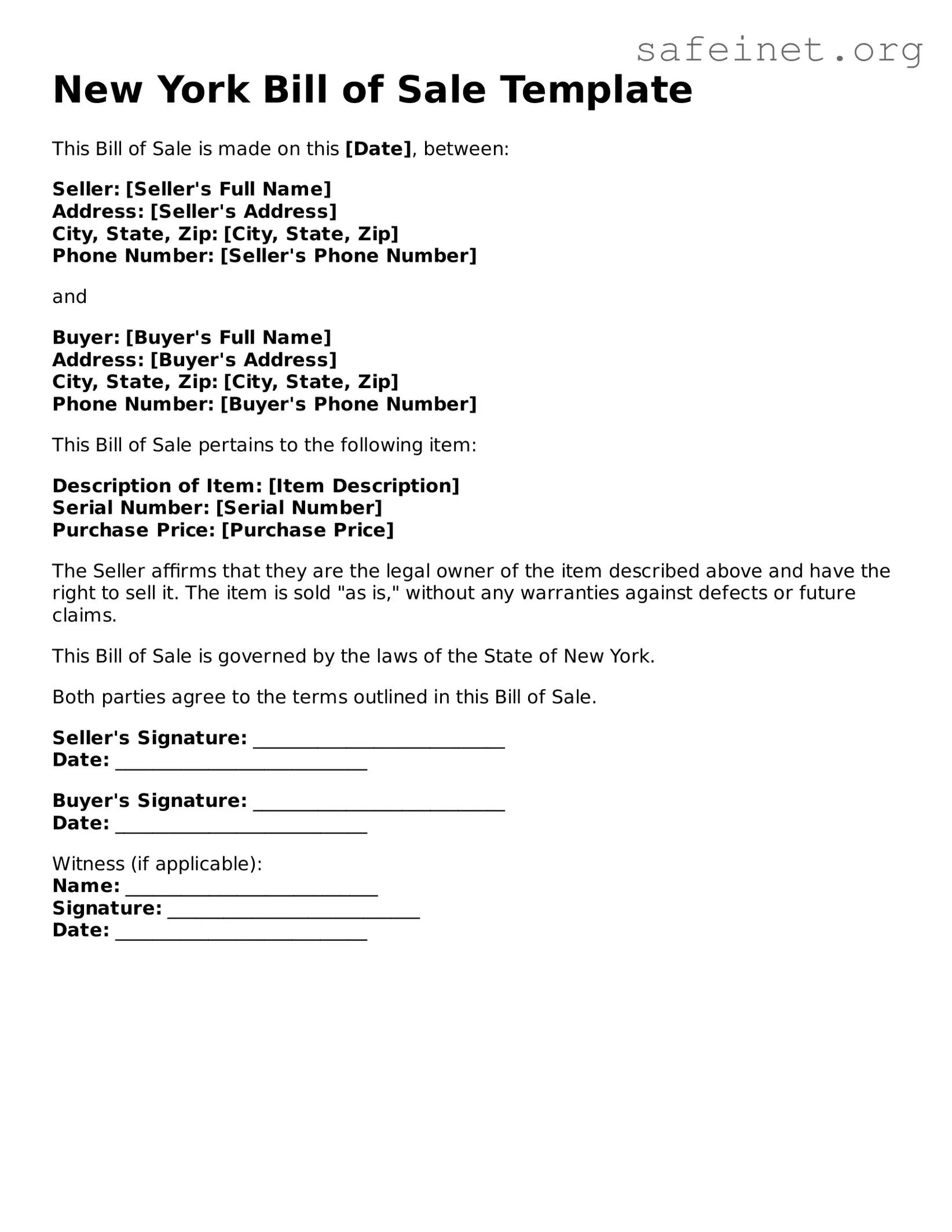
New York Bill of Sale Template
This Bill of Sale is made on this [Date], between:
Seller: [Seller's Full Name]
Address: [Seller's Address]
City, State, Zip: [City, State, Zip]
Phone Number: [Seller's Phone Number]
and
Buyer: [Buyer's Full Name]
Address: [Buyer's Address]
City, State, Zip: [City, State, Zip]
Phone Number: [Buyer's Phone Number]
This Bill of Sale pertains to the following item:
Description of Item: [Item Description]
Serial Number: [Serial Number]
Purchase Price: [Purchase Price]
The Seller affirms that they are the legal owner of the item described above and have the right to sell it. The item is sold "as is," without any warranties against defects or future claims.
This Bill of Sale is governed by the laws of the State of New York.
Both parties agree to the terms outlined in this Bill of Sale.
Seller's Signature: ___________________________
Date: ___________________________
Buyer's Signature: ___________________________
Date: ___________________________
Witness (if applicable):
Name: ___________________________
Signature: ___________________________
Date: ___________________________
| Fact Name | Description |
|---|---|
| Purpose | The New York Bill of Sale form is used to document the sale of personal property between a buyer and a seller. |
| Governing Law | This form is governed by New York State law, specifically under the Uniform Commercial Code (UCC). |
| Types of Property | The form can be used for various types of personal property, including vehicles, equipment, and other goods. |
| Notarization | While notarization is not required, it is recommended to enhance the document's credibility. |
| Transfer of Ownership | The Bill of Sale serves as proof of the transfer of ownership from the seller to the buyer. |
| Record Keeping | Both parties should keep a copy of the Bill of Sale for their records after the transaction. |
Filling out the New York Bill of Sale form is straightforward. After completing the form, you will have a document that serves as proof of the transaction between the buyer and seller. Make sure to keep a copy for your records, as it may be needed for future reference.
What is a Bill of Sale in New York?
A Bill of Sale is a legal document that records the transfer of ownership of personal property from one person to another. In New York, it serves as proof that a sale has occurred and outlines the details of the transaction, such as the item sold, the sale price, and the date of the sale.
Do I need a Bill of Sale for every transaction?
While not every transaction requires a Bill of Sale, it is highly recommended for significant purchases, such as vehicles or expensive items. Having a Bill of Sale can help protect both the buyer and seller in case of disputes or misunderstandings in the future.
What information should be included in a New York Bill of Sale?
A typical New York Bill of Sale should include the names and addresses of both the buyer and seller, a description of the item being sold, the sale price, and the date of the transaction. It’s also helpful to include any warranties or conditions related to the sale.
Is a Bill of Sale required for vehicle sales in New York?
Yes, a Bill of Sale is required for vehicle sales in New York. It serves as proof of the transaction and is necessary for the buyer to register the vehicle with the Department of Motor Vehicles (DMV). The form must be filled out completely and signed by both parties.
Can I create my own Bill of Sale?
Yes, you can create your own Bill of Sale. However, it’s important to ensure that it includes all the necessary information to make it legally binding. Many templates are available online that can help guide you in creating a valid document.
Do I need to have the Bill of Sale notarized?
In New York, notarization is not required for a Bill of Sale to be valid. However, having it notarized can add an extra layer of authenticity and may be beneficial if any disputes arise later.
What should I do with the Bill of Sale after the transaction?
After the transaction, both the buyer and seller should keep a copy of the Bill of Sale for their records. This document may be needed for future reference, especially if there are any issues related to the sale or ownership of the item.
Where can I find a New York Bill of Sale template?
You can find a New York Bill of Sale template online through various legal websites, government resources, or by consulting with a legal professional. Many templates are free to download and can be customized to fit your specific transaction.
Incomplete Information: Many individuals forget to fill out all required fields. This can lead to confusion or disputes later on. Always ensure that names, addresses, and descriptions of the item are fully provided.
Incorrect Dates: Entering the wrong date can create issues, especially if the sale is questioned in the future. Double-check that the date of the transaction is accurate.
Missing Signatures: Both the seller and buyer must sign the form. Failing to obtain the necessary signatures can render the document invalid. Ensure that everyone involved has signed before finalizing the sale.
Not Including Payment Details: Omitting information about the payment method or amount can lead to misunderstandings. Clearly state how much was paid and the form of payment used.
Neglecting to Make Copies: After completing the Bill of Sale, it's important to keep a copy for personal records. Without it, tracking the transaction later may become difficult.
Ignoring Local Regulations: Different areas may have specific requirements for a Bill of Sale. Failing to adhere to local laws can cause complications. Always check local regulations to ensure compliance.
A Bill of Sale is an important document that serves as proof of a transaction between a buyer and a seller. In New York, this form is often accompanied by various other documents to ensure that the transaction is clear and legally binding. Below is a list of additional forms and documents commonly used alongside the New York Bill of Sale.
These documents collectively help to clarify the terms of the sale and protect the interests of both parties involved. It is essential to ensure that all relevant paperwork is completed accurately to facilitate a smooth transaction.
The Vehicle Bill of Sale is similar to the New York Bill of Sale form as it serves as a written record of the transfer of ownership for a vehicle. This document includes details such as the vehicle identification number (VIN), make, model, and year. It protects both the buyer and seller by documenting the sale, ensuring that both parties have a clear understanding of the transaction.
The Personal Property Bill of Sale is another document that resembles the New York Bill of Sale. It is used for the sale of personal items, such as furniture, electronics, or collectibles. This form outlines the items being sold, their condition, and the agreed-upon price. Like the New York Bill of Sale, it provides proof of ownership transfer and can help resolve disputes in the future.
The Boat Bill of Sale is specifically designed for the sale of boats and watercraft. This document includes information about the boat, such as its hull identification number, make, and model. It serves a similar purpose as the New York Bill of Sale, ensuring that ownership is legally transferred and that both parties are protected during the transaction.
The Firearm Bill of Sale is used when buying or selling firearms. This document includes details about the firearm, such as its make, model, and serial number. It functions like the New York Bill of Sale by providing a record of the transaction and ensuring compliance with state and federal laws regarding firearm ownership transfers.
The Business Bill of Sale is relevant for the sale of a business or its assets. This document outlines the terms of the sale, including the assets being transferred, the purchase price, and any liabilities assumed by the buyer. Similar to the New York Bill of Sale, it formalizes the transaction and protects both parties involved.
The Equipment Bill of Sale is used for the sale of machinery or equipment, often in a business context. This document includes details about the equipment, such as its condition and any warranties. It serves the same purpose as the New York Bill of Sale by providing a clear record of ownership transfer and the terms of the sale.
The RV Bill of Sale is tailored for the sale of recreational vehicles. This document captures essential information about the RV, including its VIN, make, and model. Like the New York Bill of Sale, it acts as a legal record of the transaction, ensuring that both the buyer and seller are protected throughout the process.
The Livestock Bill of Sale is specifically for the sale of livestock, such as cattle, horses, or sheep. This document includes details about the animals being sold, their health status, and any registration numbers. It functions similarly to the New York Bill of Sale by providing a formal record of the transaction and protecting the interests of both parties.
The Mobile Home Bill of Sale is used when buying or selling mobile homes. This document outlines the details of the mobile home, including its identification number, make, and model. It serves a similar function to the New York Bill of Sale, ensuring that ownership is transferred legally and that both parties have a clear understanding of the terms of the sale.
When filling out the New York Bill of Sale form, it is essential to approach the task with care and attention to detail. Here are some important do's and don'ts to consider:
When dealing with the New York Bill of Sale form, many people hold misconceptions that can lead to confusion. Here are seven common misunderstandings about this important document:
Understanding these misconceptions can help individuals navigate the process of buying or selling property in New York more effectively. A well-prepared Bill of Sale protects both the buyer and the seller, ensuring clarity and security in the transaction.
When it comes to buying or selling personal property in New York, a Bill of Sale is an essential document. Here are some key takeaways to consider when filling out and using this form:
Understanding these points can make the process smoother and help protect both parties involved in the transaction.