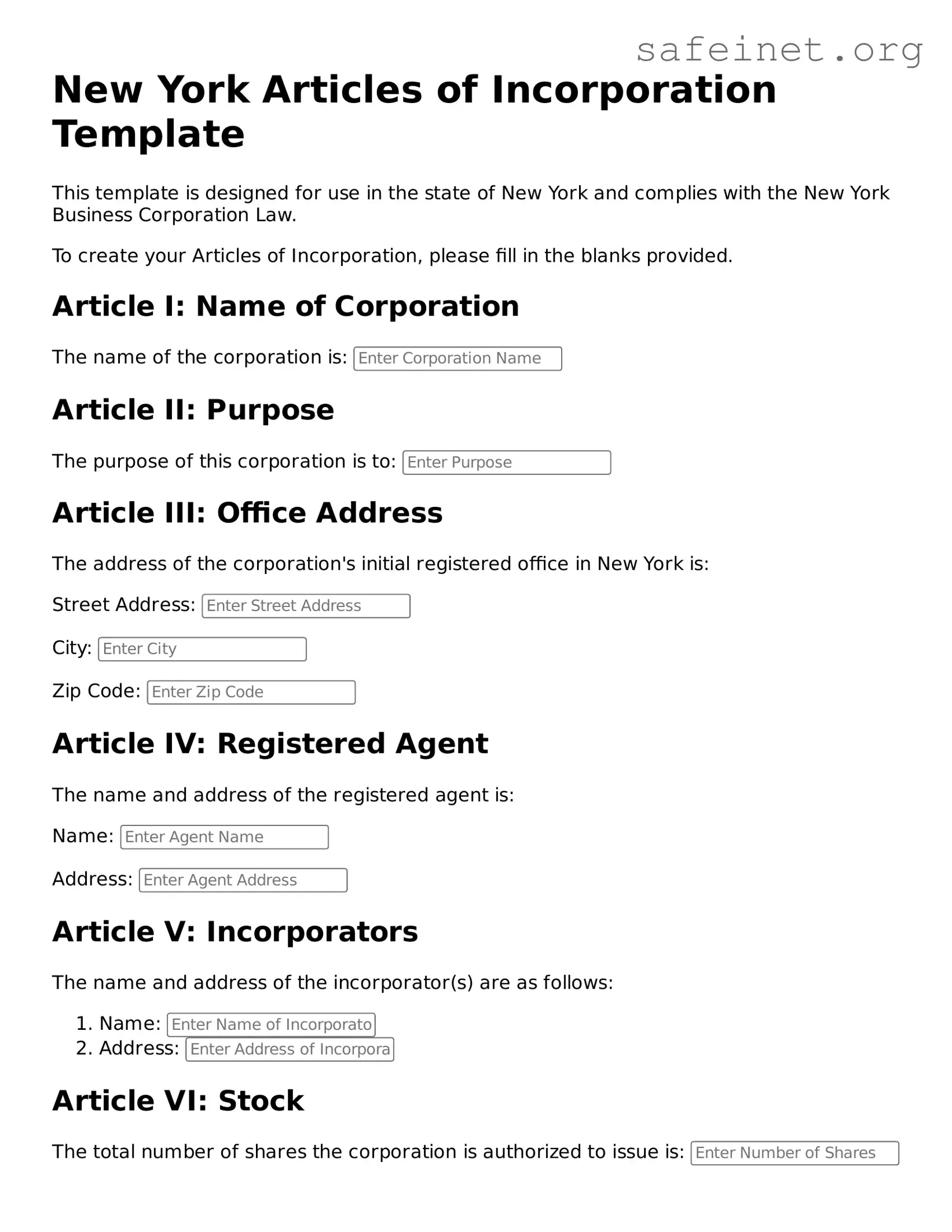
When embarking on the journey of establishing a corporation in New York, one of the first critical steps involves completing the Articles of Incorporation form. This essential document lays the foundation for your business entity and serves as a formal declaration to the state regarding your corporation’s existence. Among its key components, the form requires the corporation's name, which must be unique and distinguishable from existing entities, as well as the purpose for which the corporation is formed, whether it be for profit or non-profit endeavors. Additionally, it mandates the listing of the corporation's registered agent—an individual or entity designated to receive legal documents on behalf of the corporation. The form also includes provisions for the number of shares the corporation is authorized to issue, along with details about the initial board of directors. By addressing these fundamental aspects, the Articles of Incorporation not only comply with state regulations but also provide a clear structure for governance and operation, paving the way for future growth and success.
New York Articles of Incorporation Template
This template is designed for use in the state of New York and complies with the New York Business Corporation Law.
To create your Articles of Incorporation, please fill in the blanks provided.
Article I: Name of Corporation
The name of the corporation is:
Article II: Purpose
The purpose of this corporation is to:
Article III: Office Address
The address of the corporation's initial registered office in New York is:
Street Address:
City:
Zip Code:
Article IV: Registered Agent
The name and address of the registered agent is:
Name:
Address:
Article V: Incorporators
The name and address of the incorporator(s) are as follows:
Article VI: Stock
The total number of shares the corporation is authorized to issue is:
Article VII: Duration
The duration of the corporation is:
Article VIII: Additional Provisions
Any additional provisions the incorporators wish to include:
Execution
We, the undersigned, hereby declare that we are the incorporators of this corporation and that the information provided above is true and correct.
Incorporator Signature: ________________________
Date:
For filing with the New York Department of State, ensure all information is accurate and complete.
| Fact Name | Description |
|---|---|
| Governing Law | The New York Articles of Incorporation are governed by the New York Business Corporation Law. |
| Purpose | The form is used to officially create a corporation in New York State. |
| Filing Fee | A filing fee is required when submitting the Articles of Incorporation, which varies based on the corporation's structure. |
| Registered Agent | Corporations must designate a registered agent to receive legal documents on their behalf. |
| Incorporator Information | The form requires the name and address of the incorporator, who initiates the incorporation process. |
| Duration | The Articles of Incorporation can specify a duration for the corporation, or it can state that it will exist perpetually. |
After completing the New York Articles of Incorporation form, you will need to submit it to the New York Department of State along with the required filing fee. Ensure all information is accurate to avoid delays in processing.
What is the New York Articles of Incorporation form?
The New York Articles of Incorporation form is a legal document that establishes a corporation in the state of New York. This form outlines essential information about the corporation, such as its name, purpose, and the address of its principal office. By filing this document with the New York Department of State, you officially create a corporation, which is a separate legal entity from its owners. This means that the corporation can enter contracts, sue, and be sued in its own name, providing a layer of protection for its shareholders.
What information do I need to provide when completing the form?
When filling out the Articles of Incorporation form, you will need to provide several key pieces of information. This includes the name of your corporation, which must be unique and not already in use by another entity in New York. You will also need to state the purpose of your corporation, which can be broad or specific. Additionally, you must include the address of your corporation's principal office and the name and address of the registered agent, who will receive legal documents on behalf of the corporation. Finally, you will need to specify the number of shares the corporation is authorized to issue.
How do I file the Articles of Incorporation in New York?
Filing the Articles of Incorporation in New York is a straightforward process. You can complete the form online through the New York Department of State's website or download a paper version to fill out by hand. Once you have completed the form, you will need to submit it along with the required filing fee. As of now, the fee is $125, but it’s always a good idea to check for any updates on the official website. After submission, the state will review your application, and if everything is in order, you will receive a certificate of incorporation, officially recognizing your corporation.
What happens after my Articles of Incorporation are approved?
Once your Articles of Incorporation are approved, your corporation is officially formed. You will receive a certificate of incorporation, which serves as proof of your corporation's existence. However, the work doesn't stop there. You will need to comply with ongoing requirements, such as holding initial board meetings, adopting bylaws, and obtaining any necessary business licenses or permits. Additionally, it's crucial to maintain good standing with the state by filing annual reports and paying any required fees. This ensures that your corporation continues to operate legally and effectively.
Failing to include the corporate name that complies with New York naming requirements. The name must be unique and distinguishable from existing entities.
Not specifying the purpose of the corporation clearly. A vague purpose can lead to confusion or rejection of the application.
Omitting the registered agent's information. Every corporation must have a registered agent in New York to receive legal documents.
Incorrectly stating the number of shares authorized for issuance. Ensure that the number aligns with your business plan and complies with state regulations.
Neglecting to include the incorporators' names and addresses. This information is crucial for the formation process.
Using the wrong form or outdated version of the Articles of Incorporation. Always check for the latest version on the New York Department of State website.
Failing to sign and date the form. An unsigned form is invalid and will be rejected.
Not including the required filing fee. Ensure that you check the current fee schedule and include payment with your submission.
When filing the New York Articles of Incorporation, several other forms and documents may be required or beneficial to complete the incorporation process. Each of these documents serves a specific purpose and helps ensure compliance with state laws.
Completing these documents alongside the New York Articles of Incorporation will help establish a solid foundation for your new corporation. Proper preparation and understanding of each document can facilitate a smoother incorporation process.
The Articles of Incorporation in New York is similar to the Certificate of Incorporation, which is a legal document filed with the state to officially create a corporation. Both documents serve the purpose of establishing a corporation's existence and outline key details such as the corporation's name, purpose, and structure. While the Articles of Incorporation may be more commonly referred to in some states, the Certificate of Incorporation is the term used in New York, and both are essential for starting a business entity legally.
The Bylaws of a corporation are another document that shares similarities with the Articles of Incorporation. Bylaws provide the internal rules and procedures for managing the corporation, including details about meetings, voting rights, and the roles of officers and directors. While the Articles of Incorporation focus on the corporation's formation and basic structure, the Bylaws delve into the operational aspects, ensuring that the corporation runs smoothly and in accordance with the law.
The Operating Agreement is akin to the Articles of Incorporation for limited liability companies (LLCs). This document outlines the management structure and operational procedures of the LLC. Just as the Articles of Incorporation define the framework of a corporation, the Operating Agreement sets the groundwork for how the LLC will function, including member roles, profit distribution, and decision-making processes.
The Partnership Agreement is another comparable document, particularly for partnerships. This agreement outlines the terms of the partnership, including each partner's contributions, responsibilities, and profit-sharing arrangements. Like the Articles of Incorporation, the Partnership Agreement is essential for establishing the legal framework within which the business will operate, helping to prevent disputes among partners.
The Certificate of Good Standing is also relevant when discussing corporate documents. This certificate verifies that a corporation is legally registered and compliant with state regulations. While the Articles of Incorporation initiate the corporation's existence, the Certificate of Good Standing serves as proof that the corporation is in good standing with the state, which is often required for business transactions or securing financing.
The Annual Report shares a connection with the Articles of Incorporation as well. Corporations are typically required to file annual reports to update the state on their activities, financial status, and any changes in structure or ownership. This document helps maintain transparency and compliance, ensuring that the information provided in the Articles of Incorporation remains current and accurate.
The Shareholder Agreement is another document that complements the Articles of Incorporation. This agreement outlines the rights and obligations of shareholders, including voting rights and procedures for buying or selling shares. While the Articles of Incorporation establish the corporation's basic framework, the Shareholder Agreement provides more detailed governance regarding shareholder interactions and decision-making.
The Business License is a document that, while not directly related to the Articles of Incorporation, is necessary for legal operation. This license is issued by local governments and permits businesses to operate within their jurisdiction. It ensures that the business complies with local regulations, just as the Articles of Incorporation ensure compliance with state laws for corporate formation.
Lastly, the Tax Identification Number (TIN) is essential for any corporation. This number, issued by the IRS, is used for tax purposes and is necessary for opening a business bank account and filing taxes. While the Articles of Incorporation establish the legal entity, the TIN is crucial for the corporation's financial operations and compliance with federal tax laws.
When filling out the New York Articles of Incorporation form, it is essential to approach the process with care. Here are six important guidelines to consider:
Understanding the New York Articles of Incorporation form is crucial for anyone looking to establish a business in the state. However, several misconceptions can lead to confusion. Here are six common misunderstandings:
By addressing these misconceptions, individuals can better navigate the process of incorporating their business in New York.
Filling out and using the New York Articles of Incorporation form is an important step for anyone looking to establish a corporation in the state. Here are some key takeaways to consider:
These points highlight the importance of careful preparation and attention to detail when completing the Articles of Incorporation form in New York.