The Non-Circumvention and Non-Disclosure (NCND) form serves as a crucial document for parties engaged in business transactions, particularly when introductions between entities are involved. Designed to protect the interests of all parties, this agreement establishes clear guidelines on how introductions and referrals should be handled to ensure fair compensation. It outlines the responsibilities of each party, emphasizing the importance of not circumventing or bypassing one another in business dealings. The form also addresses the need for confidentiality, mandating that sensitive information shared during negotiations remains private unless explicit consent is granted for disclosure. Additionally, it includes provisions that govern the duration of the agreement, typically set for five years, and specifies that it is irrevocable and non-cancelable during this period. The NCND form also clarifies that any fees or commissions arising from transactions initiated through introductions must be honored, thereby safeguarding the financial interests of all involved. By outlining these essential aspects, the NCND form fosters trust and accountability, laying the groundwork for successful and mutually beneficial business relationships.
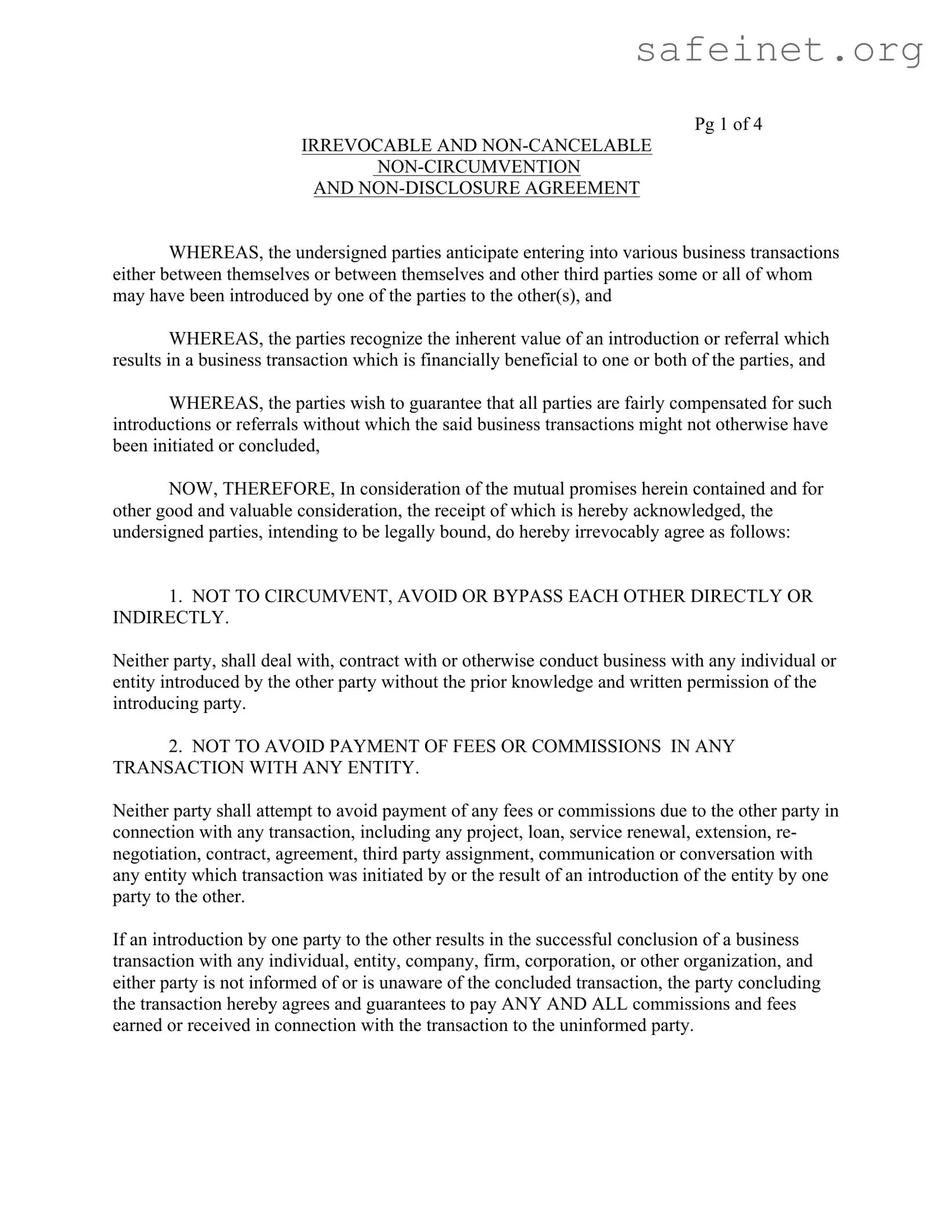
Pg 1 of 4
IRREVOCABLE AND
AND
WHEREAS, the undersigned parties anticipate entering into various business transactions either between themselves or between themselves and other third parties some or all of whom may have been introduced by one of the parties to the other(s), and
WHEREAS, the parties recognize the inherent value of an introduction or referral which results in a business transaction which is financially beneficial to one or both of the parties, and
WHEREAS, the parties wish to guarantee that all parties are fairly compensated for such introductions or referrals without which the said business transactions might not otherwise have been initiated or concluded,
NOW, THEREFORE, In consideration of the mutual promises herein contained and for other good and valuable consideration, the receipt of which is hereby acknowledged, the undersigned parties, intending to be legally bound, do hereby irrevocably agree as follows:
1.NOT TO CIRCUMVENT, AVOID OR BYPASS EACH OTHER DIRECTLY OR INDIRECTLY.
Neither party, shall deal with, contract with or otherwise conduct business with any individual or entity introduced by the other party without the prior knowledge and written permission of the introducing party.
2.NOT TO AVOID PAYMENT OF FEES OR COMMISSIONS IN ANY TRANSACTION WITH ANY ENTITY.
Neither party shall attempt to avoid payment of any fees or commissions due to the other party in connection with any transaction, including any project, loan, service renewal, extension, re- negotiation, contract, agreement, third party assignment, communication or conversation with any entity which transaction was initiated by or the result of an introduction of the entity by one party to the other.
If an introduction by one party to the other results in the successful conclusion of a business transaction with any individual, entity, company, firm, corporation, or other organization, and either party is not informed of or is unaware of the concluded transaction, the party concluding the transaction hereby agrees and guarantees to pay ANY AND ALL commissions and fees earned or received in connection with the transaction to the uninformed party.
Pg 2 of 4
For purposes of this agreement, a person or entity shall be considered “introduced by” a signatory it if that person or entity is in a “chain” of contacts resulting from an original introduction by a Signatory.
For example: Signatory A (mortgage broker) introduces Signatory B (potential borrower) to Signatory C (potential lender, JV partner, investor, buyer, or other entity). C is unable to participate in the business transaction, but refers B to Third party X (2nd potential lender, JV partner, investor, buyer, or other entity) who enters into a transaction with Signatory B. Since Third Party X would not have been aware of or entered into the business transaction with B and/or C but for the original introduction by Signatory A, Third Party X shall be considered “introduced” by Signatory A and Signatory A shall be entitled to any and all fees or commissions specified under any contract between Signatories A and B or A and C.
3.
Each party agrees not to disclose or otherwise reveal to any third party any confidential information provided by the other, particularly that concerning lenders, sellers, borrowers, buyers names, bank information, codes, references and/or any such information advised to the other as being confidential or privileged without the written consent of the other party. Each party agrees to keep confidential the names, addresses, telephone numbers, tax ID numbers, email addresses and fax numbers of any contacts introduced by the other party, unless prior written permission is given by the introducing party.
This agreement is expressly intended to cover negligent or inadvertent disclosure of confidential information, which are also considered violations of this agreement.
4.ADDITIONAL AGREEMENTS OF THE PARTIES.
a.The term of this Agreement shall be five (5) years from the date of its execution and is irrevocable and
b.This agreement shall be binding on the parties, their successors and assigns, including any business entity in which a party has an ownership interest and shall include any proprietorship, company, firm, corporation, LLC, partnership or other business entity of which the party is an employee, member, officer, partner, or agent.
Pg 3 of 4
cAll moneys due and owing from any client transaction undertaken by both parties will be irrevocably and unconditionally guaranteed to be paid without legal impediment upon request.
d.Should a violation, disagreement or dispute occur between the parties arising out of, or connected with this agreement, which cannot be adjusted by and between the parties involved, the disputed disagreement shall be submitted to the American Arbitration Association located in Denver, Colorado and all parties agree to abide by the decision of the referees of said Association. Judgment, upon award, may be entered in any court having jurisdiction thereof.
Notwithstanding the above, both parties agree to fully disclose and inform one another on a current and ongoing basis of all discussions, negotiations and transactions which are under consideration or discussion with any party which is a subject of this agreement. If a party requests updated information by email or telephone regarding the status of a transaction contemplated herein and the other party does not respond within 24 hours of the request, and the requesting party has reasonable grounds to believe that the lack of response is intentional, then the requesting party, at his or her discretion, may take immediate and appropriate legal action to protect such party’s interests under this agreement. Any party who intentionally fails to respond in a timely manner to a request for an information update under this provision hereby waives any claim for damages against the requesting party if any transaction subject hereto is delayed or not concluded as a result of legal action taken by the requesting party under this provision.
e.In the event of any conflict between the terms of this Agreement and any Loan Authorization Agreement, the terms of the Loan Authorization Agreement shall prevail.
f.In the event that either of the parties resorts to legal action against the other, the prevailing party shall be entitled to reimbursement from the other party for all reasonable attorney fees and other costs incurred in such action.
g.This agreement shall be construed and enforced in accordance with the applicable laws and regulations of the State of Colorado.
h.In the event any one or more of the provisions of this agreement shall, for any reason, be held to be invalid, illegal, or unenforceable, the remainder of this agreement shall not be affected thereby.
i.This agreement contains the entire agreement and understanding concerning the subject matter hereof and supersedes all prior negotiations and proposed agreements, written, or oral. Neither of the parties may alter, amend, nor, modify this agreement except by an instrument in writing signed by both parties, or their duly authorized representatives.
j.Additionally, the parties agree that this instrument may be negotiated via telefax/facsimile/fax transmission, and the respective parties accept the signatures by fax as though they were original.

Pg 4 of 4
BY OUR SIGNATURES WE CONFIRM WE HAVE FULL AUTHORITY TO EXECUTE THIS AGREEMENT AND OBLIGATE ALL ASSOCIATED COMPANIES, FIRMS, CORPORATIONS, PARTNERSHIPS, ORGANIZATIONS, INDIVIDUALS AND/OR ENTITIES CONTEMPLATED HEREIN, WHETHER SPECIFICALLY NAMED OR NOT.
Signature |
|
Dated: ____________ |
Please Print Name
Company Name (Please print or type)
Dated:
Robert E. Larson, President
Janus Mortgage, Inc
| Fact Name | Description |
|---|---|
| Purpose | The NCND form is designed to protect the interests of parties entering into business transactions by ensuring that all introductions and referrals are compensated fairly. |
| Non-Circumvention Clause | This clause prohibits either party from bypassing the other when dealing with individuals or entities introduced by one party, ensuring that introductions lead to compensation. |
| Confidentiality Agreement | Both parties agree to keep all confidential information private, including details about contacts and transactions, unless written consent is given to disclose such information. |
| Duration | The agreement is irrevocable and non-cancelable for a term of five years from the date of execution, covering all transactions initiated during that period. |
| Governing Law | This agreement is governed by the laws of the State of Colorado, ensuring that any disputes are resolved according to local regulations. |
Filling out the NCND form is an important step in establishing a clear understanding between parties regarding business transactions. Once completed, this form will help ensure that all parties involved are aware of their obligations and rights, fostering trust and transparency. Here’s how to fill out the form correctly.
What is the purpose of the NCND form?
The NCND form, which stands for Non-Circumvention and Non-Disclosure Agreement, is designed to protect the interests of parties involved in business transactions. It ensures that parties do not bypass each other when dealing with introduced contacts. The form also safeguards confidential information shared during these transactions, preventing unauthorized disclosure to third parties.
How long does the NCND agreement last?
The NCND agreement is effective for a term of five years from the date it is executed. During this period, the agreement remains irrevocable and non-cancelable. This means that all parties are bound by its terms for the entire duration, regardless of whether specific transactions are successful.
What happens if one party violates the NCND agreement?
If a violation occurs, the parties are required to resolve the issue through arbitration. The American Arbitration Association in Denver, Colorado, will handle disputes that cannot be settled amicably. Both parties agree to abide by the arbitration decision, and any judgment may be enforced in a court with appropriate jurisdiction.
Are there any fees or commissions involved?
Yes, the NCND agreement stipulates that if one party introduces a contact that leads to a business transaction, the other party must pay any agreed-upon fees or commissions. This obligation exists even if the introducing party is not informed about the transaction's conclusion. It ensures fair compensation for introductions that lead to successful deals.
What types of information are considered confidential under the NCND agreement?
The NCND agreement covers various types of confidential information. This includes, but is not limited to, names, addresses, contact details, and financial information of introduced parties. Parties are prohibited from disclosing this information to third parties without prior written consent from the other party. This protection extends to negligent or inadvertent disclosures as well.
Can the terms of the NCND agreement be modified?
Yes, the terms of the NCND agreement can be modified, but only through a written instrument signed by both parties. Any changes must be documented to ensure clarity and mutual understanding. This requirement helps maintain the integrity of the agreement and ensures that all parties are aware of any alterations.
Incomplete Information: Failing to fill out all required fields can lead to delays or even rejection of the form. Make sure every section is complete.
Incorrect Signatures: Not signing the form correctly can invalidate the agreement. Ensure that all parties sign in the designated areas.
Missing Dates: Forgetting to include dates next to signatures can create confusion about when the agreement was executed. Always double-check for this detail.
Failure to Identify Parties: Not clearly identifying all parties involved can lead to ambiguity. Use full names and titles to avoid misunderstandings.
Ignoring Confidentiality Clauses: Overlooking the importance of confidentiality can have serious repercussions. Be sure to understand and agree to these terms.
Not Keeping a Copy: Failing to retain a copy of the signed agreement can lead to disputes later. Always keep a record for your files.
Misunderstanding Terms: Not fully grasping the terms of the agreement can lead to unintended consequences. Take the time to read and understand every provision.
Neglecting to Review with Legal Counsel: Skipping a review by a legal professional can result in overlooking important legal implications. Consult with an attorney if possible.
Assuming Verbal Agreements are Sufficient: Believing that verbal agreements will suffice can be a costly mistake. Ensure all agreements are documented in writing.
The Non-Circumvention and Non-Disclosure (NCND) form is often accompanied by several other important documents that help clarify the terms of business relationships and protect the interests of the parties involved. Below are four commonly used forms and documents that are frequently associated with the NCND form.
Utilizing these documents in conjunction with the NCND form can help ensure that all parties involved in a business transaction have a clear understanding of their rights and obligations. This comprehensive approach aids in minimizing disputes and fosters a more cooperative business environment.
The Non-Disclosure Agreement (NDA) is similar to the NCND form in that both documents aim to protect sensitive information shared between parties. An NDA explicitly outlines what information is confidential and how it should be handled. Like the NCND, it prevents parties from disclosing proprietary information to third parties without consent. Both agreements emphasize the importance of trust and confidentiality in business relationships, ensuring that parties can communicate openly without fear of unauthorized disclosure.
The Non-Circumvention Agreement (NCA) shares similarities with the NCND form as both documents seek to protect the interests of parties involved in business transactions. The NCA specifically prohibits one party from bypassing the other to engage directly with a client or contact introduced by the first party. This is akin to the NCND's stipulation against circumventing introductions. Both agreements aim to foster fair business practices and ensure that all parties receive due recognition and compensation for their contributions.
The Partnership Agreement also resembles the NCND form in that it establishes clear expectations and responsibilities between parties. While a Partnership Agreement typically outlines the terms of a business relationship, including profit sharing and decision-making processes, it similarly emphasizes mutual respect and cooperation. Like the NCND, it seeks to protect the interests of all involved, ensuring that each party understands their role and the importance of maintaining confidentiality and trust.
Lastly, the Confidentiality Agreement (CA) is closely aligned with the NCND form. Both documents focus on safeguarding sensitive information shared between parties. The CA, like the NCND, defines what constitutes confidential information and sets guidelines for its use. This agreement reinforces the notion that both parties have a vested interest in protecting each other’s proprietary information, fostering a secure environment for business discussions and transactions.
When filling out the NCND form, it is essential to follow certain guidelines to ensure clarity and compliance. Here are four things you should and shouldn't do:
Misconceptions about the Non-Circumvention and Non-Disclosure (NCND) form can lead to confusion and unintended consequences in business dealings. Here are seven common misconceptions, along with explanations to clarify the realities of the NCND form:
When filling out and using the Non-Circumvention and Non-Disclosure (NCND) form, consider these key takeaways: