The NC-4 form, officially known as the Employee’s Withholding Allowance Certificate, is a crucial document for employees in North Carolina. It plays a significant role in determining how much state income tax will be withheld from an employee's paycheck. By completing the NC-4, individuals can specify their withholding allowances, which directly affects their take-home pay. If an employee fails to submit this form, the employer is required to withhold taxes based on a default status of “Single” with zero allowances. The form includes various options, such as the NC-4 EZ for those claiming standard deductions or the NC-4 NRA for nonresident aliens. Completing the NC-4 Allowance Worksheet is essential for accurately calculating the number of allowances based on personal financial situations, including income adjustments and potential tax credits. Additionally, the form outlines specific instructions for different filing statuses, including married couples and heads of household, making it adaptable to various circumstances. Employees must also be aware of the penalties for providing inaccurate information on the form, as this could lead to a significant under-withholding of taxes. Understanding the NC-4 form is vital for effective tax planning and compliance with North Carolina tax regulations.
Do Not Include This Page
Guidelines
::::==·
. •• ··=!!!:::!:•
Instructions
For Handwritten
Forms
NCD(i)• R
Before Sending
I NORTH CAROLINA DEPARTMENT OF REVENUE
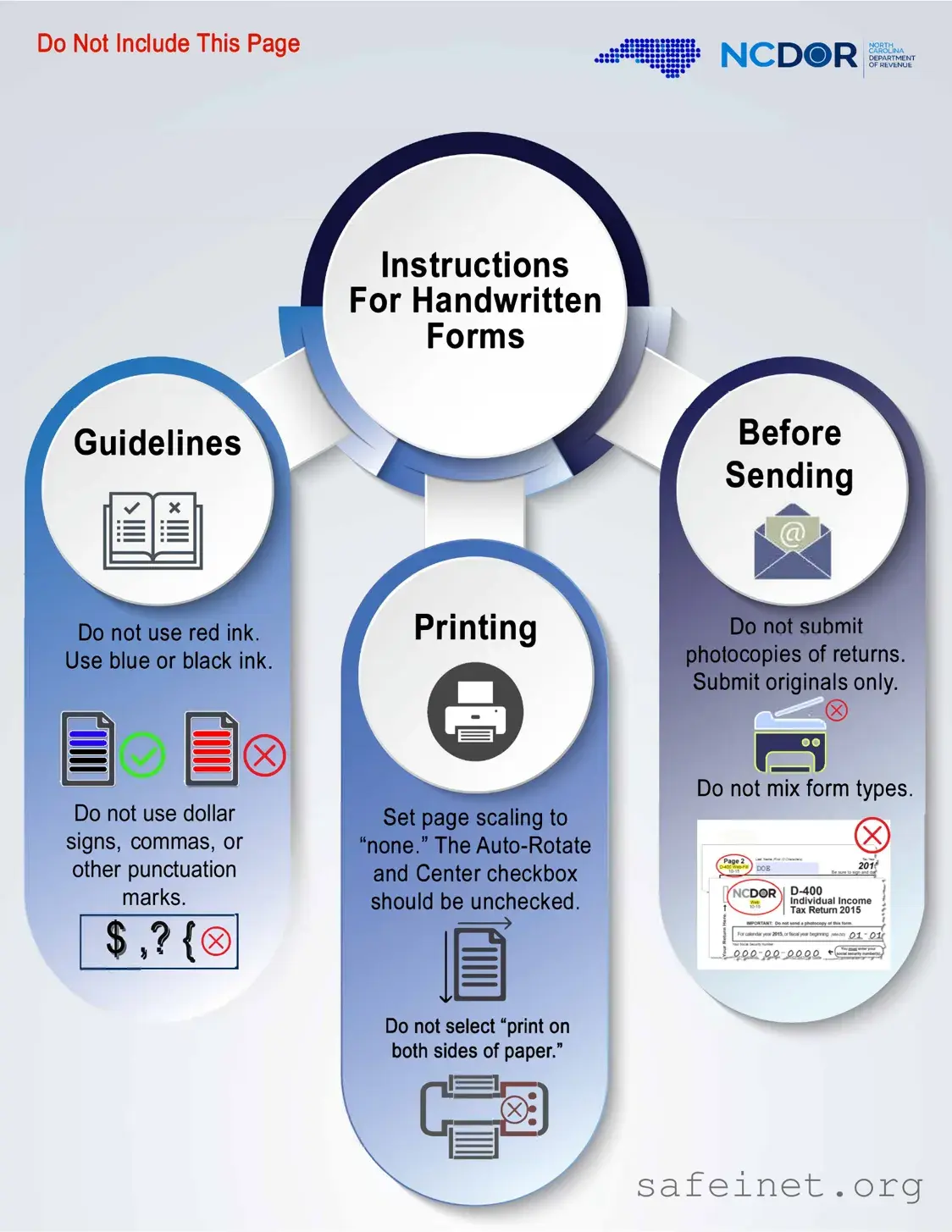
Do not use red ink. Use blue or black ink.
®
Do not use dollar signs, commas, or other punctuation
marks.
, 1 t®I
Printing
Set page scaling to
"none." The
1�
ocopies of returns. Submit originals only.
,,___(8)
Do not mix form types.
Do not select "print on bothc;sides of paper."
;�1
Web
Employee’s Withholding Allowance Certificate
PURPOSE - Complete Form
FORM
FORM
FORM
including the N.C. Child Deduction Amount, N.C. itemized deductions, and N.C. tax credits. However, you may claim fewer allowances than
you are entitled to if you wish to increase the tax withheld during the tax year. If your withholding allowances decrease, you must file a new
When an individual ceases to be “Head of Household” after maintaining the household for the major portion of the year, a new
TWO OR MORE JOBS - If you have more than one job, determine the total number of allowances you are entitled to claim on all jobs using one Form
“Multiple Jobs Table” to determine the additional amount to be withheld on Line 2 of Form
NONWAGE INCOME - If you have a large amount of nonwage income, such as interest or dividends, you should consider making estimated tax
payments using Form
ncdor.gov.
HEAD OF HOUSEHOLD - Generally you may claim “Head of Household” filing status on your tax return only if you are unmarried and pay more than 50% of the costs of keeping up a home for yourself and your dependent(s)
or other qualifying individuals.
SURVIVING SPOUSE - You may claim “Surviving Spouse” filing status only if your spouse died in either of the two preceding tax years and you meet the following requirements:
1.Your home is maintained as the main household of a child or stepchild for whom you can claim a federal exemption; and
2.You were entitled to file a joint return with your spouse in the year of your spouse’s death.
MARRIED TAXPAYERS - For married taxpayers, both spouses must agree as to whether they will complete the
the filing status, “Married Filing Jointly” or “Married Filing Separately.”
•Married taxpayers who complete the worksheet based on the filing status, “Married Filing Jointly” should consider the sum of both spouses’ income, federal and State adjustments to income, and State tax credits to determine the number of allowances.
•Married taxpayers who complete the worksheet based on the filing status, “Married Filing Separately” should consider only his or her portion of income, federal and State adjustments to income, and State tax credits to determine the number of allowances.
All
CAUTION: If you furnish an employer with an Employee’s Withholding Allowance Certificate that contains information which has no reasonable basis and results in a lesser amount of tax being withheld than would have been withheld had you furnished reasonable information, you are subject to a penalty of 50% of the amount not properly withheld.
Cut here and give this certificate to your employer. Keep the top portion for your records.
WebEmployee’s Withholding Allowance Certificate
1.Total number of allowances you are claiming
(Enter zero (0), or the number of allowances from Page 2, Line 17 of the
2. Additional amount, if any, withheld from each pay period (Enter whole dollars)
,.00
Social Security Number
Filing Status |
|
|
Single or Married Filing Separately |
Head of Household |
Married Filing Jointly or Surviving Spouse |
First Name (USE CAPITAL LETTERS FOR YOUR NAME AND ADDRESS) |
M.I. |
|
|
Last Name |
|
|
|
|
|
|
|
|
|
|
|
||||||
|
|
|
|
|
|
|
|
|
|
|
|
|
|
|
|
|
|
|
|
|
|
|
|
|
|
|
|
|
|
|
|
|
|
|
|
|
|
|
|
|
|
|
|
Address |
|
|
|
|
|
|
|
|
|
|
|
|
|
|
|
County (Enter first five letters) |
|||||
|
|
|
|
|
|
|
|
|
|
|
|
|
|
|
|
|
|
|
|||
|
|
|
|
|
|
|
|
|
|
|
|
|
|
|
|
|
|
|
|
|
|
City |
|
|
|
State |
Zip Code (5 Digit) |
|
|
Country (If not U.S.) |
|||||||||||||
|
|
|
|
|
|
|
|
|
|
|
|
|
|
|
|
|
|
|
|
|
|
|
|
|
|
|
|
|
|
|
|
|
|
|
|
|
|
|
|
|
|
|
|
Employee’s Signature |
Date |
I certify, under penalties provided by law, that I am entitled to the number of withholding allowances claimed on Line 1 above.

|
|
|
|
|
PART I |
||
|
Answer all of the following questions for your filing status. |
|
|
|
|
|
|
|
|
|
|
|
|
|
|
|
Single - |
|
|
|
|
|
|
|
1. |
Will your N.C. itemized deductions from Page 3, Schedule 1 exceed $13,249? |
Yes |
o |
No |
o |
|
|
2. |
Will your N.C. Child Deduction Amount from Page 3, Schedule 2 exceed $2,499? |
Yes |
o |
No |
o |
|
|
3. |
Will you have federal adjustments or State deductions from income? |
Yes |
o |
No |
o |
|
|
4. |
Will you be able to claim any N.C. tax credits or tax credit carryovers? |
Yes |
o |
No |
o |
|
|
If you answered “No” to all of the above, STOP HERE and enter ZERO (0) as total allowances on Form |
|
|||||
|
If you answered “Yes” to any of the above, you may choose to go to Page 2, Part II to determine if you qualify for |
|
|||||
|
additional allowances. Otherwise, enter ZERO (0) on Form |
|
|
|
|
|
|
|
|
|
|
|
|
|
|
|
|
|
|
|
|
|
|
|
Married Filing Jointly - |
|
|
|
|
|
|
|
1. |
Will your N.C. itemized deductions from Page 3, Schedule 1 exceed $23,999? |
Yes |
o |
No |
o |
|
|
2. |
Will your N.C. Child Deduction Amount from Page 3, Schedule 2 exceed $2,499? |
Yes |
o |
No |
o |
|
|
3. |
Will you have federal adjustments or State deductions from income? |
Yes |
o |
No |
o |
|
|
4. |
Will you be able to claim any N.C. tax credits or tax credit carryovers? |
Yes |
o |
No |
o |
|
|
5. |
Will your spouse receive combined wages and taxable retirement benefits of |
|
|
|
|
|
|
|
less than $8,250 or only retirement benefits not subject to N.C. income tax? |
Yes |
o |
No |
o |
|
|
If you answered “No” to all of the above, STOP HERE and enter ZERO (0) as total allowances on Form |
|
|||||
|
If you answered “Yes” to any of the above, you may choose to go to Page 2, Part II to determine if you qualify for |
|
|||||
|
additional allowances. Otherwise, enter ZERO (0) on Form |
|
|
|
|
|
|
|
|
|
|
|
|
|
|
|
|
|
|
|
|
|
|
|
Married Filing Separately - |
|
|
|
|
|
|
|
1. |
Will your portion of N.C. itemized deductions from Page 3, Schedule 1 exceed $13,249? |
Yes |
o |
No |
o |
|
|
2. |
Will your N.C. Child Deduction Amount from Page 3, Schedule 2 exceed $2,499? |
Yes |
o |
No |
o |
|
|
3. |
Will you have federal adjustments or State deductions from income? |
Yes |
o |
No |
o |
|
|
4. |
Will you be able to claim any N.C. tax credits or tax credit carryovers? |
Yes |
o |
No |
o |
|
|
If you answered “No” to all of the above, STOP HERE and enter ZERO (0) as total allowances on Form |
|
|||||
|
If you answered “Yes” to any of the above, you may choose to go to Page 2, Part II to determine if you qualify for |
|
|||||
|
additional allowances. Otherwise, enter ZERO (0) on Form |
|
|
|
|
|
|
|
|
|
|
|
|
|
|
|
|
|
|
|
|
|
|
|
Head of Household- |
|
|
|
|
|
|
|
1. |
Will your N.C. itemized deductions from Page 3, Schedule 1 exceed $18,624? |
Yes |
o |
No |
o |
|
|
2. |
Will your N.C. Child Deduction Amount from Page 3, Schedule 2 exceed $2,499? |
Yes |
o |
No |
o |
|
|
3. |
Will you have federal adjustments or State deductions from income? |
Yes |
o |
No |
o |
|
|
4. |
Will you be able to claim any N.C. tax credits or tax credit carryovers? |
Yes |
o |
No |
o |
|
|
If you answered “No” to all of the above, STOP HERE and enter ZERO (0) as total allowances on Form |
|
|||||
|
If you answered “Yes” to any of the above, you may choose to go to Page 2, Part II to determine if you qualify for |
|
|||||
|
additional allowances. Otherwise, enter ZERO (0) on Form |
|
|
|
|
|
|
|
|
|
|
|
|
|
|
Page 1

Surviving Spouse - |
|
|
|
|
|
1. |
Will your N.C. itemized deductions from Page 3, Schedule 1 exceed 23,999? |
Yes |
o |
No |
o |
2. |
Will your N.C. Child Deduction Amount from Page 3, Schedule 2 exceed $2,499? |
Yes |
o |
No |
o |
3. |
Will you have federal adjustments or State deductions from income? |
Yes |
o |
No |
o |
4. |
Will you be able to claim any N.C. tax credits or tax credit carryovers? |
Yes |
o |
No |
o |
If you answered “No” to all of the above, STOP HERE and enter FOUR (4) as total allowances on Form |
|||||
If you answered “Yes” to any of the above, you may choose to go to Part II to determine if you qualify for additional |
|||||
allowances. Otherwise, enter FOUR (4) on Form |
|
|
|
|
|
1. |
Enter your total estimated N.C. itemized deductions from Page 3, Schedule 1 |
..................................................... |
1. |
_______________________$ |
. |
|||
|
|
|
||||||
2. |
Enter the applicable |
{ |
$10,750 if Single |
|
|
|
|
|
|
N.C. standard deduction |
$21,500 if Married Filing Jointly or Surviving Spouse |
|
|
|
|||
|
based on your filing status. |
$10,750 if Married Filing Separately |
|
|
|
_______________________$ |
. |
|
|
|
$16,125 if Head of Household |
|
2. |
||||
3. |
Subtract Line 2 from Line 1. If Line 1 is less than Line 2, enter ZERO (0) |
|
3. |
_______________________$ |
. |
|||
|
|
|||||||
4. |
Enter an estimate of your total N.C. Child Deduction Amount from Page 3, Schedule 2 |
4. |
_______________________$ |
. |
||||
|
||||||||
5. |
Enter an estimate of your total federal adjustments to income and State deductions from |
|
_______________________$ |
. |
||||
|
federal adjusted gross income |
................................................................................................................................ |
|
|
5. |
|||
|
|
|
|
|
|
|||
6. |
Add Lines 3, 4, and 5 |
|
|
|
6. |
_______________________$ |
. |
|
|
|
|
|
|||||
7. |
Enter an estimate of your nonwage income (such as dividends or interest) |
7. |
$_____________________ |
. |
|
|
||
|
|
|
||||||
8.Enter an estimate of your State additions to federal adjusted gross
|
income |
8. |
$ |
. |
|
|
|
|
|
|
|||
9. |
Add Lines 7 and 8 |
|
9. |
$ |
. |
|
|
|
|||||
10. |
Subtract Line 9 from Line 6 (Do not enter less than zero) |
|
10. |
$ |
. |
|
|
|
|||||
11. |
Divide the amount on Line 10 by $2,500 . Round down to whole number |
|
11. |
_______________________ |
||
|
Ex. $3,900 ÷ $2,500 = 1.56 rounds down to 1 |
|
|
|
|
|
12. |
Enter the amount of your estimated N.C. tax credits |
12. |
$ |
. |
|
|
|
|
|
||||
13. |
Divide the amount on Line 12 by $134. Round down to whole number |
|
13. |
_______________________ |
||
|
Ex. $200 ÷ $134 = 1.49 rounds down to 1 |
|
|
|
|
|
14. If filing as Single, Head of Household, or Married Filing Separately, enter zero (0) on this line. If filing as Surviving Spouse, enter 4.
If filing as Married Filing Jointly, enter the appropriate number from either (a), (b), (c), (d), or (e) below.
(a)Your spouse expects to have combined wages and taxable retirement benefits of $0 for N.C. purposes, enter 4. (Taxable retirement benefits do not include: Bailey, Social Security, and Railroad retirement)
(b)Your spouse expects to have combined wages and taxable retirement benefits of more than $0 but less than or equal to $3,250, enter 3.
(c)Your spouse expects to have combined wages and taxable retirement benefits of more than $3,250 but less than or equal to $5,750, enter 2.
(d)Your spouse expects to have combined wages and taxable retirement benefits of more than $5,750 but less than or equal to $8,250, enter 1.
(e)Your spouse expects to have combined wages and taxable retirement benefits of more than
$8,250, enter 0 |
14. |
_______________________ |
|
|
15. Add Lines 11, 13, and 14, and enter the total here |
15. |
_______________________ |
|
|
16. If you completed this worksheet on the basis of Married Filing Jointly, the total number of allowances determined |
|
|
|
|
on Line 15 may be split between you and your spouse, however, you choose. Enter the number of allowances |
|
|
|
|
from Line 15 that your spouse plans to claim |
16. |
_______________________ |
|
|
17. Subtract Line 16 from Line 15 and enter the total number of allowances here and on Line 1 of your |
|
|
|
|
Form |
17. |
_______________________ |
|
|
|
|
|
|
|
|
|
Page |
|
2 |
|
|
|
|
|

Important: If you cannot reasonably estimate the amount to enter in the schedules below, you should enter ZERO (0) on Line 1,
Schedule 1 |
Estimated N.C. Itemized Deductions |
|
|
|
Qualifying mortgage interest |
$ |
. |
|
|
Real estate property taxes |
$ |
. |
|
. |
Total qualifying mortgage interest and real estate property taxes* |
$ |
|||
Charitable Contributions (Same as allowed for federal purposes) |
$ |
. |
||
Medical and Dental Expenses (Same as allowed for federal purposes) |
$ |
. |
||
Total estimated N.C. itemized deductions. Enter on Page 2, Part II, Line 1 |
|
$ |
. |
|
*The sum of your qualified mortgage interest and real estate property taxes may not exceed $20,000. For married taxpayers, the $20,000 limitation applies to the combined total of qualified mortgage interest and real estate property
taxes claimed by both spouses, rather than to each spouse separately.
Schedule 2 |
Estimated N.C. Child Deduction Amount |
A taxpayer who is allowed a federal child tax credit under section 24 of the Internal Revenue Code is allowed a deduction for each dependent child unless adjusted gross income exceeds the threshold amount shown below.
The N.C. Child Deduction Amount can be claimed only for a child who is under 17 years of age on the last day of the year.
|
|
|
Deduction |
|
|
|
No. of |
Amount per |
Estimated |
Filing Status |
Adjusted Gross Income |
Children |
Qualifying Child |
Deduction |
Single |
Up to |
$ |
20,000 |
|
Over |
$ |
20,000 |
|
Over |
$ |
30,000 |
|
Over |
$ |
40,000 |
|
Over |
$ |
50,000 |
|
Over |
$ |
60,000 |
MFJ or SS |
Up to |
$ |
40,000 |
|
Over |
$ |
40,000 |
|
Over |
$ |
60,000 |
|
Over |
$ |
80,000 |
|
Over |
$ |
100,000 |
|
Over |
$ |
120,000 |
HOH |
Up to |
$ |
30,000 |
|
Over |
$ |
30,000 |
|
Over |
$ |
45,000 |
|
Over |
$ |
60,000 |
|
Over |
$ |
75,000 |
|
Over |
$ |
90,000 |
MFS |
Up to |
$ |
20,000 |
|
Over |
$ |
20,000 |
|
Over |
$ |
30,000 |
|
Over |
$ |
40,000 |
|
Over |
$ |
50,000 |
|
Over |
$ |
60,000 |
|
|
|
_____________ |
$ |
2,500 |
______________ |
Up to |
$ |
30,000 |
_____________ |
$ |
2,000 |
______________ |
Up to |
$ |
40,000 |
_____________ |
$ |
1,500 |
______________ |
Up to |
$ |
50,000 |
_____________ |
$ |
1,000 |
______________ |
Up to |
$ |
60,000 |
_____________ |
$ |
500 |
______________ |
|
|
|
_____________ |
$ |
- |
______________ |
|
|
|
_____________ |
$ |
2,500 |
______________ |
Up to |
$ |
60,000 |
_____________ |
$ |
2,000 |
______________ |
Up to |
$ |
80,000 |
_____________ |
$ |
1,500 |
______________ |
Up to |
$ |
100,000 |
_____________ |
$ |
1,000 |
______________ |
Up to |
$ |
120,000 |
_____________ |
$ |
500 |
______________ |
|
|
|
_____________ |
$ |
- |
______________ |
|
|
|
_____________ |
$ |
2,500 |
______________ |
Up to |
$ |
45,000 |
_____________ |
$ |
2,000 |
______________ |
Up to |
$ |
60,000 |
_____________ |
$ |
1,500 |
______________ |
Up to |
$ |
75,000 |
_____________ |
$ |
1,000 |
______________ |
Up to |
$ |
90,000 |
_____________ |
$ |
500 |
______________ |
|
|
|
_____________ |
$ |
- |
______________ |
|
|
|
_____________ |
$ |
2,500 |
______________ |
Up to |
$ |
30,000 |
_____________ |
$ |
2,000 |
______________ |
Up to |
$ |
40,000 |
_____________ |
$ |
1,500 |
______________ |
Up to |
$ |
50,000 |
_____________ |
$ |
1,000 |
______________ |
Up to |
$ |
60,000 |
_____________ |
$ |
500 |
______________ |
|
|
|
_____________ |
$ |
- |
______________ |
Page 3

Multiple Jobs Table
Find the amount of your estimated annual wages from your lowest paying job(s) in the left hand column. Follow across to find the amount of additional tax to be withheld for each pay period. Enter the additional amount to be withheld on Line 2 of your Form
Additional Withholding for Single, Married, or Surviving Spouse with Multiple Jobs
Estimated Annual Wages |
|
Payroll Period |
|
||
At Least |
But Less Than |
Monthly |
Semimonthly |
Biweekly |
Weekly |
|
|
|
|
|
|
0 |
1000 |
2 |
1 |
1 |
1 |
1000 |
2000 |
7 |
3 |
3 |
2 |
|
|
|
|
|
|
2000 |
3000 |
11 |
6 |
5 |
3 |
|
|
|
|
|
|
3000 |
4000 |
16 |
8 |
7 |
4 |
|
|
|
|
|
|
4000 |
5000 |
20 |
10 |
9 |
5 |
|
|
|
|
|
|
5000 |
6000 |
25 |
12 |
11 |
6 |
|
|
|
|
|
|
6000 |
7000 |
29 |
14 |
13 |
7 |
7000 |
8000 |
33 |
17 |
15 |
8 |
|
|
|
|
|
|
8000 |
9000 |
38 |
19 |
17 |
9 |
9000 |
10000 |
42 |
21 |
20 |
10 |
10000 |
10750 |
46 |
23 |
21 |
11 |
|
|
|
|
|
|
10750 |
Unlimited |
48 |
24 |
22 |
11 |
Additional Withholding for Head of Household Filers with Multiple Jobs
Estimated Annual Wages |
|
Payroll Period |
|
||
At Least |
But Less Than |
Monthly |
Semimonthly |
Biweekly |
Weekly |
|
|
|
|
|
|
0 |
1000 |
2 |
1 |
1 |
1 |
|
|
|
|
|
|
1000 |
2000 |
7 |
3 |
3 |
2 |
2000 |
3000 |
11 |
6 |
5 |
3 |
|
|
|
|
|
|
3000 |
4000 |
16 |
8 |
7 |
4 |
4000 |
5000 |
20 |
10 |
9 |
5 |
5000 |
6000 |
25 |
12 |
11 |
6 |
6000 |
7000 |
29 |
14 |
13 |
7 |
7000 |
8000 |
33 |
17 |
15 |
8 |
8000 |
9000 |
38 |
19 |
17 |
9 |
9000 |
10000 |
42 |
21 |
20 |
10 |
10000 |
11000 |
47 |
23 |
22 |
11 |
11000 |
12000 |
51 |
26 |
24 |
12 |
12000 |
13000 |
56 |
28 |
26 |
13 |
13000 |
14000 |
60 |
30 |
28 |
14 |
14000 |
15000 |
65 |
32 |
30 |
15 |
15000 |
16000 |
69 |
35 |
32 |
16 |
16000 |
Unlimited |
71 |
36 |
33 |
16 |
Page 4
| Fact Name | Description | Governing Law |
|---|---|---|
| Purpose | The NC-4 form is used by employees to inform their employers of the number of withholding allowances they are claiming for state income tax purposes. | North Carolina General Statutes § 105-163.1 |
| Form Variants | There are different variants of the NC-4 form, including the NC-4 EZ for those claiming standard deductions and the NC-4 NRA for nonresident aliens. | North Carolina General Statutes § 105-163.1 |
| Allowance Worksheet | Completing the NC-4 Allowance Worksheet helps employees determine their withholding allowances based on various income adjustments and deductions. | North Carolina General Statutes § 105-163.1 |
| Filing Requirements | Employees must submit the NC-4 form to their employers; failure to do so results in the employer withholding taxes at the highest rate. | North Carolina General Statutes § 105-163.1 |
Completing the NC-4 form is essential for ensuring that your employer withholds the correct amount of state income tax from your pay. Follow these steps carefully to fill out the form accurately.
Once completed, submit the NC-4 form to your employer. Retain the top portion for your records. It is important to keep this information updated, especially if your circumstances change throughout the year.
What is the purpose of the NC-4 form?
The NC-4 form, also known as the Employee’s Withholding Allowance Certificate, is designed to help your employer determine the correct amount of North Carolina state income tax to withhold from your paycheck. If you do not submit this form, your employer will automatically withhold taxes based on a "Single" filing status with zero allowances, which may not accurately reflect your tax situation.
Who should use the NC-4 EZ form?
The NC-4 EZ form is a simplified version of the NC-4. You can use this form if you plan to claim either the North Carolina Standard Deduction or the North Carolina Child Deduction Amount, and you do not intend to claim any other deductions or tax credits. This form streamlines the process for those with straightforward tax situations.
What should I do if my withholding allowances change?
If your circumstances change and your withholding allowances decrease, you are required to submit a new NC-4 form to your employer within 10 days of the change. However, if you no longer qualify as "Head of Household," you do not need to file a new form until the next tax year. Keeping your withholding accurate is essential to avoid underpayment or overpayment of taxes.
How do I handle multiple jobs when filling out the NC-4?
If you have more than one job, it’s best to determine your total number of allowances using one NC-4 Allowance Worksheet. For the most accurate withholding, claim all your allowances on the NC-4 for your highest-paying job and claim zero allowances on the others. Additionally, refer to the “Multiple Jobs Table” to adjust your withholding accordingly.
What happens if I do not provide accurate information on the NC-4?
Providing inaccurate information on your NC-4 can lead to significant penalties. If you submit a form that results in less tax being withheld than should be, you may face a penalty of 50% of the amount that was not properly withheld. It’s crucial to ensure that the information you provide is correct and based on your actual tax situation.
Can married couples file separately using the NC-4?
Yes, married taxpayers can choose to file separately using the NC-4. However, both spouses must agree on the filing status they will use when completing the NC-4 Allowance Worksheet. Each spouse should consider their individual income and deductions to determine the number of allowances they can claim, ensuring that they accurately reflect their tax situation.
Using the Wrong Ink Color: It's crucial to use blue or black ink only. Using red ink can lead to confusion and may cause your form to be rejected.
Including Punctuation: Avoid using dollar signs, commas, or any other punctuation marks. This can result in misinterpretation of the information you provide.
Incorrect Page Scaling: Ensure that page scaling is set to "none." If not, the form may not print correctly, which could lead to processing delays.
Mixing Form Types: Do not mix different types of forms. Each form must be submitted separately to ensure accurate processing.
Failing to Complete the Allowance Worksheet: This worksheet is essential for determining the correct number of allowances. Neglecting it can lead to incorrect withholding.
Claiming More Allowances Than Eligible: Ensure that the number of allowances claimed is accurate. Claiming more than you are entitled to can result in penalties.
Not Updating the Form After Life Changes: If your circumstances change, such as a change in marital status or job, you must submit a new NC-4 within 10 days.
Ignoring Nonwage Income: If you have significant nonwage income, consider making estimated tax payments. Failing to do so could lead to underpayment penalties.
Incorrectly Identifying Filing Status: Ensure that you accurately select your filing status. Misidentifying this can affect your tax calculations.
Not Signing the Form: Your signature is a declaration of the accuracy of the information provided. Failing to sign can lead to the form being considered invalid.
The NC-4 form is essential for determining the correct amount of state income tax withheld from an employee's paycheck in North Carolina. Several other forms and documents are often used in conjunction with the NC-4 to ensure accurate tax reporting and compliance. Below is a list of these forms, each serving a specific purpose in the tax process.
Understanding these forms and their purposes can help ensure that you are compliant with tax regulations and that your withholding amounts are accurate. It is advisable to consult with a tax professional if you have questions about which forms apply to your specific situation.
The NC-4 form, known as the Employee’s Withholding Allowance Certificate, shares similarities with the W-4 form used for federal income tax withholding. Both documents allow employees to indicate the number of allowances they wish to claim, which directly affects how much tax is withheld from their paychecks. By completing these forms accurately, individuals can ensure that their tax withholding aligns with their financial situation, preventing both underpayment and overpayment of taxes. While the W-4 is federal, the NC-4 specifically caters to North Carolina state income tax, emphasizing the importance of understanding both federal and state requirements.
Another document similar to the NC-4 is the NC-4 EZ form. This simplified version is designed for individuals who plan to claim only the North Carolina Standard Deduction or the N.C. Child Deduction Amount, without any additional deductions or tax credits. Like the NC-4, the NC-4 EZ helps determine the correct amount of state income tax withholding. The key difference lies in its streamlined nature, making it easier for eligible taxpayers to complete while still ensuring proper withholding for state taxes.
The NC-4 NRA form is tailored for nonresident aliens, offering a specific option for those who do not meet the criteria for U.S. citizens or residents. Similar to the standard NC-4, it allows nonresident aliens to declare their withholding allowances, but it also addresses unique tax considerations that apply to their situation. This form ensures that nonresident aliens comply with North Carolina tax laws while accurately reflecting their tax obligations based on their residency status.
The IRS Form 1040, the U.S. Individual Income Tax Return, is another document that relates to the NC-4. While the NC-4 determines withholding allowances during the tax year, the 1040 is filed annually to report total income, deductions, and tax liability. Understanding how the allowances claimed on the NC-4 impact the overall tax situation reported on the 1040 is crucial for effective tax planning. Both forms work together to ensure taxpayers are meeting their obligations while optimizing their tax outcomes.
Lastly, the NC-40 form is relevant for individuals with significant nonwage income, such as dividends or interest. This form allows taxpayers to make estimated tax payments to avoid underpayment penalties. While the NC-4 focuses on withholding allowances for regular wages, the NC-40 addresses additional tax responsibilities that may arise from other income sources. Together, these forms provide a comprehensive approach to managing state tax obligations throughout the year.
When filling out the NC-4 form, it’s important to follow certain guidelines to ensure accuracy and compliance. Here’s a list of things you should and shouldn't do:
Understanding the NC-4 form can be crucial for ensuring accurate state income tax withholding. However, several misconceptions often lead to confusion. Here are four common misunderstandings:
This is not entirely true. While the NC-4 is used to claim withholding allowances, it is also important for employees who want to ensure that the correct amount of state income tax is withheld from their paychecks. If you do not submit an NC-4, your employer will withhold taxes as if you are single with zero allowances.
This is incorrect. You should submit a new NC-4 whenever your circumstances change, such as a change in your filing status or the number of allowances you wish to claim. Additionally, if your withholding allowances decrease, you must file a new NC-4 within ten days of that change.
Not all employees are required to use this form. For example, nonresident aliens must use the NC-4 NRA form instead. Understanding your specific situation is essential to determine which form is appropriate for you.
This belief can lead to unexpected tax liabilities. The NC-4 helps you manage how much tax is withheld from your paycheck, which can affect your overall tax situation. By accurately completing the form, you can avoid underpayment penalties or receiving a large tax bill at the end of the year.
Filling out the NC-4 form accurately is essential for ensuring the correct amount of state income tax is withheld from your paycheck. Here are some key takeaways to consider:
By following these guidelines, you can help ensure that your tax withholding aligns with your financial situation, minimizing surprises during tax season.