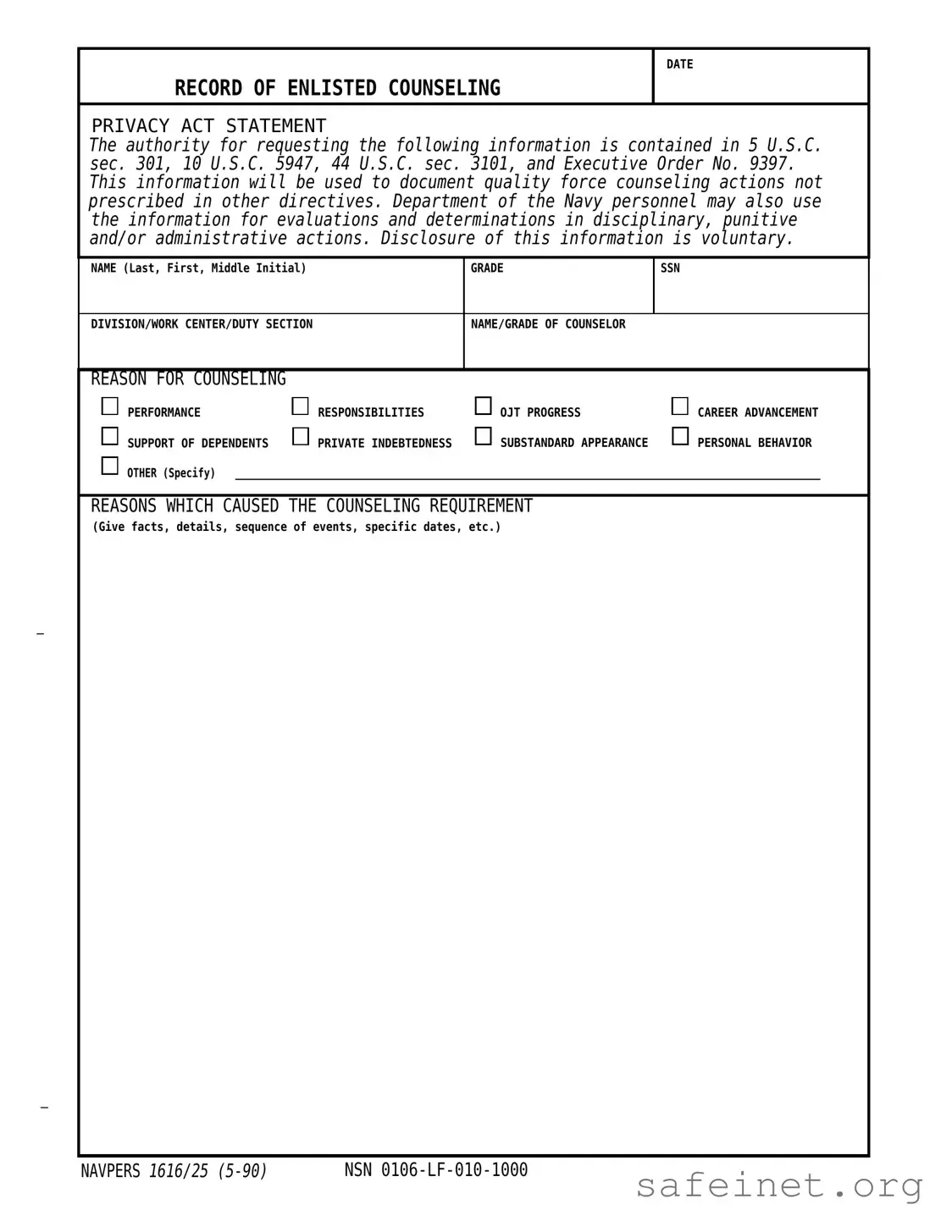
The NAVPERS 1616/25 form serves as a crucial tool for documenting counseling sessions within the Department of the Navy. This form captures essential information related to enlisted personnel, including the date of the counseling session, the counselor's name and grade, and the specific reasons for counseling. It is designed to address various performance-related issues, such as on-the-job training progress, career advancement, and personal behavior. The form also includes a section for detailing the circumstances that necessitated the counseling, allowing for a comprehensive account of the events leading to the session. Furthermore, it emphasizes the collaborative development of a plan between the member and the counselor aimed at fostering superior performance or resolving identified problems. Notably, the completion of this form is voluntary, but the information collected can play a significant role in evaluations and administrative actions. Understanding the NAVPERS 1616/25 form is essential for both counselors and enlisted personnel, as it lays the groundwork for constructive feedback and professional growth.

-
-
DATE
RECORD OF ENLISTED COUNSELING
PRIVACY ACT STATEMENT
The authority for requesting the following information is contained in 5 U.S.C. sec. 301, 10 U.S.C. 5947, 44 U.S.C. sec. 3101, and Executive Order No. 9397. This information will be used to document quality force counseling actions not prescribed in other directives. Department of the Navy personnel may also use the information for evaluations and determinations in disciplinary, punitive and/or administrative actions. Disclosure of this information is voluntary.
NAME (Last, First, Middle Initial) |
|
GRADE |
SSN |
|||||||||||||
|
|
|
|
|
|
|
|
|
|
|
|
|
|
|
|
|
DIVISION/WORK CENTER/DUTY SECTION |
|
NAME/GRADE OF COUNSELOR |
|
|
|
|
|
|
||||||||
|
|
|
|
|
|
|
|
|
|
|
|
|
|
|
|
|
REASON FOR COUNSELING |
|
|
|
|
|
|
|
|
|
|
||||||
|
|
PERFORMANCE |
|
|
|
RESPONSIBILITIES |
|
|
OJT PROGRESS |
|
|
|
|
CAREER ADVANCEMENT |
||
|
|
|
|
|
|
|
|
|||||||||
|
|
SUPPORT OF DEPENDENTS |
|
|
PRIVATE INDEBTEDNESS |
|
|
SUBSTANDARD APPEARANCE |
|
|
|
|
PERSONAL BEHAVIOR |
|||
|
|
|
|
|
|
|
||||||||||
|
|
OTHER (Specify) |
|
|
|
|
|
|
|
|
|
|
|
|||
|
|
|
|
|
|
|
|
|
|
|
|
|||||
REASONS WHICH CAUSED THE COUNSELING REQUIREMENT
(Give facts, details, sequence of events, specific dates, etc.)
NAVPERS 1616/25 |
NSN |

PLAN (DEVELOPED BY THE MEMBER AND COUNSELOR) TO CONTINUE SUPERIOR PERFORMANCE OR TO OVERCOME PROBLEM(S) AND PRECLUDE FUTURE INVOLVEMENT
(Outline all resolutions discussed and indicate which actions the member has personally elected to pursue.)
Signature of Counselor/Date |
Signature of Member/Date |
I do/do not desire to make a statement.
Signature of Member/Date
-
NAVPERS 1616/25 |
• U.S. GPO: |
| Fact Name | Description |
|---|---|
| Purpose | The NAVPERS 1616/25 form is used to document quality force counseling actions for enlisted personnel in the Navy. |
| Legal Authority | This form is authorized under several laws, including 5 U.S.C. sec. 301, 10 U.S.C. 5947, and 44 U.S.C. sec. 3101, as well as Executive Order No. 9397. |
| Voluntary Disclosure | Providing information on this form is voluntary, but it may affect evaluations and disciplinary actions. |
| Information Collected | The form collects personal details such as name, grade, Social Security Number (SSN), and the reason for counseling. |
| Counselor's Role | The counselor’s name and grade are recorded, highlighting their responsibility in the counseling process. |
| Reasons for Counseling | Various reasons can lead to counseling, including performance issues, personal behavior, and career advancement concerns. |
| Action Plan | The form requires an action plan developed collaboratively by the member and counselor to address identified issues. |
| Signature Requirement | Both the counselor and the member must sign and date the form, indicating their acknowledgment of the counseling session. |
Completing the NAVPERS 1616/25 form is an essential step in documenting counseling actions for enlisted personnel. This form captures vital information related to performance, behavior, and development. Follow these steps to ensure that you fill it out accurately and completely.
After completing the form, review it for accuracy before submitting it to the appropriate personnel. This documentation will play a crucial role in your ongoing development and evaluation within the Navy.
What is the NAVPERS 1616/25 form?
The NAVPERS 1616/25 form is used by the Department of the Navy to document counseling sessions for enlisted personnel. It serves as a record of various counseling actions related to performance, behavior, and other areas of concern. This form helps ensure that service members receive the support they need to improve or maintain their performance.
What information is required on the form?
The form requires several key pieces of information, including the member's name, grade, social security number, division or work center, and the name and grade of the counselor. Additionally, it asks for the reason for counseling, which could range from performance responsibilities to personal behavior. Detailed descriptions of the events leading to the counseling are also necessary.
Who can use the NAVPERS 1616/25 form?
This form is intended for use by Department of the Navy personnel. Counselors and members can fill it out together during a counseling session. It is designed to document actions not prescribed in other directives, making it a flexible tool for various counseling needs.
Is the information on the NAVPERS 1616/25 form confidential?
Yes, the information collected on this form is subject to the Privacy Act. It is intended to protect the privacy of service members while allowing the Navy to use the information for evaluations and disciplinary actions when necessary. Disclosure of information is voluntary, but it is important for accurate documentation.
What are some common reasons for counseling documented on the form?
Common reasons for counseling include performance responsibilities, on-the-job training progress, career advancement, support of dependents, personal indebtedness, substandard appearance, and personal behavior. Each case is unique, and the form allows for specific details to be outlined.
What should be included in the "Reasons Which Caused the Counseling Requirement" section?
This section should provide a clear and detailed account of the events that led to the counseling. Include specific facts, a sequence of events, and relevant dates. The more detailed the information, the better it will support the counseling session and any subsequent actions.
How is a plan for improvement developed on the form?
The plan for improvement is developed collaboratively between the member and the counselor. It outlines the steps the member will take to continue superior performance or address any problems. This section should include actionable resolutions discussed during the counseling session, highlighting the member's commitment to improvement.
What is the significance of the signatures on the form?
The signatures of both the counselor and the member indicate that the counseling session has taken place and that both parties agree on the content of the discussion. The member also has the option to indicate whether they wish to make a statement, which adds another layer of documentation to the counseling process.
Can the NAVPERS 1616/25 form be used for disciplinary actions?
Yes, the information documented on the NAVPERS 1616/25 form can be utilized in disciplinary, punitive, or administrative actions if necessary. It serves as a record of counseling that may be referenced in future evaluations or decisions regarding the member's conduct and performance.
Incorrect Personal Information: Failing to accurately fill in the name, grade, or social security number can lead to significant delays in processing.
Omitting the Counselor's Information: Not providing the name and grade of the counselor can create confusion regarding accountability and responsibility.
Insufficient Details on Counseling Reasons: Providing vague descriptions instead of specific facts and dates may hinder the effectiveness of the counseling process.
Neglecting to Sign: Forgetting to sign the form can result in it being deemed incomplete, which may lead to further complications.
Failure to Include a Plan: Not outlining a plan for improvement or resolution can undermine the purpose of the counseling session.
Ignoring Privacy Act Statement: Not acknowledging the Privacy Act statement can lead to misunderstandings about the use of the provided information.
Inaccurate Reason for Counseling: Selecting the wrong reason for counseling can misrepresent the situation and affect future evaluations.
Leaving Sections Blank: Omitting any section of the form can create gaps in documentation, making it difficult to track progress or issues.
Not Reviewing Before Submission: Failing to double-check the completed form for errors can lead to unnecessary complications and delays.
The NAVPERS 1616/25 form is used to document counseling sessions for enlisted personnel in the Navy. It helps track performance issues, career advancement, and personal behavior among other areas. Alongside this form, several other documents are commonly utilized to provide a comprehensive view of a service member's performance and conduct. Below is a list of related forms and documents.
These documents, when used in conjunction with the NAVPERS 1616/25 form, help create a complete picture of a service member's performance and conduct. Together, they support effective counseling and evaluation processes within the Navy.
The NAVPERS 1616/25 form is similar to the Employee Performance Review form, commonly used in various workplaces. Both documents aim to assess an individual's performance and provide constructive feedback. They typically include sections for outlining strengths, areas for improvement, and future goals. While the NAVPERS 1616/25 focuses specifically on military personnel and their unique counseling needs, the Employee Performance Review is broader and applicable to civilian employees across different sectors.
Another document that shares similarities is the Counseling Statement form. This form is used in both military and civilian contexts to formally document counseling sessions. Like the NAVPERS 1616/25, it records details about the counseling session, including the reason for the meeting and the actions agreed upon. The Counseling Statement emphasizes the importance of addressing performance issues and developing a plan for improvement, paralleling the objectives of the NAVPERS 1616/25.
The Individual Development Plan (IDP) is another document akin to the NAVPERS 1616/25. An IDP outlines a member's career goals and the steps necessary to achieve them. Both documents encourage proactive planning for personal and professional development. The NAVPERS 1616/25 may include elements of an IDP, particularly when discussing career advancement and support for dependents, emphasizing the importance of a structured approach to career growth.
The Performance Improvement Plan (PIP) also bears resemblance to the NAVPERS 1616/25. A PIP is designed to help employees who are struggling to meet performance standards. It outlines specific performance issues, expectations for improvement, and timelines for achieving these goals. Similarly, the NAVPERS 1616/25 documents counseling sessions aimed at improving performance and preventing future issues, making both forms essential tools for fostering accountability and growth.
Another comparable document is the Disciplinary Action form. This form is used to document any disciplinary measures taken against an employee or service member. While the NAVPERS 1616/25 may address performance issues that could lead to disciplinary actions, it focuses on counseling and improvement rather than punishment. Both forms emphasize the need for documentation in managing personnel issues, but the NAVPERS 1616/25 adopts a more supportive tone.
Lastly, the Mentorship Agreement form is similar in that it fosters development through guidance and support. This form outlines the relationship between a mentor and a mentee, detailing goals and expectations. The NAVPERS 1616/25 also encourages a collaborative approach to personal development, as it involves both the counselor and the member in creating a plan for improvement. Both documents highlight the importance of mentorship and support in achieving personal and professional success.
When filling out the Navpers 1616 25 form, it's important to follow certain guidelines. Here’s a list of things you should and shouldn't do:
Understanding the Navpers 1616 25 form is crucial for those involved in the Navy's counseling process. However, several misconceptions often arise regarding its purpose and use. Here are six common misconceptions:
Clarifying these misconceptions can help ensure that all parties understand the purpose and use of the Navpers 1616 25 form effectively.
Filling out and using the NAVPERS 1616/25 form is an important process for documenting counseling actions within the Department of the Navy. Here are some key takeaways to keep in mind:
By following these takeaways, you can ensure that the NAVPERS 1616/25 form is completed effectively, supporting both your professional development and the standards of the Navy.