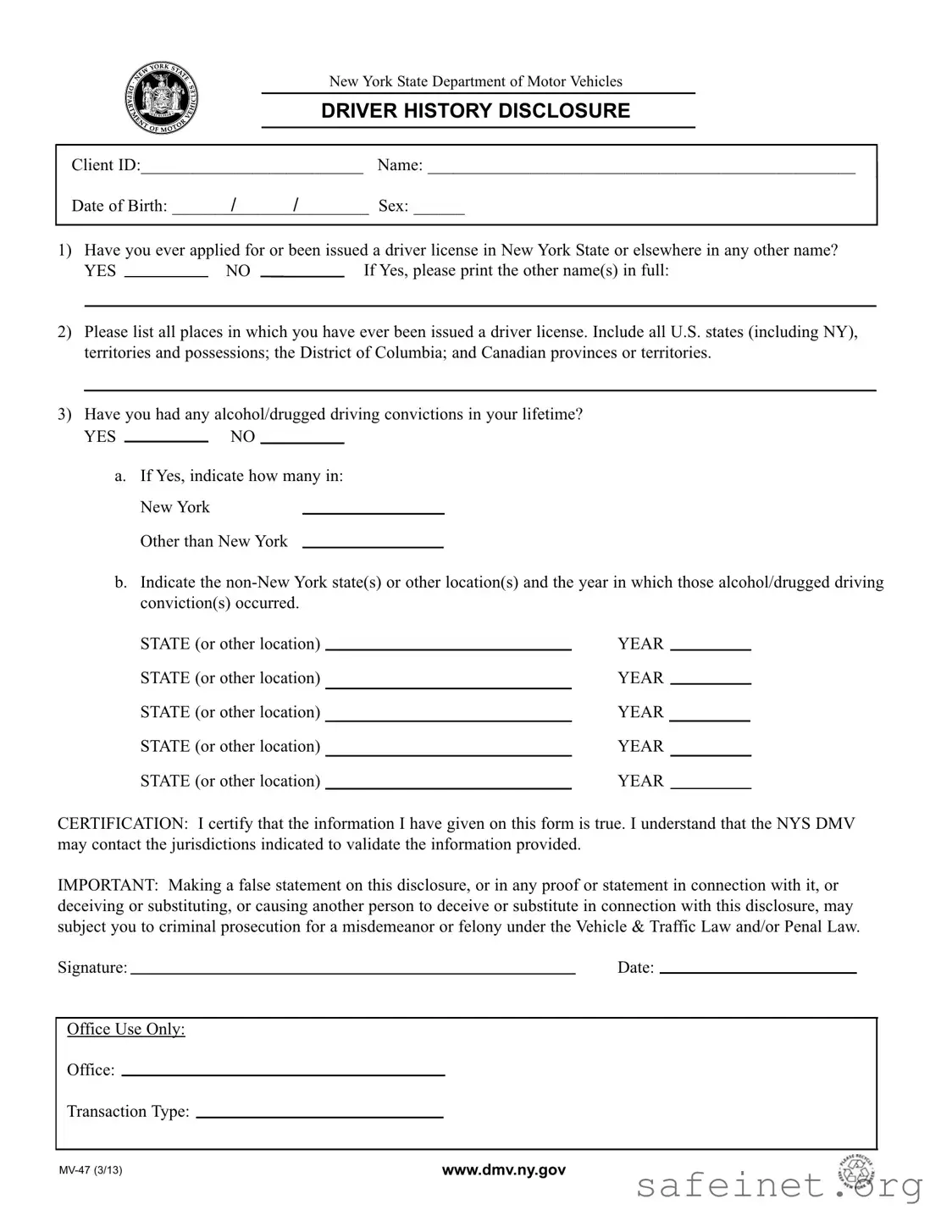
The MV-47 form, an essential document from the New York State Department of Motor Vehicles, plays a critical role in obtaining a comprehensive driver history disclosure. This form serves as a tool for individuals to provide vital information regarding their driving history, ensuring that the DMV can accurately assess their eligibility for a driver’s license. When completing the MV-47, applicants must disclose whether they have ever applied for or been issued a driver license under any other name. Additionally, the form requests a detailed list of all jurisdictions, including U.S. states, territories, and Canadian provinces, where a driver license has been issued. One of the key aspects of the MV-47 is its focus on any past alcohol or drug-related driving convictions. Applicants are required to indicate the number of such convictions they have faced, both in New York and elsewhere, along with the specific locations and years of these incidents. The certification section at the end of the form emphasizes the importance of honesty, as providing false information can lead to serious legal consequences. Overall, the MV-47 is not just a form; it is a crucial step in ensuring that driving records are accurate and up to date, thereby promoting safer roads for everyone.

NewYork State Department of MotorVehicles
DRIVER HISTORY DISCLOSURE
Client ID:__________________________ |
Name: __________________________________________________ |
|||
Date of Birth: |
/ |
/ |
Sex: ______ |
|
|
|
|||
1) Have you ever applied for or been issued a driver license in NewYork State or elsewhere in any other name? |
||||
YES |
|
NO |
|
IfYes, please print the other name(s) in full: |
2)Please list all places in which you have ever been issued a driver license. Include all U.S. states (including NY), territories and possessions; the District of Columbia; and Canadian provinces or territories.
3)Have you had any alcohol/drugged driving convictions in your lifetime?
YES NO
a.IfYes, indicate how many in: NewYork
Other than NewYork
b.Indicate the
STATE (or other location) |
|
|
YEAR |
STATE (or other location) |
|
|
YEAR |
STATE (or other location) |
|
|
YEAR |
STATE (or other location) |
|
|
YEAR |
STATE (or other location) |
|
|
YEAR |
CERTIFICATION: I certify that the information I have given on this form is true. I understand that the NYS DMV may contact the jurisdictions indicated to validate the information provided.
IMPORTANT: Making a false statement on this disclosure, or in any proof or statement in connection with it, or deceiving or substituting, or causing another person to deceive or substitute in connection with this disclosure, may subject you to criminal prosecution for a misdemeanor or felony under theVehicle &Traffic Law and/or Penal Law.
Signature:Date:
Office Use Only:
Office:
TransactionType:
www.dmv.ny.gov |
| Fact Name | Details |
|---|---|
| Purpose of Form | The MV-47 form is used to disclose a driver's history, including past licenses and any alcohol or drug-related convictions. |
| Governing Law | This form is governed by the New York State Vehicle and Traffic Law. |
| Client Information | The form requires personal details such as Client ID, name, date of birth, and sex. |
| Certification Requirement | Applicants must certify that the information provided is true, understanding that false statements can lead to criminal prosecution. |
| Contact with Jurisdictions | The New York State DMV may contact other jurisdictions to validate the information submitted on the form. |
Completing the MV-47 form is a straightforward process that requires accurate personal information and a few specific details regarding your driving history. After filling out this form, it will be submitted to the appropriate department for processing. Ensure that all information is correct to avoid any delays.
What is the purpose of the MV-47 form?
The MV-47 form, also known as the Driver History Disclosure form, is used by the New York State Department of Motor Vehicles (DMV) to gather information about an individual's driving history. This form is essential for those applying for a driver’s license or for those who need to disclose their driving record for various reasons. By completing this form, individuals provide details about any previous licenses held, any name changes, and any alcohol or drug-related driving convictions. The DMV uses this information to assess eligibility for a driver’s license and to ensure public safety on the roads.
What information do I need to provide on the MV-47 form?
When filling out the MV-47 form, you will need to provide several key pieces of information. First, you must include your full name, date of birth, and sex. The form also asks if you have ever applied for or been issued a driver’s license under any other name. If applicable, you will need to list those names. Additionally, you must detail all locations where you have been issued a driver’s license, including all U.S. states, territories, and Canadian provinces. Lastly, you will need to disclose any alcohol or drugged driving convictions, specifying the number and locations of those incidents, if any.
What happens if I provide false information on the MV-47 form?
Providing false information on the MV-47 form can have serious consequences. The form includes a certification section where you affirm that the information provided is true. If the DMV discovers that you have made a false statement, you could face criminal prosecution, which may result in misdemeanor or felony charges under the Vehicle and Traffic Law or the Penal Law. It is crucial to be honest and thorough when completing this form to avoid legal repercussions.
How does the DMV verify the information provided on the MV-47 form?
The New York State DMV may contact the jurisdictions you listed on the MV-47 form to validate the information you provided. This verification process helps ensure that the records are accurate and up-to-date. If discrepancies arise during this verification, the DMV may take further action, which could include denying your application for a driver’s license or imposing penalties. Therefore, it is important to provide accurate information and to be prepared for possible follow-up inquiries from the DMV.
Incomplete Client ID: Failing to provide a Client ID can delay processing. Ensure this field is filled out completely.
Missing Name Information: Not writing the full name as it appears on legal documents can lead to discrepancies. Always double-check for accuracy.
Incorrect Date of Birth: Entering the wrong date can result in rejection. Verify that the format is correct and matches official records.
Overlooking Previous Licenses: Forgetting to list all places where a driver license was issued may lead to complications. Include every U.S. state and territory, as well as Canadian provinces.
Inaccurate Conviction Reporting: Misreporting the number of alcohol/drugged driving convictions can have serious consequences. Be honest and thorough when providing this information.
Neglecting the Certification Statement: Failing to sign and date the form can result in automatic rejection. Always ensure the certification section is completed.
The MV-47 form is essential for disclosing driver history in New York State. However, there are several other forms and documents that may accompany it in various situations related to driver licensing and vehicle registration. Below is a list of these documents, along with a brief description of each.
Each of these forms plays a critical role in the process of obtaining or maintaining a driver license or vehicle registration in New York State. Ensure you have the correct documents ready when dealing with the DMV to facilitate a smoother experience.
The MV-47 form, used for driver history disclosure in New York State, shares similarities with the Form DS-11, which is the application for a U.S. passport. Both documents require personal identification details, including name and date of birth, and ask applicants to disclose any previous names. Just as the MV-47 inquires about past driver licenses issued in other states, the DS-11 requires applicants to provide information about any previous passports. Both forms emphasize the importance of providing accurate information and include a certification statement, underscoring the legal implications of false declarations.
Another document that resembles the MV-47 is the Form I-9, Employment Eligibility Verification. This form is essential for confirming an individual's identity and employment eligibility in the United States. Similar to the MV-47, the Form I-9 requires individuals to disclose their full name and date of birth. It also includes sections where applicants must list previous names or aliases. Both forms serve to validate the identity of the applicant and ensure compliance with legal requirements, reinforcing the importance of truthful disclosures.
The Form 1040, used for individual income tax returns, also bears similarities to the MV-47. Both documents require personal information, including name and Social Security number, and demand accuracy in reporting. While the MV-47 focuses on driving history, the Form 1040 requires information about income sources. Each form carries legal consequences for false statements, thereby highlighting the significance of honesty in official documentation.
Another comparable document is the Form N-400, Application for Naturalization. This form is used by lawful permanent residents seeking U.S. citizenship. Like the MV-47, the N-400 requires personal details such as name and date of birth. Additionally, both forms ask about any previous names used. The N-400 also includes questions regarding the applicant’s history, similar to the MV-47’s inquiries about past driving offenses. Both forms emphasize the need for accurate and complete information, as misrepresentations can lead to serious legal repercussions.
The Form W-4, Employee's Withholding Certificate, is another document that shares features with the MV-47. Both forms require personal identification and necessitate accurate information to ensure compliance with regulations. The MV-47 focuses on driving history, while the W-4 addresses tax withholding preferences. However, both documents underscore the importance of honesty and accuracy, as incorrect information can lead to significant consequences, whether in driving privileges or tax obligations.
Similar to the MV-47, the Form 5500, Annual Return/Report of Employee Benefit Plan, requires detailed information about an individual or entity. While the MV-47 centers on driving history, the Form 5500 focuses on employee benefits. Both documents require accurate reporting and include sections for disclosing previous names. Each form carries legal responsibilities, emphasizing the need for truthful disclosures to avoid penalties or legal issues.
The Form 990, Return of Organization Exempt from Income Tax, also resembles the MV-47 in its requirement for detailed personal and organizational information. While the MV-47 pertains to individual driving history, the Form 990 focuses on financial transparency for nonprofits. Both forms require accuracy in reporting and include sections for disclosing prior names or aliases. Each document serves a specific regulatory purpose, highlighting the importance of compliance with legal standards.
Another document that aligns with the MV-47 is the Form 1065, U.S. Return of Partnership Income. This form requires detailed information about partnerships and their partners. Similar to the MV-47, it necessitates accurate reporting of names and other identifying information. Both forms are critical for compliance with legal requirements, and misrepresentation can lead to serious consequences, reinforcing the need for honesty in all disclosures.
Lastly, the Form 1099, Miscellaneous Income, shares characteristics with the MV-47. Both documents require personal information and demand accuracy in reporting. While the MV-47 focuses on driving history, the Form 1099 addresses income received outside of traditional employment. Each form emphasizes the importance of providing truthful information, as inaccuracies can lead to legal ramifications, whether concerning driving privileges or tax obligations.
When filling out the MV-47 form, it is crucial to ensure accuracy and completeness. Here are six important dos and don’ts to keep in mind:
Following these guidelines will help ensure a smooth processing of your application.
Understanding the Mv 47 form is crucial for anyone who needs to provide their driver history disclosure to the New York State Department of Motor Vehicles. However, several misconceptions can lead to confusion. Here are six common misconceptions about the Mv 47 form, along with clarifications:
This form is applicable to anyone who has ever held a driver license in New York State or elsewhere. It’s important for individuals from other states or countries to fill it out accurately as well.
Every question on the Mv 47 form must be answered. Omitting information can lead to delays or complications in processing your application.
All alcohol or drugged driving convictions, regardless of where they occurred, must be disclosed. This includes convictions from other states and countries.
A signature is necessary to certify that the information provided is true. Without it, the form may be considered incomplete.
Making false statements can lead to serious consequences, including criminal prosecution. It is essential to be truthful and thorough when completing the form.
This form may be required for various transactions, including renewals and changes to your driver record. Always check if it’s necessary for your specific situation.
Being aware of these misconceptions can help ensure that you complete the Mv 47 form correctly and avoid potential legal issues. Take the time to review your information carefully before submission.
When filling out the MV-47 form, it is important to keep a few key points in mind. This form is used for disclosing your driver history to the New York State Department of Motor Vehicles. Below are some essential takeaways:
Taking these steps seriously will help ensure that your application process goes smoothly and that you remain compliant with the law.