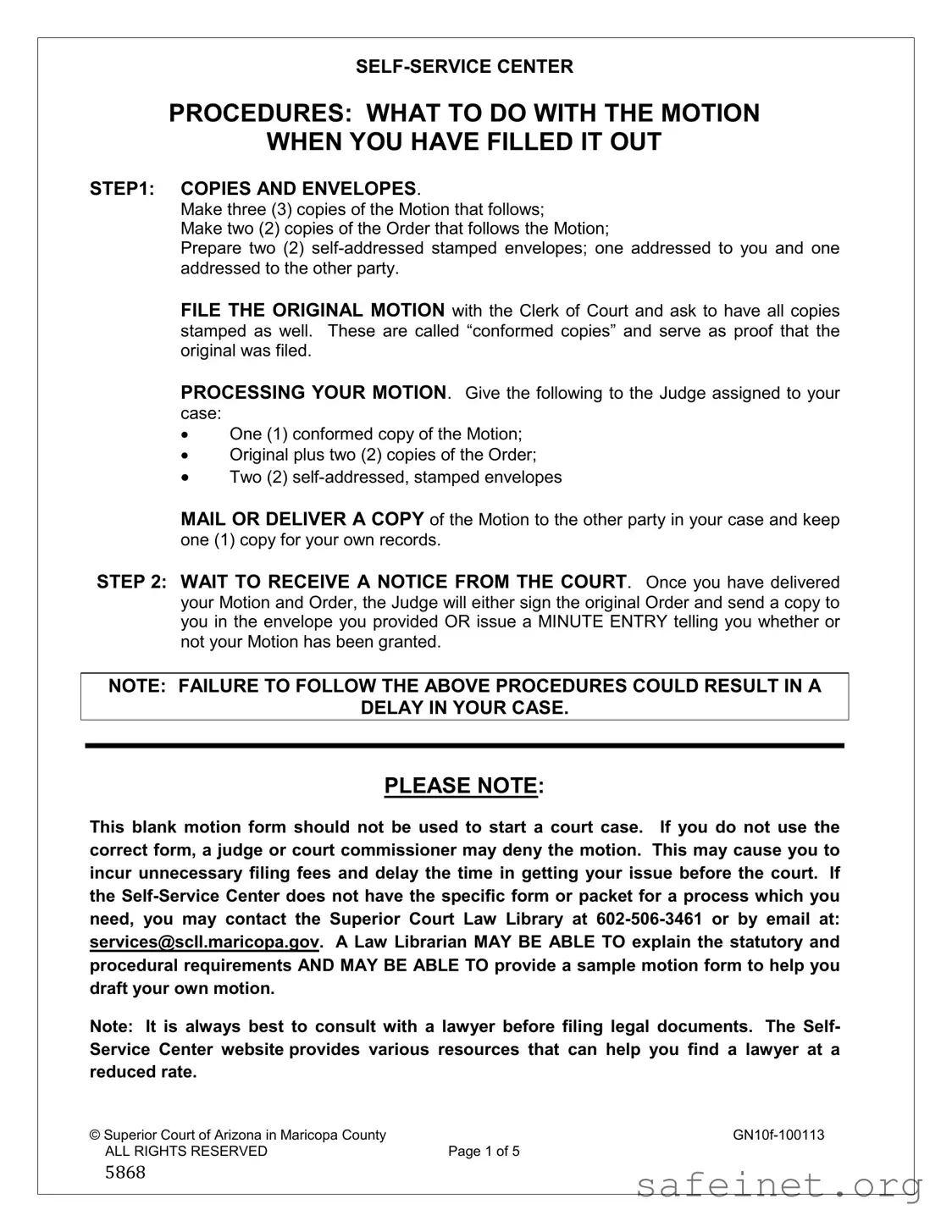
Filing a Motion in Maricopa County is a crucial step in navigating the legal system, whether you are representing yourself or working with an attorney. This form serves as a formal request to the court, asking for a specific ruling or order regarding your case. To initiate this process, you must first prepare multiple copies of your Motion and the accompanying Order, ensuring that all necessary parties receive the appropriate documentation. The procedure involves filing the original Motion with the Clerk of Court, who will stamp your copies to confirm their submission. Additionally, you will need to provide self-addressed stamped envelopes for the court to return the signed Order or a notification regarding your request. After submitting your Motion, patience is key; you will await a response from the Judge, who will either sign your Order or issue a “minute entry” detailing the outcome of your request. It is important to follow these steps meticulously, as any oversight could delay your case or lead to unnecessary complications. Remember, while the Self-Service Center offers valuable resources, consulting with a lawyer can provide clarity and guidance tailored to your specific situation.

PROCEDURES: WHAT TO DO WITH THE MOTION
WHEN YOU HAVE FILLED IT OUT
STEP1: COPIES AND ENVELOPES.
Make three (3) copies of the Motion that follows;
Make two (2) copies of the Order that follows the Motion;
Prepare two (2)
FILE THE ORIGINAL MOTION with the Clerk of Court and ask to have all copies stamped as well. These are called “conformed copies” and serve as proof that the original was filed.
PROCESSING YOUR MOTION. Give the following to the Judge assigned to your case:
•One (1) conformed copy of the Motion;
•Original plus two (2) copies of the Order;
•Two (2)
MAIL OR DELIVER A COPY of the Motion to the other party in your case and keep one (1) copy for your own records.
STEP 2: WAIT TO RECEIVE A NOTICE FROM THE COURT. Once you have delivered your Motion and Order, the Judge will either sign the original Order and send a copy to you in the envelope you provided OR issue a MINUTE ENTRY telling you whether or not your Motion has been granted.
NOTE: FAILURE TO FOLLOW THE ABOVE PROCEDURES COULD RESULT IN A
DELAY IN YOUR CASE.
PLEASE NOTE:
This blank motion form should not be used to start a court case. If you do not use the correct form, a judge or court commissioner may deny the motion. This may cause you to incur unnecessary filing fees and delay the time in getting your issue before the court. If the
Note: It is always best to consult with a lawyer before filing legal documents. The Self- Service Center website provides various resources that can help you find a lawyer at a reduced rate.
© Superior Court of Arizona in Maricopa County |
|
ALL RIGHTS RESERVED |
Page 1 of 5 |
5868

Person Filing: |
|
|
|
|
Address (if not protected): |
|
|
|
|
City, State, Zip Code: |
|
|
|
|
Telephone: |
|
|
|
|
Email Address: |
|
|
|
|
Lawyer’s Bar Number: |
|
|
FOR CLERK’S USE ONLY |
|
Representing |
Self, without a Lawyer or |
Attorney for |
Petitioner OR |
Respondent |
SUPERIOR COURT OF ARIZONA
IN MARICOPA COUNTY
Case Number:
Name of Plaintiff or Petitioner
Title:
Name of Defendant or Respondent
Explain what you want the Court to order. The Judge may grant, deny, or change your request (or “motion”). A ruling will be issued by “minute entry.”
© Superior Court of Arizona in Maricopa County |
|
ALL RIGHTS RESERVED |
Page 2 of 5 |
5868

Today’s Date:
Your Signature
© Superior Court of Arizona in Maricopa County |
|
ALL RIGHTS RESERVED |
Page 3 of 5 |
5868

Case No.
This page must be completed and attached to the LAST page of your Motion/Request
I filed the ORIGINAL of the attached document(s) with the Clerk of the Superior Court
in Maricopa County on: |
|
|
|
. |
|
Month |
Date |
Year |
|
I mailed/delivered a COPY of the attached document(s) to the Judicial Officer assigned
to my case, Judge (or Commissioner): |
|
, on |
|
(Judicial Officer assigned to your case) |
|
Month Date Year
I mailed/delivered a COPY of the attached document(s) on this date:
To: __________________________________
Month Date Year
(You must mail a copy of all documents to the other side and his/her lawyer)
Name of Other Side |
Name of Other Side’s Lawyer |
|
|
Address |
Lawyer’s Address |
|
|
City, State, Zip |
City, State, Zip |
By signing below, I state to the Court, under penalty of law, that the information stated on these pages is true and correct to the best of my knowledge and belief.
I further state that I have filed/mailed the attached document(s) as shown above. I understand that if I do not file/mail the attached document(s) as shown above, the judge in my case will not read my request/motion.
Your signature
© Superior Court of Arizona in Maricopa County |
|
ALL RIGHTS RESERVED |
Page 4 of 5 |
5868

Person Filing: |
|
|
|
|
Address (if not protected): |
|
|
|
|
City, State, Zip Code: |
|
|
|
|
Telephone: |
|
|
|
|
Email Address: |
|
|
|
|
Lawyer’s Bar Number: |
|
|
FOR CLERK’S USE ONLY |
|
|
|
|
|
|
Representing |
Self, without a Lawyer or |
Attorney for |
Petitioner OR |
Respondent |
SUPERIOR COURT OF ARIZONA
IN MARICOPA COUNTY
Case Number:
Name of Plaintiff or Petitioner
ORDER
Name of Defendant or Respondent
When you submit a motion [a request] to the Court, you may submit your own proposed version of the Order you want the Judge to sign. IF this motion is a stipulation [an agreement or joint request] presented by two or more parties, you MUST submit your own proposed version of the Order. [Maricopa County Local Rule 3.2 (i)(1)].
The Judicial Officer will make a decision on your request and may sign the page that you submitted, or more likely will direct the Clerk to make a “minute entry” recording the decision. A “minute entry” is a note in the records of the Court’s proceedings. The minute entry will be printed, reviewed, approved and signed by the Judge, and sent to all parties.
If you have submitted your own proposed Order, you must include a copy of the Request and the Order and a stamped envelope addressed to each party who has “entered an appearance” in the case. This means named parties or anyone that has filed papers in the case. [Maricopa County Local Rule 3.2 (i)(1)].
IT IS ORDERED THAT:
DONE IN OPEN COURT: |
. |
|
|
|
|
|
|
|
|
JUDGE/COMMISSIONER |
|
© Superior Court of Arizona in Maricopa County |
|
|
|||
ALL RIGHTS RESERVED |
|
Page 5 of 5 |
|||
5868
| Fact Name | Description |
|---|---|
| Copies Required | You need to make three copies of the Motion and two copies of the Order. This ensures that all parties involved have the necessary documents. |
| Filing Process | The original Motion must be filed with the Clerk of Court. Ask for all copies to be stamped as conformed copies, which serve as proof of filing. |
| Waiting for Court Notice | After submitting your Motion and Order, wait for a notice from the court. The Judge will either sign the Order or issue a Minute Entry regarding your request. |
| Legal Consultation | It’s advised to consult with a lawyer before filing any legal documents. This can help avoid unnecessary delays and costs in your case. |
After completing the Motion Maricopa County form, you will need to follow specific steps to ensure proper filing and processing. It is essential to adhere to these steps closely to avoid any delays in your case.
Be aware that failing to follow these procedures could lead to delays in your case. It is advisable to consult with a legal professional if you have any uncertainties about the process.
What should I do after filling out the Motion Maricopa County form?
After completing the Motion, you need to make three copies of it and two copies of the accompanying Order. Prepare two self-addressed stamped envelopes—one for yourself and one for the other party involved in your case. File the original Motion with the Clerk of Court and request that all copies be stamped. These stamped copies are known as "conformed copies" and serve as proof that your original Motion was filed. You will then need to deliver a copy of the Motion to the other party and keep one for your own records.
How will I know if my Motion has been granted?
Once you have submitted your Motion and Order, the Judge will review them. You will either receive a signed copy of the original Order in the envelope you provided or a MINUTE ENTRY that informs you whether your Motion has been granted or denied. It’s important to wait for this notice, as it will outline the Judge's decision regarding your request.
What happens if I do not follow the procedures correctly?
Failing to follow the outlined procedures could lead to delays in your case. If you do not use the correct form or fail to file the necessary documents, a judge or court commissioner may deny your Motion. This could result in additional filing fees and prolong the time it takes to resolve your issue in court.
Can I use this Motion form to start a new court case?
No, this Motion form is not intended to start a new court case. It is specifically designed for requests related to an ongoing case. If you need to initiate a new case, you must use the appropriate form for that purpose. If you are unsure which form to use, consider reaching out to the Superior Court Law Library for assistance.
Is it advisable to consult a lawyer before filing my Motion?
Yes, it is always a good idea to consult with a lawyer before filing any legal documents. A lawyer can provide valuable guidance and ensure that your Motion is properly prepared. If you need help finding a lawyer, the Self-Service Center website offers resources to help you locate legal assistance at a reduced rate.
Not making enough copies: It's essential to create three copies of the Motion and two copies of the Order. Failing to do so can lead to delays.
Skipping self-addressed stamped envelopes: Forgetting to prepare two self-addressed stamped envelopes can prevent the court from sending you the necessary documents.
Not filing the original Motion: Always file the original Motion with the Clerk of Court. If you skip this step, your request may not be processed.
Ignoring conformed copies: After filing, ask the Clerk to stamp all copies. These conformed copies serve as proof that your Motion was filed.
Failing to deliver copies: You must mail or deliver a copy of the Motion to the other party. Neglecting this step could cause complications in your case.
Not waiting for a notice: After submitting your Motion and Order, be patient. The Judge will notify you of the decision, either through a signed Order or a Minute Entry.
Using the wrong form: Ensure you are using the correct Motion form. Using an incorrect form can lead to denial and additional fees.
Neglecting to consult a lawyer: It's always wise to seek legal advice before filing. A lawyer can help clarify procedures and improve your chances of success.
When filing a Motion in Maricopa County, several other documents may accompany it to ensure the process is smooth and compliant with court procedures. Understanding each of these forms is essential for proper filing and to avoid delays in your case. Below is a list of commonly used forms that often accompany the Motion Maricopa County form.
Each of these documents plays a significant role in the court's decision-making process. Properly preparing and submitting them alongside your motion can help facilitate a more efficient resolution to your case. Always ensure that you follow the specific guidelines set forth by the court to avoid any unnecessary complications.
The Motion for Summary Judgment is a document that requests the court to rule in favor of one party based on the facts that are not disputed. Similar to the Motion Maricopa County form, it requires the party to present clear evidence and legal arguments. Both documents aim to expedite the court process by resolving issues without a full trial. Just as the Motion Maricopa County form requires copies and proof of service, the Motion for Summary Judgment also necessitates that all parties receive notice and have the opportunity to respond.
The Motion to Dismiss is another document that serves a similar purpose. This motion asks the court to dismiss a case on specific grounds, such as lack of jurisdiction or failure to state a claim. Like the Motion Maricopa County form, it must be filed with supporting documents and served to all parties involved. Both motions seek to resolve legal matters efficiently, minimizing unnecessary court proceedings.
The Request for Temporary Orders is comparable as it seeks immediate relief from the court. This document is often used in family law cases to request urgent measures, such as child custody or support. Similar to the Motion Maricopa County form, it requires the filing of specific documents and adherence to procedural rules. Both forms aim to provide timely solutions while awaiting a more comprehensive hearing.
The Motion for Continuance asks the court to postpone a hearing or trial. This document, like the Motion Maricopa County form, must provide valid reasons for the request and be served to all parties. Both motions are crucial for ensuring that parties have adequate time to prepare their cases or respond to changes in circumstances.
The Motion for Reconsideration is used to ask the court to review a prior ruling. This document is similar to the Motion Maricopa County form in that it requires a clear explanation of why the previous decision should be changed. Both motions must follow specific filing procedures and be served appropriately to ensure all parties are informed.
The Notice of Appeal is a document that indicates a party's intention to challenge a court decision. Similar to the Motion Maricopa County form, it must be filed within a specific timeframe and served on the other party. Both documents are essential for preserving a party's rights to contest court rulings and require careful attention to procedural details.
The Motion for Protective Order is used to request the court to limit the scope of discovery or protect a party from harassment or undue burden. This document shares similarities with the Motion Maricopa County form, as both require a clear statement of the request and must be served to all involved parties. Both motions aim to ensure fairness and protect individuals during legal proceedings.
The Affidavit in Support of Motion is a sworn statement that provides evidence to support a motion. Like the Motion Maricopa County form, it must be properly filed and served. Both documents are critical in presenting facts and arguments to the court, ensuring that the judge has the necessary information to make an informed decision.
The Motion to Compel is used to request the court to order a party to comply with discovery requests. This document is similar to the Motion Maricopa County form, as it requires a clear explanation of the request and adherence to filing procedures. Both motions aim to ensure that all parties fulfill their obligations and maintain the integrity of the legal process.
The Stipulation is a document where parties agree on certain facts or procedures. Similar to the Motion Maricopa County form, it requires the signatures of all parties involved and must be filed with the court. Both documents facilitate cooperation between parties and help streamline the court process by reducing disputes over agreed-upon matters.
When filling out the Motion Maricopa County form, there are several important dos and don'ts to keep in mind. Following these guidelines can help ensure that your motion is processed smoothly.
By adhering to these guidelines, you can help avoid unnecessary delays and complications in your case. Remember, attention to detail is key when dealing with legal documents.
Understanding the Motion Maricopa County form can be tricky. Here are some common misconceptions:
Filling out and using the Motion Maricopa County form requires careful attention to detail. Here are six key takeaways to ensure a smooth process.
Following these steps carefully can help avoid delays and ensure that your Motion is processed correctly.