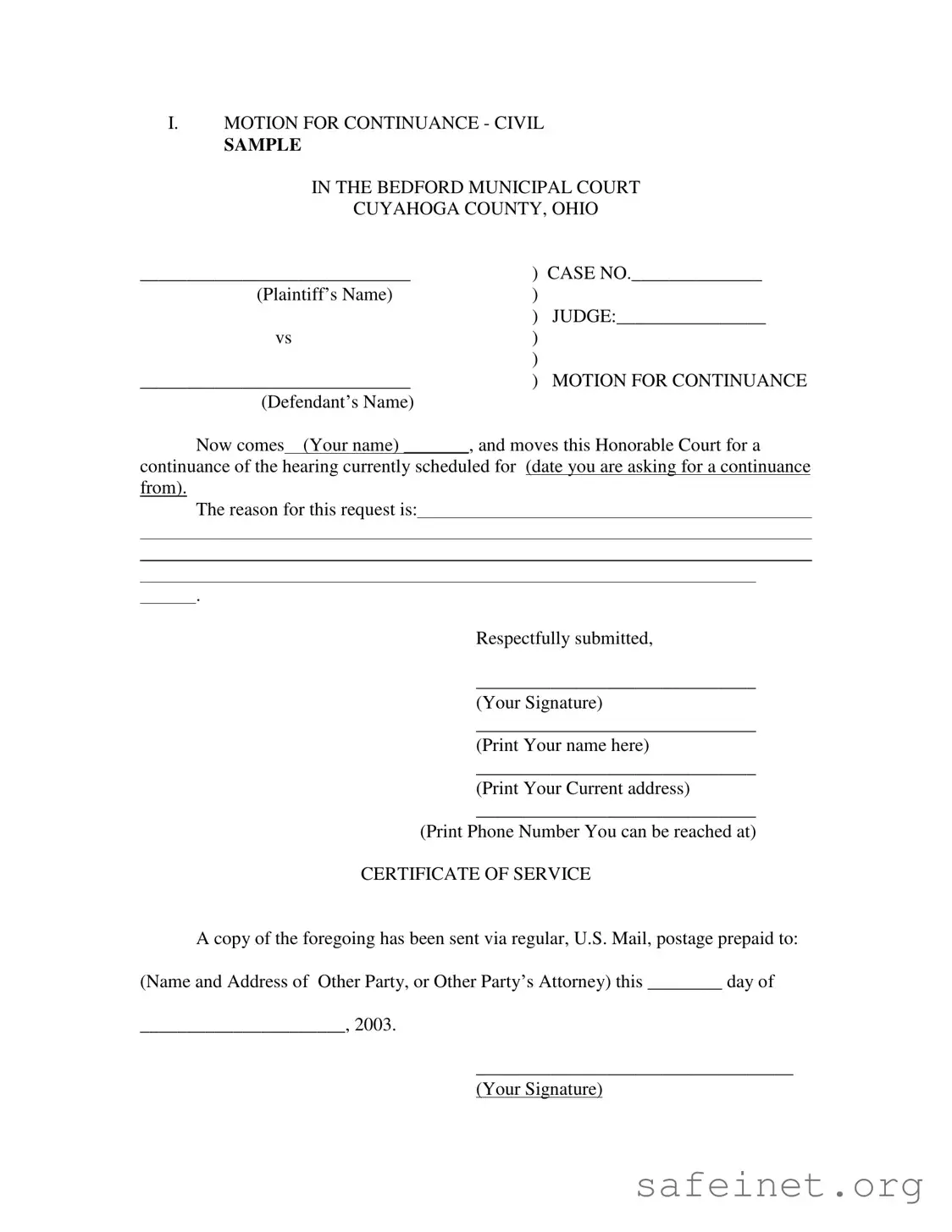
The Motion for Continuance form is a crucial document used in civil court proceedings, particularly in the Bedford Municipal Court of Cuyahoga County, Ohio. This form allows a party involved in a case to formally request a delay in the scheduled hearing. It serves as a written notice to the court, indicating the specific date of the hearing that the party seeks to postpone. The individual filing the motion must clearly state their name, the case number, and the name of the opposing party. Additionally, the form requires a brief explanation of the reason for the request, which can range from personal emergencies to the need for more time to gather evidence. After completing the motion, the filer must sign it, print their name and current address, and provide a reachable phone number. Furthermore, the form includes a Certificate of Service section, which confirms that a copy of the motion has been sent to the other party or their attorney, ensuring that all involved are informed of the request. This structured approach helps maintain transparency and fairness in the judicial process.

I.MOTION FOR CONTINUANCE - CIVIL
SAMPLE
IN THE BEDFORD MUNICIPAL COURT
CUYAHOGA COUNTY, OHIO
_____________________________ |
) CASE NO.______________ |
|
(Plaintiffís Name) |
) |
|
|
) |
JUDGE:________________ |
vs |
) |
|
|
) |
|
_____________________________ |
) |
MOTION FOR CONTINUANCE |
(Defendantís Name)
Now comes (Your name) _______, and moves this Honorable Court for a
continuance of the hearing currently scheduled for (date you are asking for a continuance from).
The reason for this request is:
.
Respectfully submitted,
______________________________
(Your Signature)
______________________________
(Print Your name here)
______________________________
(Print Your Current address)
______________________________
(Print Phone Number You can be reached at)
CERTIFICATE OF SERVICE
A copy of the foregoing has been sent via regular, U.S. Mail, postage prepaid to:
(Name and Address of Other Party, or Other Partyís Attorney) this ________ day of
______________________, 2003.
__________________________________
(Your Signature)
| Fact Name | Details |
|---|---|
| Purpose | The Motion for Continuance form is used to request a delay in a scheduled court hearing. |
| Governing Law | This form is governed by Ohio Civil Rule 41, which outlines the procedures for continuances in civil cases. |
| Filing Requirements | The form must be filed with the court where the case is pending, along with any required fees. |
| Signature Requirement | The person requesting the continuance must sign the form to validate the request. |
| Notification | A certificate of service is included to confirm that the other party has been notified of the motion. |
| Deadline for Filing | It is advisable to file the motion as soon as possible before the scheduled hearing date. |
| Information Needed | The form requires the case number, names of the parties, the current hearing date, and the reason for the continuance. |
| Judicial Discretion | The judge has the discretion to grant or deny the motion based on the reasons provided. |
After completing the Motion for Continuance form, submit it to the court where your case is being heard. Ensure that you provide a copy to the other party involved in the case. Timeliness is crucial, so act quickly to avoid any delays in your proceedings.
After completing the main section, move to the CERTIFICATE OF SERVICE section. Here, you will need to send a copy of the motion to the other party or their attorney. Fill in their name and address, then indicate the date you are sending it. Sign this section as well.
What is a Motion for Continuance?
A Motion for Continuance is a formal request to postpone a scheduled court hearing or trial. This request is made to the court, and it must specify the reasons for the postponement. The motion is typically filed by one of the parties involved in the case, either the plaintiff or the defendant.
When should I file a Motion for Continuance?
You should file a Motion for Continuance as soon as you know that you will not be able to attend the scheduled hearing. Common reasons include personal emergencies, scheduling conflicts, or the need for additional time to prepare your case. It’s important to file the motion well in advance of the hearing date to give the court time to consider your request.
How do I complete the Motion for Continuance form?
To complete the form, fill in your name, the case number, the name of the other party, and the date of the hearing you wish to postpone. In the section for reasons, clearly explain why you are requesting the continuance. After filling out the form, sign it and include your current address and phone number. Finally, make sure to send a copy to the other party or their attorney.
Is there a fee associated with filing a Motion for Continuance?
Typically, there is no additional fee for filing a Motion for Continuance itself. However, you should check with the specific court where your case is being heard, as some jurisdictions may have different rules or fees associated with motions.
What happens after I file the Motion for Continuance?
After you file the motion, the court will review it. The judge may grant or deny your request based on the reasons you provided. If the motion is granted, the court will reschedule the hearing. If it is denied, you will need to attend the hearing as originally scheduled.
Do I need to attend the hearing if I file a Motion for Continuance?
In most cases, you will still need to attend the hearing unless the court specifically grants your motion before the hearing date. If the motion is not resolved before the hearing, your absence could negatively impact your case.
How should I serve the Motion for Continuance to the other party?
You must send a copy of the Motion for Continuance to the other party or their attorney via regular U.S. Mail. Be sure to include the date of mailing in the Certificate of Service section of the form. This step is crucial as it ensures that all parties are informed of your request.
Can a Motion for Continuance be denied?
Yes, a Motion for Continuance can be denied. The judge will consider the reasons you provided and any objections from the other party. If the judge believes that your reasons do not justify a delay, they may deny the motion, and you will be required to proceed with the hearing as scheduled.
What should I do if my Motion for Continuance is denied?
If your motion is denied, it is essential to prepare for the hearing. Gather all necessary documents and evidence, and consider consulting with a legal professional for guidance. Being well-prepared can help you present your case effectively, even if you were unable to secure a postponement.
Incomplete Information: Failing to fill in all required fields can lead to delays. Ensure every section is complete, including your name, address, and the case number.
Missing Signature: Forgetting to sign the form is a common mistake. Always double-check that your signature is included before submission.
Incorrect Date: Providing the wrong date for the hearing can cause confusion. Verify the date you are requesting a continuance from is accurate.
Insufficient Reasoning: Not giving a clear reason for the continuance can weaken your request. Be specific and concise about why you need more time.
Failure to Serve Other Party: Not sending a copy of the motion to the other party is a critical error. Make sure to include their name and address in the Certificate of Service section.
Incorrect Certificate of Service: Filling out this section incorrectly can lead to complications. Ensure that the date and details are accurate and complete.
When filing a Motion for Continuance, there are several other forms and documents that may be relevant to your case. These documents help to provide context, support, or additional information related to your request for postponement. Below is a list of commonly used forms that you might encounter.
Understanding these documents can be crucial for navigating the legal process effectively. Each form serves a specific purpose and contributes to a clearer communication of your intentions to the court and other parties involved.
The Motion for Continuance form is similar to a Motion for Extension of Time. Both documents request additional time to complete a specific task related to a legal proceeding. While the Motion for Continuance focuses on postponing a hearing or trial date, the Motion for Extension of Time is often used to ask for more time to file documents or respond to motions. The underlying principle in both cases is the need for more time to adequately prepare, ensuring that all parties have a fair opportunity to present their case.
Another document that shares similarities is the Motion to Postpone. This motion specifically seeks to delay a scheduled court date due to unforeseen circumstances, such as illness or scheduling conflicts. Like the Motion for Continuance, it emphasizes the importance of having adequate time to prepare for the hearing. Both motions require a clear explanation of the reasons for the request, demonstrating the necessity of the delay to the court.
The Motion for Reconsideration also bears resemblance to the Motion for Continuance. While the former seeks to have a court review and potentially change a previous ruling, both documents reflect a desire for a second chance to present information or arguments. In both cases, the individual filing the motion must articulate their reasons clearly, whether for delaying proceedings or for revisiting a decision made by the court.
A Motion to Amend is another document that can be compared to the Motion for Continuance. This motion requests permission to change or add to previously filed documents, such as pleadings or complaints. Both motions involve a need for adjustments in legal proceedings, though the Motion to Amend focuses on the content of documents rather than the timing of hearings. Each requires a justification for the requested change, emphasizing the importance of accuracy and fairness in legal processes.
The Motion for Default Judgment is similar in that it can be filed when one party fails to respond or appear in a legal matter. While it does not seek to delay proceedings, it reflects the need for the court to consider the circumstances surrounding a party's absence. Both motions highlight the importance of ensuring that all parties are afforded the opportunity to participate meaningfully in the legal process.
Additionally, the Motion for Summary Judgment shares some characteristics with the Motion for Continuance. Both motions can be filed in the course of litigation and require the party to present their case to the court. While a Motion for Summary Judgment seeks to resolve a case without a trial, it similarly emphasizes the importance of presenting clear and compelling reasons to support the request, whether for a continuance or for a judgment in favor of one party.
Lastly, the Motion for a Protective Order is akin to the Motion for Continuance in that both seek to protect the interests of a party involved in legal proceedings. A Motion for a Protective Order aims to limit discovery or prevent certain information from being disclosed, while the Motion for Continuance seeks to postpone proceedings for valid reasons. Both documents require a thoughtful explanation of the circumstances and the necessity of the request to ensure fairness and justice in the legal process.
When filling out the Motion For Continuance form, it is essential to approach the task with care and attention to detail. Here are six important do's and don'ts to keep in mind:
By following these guidelines, you can navigate the process of requesting a continuance more effectively and with greater confidence.
Misconceptions about the Motion for Continuance form can lead to confusion. Here are five common misunderstandings:
Understanding these misconceptions can help individuals navigate the legal process more effectively.
When it comes to navigating the legal system, understanding how to properly fill out and use the Motion For Continuance form can significantly impact your case. Here are some key takeaways to keep in mind:
By keeping these takeaways in mind, you can approach the process of requesting a continuance with greater confidence and clarity.