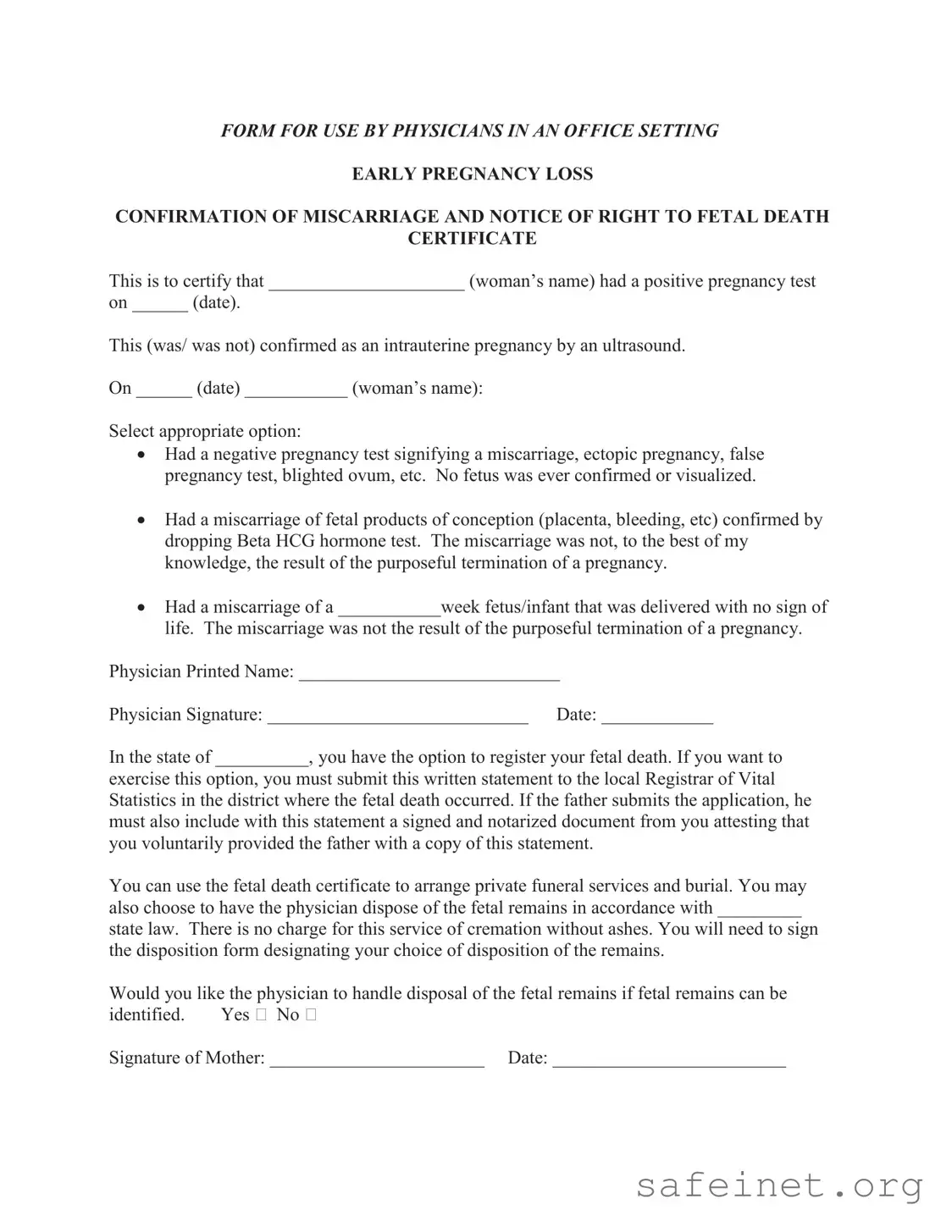
The Miscarriage Discharge Paper form serves as an important document for women experiencing early pregnancy loss. This form is utilized by physicians in an office setting to confirm a miscarriage and provide essential information regarding the options available to the mother. It begins by certifying the woman's positive pregnancy test and whether an intrauterine pregnancy was confirmed through ultrasound. Following this, the form outlines various scenarios that may have occurred, including negative pregnancy tests, confirmed miscarriages, or the delivery of a fetus without signs of life. It emphasizes that these events were not the result of a purposeful termination of pregnancy. Additionally, the form informs women about their rights regarding the registration of fetal death and the process for obtaining a fetal death certificate. This certificate is crucial for arranging funeral services or burial, should the mother choose to do so. Furthermore, the form addresses the disposition of fetal remains, offering options for cremation or disposal in accordance with state law, and ensures that the mother’s preferences are documented. Overall, the Miscarriage Discharge Paper form not only serves a medical purpose but also provides emotional support and clarity during a difficult time.
FORM FOR USE BY PHYSICIANS IN AN OFFICE SETTING
EARLY PREGNANCY LOSS
CONFIRMATION OF MISCARRIAGE AND NOTICE OF RIGHT TO FETAL DEATH
CERTIFICATE
This is to certify that _____________________ (woman’s name) had a positive pregnancy test
on ______ (date).
This (was/ was not) confirmed as an intrauterine pregnancy by an ultrasound.
On ______ (date) ___________ (woman’s name):
Select appropriate option:
•Had a negative pregnancy test signifying a miscarriage, ectopic pregnancy, false pregnancy test, blighted ovum, etc. No fetus was ever confirmed or visualized.
•Had a miscarriage of fetal products of conception (placenta, bleeding, etc) confirmed by dropping Beta HCG hormone test. The miscarriage was not, to the best of my knowledge, the result of the purposeful termination of a pregnancy.
•Had a miscarriage of a ___________week fetus/infant that was delivered with no sign of life. The miscarriage was not the result of the purposeful termination of a pregnancy.
Physician Printed Name: ____________________________
Physician Signature: ____________________________ Date: ____________
In the state of __________, you have the option to register your fetal death. If you want to
exercise this option, you must submit this written statement to the local Registrar of Vital Statistics in the district where the fetal death occurred. If the father submits the application, he must also include with this statement a signed and notarized document from you attesting that you voluntarily provided the father with a copy of this statement.
You can use the fetal death certificate to arrange private funeral services and burial. You may also choose to have the physician dispose of the fetal remains in accordance with _________
state law. There is no charge for this service of cremation without ashes. You will need to sign the disposition form designating your choice of disposition of the remains.
Would you like the physician to handle disposal of the fetal remains if fetal remains can be identified. Yes No
Signature of Mother: _______________________ Date: _________________________
| Fact Name | Details |
|---|---|
| Form Purpose | This form is used by physicians to confirm early pregnancy loss and inform the patient about their rights regarding fetal death certificates. |
| Positive Pregnancy Test | The form requires documentation of a positive pregnancy test, including the date it was taken. |
| Ultrasound Confirmation | Physicians must indicate whether the positive pregnancy test was confirmed by an ultrasound. |
| Miscarriage Options | The form provides options to classify the type of miscarriage, including negative tests and confirmed fetal loss. |
| Fetal Death Registration | In some states, parents can register a fetal death with the local Registrar of Vital Statistics. |
| Father's Role | If the father submits the application for fetal death registration, he must include a notarized statement from the mother. |
| Funeral Arrangements | The fetal death certificate can be used to arrange private funeral services and burial. |
| Disposal Options | Parents can choose how to dispose of fetal remains, including cremation or burial, in accordance with state law. |
| Signature Requirement | The mother must sign the form to authorize the chosen method of disposal for the fetal remains. |
| State-Specific Laws | Each state has its own laws governing fetal death registration and remains disposal, so it is important to check local regulations. |
Completing the Miscarriage Discharge Paper form is an important step following a miscarriage. This form requires specific information to ensure proper documentation and options for the next steps. Follow the instructions carefully to fill out the form accurately.
What is the purpose of the Miscarriage Discharge Paper form?
The Miscarriage Discharge Paper form is used by physicians to document early pregnancy loss. It confirms that a woman had a positive pregnancy test and outlines the details surrounding the miscarriage. This form also informs the woman of her rights regarding the registration of fetal death and the options available for the disposition of fetal remains.
What information is included in the form?
The form includes the woman's name, the date of the positive pregnancy test, and whether the pregnancy was confirmed by ultrasound. It provides options for documenting the type of miscarriage, including whether a fetus was visualized or if there were any complications. Additionally, it includes the physician's printed name, signature, and the date of completion.
What options do I have for the disposition of fetal remains?
You have several options for the disposition of fetal remains. You can choose to have the physician handle the disposal in accordance with state law. This service may include cremation without ashes at no charge. Alternatively, you may arrange for private funeral services and burial. You will need to sign a disposition form to indicate your choice.
Can I register the fetal death in my state?
Yes, you can register the fetal death in your state if you wish. To do this, you must submit the written statement provided by your physician to the local Registrar of Vital Statistics in the district where the fetal death occurred. If the father submits the application, he must include a signed and notarized document from you, confirming that you provided him with a copy of the statement.
What should I do if I have questions about the form or my options?
If you have questions about the Miscarriage Discharge Paper form or your options regarding fetal remains, it is important to talk to your physician. They can provide you with detailed information and guidance based on your specific situation. Don’t hesitate to ask for clarification on any part of the process.
Failing to provide the woman's full name in the designated space. It's essential to ensure that the name matches official documents.
Not entering the correct date of the positive pregnancy test. Accuracy in this date is crucial for medical records.
Choosing the wrong option regarding the outcome of the pregnancy. Make sure to carefully read each option and select the one that accurately reflects the situation.
Omitting the physician's printed name or signature. This step is vital for the validity of the form.
Not indicating the date when the form is signed. This can lead to confusion about when the information was certified.
Overlooking the section about registering the fetal death. If you wish to pursue this option, ensure all necessary steps are followed.
Failing to include the father's signed and notarized document if he is submitting the application. This requirement is important for legal compliance.
Neglecting to specify how the fetal remains should be disposed of. This choice is significant and should be clearly indicated.
Not signing the form where indicated. A signature is a confirmation of the information provided and is required for the form to be complete.
The process following a miscarriage can be emotionally challenging. Alongside the Miscarriage Discharge Paper form, several other documents may be necessary for medical, legal, or personal reasons. Understanding these documents can help you navigate this difficult time more effectively.
Each of these documents plays a vital role in the aftermath of a miscarriage. Familiarizing yourself with them can ease some of the burdens during this challenging time. It is important to prioritize your health and emotional well-being as you navigate this process.
The Miscarriage Discharge Paper form shares similarities with the Medical Certificate of Death. Both documents serve to officially acknowledge a loss, providing necessary details about the circumstances surrounding the event. The Medical Certificate of Death is used to confirm the death of an individual, much like the Miscarriage Discharge Paper confirms the loss of a pregnancy. Each document requires the signature of a medical professional, ensuring that the information provided is accurate and legally recognized. Additionally, both forms can be critical for the grieving families, as they may need these documents for legal and administrative purposes.
Another document that resembles the Miscarriage Discharge Paper is the Fetal Death Certificate. This certificate is specifically designed to record the death of a fetus prior to birth, similar to how the Miscarriage Discharge Paper details the circumstances of a miscarriage. Both documents require medical confirmation of the loss and may be necessary for registering the death with local authorities. Families can use the Fetal Death Certificate to arrange for burial or cremation services, just as they can with the Miscarriage Discharge Paper. This connection underscores the emotional and legal significance of both forms in the context of pregnancy loss.
The Birth Certificate is also comparable to the Miscarriage Discharge Paper, albeit in a different context. While a Birth Certificate records the successful delivery of a child, it similarly serves as an official document that requires medical verification. In cases of miscarriage, the Miscarriage Discharge Paper acts as a formal acknowledgment of the pregnancy and its loss, while the Birth Certificate signifies a new life. Both documents are crucial for parents in navigating legal and healthcare systems, highlighting the importance of accurate record-keeping in matters of life and loss.
Lastly, the Authorization for Release of Medical Records form bears resemblance to the Miscarriage Discharge Paper in terms of its function in medical documentation. This form allows individuals to request access to their medical records, which may include the details surrounding a miscarriage. Both documents require signatures and are used to facilitate communication between healthcare providers and patients. In the case of a miscarriage, having access to medical records can help families understand the circumstances of their loss and can be essential for emotional healing and future medical care.
When filling out the Miscarriage Discharge Paper form, there are important guidelines to follow to ensure accuracy and clarity. Here are seven things to do and avoid:
Understanding the Miscarriage Discharge Paper form is crucial for those navigating the emotional and legal aspects of early pregnancy loss. Here are eight common misconceptions about this form:
Addressing these misconceptions can help individuals feel more informed and empowered during a difficult period. Understanding the purpose and options related to the Miscarriage Discharge Paper form is an important step in the healing process.
Filling out the Miscarriage Discharge Paper form is an important step for women experiencing early pregnancy loss. Here are some key takeaways to consider: