In Michigan, managing the estate of a deceased loved one can be a daunting task, especially when it comes to navigating the complexities of probate law. However, the Michigan Small Estate Affidavit form offers a streamlined process for settling smaller estates without the need for formal probate proceedings. This form is designed for estates valued at $25,000 or less, allowing heirs to claim assets efficiently and with minimal hassle. By using the Small Estate Affidavit, individuals can avoid lengthy court processes, enabling them to access funds, personal property, and other assets in a timely manner. The form requires the completion of specific information, including details about the deceased, a list of assets, and the rightful heirs. Moreover, it must be signed under oath, ensuring that all provided information is accurate and truthful. Understanding the requirements and implications of this affidavit is crucial for those looking to settle an estate quickly and effectively, making it an essential tool in the estate administration process.
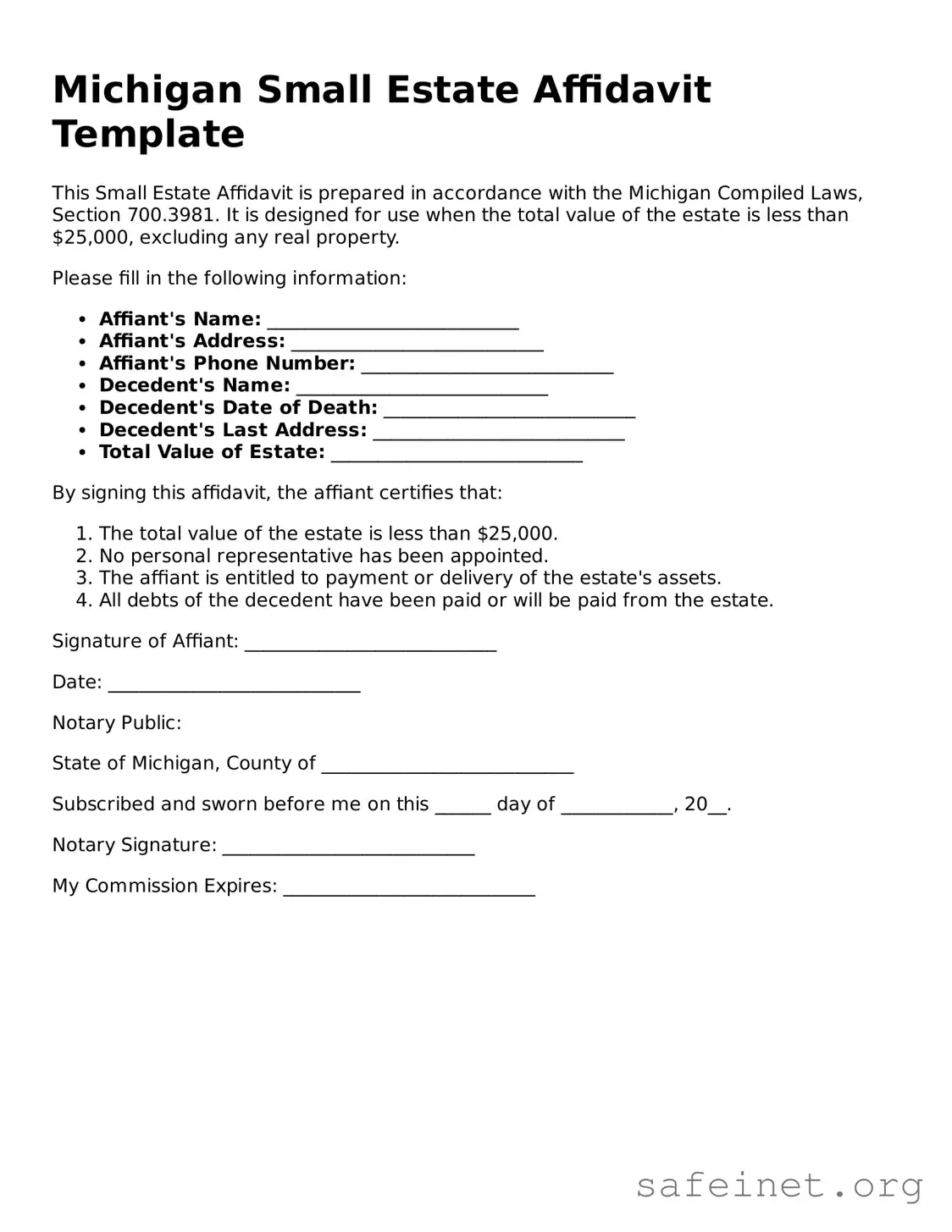
Michigan Small Estate Affidavit Template
This Small Estate Affidavit is prepared in accordance with the Michigan Compiled Laws, Section 700.3981. It is designed for use when the total value of the estate is less than $25,000, excluding any real property.
Please fill in the following information:
By signing this affidavit, the affiant certifies that:
Signature of Affiant: ___________________________
Date: ___________________________
Notary Public:
State of Michigan, County of ___________________________
Subscribed and sworn before me on this ______ day of ____________, 20__.
Notary Signature: ___________________________
My Commission Expires: ___________________________
| Fact Name | Description |
|---|---|
| Purpose | The Michigan Small Estate Affidavit allows individuals to claim assets of a deceased person without going through a formal probate process. |
| Eligibility | To use this form, the total value of the deceased's estate must be less than $24,000, excluding certain assets. |
| Governing Law | This form is governed by Michigan Compiled Laws, specifically MCL 700.3980. |
| Filing Process | Individuals must complete the affidavit and present it to the financial institution or entity holding the deceased's assets. |
| Signature Requirement | The affidavit must be signed by the person claiming the assets, and it may require notarization for validity. |
Once you have the Michigan Small Estate Affidavit form in hand, it's time to fill it out accurately to ensure a smooth process. This form allows you to claim assets of a deceased person without going through the full probate process, provided the estate meets certain criteria. Follow these steps to complete the form correctly.
After submitting the form, be prepared for any follow-up actions that may be necessary. Depending on the situation, you might need to provide additional documentation or respond to inquiries from the court or other parties involved. Staying organized and responsive will help facilitate the process.
What is a Michigan Small Estate Affidavit?
The Michigan Small Estate Affidavit is a legal document that allows individuals to claim property from a deceased person's estate without going through the formal probate process. This form is typically used when the total value of the estate is below a certain threshold, which is currently set at $24,000 for individuals and $48,000 for married couples. By using this affidavit, heirs can simplify the transfer of assets such as bank accounts, vehicles, and personal property.
Who is eligible to use the Small Estate Affidavit?
Eligibility to use the Small Estate Affidavit is generally limited to individuals who are either heirs or beneficiaries of the deceased. The person filing the affidavit must be at least 18 years old and must have a legal claim to the property in question. Additionally, the total value of the estate must not exceed the specified limits. It is important to ensure that no formal probate proceedings are ongoing for the estate in question.
How do I complete the Small Estate Affidavit?
Completing the Small Estate Affidavit involves filling out the required form with accurate information about the deceased and the assets being claimed. The form will typically require details such as the decedent's name, date of death, and a list of the assets along with their values. Once completed, the affidavit must be signed in the presence of a notary public. This notarization serves to validate the document before it is presented to financial institutions or other entities holding the deceased's assets.
Where do I submit the Small Estate Affidavit?
The Small Estate Affidavit should be submitted to the institutions or individuals that hold the assets you are claiming. For example, if you are claiming funds from a bank account, you would present the affidavit to the bank. Each institution may have its own procedures for accepting the affidavit, so it is advisable to contact them beforehand to ensure compliance with their requirements.
What happens after I submit the Small Estate Affidavit?
After submitting the Small Estate Affidavit, the institution or individual in possession of the assets will review the document. If everything is in order, they will release the assets to the heir or beneficiary named in the affidavit. It is important to keep in mind that the process may vary depending on the institution, and some may require additional documentation or verification before proceeding with the transfer.
Not providing all required information. Each section of the form must be completed accurately. Missing details can lead to delays or rejection.
Failing to sign the affidavit. The form must be signed by the person claiming the estate. An unsigned form is not valid.
Incorrectly estimating the value of the estate. It's essential to provide an accurate assessment of the estate's value to avoid legal complications.
Neglecting to include all heirs. All individuals entitled to inherit must be listed. Omitting an heir can create disputes later on.
Not providing supporting documents. Necessary documents, such as death certificates or wills, should accompany the affidavit to support the claim.
Using outdated forms. Always ensure you have the most current version of the Small Estate Affidavit form. Using an old form can result in issues.
Ignoring state-specific requirements. Each state may have unique rules regarding small estates. Familiarize yourself with Michigan's specific requirements.
The Michigan Small Estate Affidavit is a useful tool for individuals dealing with the estate of a deceased person when the estate's value is below a certain threshold. However, several other forms and documents may accompany this affidavit to ensure a smooth process in settling the estate. Below is a list of commonly used documents in conjunction with the Michigan Small Estate Affidavit.
Utilizing these documents alongside the Michigan Small Estate Affidavit can streamline the process of settling an estate. Each document plays a vital role in ensuring that the decedent's wishes are honored and that all legal requirements are met.
The Michigan Small Estate Affidavit form is similar to the Affidavit of Heirship. This document is used to establish the heirs of a deceased individual when there is no will. It allows heirs to claim property without going through formal probate. Both documents simplify the transfer of assets, but the Affidavit of Heirship focuses more on identifying rightful heirs, while the Small Estate Affidavit is used to claim specific assets valued below a certain threshold.
Another similar document is the Will. A Will outlines a person's wishes regarding the distribution of their assets after death. While the Small Estate Affidavit can be used when a person dies intestate (without a will), a Will provides clear instructions on asset distribution. Both documents serve the purpose of transferring property but differ in their requirements and the presence of a testator's explicit wishes.
The Transfer on Death Deed (TODD) is also comparable. This deed allows property owners to transfer real estate to beneficiaries upon their death without going through probate. Similar to the Small Estate Affidavit, the TODD simplifies the process of asset transfer. However, the TODD specifically applies to real estate, while the Small Estate Affidavit can encompass various types of assets.
The Affidavit for Collection of Personal Property is another related document. This affidavit allows individuals to collect personal property of a deceased person without formal probate if the estate meets certain criteria. Both the Affidavit for Collection and the Small Estate Affidavit facilitate the transfer of assets without extensive legal proceedings, but the former is limited to personal property.
The Petition for Summary Administration shares similarities as well. This petition is used in probate court to expedite the distribution of a small estate. Like the Small Estate Affidavit, it aims to simplify the process for smaller estates. However, the Petition for Summary Administration requires court involvement, whereas the Small Estate Affidavit can often be completed without court proceedings.
The Declaration of Trust can be compared to the Small Estate Affidavit in that both documents help manage the distribution of assets. A Declaration of Trust outlines how assets are to be managed during a person's lifetime and after death. While the Small Estate Affidavit is used posthumously, both documents serve to ensure that assets are handled according to the deceased's wishes.
The Living Trust is another document with similarities. A Living Trust allows individuals to place their assets in a trust during their lifetime, which can then be distributed upon their death without going through probate. Both the Living Trust and the Small Estate Affidavit aim to streamline the transfer of assets, but the Living Trust requires more active management during the grantor's lifetime.
The Affidavit of Support can also be seen as related in terms of establishing financial responsibility. This document is often used in immigration cases to demonstrate that a sponsor can financially support an immigrant. While it serves a different purpose, both documents involve an affidavit format and aim to provide proof of certain conditions, whether it be financial support or rightful heirship.
Lastly, the Power of Attorney document has some similarities. A Power of Attorney grants authority to another person to make decisions on behalf of someone else, often in financial or legal matters. While the Small Estate Affidavit is used after death to transfer assets, both documents involve the management of a person's affairs, albeit in different contexts and timelines.
When filling out the Michigan Small Estate Affidavit form, it’s important to ensure accuracy and compliance with the requirements. Here are five essential dos and don'ts to keep in mind:
By following these guidelines, you can navigate the process of completing the Small Estate Affidavit more effectively.
The Michigan Small Estate Affidavit form is a valuable tool for settling small estates, but several misconceptions can lead to confusion. Here are six common misunderstandings:
Understanding these misconceptions can help individuals navigate the Small Estate Affidavit process more effectively and with greater confidence.
Filling out and using the Michigan Small Estate Affidavit form can simplify the process of settling a deceased person's estate when the total value is below a certain threshold. Here are some key takeaways: