In the realm of business and personal relationships, confidentiality plays a crucial role in fostering trust and protecting sensitive information. The Michigan Non-disclosure Agreement (NDA) form serves as a vital tool for individuals and organizations looking to safeguard their proprietary information from unauthorized disclosure. This legally binding document outlines the terms under which confidential information may be shared between parties while establishing clear expectations regarding its use and protection. Key elements of the Michigan NDA include definitions of what constitutes confidential information, the obligations of the receiving party, and the duration of the confidentiality obligation. Additionally, the form often specifies the consequences of breaching the agreement, ensuring that all parties understand the seriousness of maintaining confidentiality. By utilizing this form, businesses and individuals can create a secure environment for sharing ideas, trade secrets, and other sensitive data, ultimately fostering collaboration while minimizing the risk of information leaks.
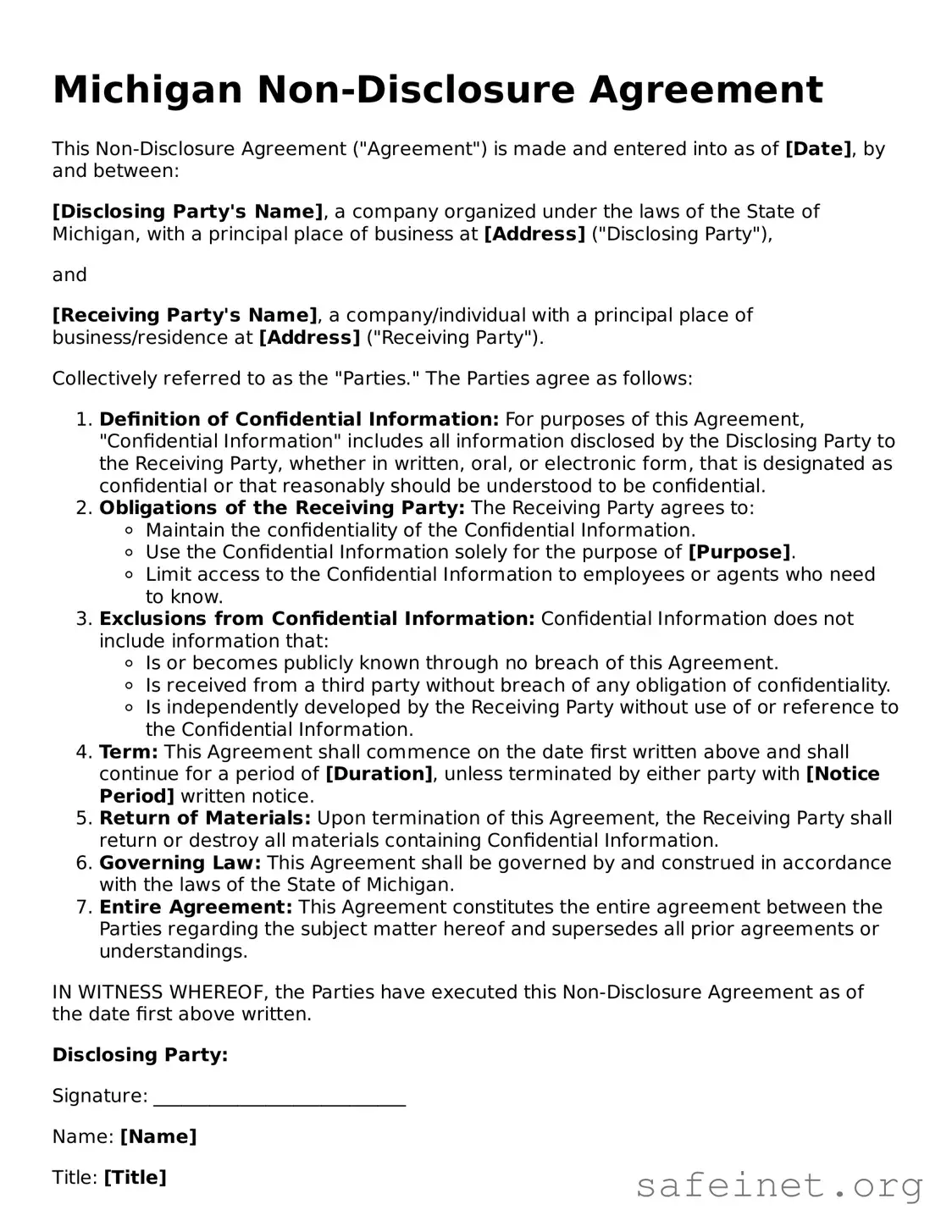
Michigan Non-Disclosure Agreement
This Non-Disclosure Agreement ("Agreement") is made and entered into as of [Date], by and between:
[Disclosing Party's Name], a company organized under the laws of the State of Michigan, with a principal place of business at [Address] ("Disclosing Party"),
and
[Receiving Party's Name], a company/individual with a principal place of business/residence at [Address] ("Receiving Party").
Collectively referred to as the "Parties." The Parties agree as follows:
IN WITNESS WHEREOF, the Parties have executed this Non-Disclosure Agreement as of the date first above written.
Disclosing Party:
Signature: ___________________________
Name: [Name]
Title: [Title]
Receiving Party:
Signature: ___________________________
Name: [Name]
Title: [Title]
| Fact Name | Description |
|---|---|
| Purpose | The Michigan Non-disclosure Agreement form is used to protect confidential information shared between parties. |
| Governing Law | The agreement is governed by the laws of the State of Michigan. |
| Parties Involved | Typically, the agreement involves at least two parties: the disclosing party and the receiving party. |
| Duration of Confidentiality | The duration for which the information must remain confidential can be specified in the agreement. |
Filling out the Michigan Non-disclosure Agreement form is an important step in protecting confidential information. After completing the form, you will be able to share sensitive information with the other party while ensuring that it remains private.
What is a Michigan Non-disclosure Agreement (NDA)?
A Michigan Non-disclosure Agreement is a legal contract that protects confidential information shared between parties. It establishes a formal understanding that certain information will remain private and not be disclosed to third parties without permission. NDAs are commonly used in business settings to safeguard trade secrets, proprietary information, and sensitive data.
Who typically uses a Non-disclosure Agreement in Michigan?
Various individuals and organizations utilize NDAs in Michigan. Businesses often require employees, contractors, and partners to sign these agreements to protect their intellectual property and sensitive information. Startups frequently use NDAs when discussing ideas with potential investors or collaborators to ensure that their concepts remain confidential.
What types of information can be protected by an NDA?
An NDA can protect a wide range of information, including but not limited to trade secrets, business plans, customer lists, financial data, marketing strategies, and proprietary technology. The key is that the information must be confidential and not publicly available. The agreement should clearly define what constitutes confidential information to avoid any ambiguity.
How long does the confidentiality obligation last under a Michigan NDA?
The duration of the confidentiality obligation can vary based on the terms set forth in the NDA. Typically, the obligation lasts for a specified period, which can range from a few years to indefinitely, depending on the nature of the information. It is essential for the parties involved to agree on a reasonable timeframe that reflects the sensitivity of the information being protected.
Are there any limitations to what an NDA can enforce?
Yes, there are limitations. An NDA cannot enforce confidentiality on information that is already public knowledge or that was independently developed by the receiving party without access to the confidential information. Additionally, if the receiving party is required by law to disclose certain information, the NDA may not prevent that disclosure. It is crucial to ensure that the NDA is fair and reasonable to both parties.
What are the consequences of breaching an NDA in Michigan?
If a party breaches an NDA, the other party may seek legal remedies. Consequences can include monetary damages, injunctions to prevent further disclosure, and, in some cases, the recovery of attorney's fees. The specific consequences will depend on the terms outlined in the NDA and the severity of the breach. Courts typically take breaches of confidentiality seriously, especially when sensitive information is involved.
How can one create a Non-disclosure Agreement in Michigan?
Creating an NDA in Michigan involves drafting a clear and concise document that outlines the terms of confidentiality. It should include definitions of confidential information, the obligations of both parties, the duration of confidentiality, and any exclusions. While templates are available online, it is advisable to consult with a legal professional to ensure that the NDA meets specific needs and complies with state laws.
Incomplete Information: One of the most common mistakes is failing to provide all necessary information. Individuals often overlook sections that require specific details about the parties involved, the nature of the confidential information, or the duration of the agreement. This can lead to ambiguity and potential legal issues.
Vague Definitions: Another frequent error is using vague language when defining what constitutes confidential information. A clear and precise definition is crucial. Without it, parties may have differing interpretations, which can undermine the purpose of the agreement.
Ignoring State-Specific Requirements: Each state may have unique legal requirements regarding non-disclosure agreements. Failing to consider Michigan's specific laws can result in an agreement that is unenforceable or lacks necessary protections.
Not Reviewing or Updating: Individuals sometimes neglect to review the agreement periodically. As business relationships evolve, so do the terms of confidentiality. Failing to update the agreement can lead to outdated terms that no longer reflect the current situation.
When entering into a Non-disclosure Agreement (NDA) in Michigan, it is often helpful to have additional forms and documents that complement the NDA. These documents can provide further clarity and support to the agreement, ensuring that all parties are on the same page regarding confidentiality and related matters. Below is a list of commonly used forms and documents that may accompany an NDA.
Using these additional forms and documents alongside a Michigan Non-disclosure Agreement can help create a comprehensive framework for protecting sensitive information. Each document serves a unique purpose, reinforcing the commitments made by the parties involved and ensuring that confidentiality is maintained throughout their interactions.
A Confidentiality Agreement, often used interchangeably with a Non-disclosure Agreement (NDA), serves a similar purpose in protecting sensitive information. This document is typically signed between parties who are considering a business relationship. It outlines what information is confidential and restricts the sharing of that information with third parties. Like an NDA, a Confidentiality Agreement aims to ensure that proprietary information, trade secrets, or sensitive business data remain protected from unauthorized disclosure.
A Non-compete Agreement is another document that shares similarities with a Non-disclosure Agreement. While its primary focus is on restricting an individual's ability to work in competing businesses after leaving a company, it often includes clauses about confidentiality. This means that, alongside preventing competition, it also protects sensitive information that the employee may have accessed during their employment. Both agreements aim to safeguard a company's interests and proprietary information.
A Non-solicitation Agreement is closely related to NDAs in that it prevents one party from soliciting the clients or employees of another party. This document is often used in conjunction with NDAs to provide a comprehensive approach to protecting business interests. While an NDA focuses on keeping information confidential, a Non-solicitation Agreement ensures that the relationships and goodwill built by a business are not compromised after a partnership or employment ends.
A Proprietary Information Agreement is similar to a Non-disclosure Agreement in that it specifically deals with the protection of proprietary information. This type of agreement is often used in situations where one party is sharing unique processes, formulas, or inventions with another party. Like an NDA, it outlines what constitutes proprietary information and establishes the obligations of the receiving party to maintain confidentiality, thereby ensuring that the proprietary information does not become public knowledge.
Finally, a Mutual Non-disclosure Agreement is akin to a standard NDA but involves two parties sharing confidential information with each other. This document is particularly useful in joint ventures or partnerships where both parties need to protect their respective sensitive information. It outlines the responsibilities of both parties regarding the handling of confidential information, ensuring that both sides are equally protected from unauthorized disclosures, similar to a traditional Non-disclosure Agreement.
When filling out the Michigan Non-disclosure Agreement (NDA) form, there are important steps to follow to ensure that the document is completed correctly. Here are five things you should and shouldn't do:
Following these guidelines can help ensure that the NDA serves its intended purpose effectively.
Non-disclosure agreements (NDAs) are common tools used to protect sensitive information. However, there are several misconceptions about the Michigan Non-disclosure Agreement form that can lead to confusion. Here are nine of those misconceptions:
Understanding these misconceptions can help individuals and businesses navigate the complexities of NDAs more effectively.
Filling out and using the Michigan Non-disclosure Agreement (NDA) form is crucial for protecting sensitive information. Here are some key takeaways to consider:
By keeping these points in mind, you can effectively use the Michigan NDA form to safeguard your sensitive information.