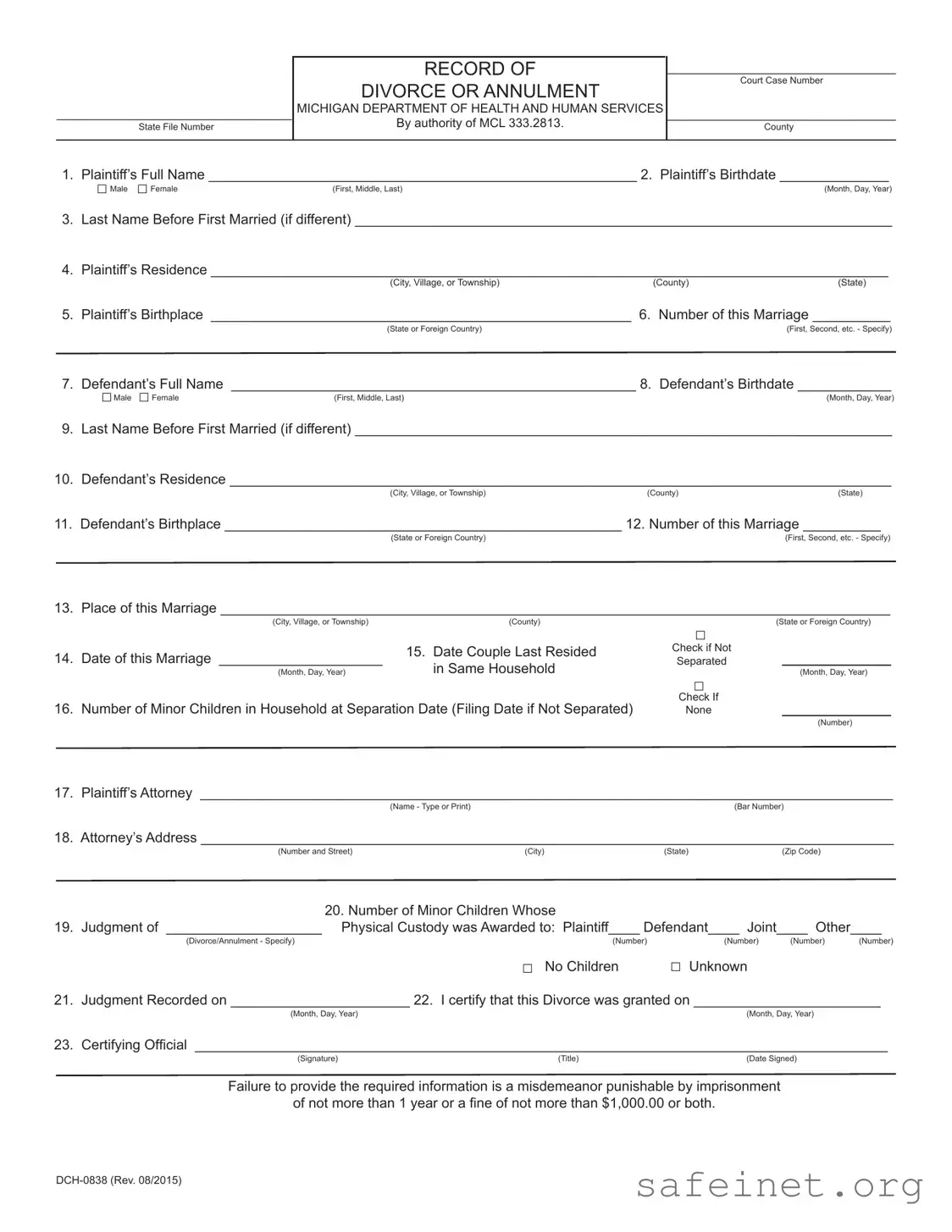
The Michigan DCH 0838 form serves as an essential document in the divorce or annulment process within the state. It captures critical information about both parties involved, including their full names, birthdates, and previous last names if applicable. The form also requires details about the marriage, such as the date it took place and the location. Additionally, it outlines the number of minor children involved and their custody arrangements, which are crucial for determining future responsibilities. Each party's residence and birthplace are also noted, ensuring that all relevant personal information is collected. The document must be completed accurately, as failure to provide the required information can lead to legal penalties. Understanding the significance of this form is vital for anyone navigating the complexities of divorce in Michigan.

__________________________________
State File Number
RECORD OF
DIVORCE OR ANNULMENT
MICHIGAN DEPARTMENT OF HEALTH AND HUMAN SERVICES
By authority of MCL 333.2813.
_________________________________
Court Case Number
_________________________________
County
1. Plaintiff’s Full Name _______________________________________________________ 2. |
Plaintiff’s Birthdate ______________ |
||||
□ |
Male |
□ |
Female |
(First, Middle, Last) |
(Month, Day, Year) |
|
|
||||
3.Last Name Before First Married (if different) _____________________________________________________________________
4.Plaintiff’s Residence _______________________________________________________________________________________
(City, Village, or Township)(County)(State)
5. |
Plaintiff’s Birthplace ______________________________________________________ 6. Number of this Marriage __________ |
|||||
|
|
|
|
|
(State or Foreign Country) |
(First, Second, etc. - Specify) |
7. |
Defendant’s Full Name ____________________________________________________ 8. Defendant’s Birthdate ____________ |
|||||
|
□ |
Male |
□ |
Female |
(First, Middle, Last) |
(Month, Day, Year) |
9.Last Name Before First Married (if different) _____________________________________________________________________
10.Defendant’s Residence _____________________________________________________________________________________
(City, Village, or Township)(County)(State)
11. Defendant’s Birthplace ___________________________________________________ 12. Number of this Marriage __________
|
|
(State or Foreign Country) |
|
(First, Second, etc. - Specify) |
||
13. |
Place of this Marriage ______________________________________________________________________________________ |
|||||
|
(City, Village, or Township) |
(County) |
□ |
(State or Foreign Country) |
||
|
|
|
|
|
||
14. |
Date of this Marriage _____________________ |
15. Date Couple Last Resided |
Check if Not |
|
|
|
Separated |
______________ |
|||||
in Same Household |
||||||
|
(Month, Day, Year) |
□ |
(Month, Day, Year) |
|||
|
|
|
|
|
||
|
|
|
Check If |
|
|
|
16. |
Number of Minor Children in Household at Separation Date (Filing Date if Not Separated) |
None |
______________ |
|||
|
|
|
|
(Number) |
|
|
17. |
Plaintiff’s Attorney _________________________________________________________________________________________ |
|||||
|
|
(Name - Type or Print) |
(Bar Number) |
|
||
18. |
Attorney’s Address _________________________________________________________________________________________ |
|||||
|
(Number and Street) |
(City) |
(State) |
(Zip Code) |
|
|
|
20. Number of Minor Children Whose |
|
|
|
||
19. |
Judgment of ____________________ Physical Custody was Awarded to: Plaintiff____ Defendant____ Joint____ Other____ |
|||||
|
(Divorce/Annulment - Specify) |
(Number) |
(Number) |
(Number) |
(Number) |
|
|
|
□ No Children |
□ Unknown |
|
|
|
21. |
Judgment Recorded on _______________________ 22. I certify that this Divorce was granted on ________________________ |
|||||
|
(Month, Day, Year) |
|
(Month, Day, Year) |
|
||
23. |
Certifying Oficial _________________________________________________________________________________________ |
|||||
|
(Signature) |
(Title) |
(Date Signed) |
|
||
Failure to provide the required information is a misdemeanor punishable by imprisonment
of not more than 1 year or a ine of not more than $1,000.00 or both.
| Fact Name | Details |
|---|---|
| Purpose | The Michigan DCH-0838 form is used to record a divorce or annulment in the state of Michigan. |
| Governing Law | This form is governed by Michigan Compiled Laws (MCL) 333.2813. |
| Required Information | It requires details such as the names, birthdates, and residences of both parties, as well as information about minor children. |
| Consequences of Incomplete Submission | Failure to provide the required information can lead to misdemeanor charges, including fines or imprisonment. |
Completing the Michigan DCH 0838 form is a straightforward process, but it requires attention to detail. After filling out this form, you will need to submit it to the appropriate court or agency as part of your divorce or annulment proceedings.
What is the purpose of the Michigan DCH 0838 form?
The Michigan DCH 0838 form serves as a Record of Divorce or Annulment. It is used to document the details surrounding a divorce or annulment that has been granted in the state of Michigan. This form collects essential information about both parties involved, including their names, birthdates, and details about the marriage, such as the date it took place and the number of minor children involved. The completed form is submitted to the Michigan Department of Health and Human Services to ensure that the divorce or annulment is officially recorded.
Who needs to fill out the DCH 0838 form?
The DCH 0838 form must be filled out by the plaintiff in a divorce or annulment case. The plaintiff is the person who initiates the divorce proceedings. In cases where a divorce is granted, the form should include information about both the plaintiff and the defendant, as well as relevant details about their marriage and any children they may have. If there are attorneys involved, their information should also be included on the form.
What information is required on the DCH 0838 form?
The form requires several key pieces of information. This includes the full names and birthdates of both the plaintiff and the defendant, their residences, and their birthplaces. It also asks for details about the marriage, such as the date and place of the marriage, the number of the marriage (first, second, etc.), and the number of minor children involved. Additionally, the form requires the names and addresses of the attorneys, if applicable, and the date the divorce was granted. Accurate and complete information is essential for proper processing.
What happens if the information on the DCH 0838 form is incomplete or incorrect?
Providing incomplete or incorrect information on the DCH 0838 form can lead to delays in processing the divorce or annulment. It is important to ensure that all required fields are filled out accurately. Failure to provide the necessary information may result in legal consequences, including potential misdemeanor charges. This could involve fines or imprisonment. Therefore, taking the time to review and verify the information before submission is crucial for a smooth process.
Missing Information: One common mistake is leaving blank spaces on the form. Every section requires attention, and missing even one detail can delay processing.
Incorrect Names: It’s crucial to provide the full names of both the plaintiff and defendant. Using nicknames or initials instead of full names can lead to confusion.
Wrong Birthdates: Entering the wrong birthdate can create significant issues. Double-check the month, day, and year to ensure accuracy.
Inaccurate Residency Information: Providing incorrect residency details can cause complications. Make sure to include the correct city, county, and state.
Marriage Number Confusion: Indicating the wrong number of the marriage (first, second, etc.) is a common oversight. This should match the context of the divorce or annulment.
Omitting Minor Children Details: If there are minor children involved, ensure that their information is accurately recorded. Leaving this section incomplete can lead to legal issues.
Signature Errors: The certifying official must sign the form. Forgetting to sign or providing an incorrect title can invalidate the submission.
Incorrect Dates: Ensure all dates, including the marriage date and the date the divorce was granted, are accurate. Mistakes here can complicate the legal process.
The Michigan DCH 0838 form is a crucial document used to record a divorce or annulment in the state. However, it is often accompanied by several other forms and documents that provide additional information or fulfill specific requirements in the divorce process. Below is a list of commonly used documents alongside the DCH 0838 form.
Each of these documents plays a significant role in ensuring that the divorce process is completed legally and fairly. Properly completing and submitting these forms can help facilitate a smoother transition for all parties involved, particularly when children are part of the equation.
The Michigan DCH 0838 form, which records a divorce or annulment, shares similarities with the Divorce Decree. A Divorce Decree is a court document that officially ends a marriage. It outlines the terms of the divorce, including property division, child custody, and support obligations. Like the DCH 0838 form, the Divorce Decree requires specific information about both spouses, such as their names, addresses, and details regarding children. Both documents serve as official records, ensuring that the divorce is recognized by the state and providing a framework for future legal matters.
Another document similar to the Michigan DCH 0838 is the Child Custody Agreement. This document details the arrangements made for the care and upbringing of minor children following a divorce. It includes information about physical and legal custody, visitation rights, and child support. Much like the DCH 0838 form, the Child Custody Agreement must be signed by both parents and may require court approval. Both documents aim to protect the interests of the children involved, ensuring their well-being during and after the divorce process.
The Marriage Certificate is also comparable to the DCH 0838 form, as it is an official record of a marriage. It includes essential details such as the names of the couple, their birthdates, and the date and location of the marriage. While the DCH 0838 form records the dissolution of a marriage, the Marriage Certificate signifies its beginning. Both documents are vital in legal proceedings, as they establish the marital status of the individuals involved and can impact matters like property division and custody arrangements.
Similarly, the Petition for Divorce is another document that shares characteristics with the DCH 0838 form. This legal document initiates the divorce process by outlining the grounds for divorce and the relief sought by the filing spouse. It requires information about the parties involved, including their names and addresses, much like the DCH 0838. Both documents are essential in the divorce process, as they help the court understand the circumstances surrounding the marriage and the reasons for its dissolution.
Lastly, the Affidavit of Support can be compared to the Michigan DCH 0838 form in the context of immigration and divorce. This document is used when one spouse sponsors the other for immigration purposes. It includes financial information to demonstrate the sponsor's ability to support the immigrant spouse. Both the Affidavit of Support and the DCH 0838 form require detailed personal information and must be filed with the appropriate authorities. They serve to protect the rights and responsibilities of both parties, particularly when children are involved or when immigration status is affected by the divorce.
When filling out the Michigan DCH 0838 form, it is crucial to follow specific guidelines to ensure accuracy and compliance. Below is a list of things you should and shouldn't do:
Many people have misunderstandings about the Michigan DCH 0838 form, which is used for recording divorces or annulments. Here are some common misconceptions:
Understanding these misconceptions can help individuals navigate the divorce process more effectively and ensure that all necessary steps are completed correctly.
When filling out and using the Michigan DCH 0838 form, there are several important points to keep in mind: