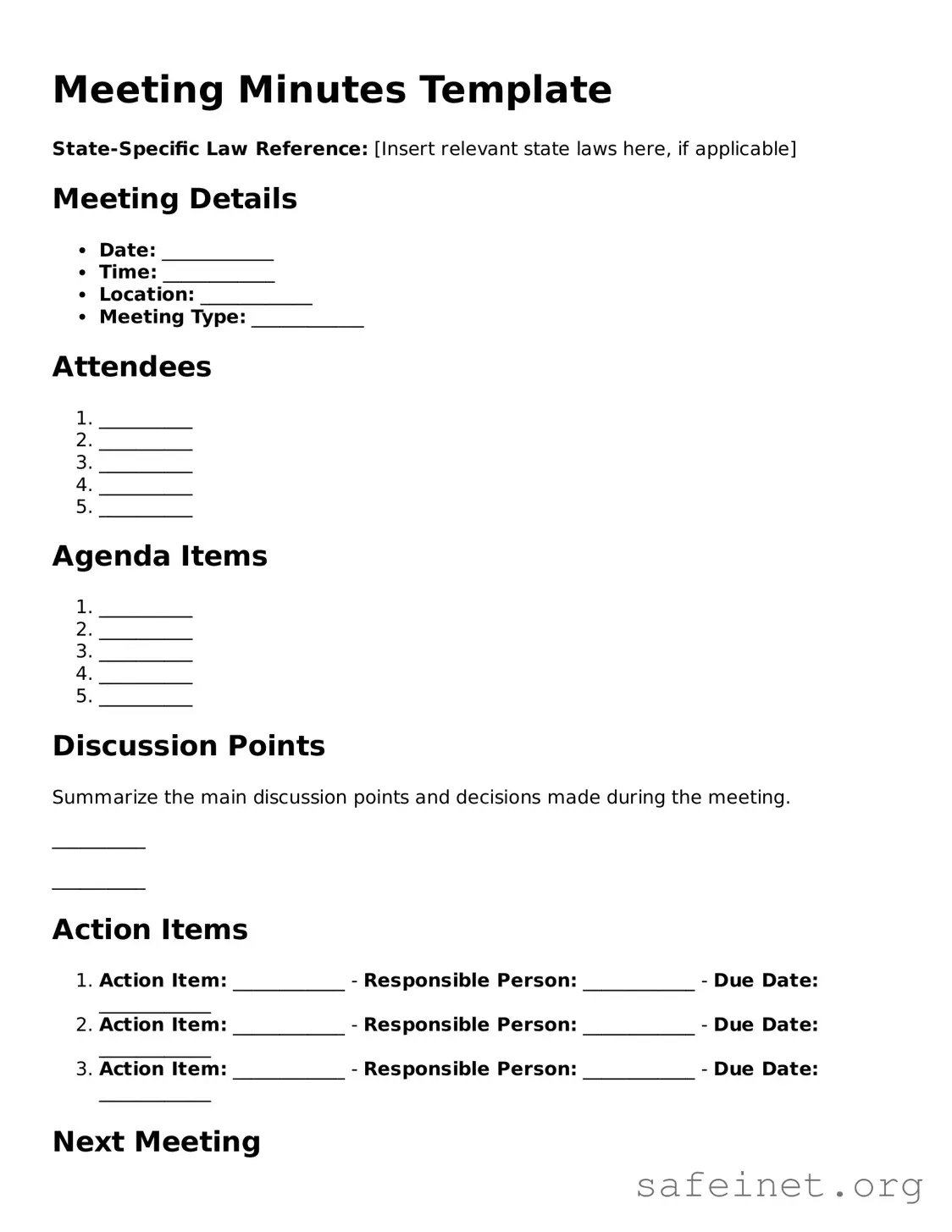
Meeting minutes are essential for keeping track of discussions, decisions, and action items during a meeting. They serve as an official record that can be referred back to, ensuring that everyone is on the same page. A well-structured Meeting Minutes form typically includes key details such as the date, time, and location of the meeting, as well as the names of attendees and absentees. It captures the agenda items discussed, highlights any decisions made, and outlines the responsibilities assigned to participants. Additionally, the form may include a section for noting any follow-up tasks and deadlines. By using a standardized format, organizations can streamline their meeting processes and enhance communication among team members. This form not only aids in accountability but also fosters transparency within the group, making it a valuable tool for effective collaboration.
Meeting Minutes Template
State-Specific Law Reference: [Insert relevant state laws here, if applicable]
Meeting Details
Attendees
Agenda Items
Discussion Points
Summarize the main discussion points and decisions made during the meeting.
__________
__________
Action Items
Next Meeting
Date: ____________
Time: ____________
Location: ____________
Additional Notes
__________
__________
| Fact Name | Description |
|---|---|
| Purpose | The Meeting Minutes form is used to document the discussions and decisions made during a meeting. |
| Participants | This form typically includes the names of attendees, absentees, and any guests present during the meeting. |
| Agenda Items | Agenda items discussed during the meeting are listed to provide clarity on the topics covered. |
| Decisions Made | Any resolutions or decisions made during the meeting are recorded to ensure accountability and follow-up. |
| State-Specific Forms | Some states have specific requirements for meeting minutes based on corporate laws or non-profit regulations. |
| Governing Laws | For example, in California, the Corporations Code Section 1500 outlines the requirements for corporate meeting minutes. |
| Retention | Meeting minutes should be retained for a specified period, often outlined in state laws or organizational policies. |
Filling out the Meeting Minutes form is an important task that helps capture the essence of discussions and decisions made during a meeting. By following the steps below, you can ensure that all necessary information is documented clearly and accurately.
What is the Meeting Minutes form?
The Meeting Minutes form is a document used to record the key points discussed during a meeting. It serves as an official record of what transpired, including decisions made, action items, and any important announcements. This form helps ensure that all participants are on the same page and can refer back to the discussions later on.
Who is responsible for filling out the Meeting Minutes form?
Typically, the responsibility of filling out the Meeting Minutes falls on the designated secretary or note-taker for the meeting. However, any participant can contribute to the minutes, especially if they have specific insights or details to share. It's essential that the form is completed accurately to reflect the meeting's content.
When should the Meeting Minutes form be completed?
The Meeting Minutes form should be completed as soon as possible after the meeting concludes. This ensures that the information is fresh in the note-taker's mind. Ideally, the minutes should be distributed to all attendees within a few days to maintain clarity and accountability.
What information should be included in the Meeting Minutes form?
Key information to include in the Meeting Minutes form consists of the meeting date, time, and location, along with a list of attendees. Summaries of discussions, decisions made, and assigned action items should also be noted. Any important announcements or future meeting dates can be added as well.
Can the Meeting Minutes form be modified after the meeting?
Yes, the Meeting Minutes form can be modified after the meeting, but changes should be made carefully. If corrections are necessary, they should be documented clearly, and ideally, the updated minutes should be shared with all participants. This helps maintain transparency and ensures everyone is aware of any amendments.
How long should Meeting Minutes be kept?
Meeting Minutes should be kept for a significant period, often recommended to be at least three to five years. This allows for future reference and can be important for compliance and organizational history. Ensure that they are stored in a secure and accessible location.
What if there are disagreements about what was discussed in the meeting?
If there are disagreements about the content of the Meeting Minutes, it’s important to address them promptly. Participants should be encouraged to review the minutes and provide feedback. A discussion can be held to clarify any misunderstandings, and necessary adjustments can be made to the minutes.
Is there a specific format for the Meeting Minutes form?
While there is no universally required format for the Meeting Minutes form, it is best to follow a clear and organized structure. A typical format includes sections for the meeting details, attendees, main discussion points, decisions made, and action items. Consistency in format helps make the minutes easier to read and reference.
Failing to include the date and time of the meeting. This information is crucial for future reference.
Not listing all attendees. Omitting names can lead to confusion about who was present and who contributed to the discussion.
Using vague language when summarizing discussions. Clear and specific notes help ensure that the intent and decisions made are well understood.
Neglecting to document action items and deadlines. This can result in tasks being overlooked or forgotten.
Not assigning responsibility for action items. Clearly stating who is responsible for each task promotes accountability.
Overloading the minutes with unnecessary details. Focus on key points to keep the document concise and relevant.
Using a format that is difficult to read. A clear structure with headings and bullet points enhances readability.
Failing to distribute the minutes in a timely manner. Prompt sharing ensures that all participants have a record of the meeting while the information is still fresh.
When conducting meetings, maintaining accurate records is essential for clarity and accountability. Alongside the Meeting Minutes form, several other documents can enhance the meeting process and ensure that all relevant information is captured and easily accessible. Below is a list of commonly used forms and documents that complement the Meeting Minutes.
Utilizing these documents alongside the Meeting Minutes form can significantly enhance the effectiveness of meetings. By ensuring that all relevant information is documented and accessible, organizations can foster better communication and collaboration among team members.
The first document that shares similarities with Meeting Minutes is the Agenda. An agenda outlines the topics to be discussed during a meeting, serving as a roadmap for participants. While meeting minutes capture what was discussed, the agenda sets the stage for those discussions. Both documents are essential for effective communication, ensuring that all participants are aware of what to expect and what decisions need to be made.
Another comparable document is the Action Item List. This list details specific tasks assigned during a meeting, including who is responsible for each task and the deadlines for completion. Like meeting minutes, the action item list serves to hold participants accountable and ensures follow-up on important discussions. Both documents aim to enhance productivity by clarifying responsibilities and expectations.
Meeting Summaries also bear a resemblance to meeting minutes. A summary provides a brief overview of the discussions and decisions made, often highlighting key points without the detailed structure of formal minutes. While minutes may include a verbatim account of discussions, summaries distill the information into a more digestible format. Both documents serve the purpose of keeping stakeholders informed about meeting outcomes.
Another related document is the Attendance Record. This document tracks who was present at a meeting, noting any absences. While meeting minutes may include attendance as part of the record, an attendance record focuses solely on participants. Both documents are crucial for maintaining accountability and ensuring that all relevant parties are engaged in the decision-making process.
Meeting Notes, often taken informally by participants, share similarities with meeting minutes. While minutes are typically a formal record, meeting notes can be more personal and subjective. They may include insights, thoughts, and reflections from attendees. Both serve to document discussions, but meeting notes are often less structured and can vary significantly from one participant to another.
Another document that aligns with meeting minutes is the Memorandum. A memorandum is often used to communicate information within an organization, summarizing discussions or decisions. Like meeting minutes, a memorandum aims to inform stakeholders about important matters. However, memoranda may also serve to propose actions or changes, whereas minutes focus on what has already occurred.
Reports, particularly those summarizing the outcomes of meetings or projects, are also similar to meeting minutes. Reports often include findings, analyses, and recommendations based on discussions held during meetings. Both documents aim to convey information clearly and can serve as a record for future reference. However, reports typically offer more comprehensive insights, while minutes focus on specific discussions.
Another related document is the Board Resolution. This formal document records decisions made by a board or committee during a meeting. While meeting minutes capture the discussions leading to a decision, a resolution states the decision itself. Both documents are vital for organizational governance, ensuring that decisions are documented and can be referenced in the future.
Lastly, the Project Charter can be considered similar to meeting minutes in that it outlines the objectives, scope, and participants of a project, often stemming from initial meetings. While the charter is more focused on the overarching goals of a project, meeting minutes detail the discussions that contribute to those goals. Both documents are essential for aligning team members and ensuring that everyone understands their roles and responsibilities.
When filling out the Meeting Minutes form, it’s essential to ensure clarity and accuracy. Here are some guidelines to follow:
Conversely, there are also common pitfalls to avoid:
Meeting minutes play a crucial role in documenting discussions and decisions made during meetings. However, several misconceptions can lead to confusion about their purpose and use. Here are eight common misconceptions about meeting minutes:
While meeting minutes do summarize discussions, they also record decisions made, action items assigned, and key points of discussion. They serve as a detailed account of what transpired.
While technically anyone can take minutes, it is best if the person is familiar with the meeting's agenda and context. A good minute-taker can capture important details and nuances effectively.
On the contrary, meeting minutes are vital for accountability and follow-up. They provide a reference point for participants and ensure that action items are completed.
Minutes should focus on key points, decisions, and action items rather than verbatim transcripts of discussions. This keeps them concise and useful.
Informal meetings can also benefit from having minutes. They help maintain clarity and continuity, especially in ongoing projects or discussions.
Minutes serve as a record for anyone interested in the meeting's outcomes. They can be shared with stakeholders who were not present to keep everyone informed.
Minutes can be amended if errors are found or if additional information needs to be included. It is essential to ensure accuracy before finalizing them.
While they may seem like a formality, meeting minutes are a critical tool for effective communication and project management. They help track progress and ensure everyone is on the same page.
Understanding these misconceptions can enhance the effectiveness of meeting minutes and improve overall meeting productivity.
Filling out and using the Meeting Minutes form effectively can help keep everyone on the same page. Here are some key takeaways to consider: