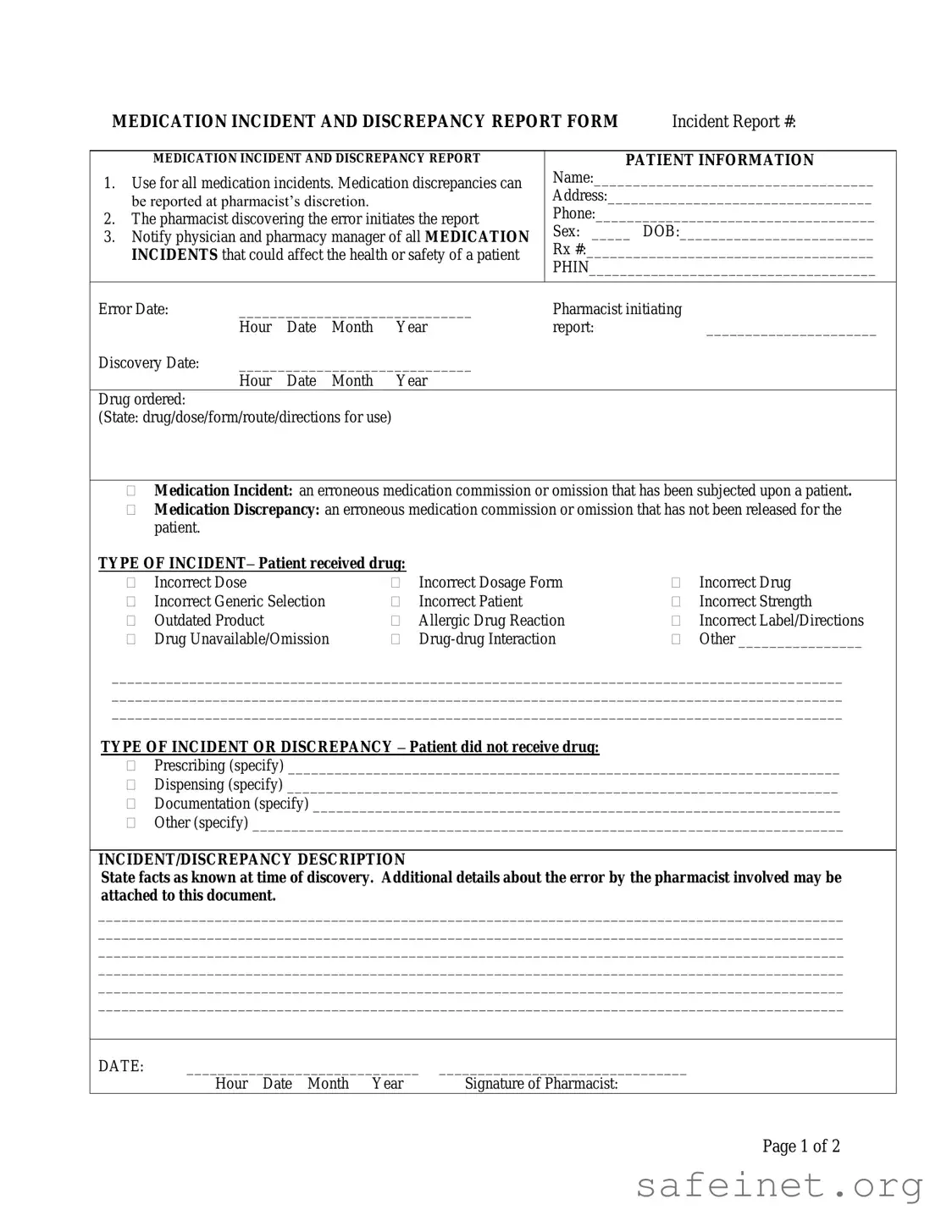
Medication errors can have serious consequences for patient safety and health. To address these incidents effectively, the Medication Error form serves as a crucial tool for pharmacists and healthcare providers. This form must be used for all medication incidents, and pharmacists have the discretion to report medication discrepancies. The process begins with the pharmacist who discovers the error, who is responsible for initiating the report. It is essential to notify both the physician and the pharmacy manager about any medication incidents that could potentially impact a patient's well-being. The form collects vital patient information, including name, address, phone number, date of birth, and relevant prescription details. It also categorizes the type of incident, whether it involves an incorrect dose, drug, or patient, among other factors. Additionally, the form allows pharmacists to document contributing factors and the severity of the incident. This thorough documentation helps ensure that appropriate follow-up actions are taken, whether through education, policy changes, or system improvements. Ultimately, the Medication Error form aims to enhance patient safety and improve healthcare practices.

MEDICATION INCIDENT AND DISCREPANCY REPORT FORM |
Incident Report #: |
MEDICATION INCIDENT AND DISCREPANCY REPORT
1.Use for all medication incidents. Medication discrepancies can be reported at pharmacist’s discretion.
2.The pharmacist discovering the error initiates the report
3.Notify physician and pharmacy manager of all MEDICATION INCIDENTS that could affect the health or safety of a patient
PATIENT INFORMATION
Name:____________________________________
Address:__________________________________
Phone:____________________________________
Sex: _____ DOB:_________________________
Rx #:_____________________________________
PHIN_____________________________________
Error Date: |
______________________________ |
Pharmacist initiating |
|
|||
|
Hour |
Date |
Month |
Year |
report: |
______________________ |
Discovery Date: |
______________________________ |
|
|
|||
|
Hour |
Date |
Month |
Year |
|
|
Drug ordered: |
|
|
|
|
|
|
(State: drug/dose/form/route/directions for use) |
|
|
|
|||
Medication Incident: an erroneous medication commission or omission that has been subjected upon a patient.
Medication Discrepancy: an erroneous medication commission or omission that has not been released for the patient.
TYPE OF INCIDENT– Patient received drug: |
|
|
|
||
|
Incorrect Dose |
|
Incorrect Dosage Form |
|
Incorrect Drug |
|
Incorrect Generic Selection |
|
Incorrect Patient |
|
Incorrect Strength |
|
Outdated Product |
|
Allergic Drug Reaction |
|
Incorrect Label/Directions |
|
Drug Unavailable/Omission |
|
|
Other ________________ |
|
______________________________________________________________________________________________
______________________________________________________________________________________________
______________________________________________________________________________________________
TYPE OF INCIDENT OR DISCREPANCY – Patient did not receive drug:
Prescribing (specify) _______________________________________________________________________
Dispensing (specify) _______________________________________________________________________
Documentation (specify) ____________________________________________________________________
Other (specify) ____________________________________________________________________________
INCIDENT/DISCREPANCY DESCRIPTION
State facts as known at time of discovery. Additional details about the error by the pharmacist involved may be attached to this document.
________________________________________________________________________________________________
________________________________________________________________________________________________
________________________________________________________________________________________________
________________________________________________________________________________________________
________________________________________________________________________________________________
________________________________________________________________________________________________
DATE: |
______________________________ |
________________________________ |
|
Hour Date Month Year |
Signature of Pharmacist: |
Page 1 of 2

CONTRIBUTING FACTORS
(To be completed by pharmacist responsible)
|
Improper patient identification |
Misread/misinterpreted drug order (include verbal orders) |
|
|
Incorrect transcription |
|
Drug unavailable |
Lack of patient counselling |
|
Other |
|
|
DATE: |
______________________________ |
__________________ |
|
|
||||
|
|
Hour Date Month Year |
Signature |
|
|
|
|||
|
NOTIFICATION – Complete the following information according to Standards of Practice. |
||||||||
1. |
Patient notified: |
|
|
|
|
|
|
|
|
|
|
|
___________________________ |
|
|||||
|
|
|
Hour |
Date |
Month |
Year |
|||
2. |
Physician notified: ____ |
______________________________ |
|
||||||
|
|
Yes/No |
Hour |
Date |
Month |
Year |
|||
|
|
|
|
|
|
|
|
|
|
|
SEVERITY |
|
|
|
|
|
|
|
|
|
|
None |
|
No change in patient’s condition: no medical intervention |
|||||
|
|
Minor |
|
|
|
required |
|
|
|
|
|
Major |
|
Produces a temporary systemic or localized response: does |
|||||
|
|
|
|
|
|
not cause ongoing complications |
|||
|
|
|
|
Requires immediate medical intervention |
|||||
|
OUTCOME OF INVESTIGATION |
|
|
|
|
|
|
|
|
|
|
|
|
|
|
|
|
|
|
|
|
|
|
|
|
|
|
||
|
Problem Identification |
|
|
|
Action |
|
|
|
|
|
|
Lack of knowledge |
|
|
Education provided |
||||
|
|
Performance problem |
|
|
Policy/procedure changed |
||||
|
|
Administration problem |
|
|
System changed |
|
|
||
|
|
Other |
|
|
Individual awareness |
||||
|
|
|
|
|
Group awareness |
||||
|
|
|
|
|
Other |
|
|
|
|
|
|
|
|
|
|||||
|
RESOLUTION OF PROBLEM THAT RESULTED IN THE ERROR BEING MADE: |
||||||||
|
|
|
|
|
|
|
|
||
|
Signature: |
Date: |
Signature: |
Date: |
|||||
|
(Pharmacist filling out the form) |
|
|
|
(Pharmacy Manager) |
||||
PHARMACY USE ONLY
Page 2 of 2
| Fact Name | Description |
|---|---|
| Purpose | This form is used to report all medication incidents and discrepancies. Pharmacists can report discrepancies at their discretion. |
| Initiation | The report is initiated by the pharmacist who discovers the medication error. |
| Notification Requirement | It is necessary to notify both the physician and the pharmacy manager of any medication incidents that could impact patient safety. |
| Incident Types | Types of incidents include incorrect doses, incorrect drugs, outdated products, and allergic reactions, among others. |
| Contributing Factors | Factors such as improper patient identification and misinterpretation of drug orders must be documented by the responsible pharmacist. |
| State-Specific Laws | Each state has its own governing laws regarding medication errors. For example, California's Business and Professions Code Section 4160 addresses pharmacy practices. |
Completing the Medication Error form requires careful attention to detail and accuracy. Once the form is filled out, it will be submitted to the appropriate parties for review and action. This process is essential to ensure patient safety and improve medication management practices.
What is the purpose of the Medication Error form?
The Medication Error form is designed to document any incidents or discrepancies related to medication. It serves as a tool for pharmacists to report errors that could potentially affect a patient's health or safety. This form ensures that all relevant details are captured, allowing for better understanding and prevention of future errors.
Who should fill out the Medication Error form?
The form should be initiated by the pharmacist who discovers the error. It is important for the pharmacist to provide accurate information regarding the incident, including the specifics of the medication involved and the circumstances surrounding the error.
What types of incidents can be reported using this form?
Incidents that can be reported include medication errors where a patient received the wrong drug, incorrect dosage, or outdated products. Additionally, discrepancies can be reported if a patient did not receive the prescribed medication due to prescribing, dispensing, or documentation errors.
What information is required from the patient on the form?
Patient information is crucial for accurately documenting the incident. The form requires the patient's name, address, phone number, sex, date of birth, prescription number, and PHIN. This information helps in tracking the incident and ensuring appropriate follow-up.
What should be included in the incident description?
The incident description should state the facts as known at the time of discovery. It is important to include specific details about the error, such as what went wrong and any contributing factors. Additional notes from the pharmacist involved may also be attached to provide further context.
What steps should be taken after completing the form?
Once the form is completed, it is essential to notify both the patient and the physician about the incident. This notification should occur promptly to ensure that any necessary medical interventions can be initiated. The pharmacist should document the time and date of these notifications on the form.
How is the severity of the incident assessed?
The severity of the incident is categorized based on its impact on the patient's condition. Options range from "none" to "requires immediate medical intervention." This assessment helps in understanding the seriousness of the error and guides the necessary follow-up actions.
What happens after the investigation of the incident?
Following the investigation, the form allows for documenting the outcomes and resolutions. This may include identifying problems, providing education, or changing policies and procedures. The goal is to prevent similar incidents in the future and improve overall medication safety.
Who signs the form once it is completed?
Once the form is completed, it must be signed by the pharmacist who filled it out and the pharmacy manager. Their signatures indicate that they have reviewed the incident and the information provided, ensuring accountability and oversight in the reporting process.
Incomplete Patient Information: Failing to provide all required patient details can lead to confusion and hinder effective communication. Ensure that the name, address, phone number, sex, date of birth, and other relevant identifiers are filled out completely.
Incorrect Incident Type Selection: Selecting the wrong type of incident can misrepresent the situation. It is important to accurately identify whether it is a medication incident or discrepancy, as this affects how the report is handled.
Insufficient Incident Description: A vague or incomplete description of the incident may result in misunderstandings. Include all pertinent facts known at the time of discovery to provide clarity and context for the investigation.
Neglecting Notification Protocols: Failing to notify the physician or pharmacy manager as required can lead to serious repercussions. It is essential to follow the notification guidelines to ensure that all relevant parties are informed promptly.
The Medication Error form is an essential document for reporting incidents and discrepancies related to medication administration. However, it often works in conjunction with other forms and documents that help ensure patient safety and proper communication among healthcare professionals. Below is a list of documents frequently used alongside the Medication Error form.
These documents work together to create a robust system for managing medication errors and enhancing patient safety. Proper documentation and communication are critical in healthcare settings, ensuring that all team members are informed and equipped to prevent future incidents.
The Incident Report Form is a crucial document used across various sectors, including healthcare, to record events that deviate from standard procedures. Similar to the Medication Error form, it captures details about incidents that could impact safety and quality. This form typically includes sections for describing the incident, identifying those involved, and outlining any immediate actions taken. Just like the Medication Error form, the Incident Report Form emphasizes the importance of transparency and communication, ensuring that all relevant parties are informed about incidents that may affect patient care.
The Adverse Event Report is another document closely related to the Medication Error form. It specifically focuses on events that result in harm to a patient due to medical care. This report details the nature of the event, the circumstances surrounding it, and any actions taken to mitigate harm. Both forms serve to document errors and promote learning within the healthcare system. They aim to improve patient safety by identifying trends and areas for improvement, thus fostering a culture of accountability and continuous enhancement of care practices.
The Quality Assurance Report is a document that evaluates the effectiveness of healthcare services and identifies areas needing improvement. Like the Medication Error form, it collects data on incidents and discrepancies that affect patient care. This report analyzes patterns over time, helping organizations develop strategies to enhance service delivery. Both documents share the goal of improving patient outcomes by systematically addressing issues that arise within the healthcare system.
The Risk Management Report is designed to assess and mitigate risks within healthcare settings. Similar to the Medication Error form, it identifies potential hazards that could lead to patient harm. This report often includes recommendations for policy changes or training initiatives to prevent future incidents. By focusing on proactive measures, both the Risk Management Report and the Medication Error form aim to create safer environments for patients and healthcare providers alike.
The Patient Safety Report is another document that aligns closely with the Medication Error form. This report focuses on incidents that compromise patient safety, documenting details about the event and its impact. Both forms prioritize patient well-being and advocate for a systematic approach to identifying and addressing safety concerns. By collecting and analyzing data from these reports, healthcare organizations can implement changes that significantly reduce the likelihood of future errors.
When filling out the Medication Error form, it's crucial to follow certain guidelines to ensure accuracy and clarity. Here are six things you should and shouldn't do:
Filling out the Medication Error form is a crucial step in ensuring patient safety and improving pharmacy practices. Here are some key takeaways to keep in mind: