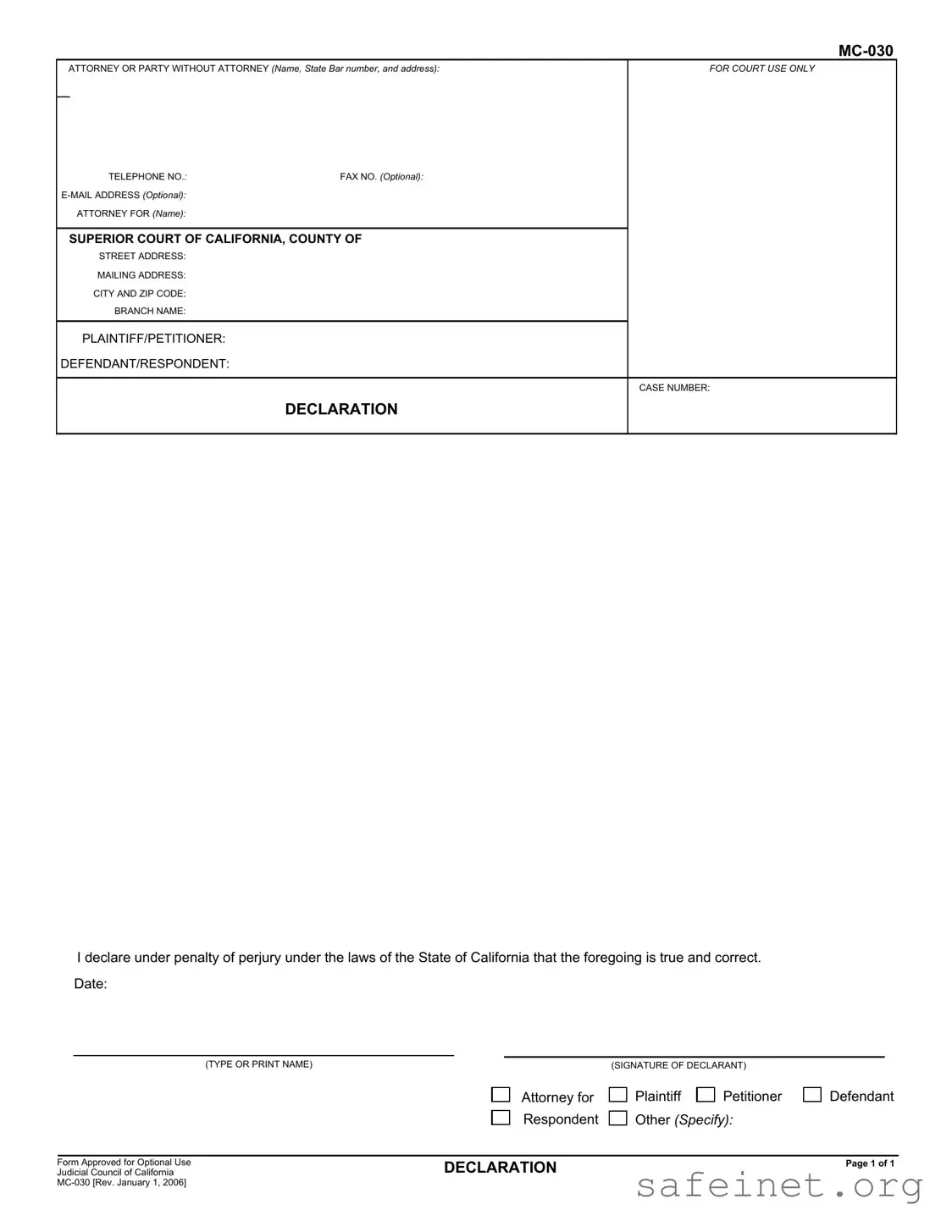
The MC-030 form is an essential document utilized in California's legal system, primarily aimed at individuals representing themselves or parties without an attorney. This form facilitates the declaration process, allowing individuals to affirm the truthfulness of the information provided under penalty of perjury. It includes critical sections such as the name and contact details of the declarant, which may be either an attorney or a self-represented party. Additionally, the form requires the identification of the court and case details, ensuring that the declaration is appropriately linked to the relevant legal matter. By providing a structured format, the MC-030 form streamlines communication with the court, making it easier for parties to present their case effectively. It is important to note that while optional, including a fax number and email address can enhance communication efficiency. The declaration concludes with a signature line, where the declarant affirms the accuracy of their statements, reinforcing the document's legal standing.
ATTORNEY OR PARTY WITHOUT ATTORNEY (Name, State Bar number, and address): |
FOR COURT USE ONLY |
TELEPHONE NO.: |
FAX NO. (Optional): |
|
|
ATTORNEY FOR (Name): |
|
SUPERIOR COURT OF CALIFORNIA, COUNTY OF
STREET ADDRESS:
MAILING ADDRESS:
CITY AND ZIP CODE:
BRANCH NAME:
PLAINTIFF/PETITIONER:
DEFENDANT/RESPONDENT:
CASE NUMBER:
DECLARATION
I declare under penalty of perjury under the laws of the State of California that the foregoing is true and correct.
Date:
(TYPE OR PRINT NAME) |
(SIGNATURE OF DECLARANT) |
|
|
|
||||||
|
|
Attorney for |
|
Plaintiff |
|
|
Petitioner |
|
|
Defendant |
|
|
|
|
|
|
|
||||
|
|
|
|
|
|
|||||
|
|
Respondent |
|
Other (Specify): |
|
|
|
|||
|
|
|
|
|
|
|||||
Form Approved for Optional Use Judicial Council of California
DECLARATION
Page 1 of 1
| Fact Name | Description |
|---|---|
| Form Purpose | The MC-030 form is used for declarations in court proceedings in California. |
| Governing Law | This form is governed by the California Rules of Court and relevant state laws. |
| Who Uses It | Attorneys and parties without attorneys may use this form to submit declarations. |
| Contact Information | The form requires the contact information of the attorney or party, including name, address, and phone number. |
| Optional Fields | Fax number and email address are optional fields on the form. |
| Signature Requirement | A signature is required from the declarant, affirming the truthfulness of the declaration. |
| Form Approval | The MC-030 form is approved for optional use by the Judicial Council of California. |
| Revision Date | The current version of the form was revised on January 1, 2006. |
| Page Information | The form is a single-page document, labeled as Page 1 of 1. |
After completing the MC-030 form, it is essential to review the information for accuracy before submitting it to the court. Ensure that all required fields are filled out correctly to avoid any delays in processing.
What is the purpose of the MC-030 form?
The MC-030 form is used in California courts to provide a declaration under penalty of perjury. This form allows individuals, whether they are attorneys or parties representing themselves, to affirm that the information they are submitting is true and correct. It serves as a crucial part of various legal proceedings, ensuring that the court has accurate and reliable information from the parties involved.
Who needs to fill out the MC-030 form?
What information is required on the MC-030 form?
The MC-030 form requires several key pieces of information. This includes the name and State Bar number of the attorney, if applicable, as well as the address and contact information for the individual or attorney submitting the form. Additionally, it requires the names of the parties involved in the case, such as the plaintiff or defendant, and the case number. Lastly, the form includes a declaration section where the individual must sign and date the document, affirming the truthfulness of the information provided.
Is the MC-030 form mandatory for all court cases?
The MC-030 form is not mandatory for every court case, but it is required when a declaration is necessary. If a party needs to provide a sworn statement to support their position or evidence in a case, they should use this form. It is advisable to consult with legal counsel or court guidelines to determine when the MC-030 form is needed in specific situations.
Missing Information: One common mistake is not filling out all required fields. Ensure that every section, such as the name, address, and case number, is completed. Incomplete forms can lead to delays or rejections.
Incorrect Case Number: Double-check the case number entered. Using an incorrect case number can cause confusion and may result in your form being filed under the wrong case.
Signature Issues: Failing to sign the form is a frequent error. Make sure to sign and date the form where indicated. An unsigned form is not valid and will not be processed.
Wrong Contact Information: Providing inaccurate contact details, like a wrong phone number or email address, can hinder communication. Always verify that your contact information is current and correct.
Not Declaring Under Penalty of Perjury: It’s essential to include the declaration statement. Forgetting this part can invalidate your form. Make sure you declare that the information is true and correct.
Using Outdated Forms: Ensure you are using the most recent version of the MC-030 form. Outdated forms may not be accepted by the court. Always check for the latest version before filling it out.
The MC-030 form is commonly used in California courts for declarations made by parties or their attorneys. However, there are several other forms and documents that often accompany it in legal proceedings. Each of these documents serves a specific purpose and helps ensure that the court has all necessary information to make informed decisions.
Each of these documents plays a vital role in the legal process. Understanding their functions can help parties navigate the complexities of court proceedings more effectively. Always ensure that you have the correct forms and that they are completed accurately to avoid delays in your case.
The MC-030 form is similar to the Declaration form (Form MC-020) used in California courts. Both documents serve to provide a sworn statement of facts, allowing individuals to declare information under penalty of perjury. The MC-020 form is often utilized in various legal proceedings to support motions or petitions. Like the MC-030, it requires the declarant's name, signature, and a statement affirming the truthfulness of the information provided. The primary difference lies in the specific context in which each form is used; the MC-030 is more focused on the attorney or party's information in a broader sense, while the MC-020 is tailored for declarations related to specific legal claims or motions.
Another document that shares similarities with the MC-030 is the Notice of Motion (Form MC-001). This form is used to inform the court and other parties about a motion that a party intends to file. Both forms require essential identifying information, such as the names of the parties involved and the case number. Additionally, both documents must be signed by the party or attorney filing them. However, the Notice of Motion is more about the procedural aspect of informing the court of an action, while the MC-030 focuses on the declaration of facts related to a specific issue.
The Proof of Service (Form POS-040) also bears resemblance to the MC-030. This form is used to demonstrate that legal documents have been properly delivered to the other parties involved in a case. Like the MC-030, it requires details about the parties and the case number. Both forms also necessitate a signature affirming the truth of the information provided. The key distinction is that the Proof of Service emphasizes the act of delivering documents, whereas the MC-030 centers on the declaration of facts by a party or attorney.
The Declaration of Disclosure (Form FL-140) is another document akin to the MC-030. This form is primarily used in family law cases to disclose financial information. Both forms require a declaration under penalty of perjury and include similar identifying information about the parties involved. While the MC-030 can be used in various types of cases, the FL-140 is specifically tailored for financial disclosures in divorce or custody matters, highlighting the different contexts in which these declarations are utilized.
Finally, the Affidavit (often used in various jurisdictions) is comparable to the MC-030. An affidavit is a written statement confirmed by oath or affirmation, often used as evidence in court. Like the MC-030, it requires the declarant to provide their name and signature, along with a statement affirming the truthfulness of the information. However, affidavits are typically more formal and may be used in a wider range of legal contexts, while the MC-030 is specifically designed for California courts and focuses on declarations related to a case.
When filling out the MC-030 form, it’s important to follow certain guidelines to ensure your submission is correct and accepted. Here’s a list of what to do and what to avoid:
This form can be used by both attorneys and individuals representing themselves in court. It is designed to accommodate various parties involved in legal proceedings.
Not every case requires the use of the MC-030 form. It is optional and should be used when a party wishes to submit a declaration under penalty of perjury.
While some information may be public, sensitive details should be handled with care. Parties should be mindful of what they include, as it may be accessible to others.
The form serves as a declaration but does not influence the court's decision. Outcomes depend on the merits of the case and the evidence presented.
Filling out the MC-030 form is an important step in legal proceedings. Here are some key takeaways to keep in mind:
Using the MC-030 form correctly can streamline your legal process and help ensure that your declarations are taken seriously by the court.