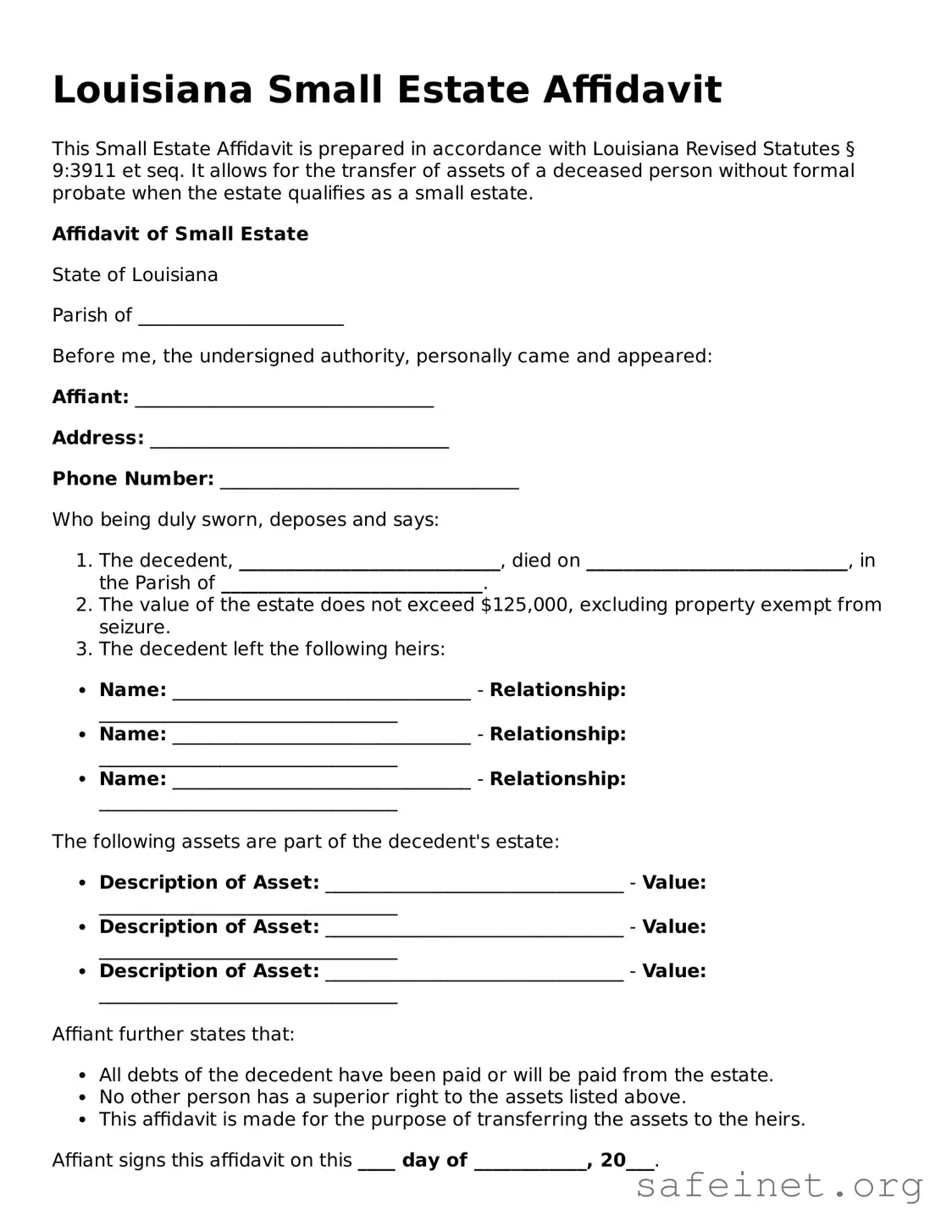
In Louisiana, navigating the process of settling a deceased person's estate can often feel overwhelming, especially when it comes to smaller estates. Fortunately, the Louisiana Small Estate Affidavit offers a streamlined approach for heirs and beneficiaries to manage the transfer of assets without the need for formal probate proceedings. This form is designed for estates with a total value that does not exceed a certain threshold, allowing for a more efficient resolution. By using the Small Estate Affidavit, individuals can assert their rights to inherit property, bank accounts, or other assets, simplifying what could otherwise be a lengthy legal process. The affidavit must be completed with accurate information and filed with the appropriate court, ensuring that all parties involved are recognized and that the deceased's wishes are honored. Understanding the requirements and procedures associated with this form can empower heirs to handle their loved one's estate with confidence and clarity.
Louisiana Small Estate Affidavit
This Small Estate Affidavit is prepared in accordance with Louisiana Revised Statutes § 9:3911 et seq. It allows for the transfer of assets of a deceased person without formal probate when the estate qualifies as a small estate.
Affidavit of Small Estate
State of Louisiana
Parish of ______________________
Before me, the undersigned authority, personally came and appeared:
Affiant: ________________________________
Address: ________________________________
Phone Number: ________________________________
Who being duly sworn, deposes and says:
The following assets are part of the decedent's estate:
Affiant further states that:
Affiant signs this affidavit on this ____ day of ____________, 20___.
Signature of Affiant: ________________________________
SWORN TO AND SUBSCRIBED before me this ____ day of ____________, 20___.
Notary Public: ________________________________
My Commission Expires: ________________________________
| Fact Name | Description |
|---|---|
| Governing Law | The Louisiana Small Estate Affidavit is governed by Louisiana Civil Code Article 3431. |
| Eligibility | The affidavit can be used for estates with a total value of $125,000 or less, excluding certain assets. |
| Filing Requirement | There is no need to file the Small Estate Affidavit with the court; it is presented to financial institutions or other entities holding assets. |
| Affidavit Signatories | The affidavit must be signed by the heir(s) or legatee(s) of the deceased. |
| Asset Types | Eligible assets include bank accounts, vehicles, and personal property, but real estate is generally excluded. |
| Time Limit | There is no specific time limit to file the affidavit after the decedent's death, but it is advisable to do so promptly. |
| Notarization | The affidavit must be notarized to ensure its validity. |
| Legal Effect | Once executed, the affidavit allows heirs to collect and manage the decedent's assets without formal probate proceedings. |
After gathering the necessary information and documents, you are ready to complete the Louisiana Small Estate Affidavit form. This form will require details about the deceased, the heirs, and the estate's assets. Once filled out, the affidavit must be signed and notarized before being submitted to the appropriate court or authority.
What is a Louisiana Small Estate Affidavit?
The Louisiana Small Estate Affidavit is a legal document that allows heirs to claim the assets of a deceased person without going through the formal probate process. This form is typically used when the value of the deceased's estate is below a certain threshold, making it easier and faster for heirs to access their inheritance.
Who is eligible to use the Small Estate Affidavit?
To use the Small Estate Affidavit, the total value of the estate must be less than $125,000, excluding certain assets such as life insurance and retirement accounts. Heirs must also be able to demonstrate their relationship to the deceased and their right to inherit under Louisiana law.
What assets can be claimed using the Small Estate Affidavit?
Heirs can claim various types of assets, including bank accounts, personal property, and real estate. However, some assets, like those held in a trust or those that have designated beneficiaries, may not be included in the affidavit.
How do I complete the Small Estate Affidavit?
Completing the Small Estate Affidavit involves filling out the form with accurate information about the deceased, their assets, and the heirs. It's important to provide detailed descriptions and values of the assets. Once completed, the affidavit must be signed in front of a notary public.
Do I need to file the Small Estate Affidavit with the court?
The Small Estate Affidavit does not need to be filed with the court. However, it should be presented to financial institutions or other entities holding the deceased's assets to facilitate the transfer of ownership to the heirs.
Is there a deadline for using the Small Estate Affidavit?
While there is no specific deadline for filing a Small Estate Affidavit, it is advisable to complete the process in a timely manner to avoid complications. Waiting too long may lead to issues with asset management or claims against the estate.
Can multiple heirs use the Small Estate Affidavit?
Yes, multiple heirs can use the Small Estate Affidavit together. All heirs must agree on the distribution of assets and should be included in the affidavit. This collaborative approach can help streamline the process.
What if there is a dispute among heirs?
If disputes arise among heirs regarding the estate, it may complicate the use of the Small Estate Affidavit. In such cases, it may be necessary to seek legal advice or consider formal probate proceedings to resolve the disagreements.
Can I use the Small Estate Affidavit for a deceased person who lived out of state?
The Small Estate Affidavit is specific to Louisiana law. If the deceased lived in another state, the laws of that state will apply. It is important to consult with an attorney in the relevant jurisdiction to understand the appropriate process.
Where can I obtain the Small Estate Affidavit form?
The Small Estate Affidavit form can typically be obtained from local parish courts, legal aid organizations, or online legal resources. Ensure that you are using the most current version of the form to avoid any issues.
Failing to determine eligibility: Before filling out the Louisiana Small Estate Affidavit, individuals must ensure that the estate qualifies under Louisiana law. The total value of the estate must not exceed the specified limit, which can lead to unnecessary complications if overlooked.
Incorrectly listing assets: It is crucial to accurately list all assets of the deceased. Omitting any property or including items that do not belong to the estate can create legal issues down the line.
Not including debts: Many people forget to mention the deceased's debts. This oversight can misrepresent the estate's value and lead to disputes among heirs.
Inaccurate personal information: Providing incorrect names, addresses, or dates of birth for the deceased or heirs can result in delays or rejections of the affidavit.
Neglecting signatures: All required signatures must be present. Failing to sign the affidavit or having the wrong individuals sign can invalidate the document.
Using outdated forms: It is essential to use the most current version of the Louisiana Small Estate Affidavit. Using an outdated form can lead to confusion and complications.
Not providing supporting documentation: Many people forget to include necessary documents, such as death certificates or proof of identity for heirs. These documents are often required to support the claims made in the affidavit.
Ignoring local laws: Each parish may have specific requirements or additional forms needed. Ignoring these local regulations can result in delays or rejection of the affidavit.
Filing in the wrong jurisdiction: It is important to file the Small Estate Affidavit in the correct court. Filing in the wrong location can complicate the process and cause unnecessary delays.
Failing to seek legal advice: Many individuals attempt to navigate the process without consulting a lawyer. While it is possible to fill out the affidavit independently, legal advice can help avoid mistakes and ensure compliance with the law.
The Louisiana Small Estate Affidavit is a useful tool for settling estates that fall below a certain value threshold, allowing heirs to bypass the formal probate process. However, several other documents may be necessary to ensure a smooth transition of assets. Below is a list of commonly used forms and documents that often accompany the Small Estate Affidavit.
These documents work in conjunction with the Louisiana Small Estate Affidavit to facilitate the efficient transfer of assets and ensure compliance with state laws. Understanding each form's purpose can help heirs navigate the estate settlement process more effectively.
The Louisiana Small Estate Affidavit is similar to the Affidavit of Heirship, which is often used to establish the heirs of a deceased person. This document serves to identify the rightful heirs without the need for formal probate proceedings. It typically includes information about the deceased, such as their date of death and a list of surviving family members. Like the Small Estate Affidavit, it simplifies the transfer of assets by providing a straightforward declaration of who inherits what, thereby avoiding lengthy legal processes.
Another document that resembles the Louisiana Small Estate Affidavit is the Affidavit for Collection of Personal Property. This affidavit allows individuals to collect personal property of a deceased person without going through probate. It is particularly useful for accessing bank accounts or personal belongings. Both documents aim to expedite the transfer of assets while minimizing legal complexities, making it easier for heirs to manage their loved one's estate.
The Summary Administration form, used in some states, also shares similarities with the Louisiana Small Estate Affidavit. Summary Administration allows for a quicker probate process for small estates. Like the Small Estate Affidavit, it is designed to simplify the distribution of assets, allowing heirs to bypass lengthy court proceedings. This document provides a streamlined approach to settling an estate, which can be a relief during an emotionally challenging time.
The Small Estate Affidavit is akin to the Will and Testament, though it serves a different purpose. A will outlines how a person's assets should be distributed after their death, while the Small Estate Affidavit is used to facilitate the transfer of assets without formal probate. Both documents are essential in estate planning, ensuring that an individual's wishes are honored, but the affidavit provides a more immediate solution for small estates.
The Petition for Probate is another document that shares some characteristics with the Small Estate Affidavit. A Petition for Probate is filed to initiate the probate process, which can be lengthy and complex. In contrast, the Small Estate Affidavit allows heirs to access the deceased's assets more quickly without court intervention. Both documents play crucial roles in estate management, but the affidavit is designed for efficiency in smaller estates.
The Transfer on Death Deed (TOD) is also similar, as it allows property owners to designate beneficiaries who will receive their property upon death. This deed avoids probate and simplifies the transfer process, much like the Small Estate Affidavit. While the TOD is specific to real estate, both documents serve the common goal of easing the burden on heirs and expediting the transfer of assets.
Lastly, the Small Estate Affidavit is comparable to the Affidavit of Debt Payment, which allows for the payment of debts owed to a deceased person without going through probate. This document enables heirs to settle outstanding debts efficiently, ensuring that the estate is managed responsibly. Both affidavits aim to simplify the process of handling a deceased person's affairs, focusing on minimizing legal hurdles and expediting asset distribution.
When completing the Louisiana Small Estate Affidavit form, it is important to follow specific guidelines to ensure accuracy and compliance with state laws. Below are five key actions to take and avoid.
The Louisiana Small Estate Affidavit is a useful tool for settling the estates of deceased individuals with limited assets. However, several misconceptions exist regarding its use and requirements. Below are seven common misunderstandings:
This is not entirely accurate. While the Small Estate Affidavit is often used for estates with minimal debts, it can still be applicable if the debts do not exceed the value of the estate's assets.
This is misleading. In Louisiana, the Small Estate Affidavit is typically limited to estates valued at $125,000 or less, excluding certain assets.
While it is beneficial for heirs to be on the same page, it is not a strict requirement. The affidavit can be filed by a single heir, provided they meet the necessary qualifications.
This is partially true. The affidavit simplifies the process and may allow heirs to bypass formal probate, but it does not eliminate the need for all legal processes in every situation.
This is incorrect. Each state has its own rules and forms for small estate affidavits. The Louisiana version has specific requirements that may differ from those in other states.
While it can be simpler than traditional probate, it still requires careful attention to detail. Errors in the affidavit can lead to delays or complications.
This is a misconception. Filing the affidavit allows heirs to claim assets, but the estate must still be managed and any debts settled before distribution can occur.
Understanding these misconceptions can help individuals navigate the process more effectively and ensure they are making informed decisions regarding estate matters in Louisiana.
When dealing with the Louisiana Small Estate Affidavit form, there are several important points to keep in mind. This process can simplify the transfer of assets after a person's death. Here are key takeaways to consider:
Understanding these aspects can help streamline the process and ensure that the estate is handled properly. The Small Estate Affidavit can be a useful tool for heirs navigating the aftermath of a loved one's passing.