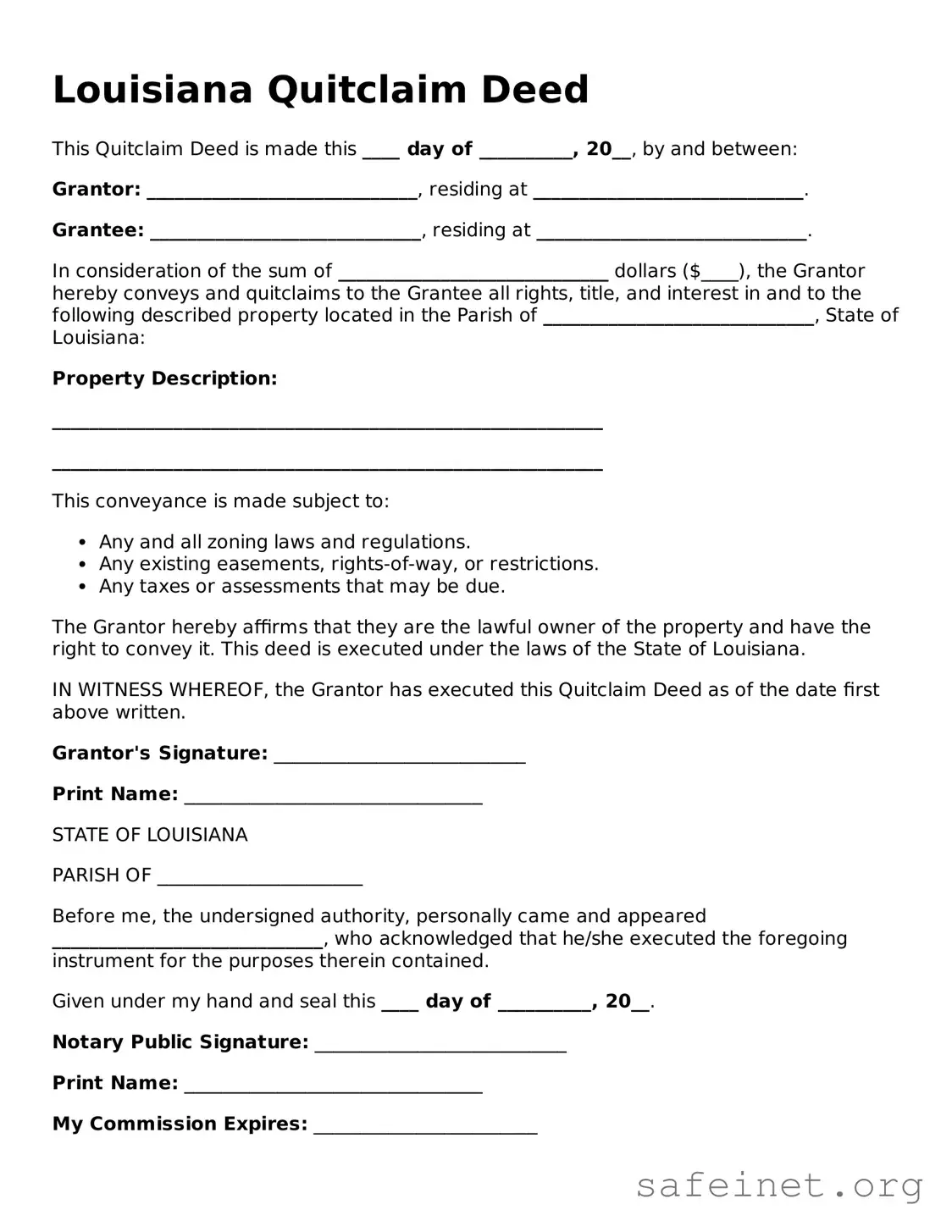
The Louisiana Quitclaim Deed form serves as a vital tool for property owners looking to transfer their interest in real estate without making any warranties about the title. This document allows individuals to convey their rights to a property to another party, often used in situations where the grantor may not have a clear title or when the transfer is between family members or acquaintances. Unlike other types of deeds, a quitclaim deed does not guarantee that the property is free of liens or other encumbrances, making it essential for the recipient to conduct due diligence. In Louisiana, specific requirements must be met for the deed to be valid, including the need for notarization and proper recording with the local parish clerk of court. Understanding these key elements can help ensure a smooth transfer process and protect the interests of all parties involved.
Louisiana Quitclaim Deed
This Quitclaim Deed is made this ____ day of __________, 20__, by and between:
Grantor: _____________________________, residing at _____________________________.
Grantee: _____________________________, residing at _____________________________.
In consideration of the sum of _____________________________ dollars ($____), the Grantor hereby conveys and quitclaims to the Grantee all rights, title, and interest in and to the following described property located in the Parish of _____________________________, State of Louisiana:
Property Description:
___________________________________________________________
___________________________________________________________
This conveyance is made subject to:
The Grantor hereby affirms that they are the lawful owner of the property and have the right to convey it. This deed is executed under the laws of the State of Louisiana.
IN WITNESS WHEREOF, the Grantor has executed this Quitclaim Deed as of the date first above written.
Grantor's Signature: ___________________________
Print Name: ________________________________
STATE OF LOUISIANA
PARISH OF ______________________
Before me, the undersigned authority, personally came and appeared _____________________________, who acknowledged that he/she executed the foregoing instrument for the purposes therein contained.
Given under my hand and seal this ____ day of __________, 20__.
Notary Public Signature: ___________________________
Print Name: ________________________________
My Commission Expires: ________________________
| Fact Name | Description |
|---|---|
| Definition | A Quitclaim Deed is a legal document that transfers ownership of real estate from one party to another without any warranties. |
| Governing Law | The Louisiana Quitclaim Deed is governed by Louisiana Civil Code, specifically Articles 2440-2448. |
| Parties Involved | The parties involved are the grantor (the person transferring the property) and the grantee (the person receiving the property). |
| No Guarantees | The Quitclaim Deed does not guarantee that the grantor has clear title to the property. |
| Use Cases | This form is often used among family members, in divorce settlements, or to clear up title issues. |
| Filing Requirements | To be effective, the deed must be signed by the grantor and filed with the local parish clerk of court. |
| Witnesses and Notarization | In Louisiana, the deed must be notarized and may require witnesses depending on the situation. |
| Tax Implications | Transfers made by Quitclaim Deed may be subject to transfer taxes, so check local regulations. |
| Revocation | A Quitclaim Deed cannot be revoked once executed and recorded, so careful consideration is necessary. |
After you have gathered all necessary information, you're ready to fill out the Louisiana Quitclaim Deed form. This document is crucial for transferring property ownership between parties. Make sure to have all the required details on hand to ensure a smooth process.
Once you've completed these steps, your Quitclaim Deed will be ready for submission. Make sure to keep a copy for your records and confirm that it has been filed correctly with the local authorities.
What is a Quitclaim Deed in Louisiana?
A Quitclaim Deed is a legal document used to transfer ownership of real estate from one party to another without any warranties or guarantees. In Louisiana, this type of deed is often used among family members or in situations where the parties know each other well. It simply conveys whatever interest the grantor has in the property.
How does a Quitclaim Deed differ from a Warranty Deed?
The main difference lies in the level of protection provided. A Warranty Deed guarantees that the grantor holds clear title to the property and has the right to sell it. In contrast, a Quitclaim Deed offers no such guarantees. The grantor does not assure the grantee of any rights to the property beyond what they may possess.
When should I use a Quitclaim Deed?
Quitclaim Deeds are commonly used in specific situations. You might consider using one during a divorce to transfer property between spouses, when adding or removing a name from the title, or when gifting property to a family member. They are also useful for clearing up title issues or when the parties know each other well.
What information is required on a Quitclaim Deed?
A Quitclaim Deed in Louisiana typically requires the names of the grantor and grantee, a description of the property, the date of the transfer, and the signature of the grantor. Including the property's legal description is crucial to ensure clarity about what is being transferred.
Do I need to notarize a Quitclaim Deed?
Yes, a Quitclaim Deed must be notarized to be legally binding in Louisiana. This process helps verify the identities of the parties involved and ensures that the document is executed correctly. After notarization, the deed should be filed with the local parish clerk's office.
Is there a fee for filing a Quitclaim Deed?
Yes, there is typically a fee associated with filing a Quitclaim Deed in Louisiana. This fee can vary by parish, so it's advisable to check with your local clerk's office for the exact amount. Additionally, there may be recording fees and taxes that apply.
Can I revoke a Quitclaim Deed?
Once a Quitclaim Deed is executed and recorded, it cannot be revoked unilaterally. If you wish to reverse the transfer, you would need to create a new legal document to convey the property back to the original owner. This process may involve additional legal steps.
What are the tax implications of using a Quitclaim Deed?
Using a Quitclaim Deed can have tax implications, particularly regarding property transfer taxes. In Louisiana, transfers between family members may be exempt from certain taxes, but it is essential to consult with a tax professional to understand any potential liabilities or benefits.
Can a Quitclaim Deed be contested?
Yes, a Quitclaim Deed can be contested in certain circumstances. If there is evidence of fraud, duress, or lack of capacity at the time of signing, a court may invalidate the deed. It is crucial to ensure that all parties fully understand the transaction and agree to the terms.
Where can I obtain a Quitclaim Deed form?
Quitclaim Deed forms can be obtained from various sources. Many legal websites offer downloadable templates, or you can visit your local courthouse for official forms. It's advisable to ensure that any form you use complies with Louisiana law and is tailored to your specific situation.
Not including all grantors and grantees: One common mistake is failing to list all parties involved. Each person who owns the property must be named as a grantor, and each person receiving the property must be named as a grantee.
Incorrect property description: The property must be described accurately. This includes the correct street address and legal description. Omitting details can lead to confusion or disputes later.
Missing signatures: All grantors must sign the deed. If even one signature is missing, the deed may not be valid.
Not having the deed notarized: A quitclaim deed must be notarized to be legally binding. Failing to do so can invalidate the document.
Using outdated forms: Laws can change, and using an outdated form may lead to issues. Always ensure you have the most current version of the quitclaim deed form.
Inaccurate date: The date on the deed should reflect when the transaction occurs. An incorrect date can create legal complications.
Not checking for liens: Before transferring property, it’s essential to check for any liens or encumbrances. Ignoring this step can lead to unexpected financial responsibilities.
Failing to record the deed: After completing the quitclaim deed, it must be recorded with the local parish clerk. Not doing so can result in the transfer being unrecognized.
Ignoring tax implications: Property transfers can have tax consequences. It’s wise to consult a tax professional to understand any potential liabilities.
Not seeking legal advice: Many people attempt to fill out the form without consulting a lawyer. Getting legal advice can help avoid common pitfalls and ensure the deed is valid.
A Louisiana Quitclaim Deed is an important document used to transfer property rights. When executing this deed, several other forms and documents may also be required to ensure a smooth transaction. Below are some commonly used documents that accompany the Quitclaim Deed.
Each of these documents plays a vital role in the property transfer process. Together, they help protect the interests of both the buyer and the seller, ensuring a clear and lawful transfer of ownership.
A Warranty Deed is similar to a Quitclaim Deed in that both are used to transfer property ownership. However, the key difference lies in the level of protection they offer. A Warranty Deed guarantees that the seller holds clear title to the property and has the right to sell it. It also protects the buyer against any future claims or disputes regarding ownership. In contrast, a Quitclaim Deed provides no such guarantees, making it a riskier option for buyers who want assurance about the property’s title status.
A Bargain and Sale Deed also shares similarities with a Quitclaim Deed, primarily in its function of transferring property. This type of deed implies that the seller has ownership of the property and the right to sell it, but it does not provide any warranties regarding the title. Like a Quitclaim Deed, a Bargain and Sale Deed offers less protection for the buyer compared to a Warranty Deed. This makes it more suitable for transactions between familiar parties, where trust is established.
An Executor’s Deed is another document that resembles a Quitclaim Deed, especially in the context of transferring property after someone’s death. This deed is used by an executor of an estate to transfer property from the deceased to the heirs or beneficiaries. While it serves a similar purpose of transferring ownership, it often lacks the warranties that come with a Warranty Deed. Thus, it operates under a similar principle of transferring rights without guaranteeing the title’s validity.
A Special Purpose Deed can also be compared to a Quitclaim Deed. This type of deed is used for specific purposes, such as transferring property between family members or in a divorce settlement. Like a Quitclaim Deed, it does not provide warranties about the title. The focus is on the intent of the parties involved rather than the security of the title, making it a straightforward option for certain types of transactions.
Lastly, a Deed of Trust shares a functional similarity with a Quitclaim Deed, particularly in real estate transactions. While a Quitclaim Deed is primarily about transferring ownership, a Deed of Trust is used to secure a loan with real property as collateral. Both documents involve the transfer of interest in property, but a Deed of Trust creates a security interest for the lender, whereas a Quitclaim Deed simply transfers ownership without any financial obligations attached. Understanding these distinctions is crucial for anyone involved in property transactions.
When filling out the Louisiana Quitclaim Deed form, it's important to approach the process with care. Here are five key dos and don'ts to keep in mind:
Here are five common misconceptions about the Louisiana Quitclaim Deed form:
Filling out and using a Louisiana Quitclaim Deed form can be a straightforward process if you keep a few key points in mind. Here are some essential takeaways to consider:
By keeping these key points in mind, you can navigate the process of filling out and using a Louisiana Quitclaim Deed with greater confidence and clarity.