In the realm of financial transactions, the Louisiana Promissory Note form serves as a vital tool for establishing clear and enforceable agreements between borrowers and lenders. This document outlines the borrower's promise to repay a specified sum of money to the lender, often accompanied by details regarding interest rates, payment schedules, and the consequences of default. The form is designed to protect both parties by ensuring that expectations are clearly defined and legally binding. Additionally, it can include provisions for late fees, prepayment options, and the choice of governing law, allowing for flexibility in various lending scenarios. As a foundational element in personal and business finance, understanding the nuances of this form is essential for anyone looking to navigate the complexities of borrowing and lending in Louisiana.
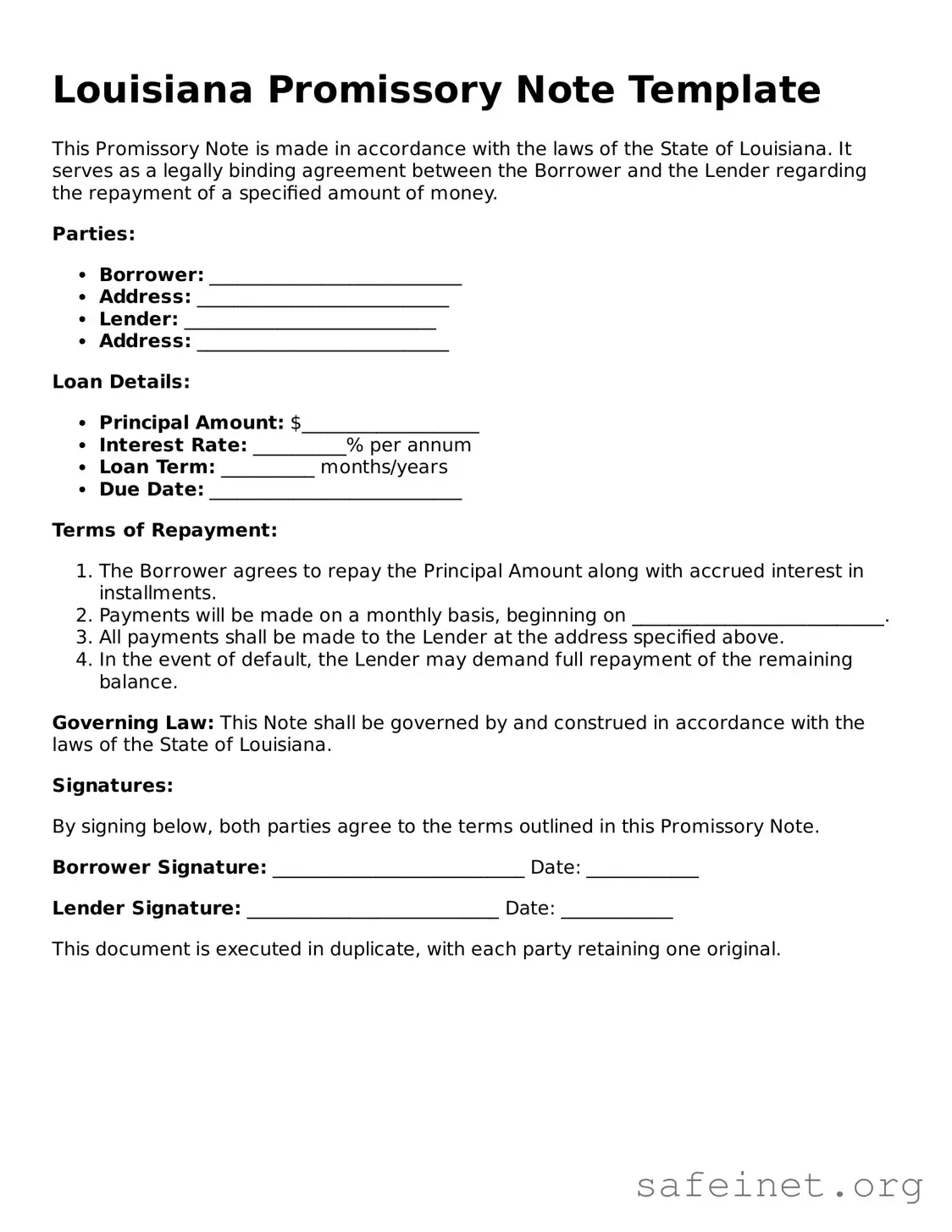
Louisiana Promissory Note Template
This Promissory Note is made in accordance with the laws of the State of Louisiana. It serves as a legally binding agreement between the Borrower and the Lender regarding the repayment of a specified amount of money.
Parties:
Loan Details:
Terms of Repayment:
Governing Law: This Note shall be governed by and construed in accordance with the laws of the State of Louisiana.
Signatures:
By signing below, both parties agree to the terms outlined in this Promissory Note.
Borrower Signature: ___________________________ Date: ____________
Lender Signature: ___________________________ Date: ____________
This document is executed in duplicate, with each party retaining one original.
| Fact Name | Description |
|---|---|
| Definition | A promissory note is a written promise to pay a specific amount of money at a certain time. |
| Governing Law | In Louisiana, promissory notes are governed by the Louisiana Civil Code, specifically Articles 3130 to 3139. |
| Parties Involved | The note involves two parties: the maker (who promises to pay) and the payee (who receives the payment). |
| Interest Rate | The interest rate can be specified in the note. If not, Louisiana law allows for a legal interest rate. |
| Payment Terms | Payment terms must be clear, including the due date and any installment plans if applicable. |
| Transferability | Promissory notes can be transferred to another party, making them negotiable instruments. |
| Default Consequences | If the maker defaults, the payee has the right to seek legal remedies to recover the owed amount. |
| Signature Requirement | The maker must sign the note for it to be valid and enforceable. |
Once you have obtained the Louisiana Promissory Note form, you will need to complete it accurately to ensure it serves its intended purpose. Follow the steps below carefully to fill out the form correctly.
After completing the form, ensure that all information is accurate and legible. It is advisable to keep copies for both parties for future reference.
What is a Louisiana Promissory Note?
A Louisiana Promissory Note is a written agreement in which one party promises to pay a specific amount of money to another party at a designated time or on demand. This document serves as a formal acknowledgment of a debt and outlines the terms of repayment. It can be used for personal loans, business transactions, or any situation where one party lends money to another.
What information is typically included in a Louisiana Promissory Note?
Typically, a Louisiana Promissory Note includes the names and addresses of the borrower and lender, the principal amount being borrowed, the interest rate (if applicable), the repayment schedule, and any specific terms regarding late payments or default. Additionally, it may contain clauses about what happens if the borrower fails to repay the loan as agreed.
Do I need to have a lawyer to create a Promissory Note in Louisiana?
While it is not legally required to have a lawyer draft a Promissory Note, it is highly advisable, especially for larger loans or complex agreements. A lawyer can ensure that the document complies with Louisiana laws and adequately protects your interests. However, simple notes can often be created using templates or forms available online.
Is a Promissory Note legally binding in Louisiana?
Yes, a properly executed Promissory Note is legally binding in Louisiana. This means that if one party fails to meet the terms outlined in the note, the other party can take legal action to enforce the agreement. To strengthen its enforceability, both parties should sign the document, and it may be beneficial to have it notarized.
What happens if the borrower defaults on the Promissory Note?
If the borrower defaults, meaning they fail to make payments as agreed, the lender has several options. They may choose to negotiate a new payment plan, pursue legal action to recover the owed amount, or potentially take possession of any collateral that was agreed upon in the note. The specific actions available will depend on the terms outlined in the Promissory Note.
Can a Promissory Note be modified after it has been signed?
Yes, a Promissory Note can be modified after it has been signed, but both parties must agree to the changes. It is essential to document any modifications in writing and have both parties sign the amended agreement. This helps prevent misunderstandings and ensures that the new terms are legally enforceable.
Are there tax implications for lending money through a Promissory Note?
Yes, there can be tax implications when lending money through a Promissory Note. The lender may need to report interest income on their tax return, while the borrower may be able to deduct interest payments, depending on the nature of the loan. It is advisable to consult a tax professional to understand the specific implications based on individual circumstances.
What is the difference between a Promissory Note and a loan agreement?
A Promissory Note is a simpler document that primarily focuses on the borrower's promise to repay the loan. It usually includes basic terms such as the amount borrowed, interest rate, and repayment schedule. In contrast, a loan agreement is more comprehensive and often includes additional details such as covenants, representations, and warranties. Loan agreements are typically used for larger or more complex loans.
Can a Promissory Note be secured or unsecured?
A Promissory Note can be either secured or unsecured. A secured Promissory Note is backed by collateral, such as property or assets, which the lender can claim if the borrower defaults. An unsecured Promissory Note does not have any collateral backing it, which means the lender relies solely on the borrower's promise to repay. Secured notes generally carry lower interest rates due to the reduced risk for the lender.
Incorrect Borrower Information: Many people fail to provide accurate details about the borrower. This includes the borrower's full name, address, and contact information. Missing or incorrect information can lead to complications in the future.
Ambiguous Loan Amount: Some individuals do not clearly state the loan amount. It is essential to write the amount both in numbers and words to avoid any misunderstandings. A vague amount can create disputes down the line.
Missing Interest Rate: Not specifying the interest rate is a common mistake. If the loan has an interest component, it should be clearly outlined. Leaving this out can lead to confusion regarding repayment terms.
Failure to Sign and Date: A promissory note must be signed and dated by both parties involved. Without signatures, the document may not hold up in legal situations. It’s crucial to ensure that all parties acknowledge their agreement.
The Louisiana Promissory Note is an essential document for recording a borrower's promise to repay a loan. However, several other forms and documents are often used in conjunction with it to ensure clarity and legal protection for all parties involved. Below is a list of these related documents.
Using these documents alongside the Louisiana Promissory Note can help clarify the terms of the loan and protect the interests of both parties. Ensuring that all necessary paperwork is in order is crucial for a smooth lending process.
A promissory note is a financial document that outlines a promise to pay a specific amount of money to a designated person or entity. It shares similarities with a loan agreement. Both documents detail the terms of borrowing money, including the amount, interest rate, repayment schedule, and consequences for default. However, a loan agreement may also include additional terms related to collateral and other obligations, making it more comprehensive than a simple promissory note.
A mortgage is another document that resembles a promissory note. It serves as a security instrument for a loan used to purchase real estate. While a promissory note focuses on the borrower's promise to repay the loan, a mortgage outlines the lender's rights to the property if the borrower fails to meet their obligations. Both documents are often executed together during real estate transactions.
A personal guarantee is similar to a promissory note in that it involves a promise to pay. However, it specifically binds an individual to repay a debt if the primary borrower defaults. This document provides additional security for lenders, as it holds an individual accountable for the debt, much like a promissory note holds the borrower accountable.
An IOU, or informal note, shares some characteristics with a promissory note. Both documents indicate a debt owed. However, an IOU is typically less formal and may not include specific repayment terms or interest rates. It serves as a simple acknowledgment of a debt rather than a binding agreement.
A business loan agreement also resembles a promissory note. It outlines the terms under which a business borrows money from a lender. Like a promissory note, it specifies the loan amount and repayment terms. However, a business loan agreement often includes more detailed provisions, such as covenants and conditions that the borrower must adhere to during the loan term.
A credit agreement is similar to a promissory note, as it establishes the terms of credit extended to a borrower. This document outlines the amount of credit, interest rates, and repayment terms. Unlike a promissory note, a credit agreement may cover multiple transactions and include provisions for future borrowing under the same terms.
A lease agreement has similarities to a promissory note in that it involves a promise to pay. In a lease, the tenant agrees to pay rent for the use of property. Both documents specify payment terms and can include consequences for non-payment. However, a lease also details the rights and responsibilities of both the landlord and tenant, making it more complex than a promissory note.
An installment agreement is another document that shares features with a promissory note. It outlines the terms for paying off a debt in installments over time. Like a promissory note, it specifies the total amount owed, payment schedule, and interest rate. However, an installment agreement may also include provisions for late fees and other penalties for missed payments.
A settlement agreement can also resemble a promissory note. It is often used to resolve a debt dispute, where one party agrees to pay a specified amount to another party. Both documents require a promise to pay, but a settlement agreement typically includes terms for a reduced payment or a payment plan, reflecting negotiations between the parties involved.
When filling out the Louisiana Promissory Note form, it’s important to follow certain guidelines to ensure accuracy and compliance. Here are seven things you should and shouldn't do:
By following these guidelines, you can help ensure that your Promissory Note is valid and enforceable. Take your time and double-check your work to avoid any potential issues.
When dealing with financial agreements, particularly in Louisiana, the Promissory Note form can be surrounded by various misconceptions. Understanding these misconceptions can help clarify its purpose and usage. Here’s a list of ten common misunderstandings about the Louisiana Promissory Note form:
Understanding these misconceptions can help individuals and businesses navigate their financial agreements more effectively. Always consider seeking professional advice if there are uncertainties regarding the specifics of a promissory note.
When dealing with a Louisiana Promissory Note, it's essential to understand its components and implications. Here are key takeaways to consider:
Understanding these elements can help ensure that the promissory note serves its intended purpose and protects the interests of both parties involved.