The Louisiana Power of Attorney form serves as a crucial legal document that allows an individual, known as the principal, to designate another person, referred to as the agent or attorney-in-fact, to make decisions on their behalf. This form can cover a wide range of powers, including financial matters, healthcare decisions, and property management. Importantly, the principal can specify the extent of authority granted, whether it be broad or limited to certain tasks. In Louisiana, the form must comply with specific state requirements to ensure its validity, including the need for notarization and, in some cases, witness signatures. Additionally, the document can be durable, meaning it remains effective even if the principal becomes incapacitated, or it can be non-durable, terminating upon the principal's incapacitation. Understanding these key aspects is essential for anyone considering the use of a Power of Attorney in Louisiana, as it provides a framework for making informed choices about one's legal and financial affairs.
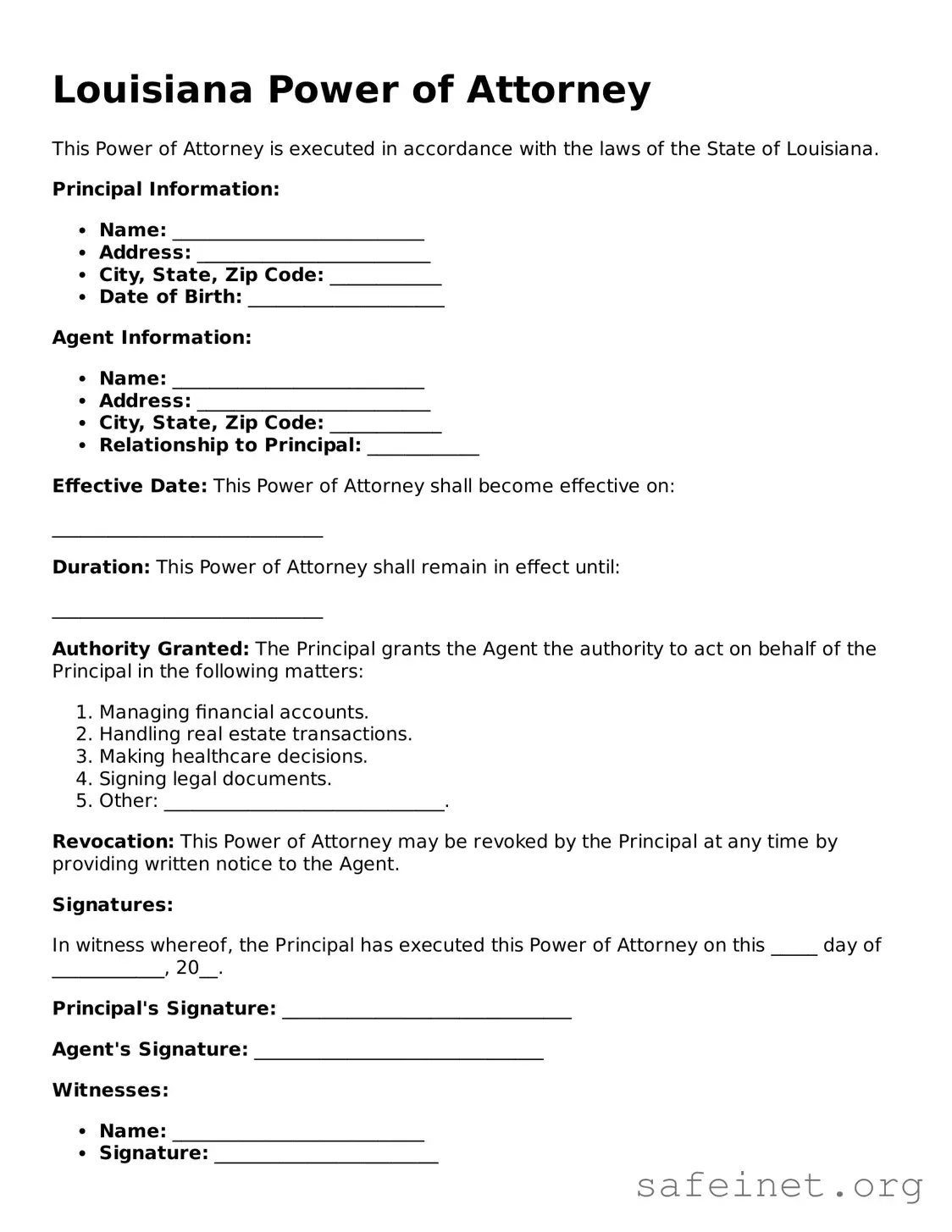
Louisiana Power of Attorney
This Power of Attorney is executed in accordance with the laws of the State of Louisiana.
Principal Information:
Agent Information:
Effective Date: This Power of Attorney shall become effective on:
_____________________________
Duration: This Power of Attorney shall remain in effect until:
_____________________________
Authority Granted: The Principal grants the Agent the authority to act on behalf of the Principal in the following matters:
Revocation: This Power of Attorney may be revoked by the Principal at any time by providing written notice to the Agent.
Signatures:
In witness whereof, the Principal has executed this Power of Attorney on this _____ day of ____________, 20__.
Principal's Signature: _______________________________
Agent's Signature: _______________________________
Witnesses:
This document is intended to comply with the laws of the State of Louisiana. It is recommended that the Principal consult with a legal professional to ensure that all requirements are met.
| Fact Name | Description |
|---|---|
| Definition | A Louisiana Power of Attorney form allows an individual to designate another person to make decisions on their behalf. |
| Governing Law | This form is governed by Louisiana Civil Code, specifically Articles 2980-3021. |
| Types | There are different types of Power of Attorney forms, including General, Durable, and Limited Power of Attorney. |
| Durability | A Durable Power of Attorney remains effective even if the principal becomes incapacitated. |
| Principal | The individual granting authority is referred to as the principal. |
| Agent | The person designated to act on behalf of the principal is known as the agent or attorney-in-fact. |
| Signing Requirements | The form must be signed by the principal and two witnesses, or notarized to be valid. |
| Revocation | The principal can revoke the Power of Attorney at any time, provided they are competent to do so. |
| Limitations | Agents must act in the best interest of the principal and cannot make decisions that benefit themselves unless explicitly stated. |
| Use Cases | This form is commonly used for financial, medical, and legal decisions when the principal is unavailable. |
Completing the Louisiana Power of Attorney form is an important step in designating someone to make decisions on your behalf. After filling out the form, you will need to ensure that it is signed and notarized to be legally effective.
What is a Louisiana Power of Attorney form?
A Louisiana Power of Attorney form is a legal document that allows one person, known as the principal, to appoint another person, called the agent or attorney-in-fact, to make decisions on their behalf. This can include financial, medical, or legal decisions, depending on the type of Power of Attorney established.
What types of Power of Attorney are available in Louisiana?
In Louisiana, there are several types of Power of Attorney forms, including Durable Power of Attorney, which remains effective even if the principal becomes incapacitated; Medical Power of Attorney, which allows the agent to make healthcare decisions; and General Power of Attorney, which grants broad powers to the agent. Each type serves different purposes, so it’s important to choose the one that fits your needs.
How do I create a Power of Attorney in Louisiana?
To create a Power of Attorney in Louisiana, you must fill out the appropriate form, which can often be found online or through legal resources. It’s essential to clearly outline the powers you wish to grant your agent. After completing the form, you must sign it in the presence of a notary public and, in some cases, witnesses, to ensure its validity.
Can I revoke a Power of Attorney in Louisiana?
Yes, you can revoke a Power of Attorney in Louisiana at any time, as long as you are mentally competent. To do this, you should create a written revocation document, sign it, and notify your agent and any relevant institutions or parties that were relying on the original Power of Attorney.
What happens if the principal becomes incapacitated?
If the principal becomes incapacitated, a Durable Power of Attorney remains in effect, allowing the agent to continue making decisions on their behalf. However, if a General Power of Attorney was created without the durable clause, it would become void upon the principal’s incapacity. It’s crucial to understand the implications when drafting the document.
Are there any limitations to the powers granted in a Power of Attorney?
Yes, the powers granted in a Power of Attorney can be limited by the principal. The document should specify the scope of authority, such as whether the agent can handle financial matters, make healthcare decisions, or manage property. If certain powers are not included in the document, the agent cannot exercise them.
Is it necessary to have a lawyer to create a Power of Attorney in Louisiana?
While it is not strictly necessary to have a lawyer to create a Power of Attorney in Louisiana, consulting with one can provide valuable guidance. A lawyer can help ensure that the document complies with state laws and accurately reflects your wishes, reducing the likelihood of disputes or misunderstandings in the future.
One common mistake is failing to clearly identify the principal and agent. The principal is the person granting authority, while the agent is the individual receiving that authority. It's essential to provide full names and addresses to avoid any confusion.
Another frequent error involves not specifying the powers being granted. The form should detail the specific actions the agent can take on behalf of the principal. Without this clarity, the agent may not have the authority needed to act effectively.
Many individuals neglect to sign and date the form correctly. Both the principal and any witnesses must sign the document to ensure its validity. A missing signature can render the entire Power of Attorney ineffective.
Lastly, people often overlook the importance of notarization. In Louisiana, having the document notarized can add an extra layer of legitimacy. This step is crucial in preventing disputes regarding the authenticity of the document.
When dealing with a Louisiana Power of Attorney, it’s important to consider additional documents that may be necessary to ensure your wishes are clearly communicated and legally recognized. Here’s a list of forms and documents that are often used alongside the Power of Attorney.
Understanding these documents can help you navigate the complexities of legal and financial decisions. Each form serves a specific purpose and can work together to provide comprehensive support for your needs and wishes.
The Louisiana Power of Attorney form shares similarities with the General Power of Attorney. Both documents allow individuals to designate another person to make decisions on their behalf. This can include financial matters, property management, and other personal affairs. The General Power of Attorney is broader in scope, granting comprehensive authority, while the Louisiana version may be tailored to specific needs or situations. This flexibility can be crucial for individuals seeking to maintain control over their affairs while delegating certain responsibilities.
Another document akin to the Louisiana Power of Attorney is the Durable Power of Attorney. This form remains effective even if the principal becomes incapacitated. In contrast, a standard Power of Attorney typically ceases to be valid if the principal loses mental competency. The Durable Power of Attorney is particularly important for long-term planning, ensuring that designated agents can act on behalf of the principal during critical times when they may no longer be able to do so themselves.
The Healthcare Power of Attorney is another document that parallels the Louisiana Power of Attorney. While the latter can address financial and legal matters, the Healthcare Power of Attorney specifically focuses on medical decisions. It allows individuals to appoint someone to make healthcare choices if they are unable to communicate their wishes. This distinction is vital, as it ensures that healthcare decisions align with the principal's values and preferences during times of medical crisis.
A Living Will is also similar to the Louisiana Power of Attorney, though it serves a different purpose. While the Power of Attorney allows for the delegation of decision-making authority, a Living Will provides explicit instructions regarding end-of-life care. This document outlines an individual’s preferences for medical treatment in situations where they cannot express their wishes. Both documents work in tandem to ensure that a person’s desires are honored when they are unable to advocate for themselves.
The Revocation of Power of Attorney is another document that relates closely to the Louisiana Power of Attorney. This document serves to formally cancel any existing Power of Attorney. If circumstances change or if the principal wishes to appoint a different agent, the Revocation of Power of Attorney is essential. It ensures clarity and prevents any potential conflicts that may arise from having multiple active Powers of Attorney.
The Financial Power of Attorney is a more specialized version of the Louisiana Power of Attorney, focusing solely on financial matters. This document allows individuals to appoint someone to manage their financial affairs, including banking, investments, and real estate transactions. While the Louisiana Power of Attorney can encompass various aspects of life, the Financial Power of Attorney narrows the focus to fiscal responsibilities, making it a useful tool for those who want to ensure their financial matters are handled appropriately.
Similarly, the Limited Power of Attorney is akin to the Louisiana Power of Attorney but is restricted in scope. This document grants authority to an agent for specific tasks or a defined period. For example, it might allow someone to handle a real estate transaction while excluding other responsibilities. This limitation can be beneficial for individuals who want to delegate certain tasks without relinquishing full control over their affairs.
Finally, the Springing Power of Attorney bears resemblance to the Louisiana Power of Attorney, as it activates under specific conditions. This type of Power of Attorney becomes effective only when the principal becomes incapacitated or unable to make decisions. This conditional aspect provides peace of mind, ensuring that the agent's authority is only exercised when truly necessary, aligning closely with the intent of the Louisiana Power of Attorney to protect the principal's interests.
When filling out the Louisiana Power of Attorney form, it is crucial to approach the process with care and attention. Here are some essential do's and don'ts to consider:
By following these guidelines, individuals can navigate the process of filling out the Louisiana Power of Attorney form with greater confidence and clarity.
Understanding the Louisiana Power of Attorney form is crucial for anyone considering this legal tool. However, several misconceptions often arise. Here are seven common misunderstandings:
Many people believe that a Power of Attorney form is universally applicable. In reality, each state has its own requirements and forms. The Louisiana Power of Attorney form has specific provisions that may differ from those in other states.
While many associate Power of Attorney with financial decisions, it can also cover healthcare decisions. In Louisiana, individuals can designate someone to make medical choices on their behalf if they become incapacitated.
This is a common misconception. A person can revoke a Power of Attorney at any time, as long as they are mentally competent. It is essential to follow the proper procedures to ensure the revocation is valid.
While it is advisable to seek legal counsel, individuals can create a Power of Attorney on their own using the appropriate forms. However, understanding the implications and ensuring compliance with state laws is vital.
People often think that only relatives can serve as agents. In Louisiana, anyone over the age of 18 can be appointed as an agent, including friends or professional fiduciaries.
This is not always true. In Louisiana, a Power of Attorney can be made effective immediately, or it can be set to activate upon a specific event, such as the principal's incapacitation.
Many fear that granting a Power of Attorney means losing all control over their affairs. However, the principal retains the right to make decisions and can revoke the Power of Attorney at any time, as long as they are competent.
Understanding these misconceptions can help individuals make informed decisions about using the Louisiana Power of Attorney form effectively.
When considering a Power of Attorney (POA) in Louisiana, it is essential to understand the implications and requirements involved. Here are key takeaways to guide you through the process:
Taking these steps can help ensure that your Power of Attorney is set up correctly and that your wishes are honored. Act promptly to protect your interests.