When it comes to ensuring that a child’s needs are met in the absence of a parent or legal guardian, the Louisiana Power of Attorney for a Child form plays a crucial role. This legal document allows a parent or guardian to appoint another trusted adult to make decisions on behalf of the child, covering various aspects such as medical care, education, and general welfare. The form typically includes essential information, such as the names and addresses of both the child and the appointed agent, as well as the specific powers granted to that agent. Importantly, the power of attorney can be tailored to suit the child's unique circumstances, providing flexibility for parents while ensuring that their child is cared for appropriately. By using this form, parents can have peace of mind knowing that someone they trust can step in and make important decisions if they are unable to do so themselves. Understanding the nuances of this document is essential for any parent looking to secure the best interests of their child.
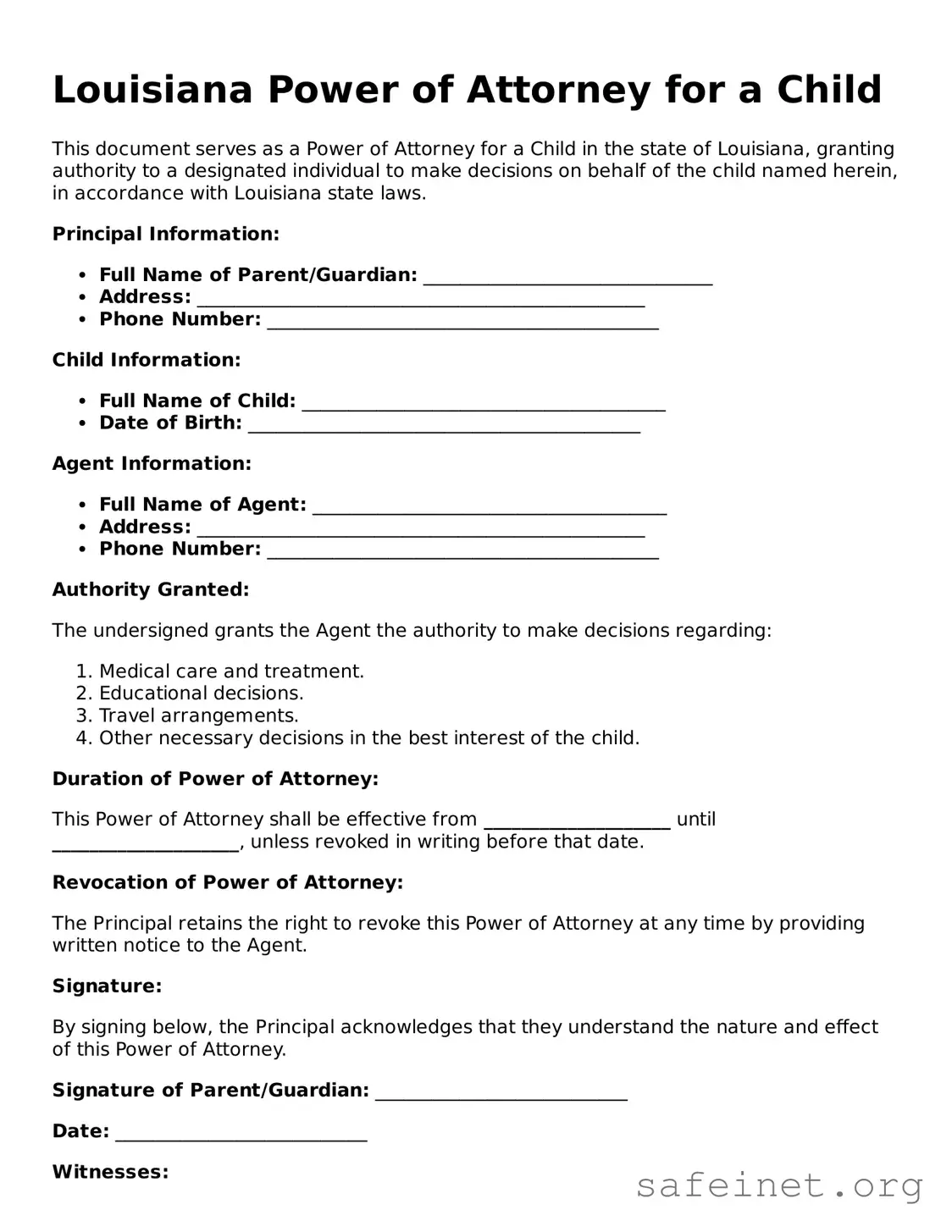
Louisiana Power of Attorney for a Child
This document serves as a Power of Attorney for a Child in the state of Louisiana, granting authority to a designated individual to make decisions on behalf of the child named herein, in accordance with Louisiana state laws.
Principal Information:
Child Information:
Agent Information:
Authority Granted:
The undersigned grants the Agent the authority to make decisions regarding:
Duration of Power of Attorney:
This Power of Attorney shall be effective from ____________________ until ____________________, unless revoked in writing before that date.
Revocation of Power of Attorney:
The Principal retains the right to revoke this Power of Attorney at any time by providing written notice to the Agent.
Signature:
By signing below, the Principal acknowledges that they understand the nature and effect of this Power of Attorney.
Signature of Parent/Guardian: ___________________________
Date: ___________________________
Witnesses:
This document must be notarized to be valid.
| Fact Name | Details |
|---|---|
| Purpose | The Louisiana Power of Attorney for a Child form allows a parent or guardian to designate another adult to make decisions on behalf of their child. |
| Governing Law | This form is governed by Louisiana Civil Code Article 2621 and related statutes. |
| Duration | The power of attorney can be effective for a specified period or until revoked by the parent or guardian. |
| Eligibility | Any adult can be designated as an agent, provided they are willing to accept the responsibilities outlined in the form. |
| Medical Decisions | The agent may have the authority to make medical decisions for the child, depending on the specifications included in the form. |
| Limitations | The form does not grant the agent the right to consent to the adoption of the child or to make decisions that would permanently alter parental rights. |
| Revocation | A parent or guardian can revoke the power of attorney at any time, provided they do so in writing. |
| Notarization | The form must be signed in the presence of a notary public to be legally binding. |
| Usage | This form is often used for temporary arrangements, such as travel, medical emergencies, or extended absences from home. |
Filling out the Louisiana Power of Attorney for a Child form is an important step in ensuring that your child's needs are met when you are unable to be present. After completing the form, you will need to sign it and have it notarized to make it legally binding.
What is a Power of Attorney for a Child in Louisiana?
A Power of Attorney for a Child in Louisiana is a legal document that allows a parent or legal guardian to grant another individual the authority to make decisions on behalf of their child. This document is particularly useful in situations where the parent is unavailable, such as during travel, medical emergencies, or temporary relocations. The appointed individual, often referred to as the agent, can be responsible for making decisions regarding the child's education, healthcare, and general welfare.
Who can be appointed as an agent in the Power of Attorney for a Child?
In Louisiana, the agent appointed in the Power of Attorney for a Child must be an adult. This individual can be a relative, friend, or trusted person who is willing to take on the responsibilities associated with caring for the child. It is crucial that the parent or guardian trusts the agent to act in the best interest of the child, as the agent will have significant authority over the child's welfare.
How long is the Power of Attorney for a Child valid?
The Power of Attorney for a Child in Louisiana can be effective for a specific period or until revoked by the parent or legal guardian. The document should clearly state the duration of its validity. Typically, it remains in effect until the specified date, the parent revokes it, or the child reaches the age of majority, which is 18 years old in Louisiana.
What decisions can the agent make on behalf of the child?
The agent appointed through the Power of Attorney for a Child can make a variety of decisions regarding the child's well-being. This includes decisions related to education, healthcare, and daily living activities. However, the document may also specify limitations on the agent's authority, such as excluding certain medical procedures or decisions about long-term care. Parents should clearly outline the scope of the agent's powers to avoid any misunderstandings.
Do I need to have the Power of Attorney for a Child notarized?
Yes, in Louisiana, the Power of Attorney for a Child typically needs to be notarized to be legally binding. This means that the document must be signed in the presence of a notary public. Notarization helps to verify the identities of the individuals involved and ensures that the document is executed properly. It is advisable to keep a copy of the notarized document for personal records and provide copies to the agent and any relevant institutions, such as schools or healthcare providers.
Can I revoke the Power of Attorney for a Child once it is established?
Yes, a parent or legal guardian can revoke the Power of Attorney for a Child at any time, as long as they are of sound mind. To revoke the document, the parent should provide written notice to the agent and any institutions that may have relied on the Power of Attorney. It is advisable to formally document the revocation to avoid any confusion or potential legal issues in the future.
Not specifying the duration of the power of attorney. It's crucial to indicate how long the authority will last. Without this, the arrangement may be unclear.
Failing to identify the child properly. Ensure the child's full name, date of birth, and any other identifying information are included. Incomplete information can lead to confusion.
Overlooking the need for notarization. The form must be signed in front of a notary public. Without this step, the document may not be legally valid.
Not including specific powers granted. Clearly outline what decisions the agent can make. Vague language can lead to misunderstandings about the agent's authority.
Neglecting to update the form when circumstances change. If there are changes in the child's situation or the agent's status, the form should be revised accordingly.
When creating a Power of Attorney for a Child in Louisiana, several other forms and documents may be necessary to ensure that all legal aspects are covered. These documents help clarify the authority granted and provide additional information that may be relevant to the child's care and well-being. Below is a list of commonly used forms that accompany the Power of Attorney for a Child.
Having these additional forms and documents in place can provide clarity and security for both the child and the appointed agent. It ensures that all parties are prepared to act in the best interest of the child, especially in situations where quick decisions are necessary.
The Louisiana Power of Attorney for a Child form is similar to a General Power of Attorney. Both documents grant authority to an agent to act on behalf of another person. However, while a General Power of Attorney can cover a broad range of financial and legal matters, the Power of Attorney for a Child specifically focuses on decisions related to the care and welfare of a minor. This distinction makes it particularly important for parents or guardians who need someone to manage their child's affairs temporarily.
Another document that shares similarities is the Medical Power of Attorney. Like the Power of Attorney for a Child, this form allows an individual to designate someone to make healthcare decisions on their behalf. In the case of a child, the parent can authorize a caregiver to make medical decisions if they are unavailable. This ensures that the child receives timely medical attention without unnecessary delays.
The Child Custody Agreement also bears resemblance to the Power of Attorney for a Child. Both documents are concerned with the welfare of a minor. While a Child Custody Agreement outlines the living arrangements and responsibilities of parents or guardians, the Power of Attorney for a Child allows a designated individual to make decisions on behalf of the child, filling in gaps during the parent's absence.
A Temporary Guardianship Agreement is another similar document. This form allows a parent to appoint a temporary guardian for their child when they are unable to care for them. Like the Power of Attorney for a Child, it ensures that someone is legally recognized to act in the child's best interest, providing a safety net for emergencies or short-term situations.
The Consent to Travel form is also akin to the Power of Attorney for a Child. This document allows a parent to authorize another adult to take their child on a trip, whether domestically or internationally. It helps prevent legal issues that may arise from traveling without parental consent, similar to how the Power of Attorney for a Child ensures that someone can make decisions on behalf of the child.
Additionally, the Educational Power of Attorney is relevant. This document allows a parent to designate someone to make educational decisions for their child, such as enrolling them in school or attending parent-teacher conferences. Like the Power of Attorney for a Child, it ensures that someone is empowered to act in the child's educational interests when the parent is not available.
The Standby Guardian form is another related document. It allows a parent to appoint a standby guardian who can take over caregiving responsibilities if the parent becomes incapacitated. This is similar to the Power of Attorney for a Child, as both provide a legal framework for ensuring that a child’s needs are met in the absence of their primary caregiver.
The Adoption Consent form also shares similarities. While it primarily focuses on the legal transfer of parental rights, it involves the consent of the biological parents for someone else to take over parenting responsibilities. This is similar to the Power of Attorney for a Child, which allows another adult to step in and manage the child's affairs temporarily.
Lastly, the Child Support Agreement can be seen as related. While its primary focus is on financial support, it often addresses the responsibilities of parents regarding the child's welfare. Like the Power of Attorney for a Child, it is concerned with ensuring that the child's needs are met, albeit from a financial perspective rather than decision-making authority.
When filling out the Louisiana Power of Attorney for a Child form, it is essential to approach the task with care. Below are some helpful guidelines outlining what you should and shouldn't do during this process.
Following these guidelines can help ensure that the Power of Attorney for a Child form is filled out correctly, providing peace of mind for all parties involved.
Understanding the Louisiana Power of Attorney for a Child form can be challenging. Here are ten common misconceptions about this important legal document:
These misconceptions can lead to confusion and potential issues. It is important for parents and guardians to fully understand the implications of this form to ensure the best interests of the child are met.
When considering the Louisiana Power of Attorney for a Child form, it’s essential to understand its significance and how to use it effectively. Here are some key takeaways:
Understanding these points can help ensure that the Power of Attorney for a Child form is filled out correctly and used effectively.