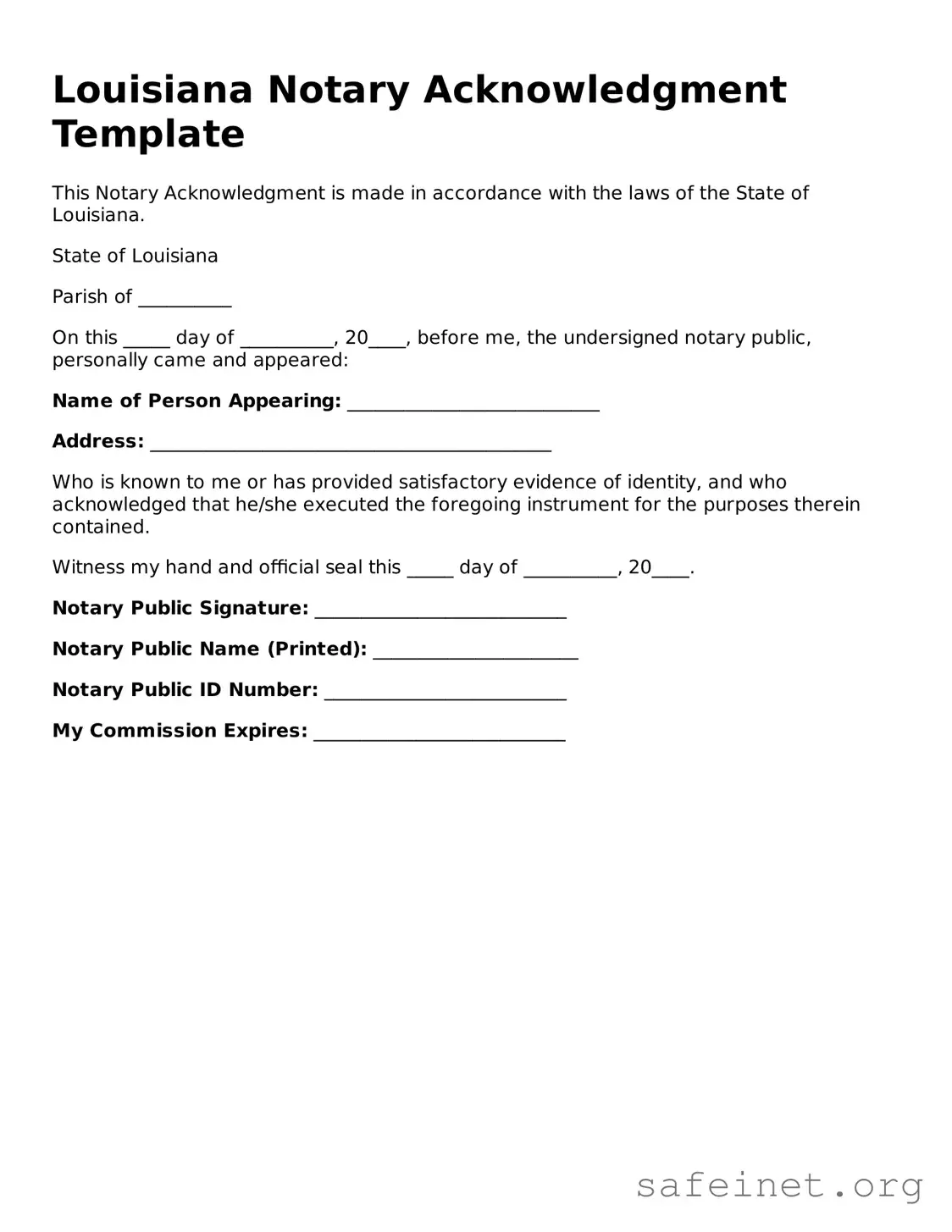
The Louisiana Notary Acknowledgment form serves a critical function in the realm of legal documentation. It is essential for confirming that a signature on a document is genuine and that the signer acted willingly and with full understanding of the contents. This form plays a vital role in various transactions, including real estate deals, wills, and contracts, ensuring that documents hold up in court if challenged. The process involves a notary public who verifies the identity of the signer and witnesses the signing. This adds an extra layer of protection against fraud. The form typically includes details such as the date of acknowledgment, the name of the signer, and the notary's signature and seal. By utilizing this form, individuals and businesses can enhance the legitimacy of their documents, fostering trust in their legal transactions.
Louisiana Notary Acknowledgment Template
This Notary Acknowledgment is made in accordance with the laws of the State of Louisiana.
State of Louisiana
Parish of __________
On this _____ day of __________, 20____, before me, the undersigned notary public, personally came and appeared:
Name of Person Appearing: ___________________________
Address: ___________________________________________
Who is known to me or has provided satisfactory evidence of identity, and who acknowledged that he/she executed the foregoing instrument for the purposes therein contained.
Witness my hand and official seal this _____ day of __________, 20____.
Notary Public Signature: ___________________________
Notary Public Name (Printed): ______________________
Notary Public ID Number: __________________________
My Commission Expires: ___________________________
| Fact Name | Description |
|---|---|
| Definition | A Louisiana Notary Acknowledgement form is a document used to confirm that a person has willingly signed a document in the presence of a notary public. |
| Governing Law | This form is governed by Louisiana Revised Statutes, specifically Title 35, which outlines the functions and duties of notaries. |
| Purpose | The purpose of the form is to provide legal verification that the signer is who they claim to be and that they signed the document voluntarily. |
| Signature Requirement | The signer must be present before the notary and must sign the document in the notary's presence for the acknowledgment to be valid. |
| Notary's Role | The notary public is responsible for verifying the identity of the signer and ensuring that the signing occurs without coercion. |
| Record Keeping | Notaries are required to maintain a record of the acknowledgment in their notarial register, which includes details of the transaction. |
| Legal Effect | A properly executed acknowledgment can enhance the credibility of the document in legal proceedings, making it easier to enforce rights and obligations. |
After completing the Louisiana Notary Acknowledgement form, the next step involves submitting it to the appropriate authority or party. Ensure that all information is accurate to avoid any delays or complications.
What is a Louisiana Notary Acknowledgement form?
The Louisiana Notary Acknowledgement form is a legal document used to verify the identity of a person signing a document. This form is essential in ensuring that the signer is who they claim to be and that they are signing the document voluntarily. It is commonly used for various legal transactions, including real estate deeds, contracts, and other important documents requiring notarization.
Who can act as a notary in Louisiana?
In Louisiana, notaries public are appointed by the state and must meet specific qualifications, including being a resident of Louisiana and at least 18 years old. They must also pass a written examination and complete a background check. Notaries play a crucial role in the acknowledgment process, ensuring that the signing of documents is carried out correctly and legally.
What information is included in the Notary Acknowledgement form?
The Notary Acknowledgement form typically includes the names of the parties involved, the date of the acknowledgment, and a statement confirming that the signer appeared before the notary. It also includes the notary's signature, seal, and commission expiration date. This information helps to establish the authenticity of the document and the legitimacy of the signing process.
Is a Notary Acknowledgement form required for all documents?
No, a Notary Acknowledgement form is not required for every document. However, it is often necessary for documents that need to be recorded in public records, such as property deeds or mortgages. It is always a good idea to check the specific requirements for the type of document you are dealing with to ensure compliance with Louisiana law.
How do I complete a Notary Acknowledgement form?
To complete a Notary Acknowledgement form, the signer must appear in person before the notary. The signer should bring a valid form of identification, such as a driver's license or passport. The notary will then confirm the signer's identity, witness the signing of the document, and complete the form by filling in the necessary information and affixing their signature and seal.
Can a Notary Acknowledgement be performed remotely?
In Louisiana, remote notarization is permitted under certain circumstances. However, specific rules and procedures must be followed. The notary and the signer must use an approved electronic platform that allows for real-time audio and visual communication. It’s important to ensure that all requirements are met to ensure the validity of the notarization.
What happens if a Notary Acknowledgement is not properly completed?
If a Notary Acknowledgement is not properly completed, it can lead to issues with the validity of the document. In some cases, the document may be rejected by courts or other entities. It is crucial to ensure that all parts of the form are filled out correctly and that the notary follows the appropriate procedures to avoid any complications.
Failing to include the correct date of the acknowledgment. The date is essential for establishing when the document was notarized.
Not providing the full name of the person signing the document. It is crucial to use the complete legal name to avoid any confusion.
Leaving out the signature of the notary public. The notary's signature is a key element that validates the acknowledgment.
Using an incorrect notary seal or failing to affix a seal altogether. The seal serves as an official mark of the notary's authority.
Not indicating the capacity in which the signer is acting, such as whether they are signing as an individual or on behalf of a business.
Providing incomplete information about the notary, such as their commission expiration date. This information is necessary for verifying the notary's authority.
Neglecting to have the signer present at the time of notarization. The signer must be physically present for the acknowledgment to be valid.
Failing to ensure that the document being acknowledged is complete. Any missing pages or sections can invalidate the acknowledgment.
Overlooking the requirement for the notary to administer an oath or affirmation if necessary. This step is important in certain situations.
Not checking for proper identification of the signer. The notary must verify the identity of the signer to prevent fraud.
The Louisiana Notary Acknowledgement form is a crucial document used to verify the identity of individuals signing legal documents. It ensures that signatures are authentic and that the signer acted voluntarily. Along with this form, several other documents may be commonly used to facilitate various legal transactions. Below is a list of these documents, each serving a specific purpose.
Understanding these documents and their functions can aid individuals in navigating legal processes more effectively. Each document plays a significant role in ensuring that transactions are conducted smoothly and that parties' rights are protected.
The Louisiana Notary Acknowledgment form shares similarities with the Affidavit. An affidavit is a written statement confirmed by oath or affirmation, typically used as evidence in court. Both documents require the presence of a notary public, who verifies the identity of the signatory. They serve to authenticate the legitimacy of the signature and the content, ensuring that the information provided is true to the best of the signer's knowledge.
Another document akin to the Louisiana Notary Acknowledgment is the Power of Attorney. This legal document allows one person to act on behalf of another in legal or financial matters. Like the acknowledgment form, the Power of Attorney must be signed in the presence of a notary public to confirm the identity of the principal and ensure that the document is executed voluntarily. Both documents carry significant legal weight and require careful consideration before signing.
The Deed is also similar to the Louisiana Notary Acknowledgment form. A deed transfers ownership of real property from one party to another. Notarization is essential for a deed to be valid, as it provides assurance that the parties involved are who they claim to be. Both documents facilitate important transactions and require proper execution to be legally binding.
The Certificate of Acknowledgment bears resemblance to the Louisiana Notary Acknowledgment as well. This document is used to confirm that a signature on a legal document was made voluntarily and with the understanding of its content. It is typically used in conjunction with various legal documents, similar to the acknowledgment form, which serves to affirm the authenticity of the signatory's consent.
Additionally, the Bill of Sale is comparable to the Louisiana Notary Acknowledgment form. A Bill of Sale is a document that transfers ownership of personal property from one party to another. Notarization is often required to validate the transaction and protect both parties involved. Both documents serve to formalize agreements and provide a record of the transaction.
Lastly, the Last Will and Testament shares characteristics with the Louisiana Notary Acknowledgment form. A will outlines an individual's wishes regarding the distribution of their estate after death. While notarization is not always required for a will, having it notarized can enhance its validity and reduce the likelihood of disputes. Both documents are critical in ensuring that an individual's intentions are respected and legally recognized.
When filling out the Louisiana Notary Acknowledgement form, it is essential to approach the task with care and attention to detail. Below are some important dos and don'ts to keep in mind.
By following these guidelines, you can help ensure that your Louisiana Notary Acknowledgement form is completed correctly and efficiently. This attention to detail can prevent unnecessary complications in the future.
Understanding the Louisiana Notary Acknowledgement form is essential for anyone involved in legal documentation in the state. However, several misconceptions can lead to confusion. Below are four common misconceptions about this form:
Clarifying these misconceptions can help individuals navigate the complexities of legal documentation in Louisiana more effectively.
When dealing with the Louisiana Notary Acknowledgement form, it’s important to understand its purpose and how to fill it out correctly. Here are some key takeaways to keep in mind:
By keeping these points in mind, individuals can effectively navigate the process of using the Louisiana Notary Acknowledgement form, ensuring that their documents are properly executed and recognized.