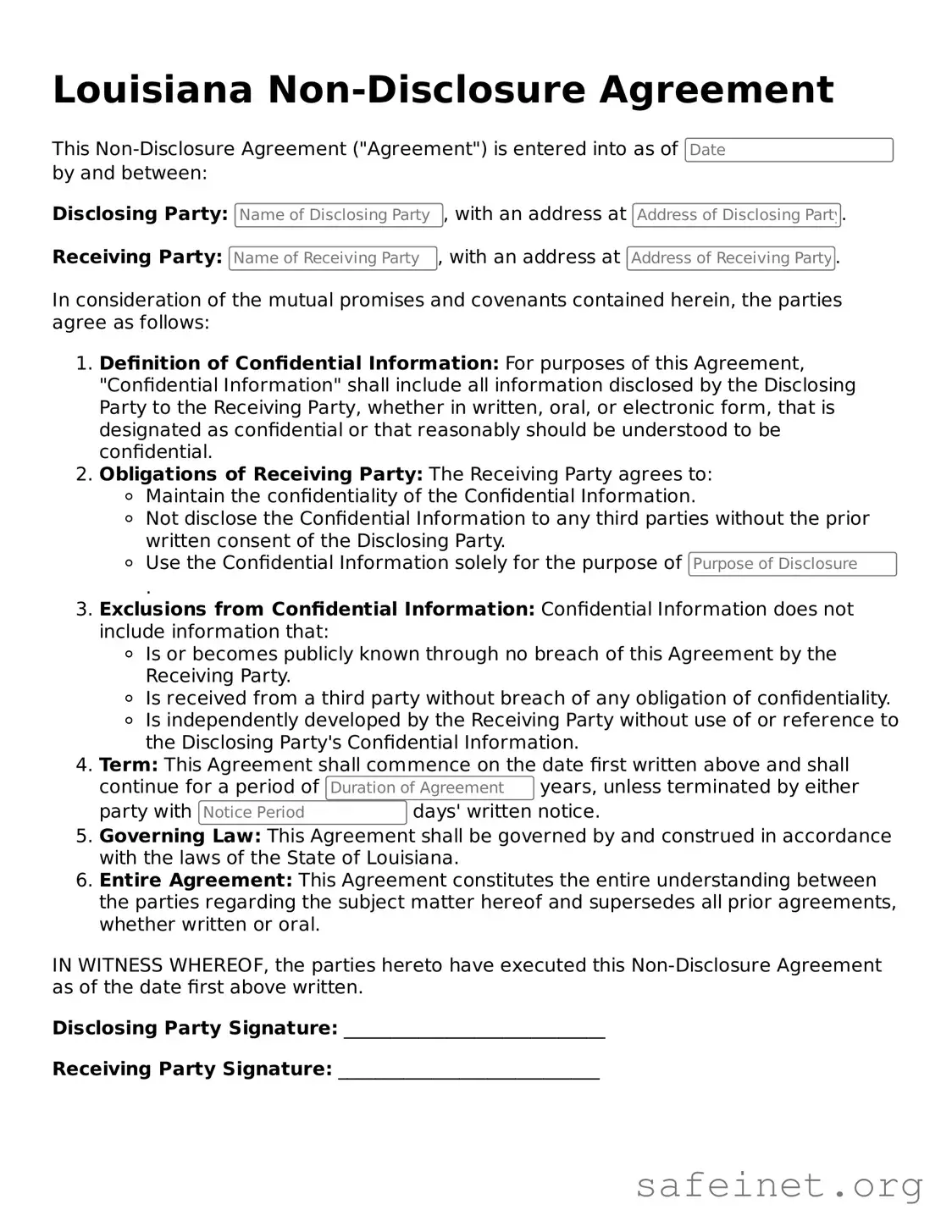
The Louisiana Non-disclosure Agreement (NDA) form serves as a crucial tool for individuals and businesses seeking to protect sensitive information from unauthorized disclosure. This legal document outlines the terms under which confidential information can be shared between parties while ensuring that such information remains secure. Typically, the NDA specifies what constitutes confidential information, the obligations of the parties involved, and the duration of the confidentiality obligation. It may also include provisions for the return or destruction of information upon termination of the agreement. By clearly defining these aspects, the NDA helps to establish trust and provides a framework for cooperation, whether in business negotiations, employment relationships, or other scenarios where sensitive data is exchanged. Understanding the key components of this form can aid in effectively safeguarding proprietary information and maintaining competitive advantages in the marketplace.
Louisiana Non-Disclosure Agreement
This Non-Disclosure Agreement ("Agreement") is entered into as of by and between:
Disclosing Party: , with an address at .
Receiving Party: , with an address at .
In consideration of the mutual promises and covenants contained herein, the parties agree as follows:
IN WITNESS WHEREOF, the parties hereto have executed this Non-Disclosure Agreement as of the date first above written.
Disclosing Party Signature: ____________________________
Receiving Party Signature: ____________________________
| Fact Name | Detail |
|---|---|
| Definition | A Non-disclosure Agreement (NDA) is a legal contract that protects confidential information shared between parties. |
| Governing Law | The NDA in Louisiana is governed by Louisiana Civil Code and relevant state statutes. |
| Purpose | NDAs are used to safeguard sensitive information, trade secrets, and proprietary data. |
| Parties Involved | Typically, an NDA involves at least two parties: the disclosing party and the receiving party. |
| Duration | The duration of confidentiality obligations can vary, often lasting several years or until the information is no longer confidential. |
| Enforceability | Louisiana courts enforce NDAs as long as they are reasonable in scope and duration. |
| Exceptions | Information that is publicly available or independently developed may not be covered by the NDA. |
| Consequences of Breach | Breaching an NDA can lead to legal action, including injunctions and monetary damages. |
| Customization | NDAs can be customized to fit the specific needs of the parties involved, including specific definitions of confidential information. |
After obtaining the Louisiana Non-disclosure Agreement form, you will need to complete it accurately to ensure its effectiveness. Follow the steps below to fill out the form properly.
What is a Louisiana Non-disclosure Agreement (NDA)?
A Louisiana Non-disclosure Agreement is a legal contract that protects confidential information shared between parties. It ensures that sensitive information, such as business plans, trade secrets, or proprietary data, is not disclosed to unauthorized individuals or entities. This agreement is crucial for businesses looking to safeguard their intellectual property and maintain a competitive edge.
Who should use a Non-disclosure Agreement in Louisiana?
Any individual or business that plans to share confidential information with another party should consider using an NDA. This includes entrepreneurs discussing ideas with potential investors, companies sharing sensitive data with contractors, or businesses entering partnerships. An NDA helps create a secure environment for open communication.
What are the key components of a Louisiana NDA?
An effective NDA typically includes the following components: a clear definition of what constitutes confidential information, the obligations of the receiving party, the duration of the confidentiality obligation, and any exclusions from confidentiality. It may also specify the consequences of a breach, which can include legal action or financial penalties.
How long does the confidentiality obligation last under a Louisiana NDA?
The duration of the confidentiality obligation can vary based on the terms set in the NDA. Generally, it can last for a specific number of years or until the information is no longer considered confidential. It’s essential to clearly outline this duration in the agreement to avoid misunderstandings later on.
Can a Louisiana NDA be enforced in court?
Yes, a Louisiana NDA can be enforced in court if it is properly drafted and both parties have agreed to its terms. If one party breaches the agreement, the other party may seek legal remedies, which could include monetary damages or injunctive relief. Having a well-structured NDA increases the likelihood of successful enforcement.
Are there any limitations to what can be protected under a Louisiana NDA?
Yes, there are limitations. Information that is already publicly available, independently developed by the receiving party, or disclosed by a third party without a breach of confidentiality cannot be protected under an NDA. It’s important to ensure that the information you wish to protect meets the criteria for confidentiality to be enforceable.
Incomplete Information: Many individuals fail to provide all necessary details. This includes missing names, addresses, or the date of the agreement. Each section must be filled out accurately.
Not Defining Confidential Information: A common mistake is not clearly defining what constitutes confidential information. Without a clear definition, it can lead to misunderstandings later.
Ignoring Duration of Agreement: Some people overlook specifying the duration of the non-disclosure obligations. It is important to indicate how long the information must remain confidential.
Failing to Include Signatures: A signed agreement is essential. Omitting signatures from either party can render the agreement unenforceable.
Not Consulting Legal Counsel: Individuals often fill out the form without seeking legal advice. Consulting with a lawyer can help ensure that the agreement meets legal standards and protects all parties involved.
When entering into a business relationship or partnership, a Louisiana Non-disclosure Agreement (NDA) is often accompanied by several other important documents. These documents help clarify the terms of the relationship and protect the interests of all parties involved. Below are some commonly used forms and documents that complement an NDA.
Understanding these documents and their purposes can enhance the effectiveness of an NDA and provide a solid foundation for a successful business relationship. Each form serves a unique role in safeguarding sensitive information and clarifying the expectations of all parties involved.
A Confidentiality Agreement is similar to a Non-disclosure Agreement (NDA) in that both documents aim to protect sensitive information. This type of agreement is often used in business settings where parties share confidential information, such as trade secrets or proprietary data. Like an NDA, a Confidentiality Agreement outlines the obligations of the parties involved to keep the information private and specifies the consequences of any unauthorized disclosure. The primary difference lies in the terminology, as both serve the same fundamental purpose of safeguarding confidential information.
A Non-compete Agreement shares similarities with a Non-disclosure Agreement, particularly in the context of protecting business interests. While an NDA focuses on confidentiality, a Non-compete Agreement restricts an individual from engaging in business activities that directly compete with their employer or business partner after leaving the company. Both documents are designed to protect valuable information and business relationships, ensuring that sensitive data does not lead to unfair competition.
A Proprietary Information Agreement is another document akin to a Non-disclosure Agreement. This type of agreement specifically addresses the protection of proprietary information, which includes trade secrets, formulas, and other intellectual property. Like an NDA, a Proprietary Information Agreement establishes guidelines for how the information can be used and shared. Both documents emphasize the importance of confidentiality and the legal obligations of the parties involved to maintain that confidentiality.
An Employment Agreement can also be compared to a Non-disclosure Agreement, particularly when it includes confidentiality clauses. Employment Agreements often outline the terms of employment, including job responsibilities, compensation, and the handling of confidential information. When an employee agrees to an NDA as part of their Employment Agreement, they commit to protecting the company’s sensitive information throughout their employment and after their departure, similar to the standalone NDA.
A Service Agreement may resemble a Non-disclosure Agreement in scenarios where a service provider is granted access to sensitive information. This document outlines the terms under which services are provided and may include confidentiality provisions to protect the client’s proprietary information. Like an NDA, a Service Agreement ensures that the service provider understands their obligation to keep the client’s information secure, thereby fostering trust and safeguarding business interests.
When filling out the Louisiana Non-disclosure Agreement form, it is important to follow certain guidelines to ensure accuracy and effectiveness. Here’s a list of things you should and shouldn't do:
When it comes to the Louisiana Non-disclosure Agreement (NDA), several misconceptions can lead to confusion. Here are five common misunderstandings:
Many people believe that non-disclosure agreements are uniform across all states. In reality, Louisiana has specific laws and requirements that govern NDAs, making them unique compared to those in other states.
While businesses frequently use NDAs, individuals can also benefit from them. Personal relationships, such as those involving sensitive information, can also require a non-disclosure agreement.
This is a common belief, but it’s not entirely accurate. NDAs typically restrict sharing information with unauthorized parties, but they often allow discussions with certain individuals, such as legal advisors or family members, under specific conditions.
Not all non-disclosure agreements are enforceable. If the terms are overly broad or if the agreement violates public policy, a court may not uphold it. Understanding the limitations is crucial.
Many assume that the obligations of an NDA are indefinite. However, most agreements specify a duration during which the information must remain confidential. After that period, the obligation may no longer apply.
When filling out and using the Louisiana Non-disclosure Agreement (NDA) form, consider the following key takeaways: