In the vibrant business landscape of Louisiana, the Non-compete Agreement form serves as a crucial tool for employers and employees alike. This document outlines the terms under which an employee agrees not to engage in certain competitive activities after leaving a job. It typically specifies the duration of the restriction, the geographical area it covers, and the types of activities that are deemed competitive. By clearly defining these parameters, the form aims to protect a company’s proprietary information and client relationships while also balancing the rights of the individual to seek new opportunities. Understanding the nuances of this agreement is essential for anyone involved in the hiring process or considering a job change, as it can have significant implications for future employment prospects. Whether you’re an employer looking to safeguard your business interests or an employee navigating your career path, familiarity with the Non-compete Agreement form can help you make informed decisions and avoid potential legal pitfalls.
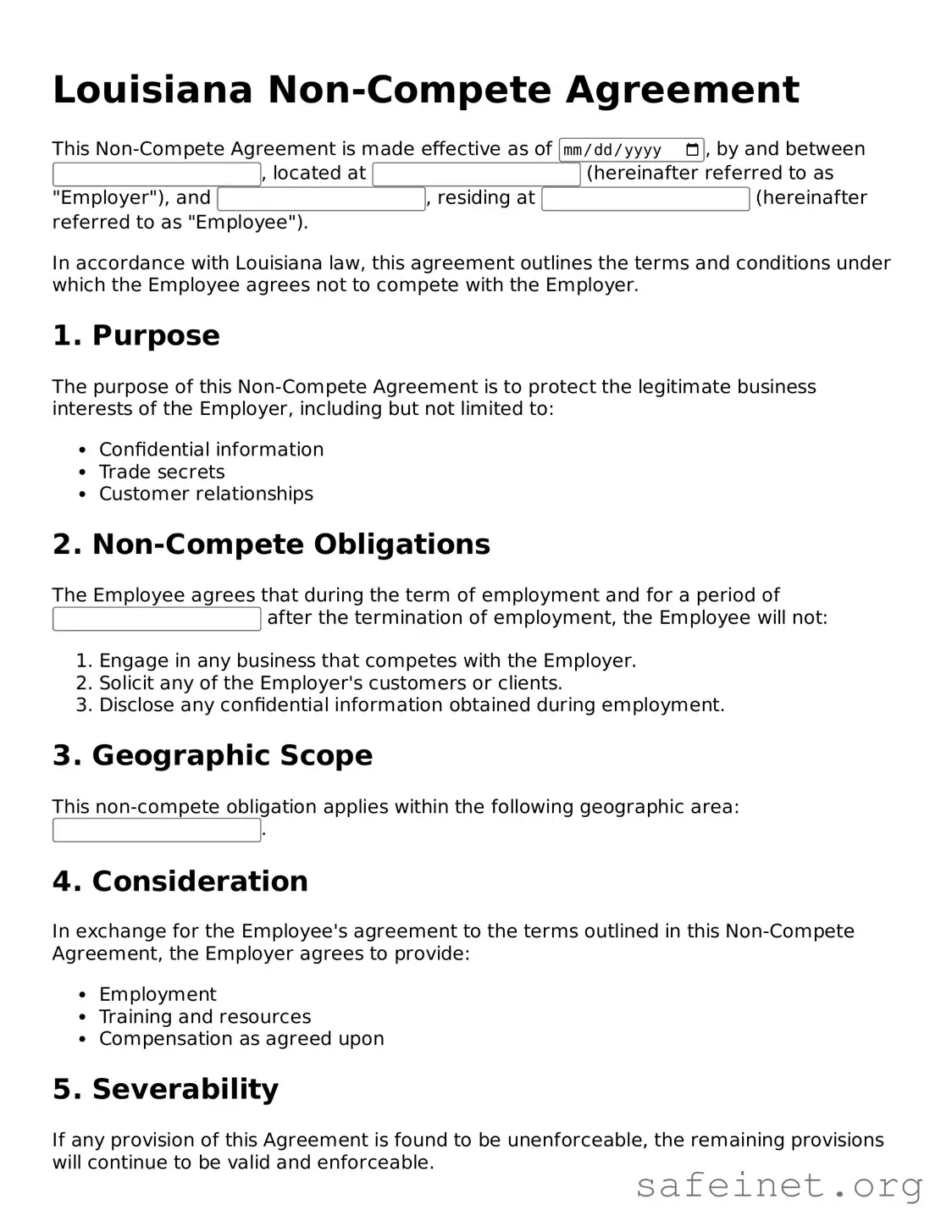
Louisiana Non-Compete Agreement
This Non-Compete Agreement is made effective as of , by and between , located at (hereinafter referred to as "Employer"), and , residing at (hereinafter referred to as "Employee").
In accordance with Louisiana law, this agreement outlines the terms and conditions under which the Employee agrees not to compete with the Employer.
1. Purpose
The purpose of this Non-Compete Agreement is to protect the legitimate business interests of the Employer, including but not limited to:
2. Non-Compete Obligations
The Employee agrees that during the term of employment and for a period of after the termination of employment, the Employee will not:
3. Geographic Scope
This non-compete obligation applies within the following geographic area: .
4. Consideration
In exchange for the Employee's agreement to the terms outlined in this Non-Compete Agreement, the Employer agrees to provide:
5. Severability
If any provision of this Agreement is found to be unenforceable, the remaining provisions will continue to be valid and enforceable.
6. Governing Law
This Agreement shall be governed by and construed in accordance with the laws of the State of Louisiana.
7. Signatures
By signing below, both parties acknowledge that they have read, understood, and agree to the terms of this Non-Compete Agreement.
______________________________
Employer Signature
Date:
______________________________
Employee Signature
Date:
| Fact Name | Details |
|---|---|
| Governing Law | The Louisiana Non-compete Agreement is governed by Louisiana Revised Statutes, Title 23, Section 921. |
| Enforceability | Non-compete agreements are enforceable in Louisiana if they meet specific criteria set by law. |
| Duration Limit | The maximum duration for a non-compete agreement in Louisiana is generally two years. |
| Geographic Scope | The agreement must specify a reasonable geographic area where the restrictions apply. |
| Business Interest | Non-compete agreements must protect a legitimate business interest, such as trade secrets or customer relationships. |
| Written Requirement | The agreement must be in writing and signed by both parties to be enforceable. |
| Exceptions | Certain professionals, like physicians, may have different rules regarding non-compete agreements. |
| Judicial Review | Courts may modify unreasonable non-compete agreements to make them enforceable. |
| Employee Rights | Employees must be informed of the non-compete agreement before signing it, ensuring transparency. |
After obtaining the Louisiana Non-compete Agreement form, you will need to fill it out accurately to ensure its validity. This process involves providing specific information about the parties involved and the terms of the agreement. Follow the steps below to complete the form correctly.
What is a Non-compete Agreement in Louisiana?
A Non-compete Agreement is a contract between an employer and an employee that restricts the employee from engaging in certain competitive activities after leaving the job. In Louisiana, these agreements must comply with specific state laws to be enforceable. They typically outline the duration, geographic area, and scope of activities that are restricted.
What are the legal requirements for a Non-compete Agreement in Louisiana?
In Louisiana, a Non-compete Agreement must be in writing and signed by both parties. It must also be limited in duration, geographic scope, and the specific activities it restricts. Generally, the duration cannot exceed two years, and the geographic area must be reasonable and not overly broad. Additionally, the agreement must protect a legitimate business interest.
Can an employee challenge a Non-compete Agreement?
Yes, an employee can challenge a Non-compete Agreement in court. If the employee believes that the agreement is overly restrictive, lacks a legitimate business interest, or does not meet the legal requirements, they may seek to have it declared unenforceable. Courts will carefully examine the terms of the agreement and the circumstances surrounding its creation.
Are there any exceptions to enforceability in Louisiana?
Yes, there are exceptions. Non-compete Agreements that restrict an employee from engaging in their profession, trade, or business after termination may not be enforceable if they do not meet the legal criteria. Additionally, if the employer does not provide adequate consideration or if the agreement is deemed overly broad, it may be invalidated.
What should an employee do before signing a Non-compete Agreement?
Before signing a Non-compete Agreement, an employee should carefully review the terms and consider seeking legal advice. Understanding the implications of the agreement is crucial, as it may impact future employment opportunities. Employees should also negotiate terms if they feel the restrictions are too limiting.
How does a Non-compete Agreement affect future employment?
A Non-compete Agreement can significantly impact future employment opportunities. If an employee is bound by such an agreement, they may be restricted from working for competitors or starting their own business in the same industry for a specified period. This can limit job prospects and career advancement.
What happens if an employee violates a Non-compete Agreement?
If an employee violates a Non-compete Agreement, the employer may seek legal action. This could result in a court enforcing the agreement, which may include injunctions or monetary damages. It is essential for employees to understand the potential consequences before engaging in activities that could be seen as a violation.
Not Clearly Defining the Scope of Activities: One common mistake is failing to specify the exact activities that are restricted. A vague description can lead to confusion and potential legal challenges. Ensure that the activities you want to restrict are clearly outlined.
Ignoring Geographic Limitations: Many individuals overlook the importance of defining the geographic area in which the non-compete applies. Without a well-defined region, the agreement may be deemed overly broad and unenforceable.
Omitting Time Restrictions: Another frequent error is not including a specific duration for the non-compete agreement. A reasonable time frame is essential; otherwise, the agreement may be considered too restrictive.
Failing to Consider State Laws: Each state has its own regulations regarding non-compete agreements. Ignoring Louisiana's specific legal requirements can render the agreement invalid. It’s crucial to understand what is enforceable in Louisiana.
Not Seeking Legal Advice: Many individuals attempt to draft or fill out the form without consulting a legal professional. This can lead to mistakes that could have been avoided. Seeking legal guidance ensures that the agreement is properly structured and enforceable.
When dealing with a Louisiana Non-compete Agreement, several other documents may also be important to ensure a smooth process. Each of these forms serves a specific purpose and can help clarify terms and protect all parties involved. Here’s a list of common documents that often accompany a Non-compete Agreement:
Having these documents in place can help both employers and employees understand their rights and obligations. It’s always best to ensure clarity and agreement on all terms to avoid potential disputes in the future.
The Louisiana Non-compete Agreement is similar to the Non-disclosure Agreement (NDA). Both documents protect sensitive information and business interests. An NDA specifically focuses on keeping proprietary information confidential, while a non-compete agreement restricts an employee from working with competitors after leaving a job. Both forms aim to safeguard a company’s trade secrets and competitive edge, ensuring that employees do not share or exploit confidential knowledge gained during their employment.
Another document that resembles the Louisiana Non-compete Agreement is the Employment Agreement. This type of agreement outlines the terms of employment, including job responsibilities, compensation, and duration of employment. While the employment agreement sets the foundation for the employer-employee relationship, the non-compete agreement adds a layer of protection for the employer by limiting the employee’s ability to engage in similar work after their employment ends. Together, these documents create a comprehensive framework for the employment relationship.
The Louisiana Non-compete Agreement also shares similarities with the Confidentiality Agreement. Like the NDA, this document focuses on protecting confidential information. However, a confidentiality agreement can be broader in scope, covering various types of sensitive information beyond just trade secrets. Both agreements serve to prevent the unauthorized sharing of critical business information, but the non-compete agreement specifically restricts future employment opportunities in competing businesses.
Additionally, the Louisiana Non-compete Agreement is akin to a Proprietary Information Agreement. This document specifically addresses the handling of proprietary information that a company may share with its employees. While it primarily focuses on the ownership and usage of proprietary data, it often complements a non-compete agreement by reinforcing the obligation to protect the company’s interests. Together, they ensure that employees understand their responsibilities regarding sensitive information and future employment opportunities.
Lastly, the Louisiana Non-compete Agreement is similar to a Partnership Agreement. This type of agreement outlines the terms and conditions under which partners operate a business. While it typically focuses on the relationship between partners, it may include non-compete clauses to prevent partners from starting a competing business after leaving the partnership. Both agreements aim to protect business interests and maintain a competitive advantage, ensuring that partners or employees do not undermine the business after their departure.
When filling out the Louisiana Non-compete Agreement form, certain practices can help ensure clarity and legality. Here are four important dos and don'ts to consider:
Non-compete agreements in Louisiana often come with a variety of misconceptions. Understanding these misunderstandings can help both employers and employees navigate their rights and responsibilities. Here are ten common misconceptions about Louisiana's Non-compete Agreement form:
Understanding these misconceptions can help both employers and employees make informed decisions regarding non-compete agreements in Louisiana.
When considering a Louisiana Non-compete Agreement, it’s essential to understand its implications and requirements. Here are some key takeaways to keep in mind:
Understanding these elements can help both employers and employees navigate the complexities of non-compete agreements in Louisiana.