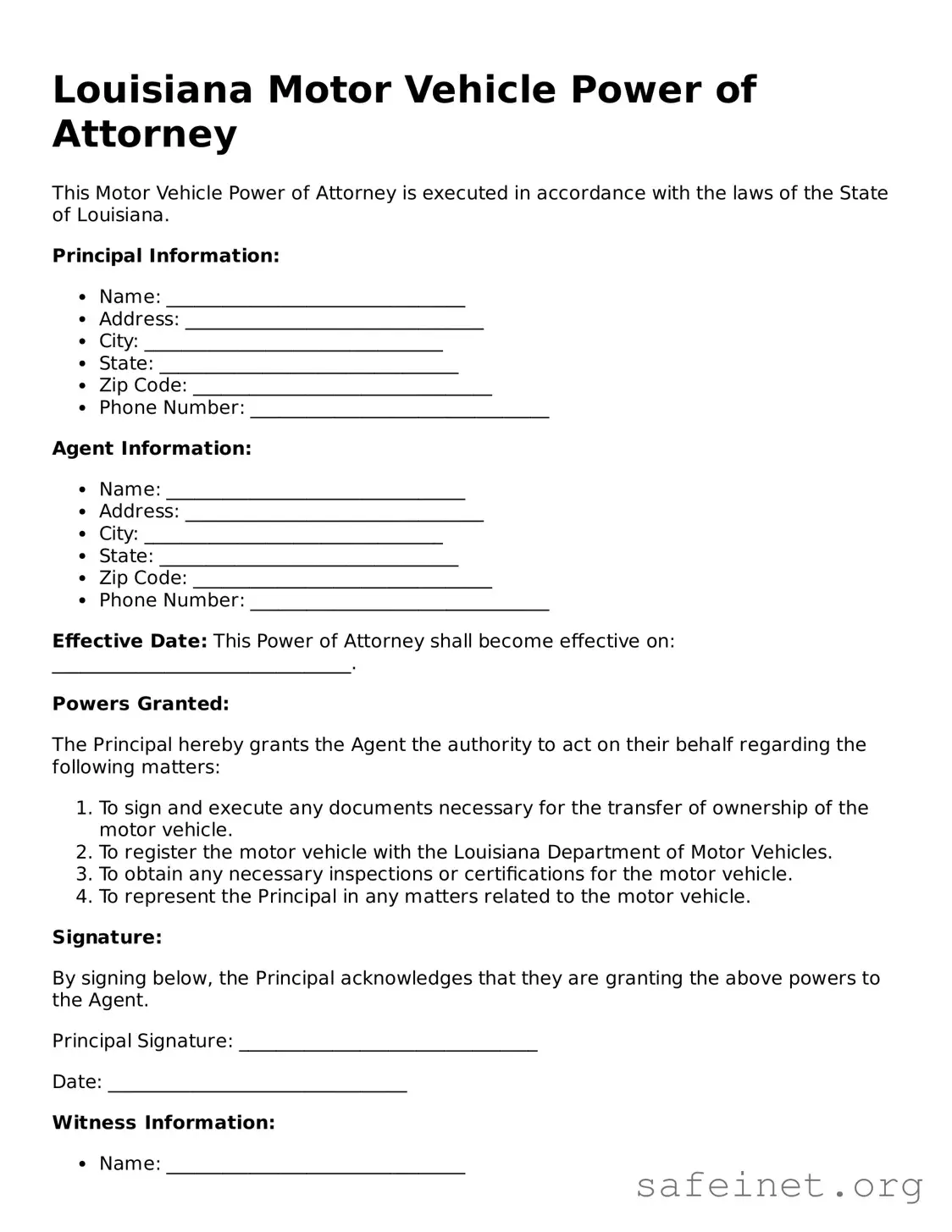
In the vibrant state of Louisiana, navigating the intricacies of motor vehicle ownership and transactions can sometimes feel overwhelming. The Louisiana Motor Vehicle Power of Attorney form serves as a crucial tool for individuals looking to delegate authority concerning their vehicle-related matters. This form empowers a designated individual—often a trusted friend or family member—to act on behalf of the vehicle owner in various capacities, such as signing documents, registering vehicles, or even transferring titles. It streamlines processes that might otherwise require the owner’s direct involvement, especially in situations where they may be unavailable due to travel, illness, or other commitments. Understanding the nuances of this form is essential for ensuring that vehicle transactions proceed smoothly and legally. By effectively utilizing this Power of Attorney, vehicle owners can maintain control over their assets while delegating responsibilities, thus enhancing convenience and peace of mind.
Louisiana Motor Vehicle Power of Attorney
This Motor Vehicle Power of Attorney is executed in accordance with the laws of the State of Louisiana.
Principal Information:
Agent Information:
Effective Date: This Power of Attorney shall become effective on: ________________________________.
Powers Granted:
The Principal hereby grants the Agent the authority to act on their behalf regarding the following matters:
Signature:
By signing below, the Principal acknowledges that they are granting the above powers to the Agent.
Principal Signature: ________________________________
Date: ________________________________
Witness Information:
Witness Signature: ________________________________
Date: ________________________________
Notary Public:
State of Louisiana
Parish of ________________________________
On this ______ day of __________, 20__, before me, a Notary Public, personally appeared ________________________________, known to me to be the person whose name is subscribed to this Power of Attorney.
Notary Signature: ________________________________
My Commission Expires: ________________________________
| Fact Name | Details |
|---|---|
| Purpose | The Louisiana Motor Vehicle Power of Attorney form allows an individual to designate another person to handle vehicle-related transactions on their behalf. |
| Governing Law | This form is governed by Louisiana Revised Statutes, Title 9, Section 4001. |
| Signature Requirement | The principal must sign the form in the presence of a notary public for it to be valid. |
| Revocation | The power of attorney can be revoked at any time by the principal, provided the revocation is in writing. |
| Duration | This power of attorney remains in effect until the principal revokes it or until the specified expiration date, if applicable. |
| Uses | Common uses include transferring vehicle titles, registering vehicles, and handling related paperwork. |
Completing the Louisiana Motor Vehicle Power of Attorney form requires careful attention to detail. This document allows an individual to designate another person to act on their behalf in matters related to their motor vehicle. Follow these steps to ensure the form is filled out correctly.
Once the form is completed and signed, it should be submitted to the appropriate authorities, such as the DMV, along with any required documents. Ensure that copies are kept for personal records.
What is a Louisiana Motor Vehicle Power of Attorney form?
The Louisiana Motor Vehicle Power of Attorney form is a legal document that allows an individual, referred to as the principal, to designate another person, known as the agent, to act on their behalf regarding motor vehicle transactions. This can include tasks such as registering a vehicle, transferring ownership, or obtaining a title. By using this form, the principal grants the agent the authority to perform specific actions related to their motor vehicle, ensuring that necessary tasks can be handled efficiently, even if the principal is unavailable.
Who can be designated as an agent in this Power of Attorney?
In Louisiana, the agent designated in the Motor Vehicle Power of Attorney form can be any competent adult. This often includes family members, friends, or trusted associates. It is important for the principal to choose someone they trust, as the agent will have the authority to make decisions regarding their motor vehicle. The agent should be reliable and capable of handling the responsibilities assigned to them, ensuring that the principal’s interests are well-represented.
How long is the Louisiana Motor Vehicle Power of Attorney valid?
The validity of the Louisiana Motor Vehicle Power of Attorney form typically lasts until the tasks specified in the document are completed or until the principal revokes the authority granted to the agent. The principal has the right to revoke the Power of Attorney at any time, provided they notify the agent and any relevant third parties. It is advisable for the principal to keep a copy of the revocation for their records to avoid any potential confusion regarding the agent’s authority.
What should be included in the Louisiana Motor Vehicle Power of Attorney form?
When completing the Louisiana Motor Vehicle Power of Attorney form, it is essential to include specific details to ensure clarity and effectiveness. Key components should consist of the full names and addresses of both the principal and the agent, a clear description of the powers being granted, and the identification details of the vehicle in question, such as the Vehicle Identification Number (VIN). Additionally, the form should be signed and dated by the principal to validate the document. Including these details helps prevent misunderstandings and ensures that the agent has the authority to act on behalf of the principal effectively.
Not providing complete information: Individuals often forget to fill in all required fields, such as the names and addresses of both the principal and the agent. Missing information can lead to delays or invalidation of the document.
Failure to sign: Some people neglect to sign the form. Without a signature, the Power of Attorney is not legally binding, rendering it ineffective.
Improper witness or notarization: In Louisiana, the form may require a witness or notary public. Failing to meet these requirements can result in the document being challenged or deemed invalid.
Choosing an unsuitable agent: Selecting someone who lacks the necessary trustworthiness or competence can lead to misuse of the authority granted. It’s crucial to choose an agent who understands the responsibilities involved.
Not specifying the powers granted: Some individuals leave the powers too vague. Clearly outlining the specific powers the agent will have helps prevent misunderstandings and misuse.
Ignoring state-specific requirements: Each state has its own rules regarding Power of Attorney forms. Failing to adhere to Louisiana’s specific requirements can invalidate the document.
When dealing with vehicle transactions in Louisiana, the Motor Vehicle Power of Attorney form often works in tandem with other important documents. Each of these forms plays a crucial role in ensuring that all legal aspects of vehicle ownership and transfer are handled properly. Here are some commonly used forms that complement the Power of Attorney.
Using these forms alongside the Louisiana Motor Vehicle Power of Attorney ensures a smooth and legal transfer of vehicle ownership. Proper documentation protects both the buyer and seller, minimizing potential disputes in the future.
The Louisiana Motor Vehicle Power of Attorney form shares similarities with a General Power of Attorney. Both documents allow one person to grant authority to another to act on their behalf. In the case of a General Power of Attorney, the scope of authority can be broad, covering various financial and legal matters. However, the Motor Vehicle Power of Attorney is specifically tailored for matters related to motor vehicles, such as transferring titles or registering vehicles. This specificity makes it a focused tool for vehicle-related transactions, unlike the more general nature of a standard power of attorney.
Another document that resembles the Louisiana Motor Vehicle Power of Attorney is the Vehicle Title Transfer Form. This form is often used when someone is buying or selling a vehicle. While the Vehicle Title Transfer Form is primarily concerned with the actual transfer of ownership, the Motor Vehicle Power of Attorney allows an individual to authorize someone else to execute this transfer on their behalf. Both documents ensure that the ownership of a vehicle is legally recognized, but the power of attorney adds a layer of convenience for those who may not be able to handle the transaction in person.
The Bill of Sale also shares some characteristics with the Motor Vehicle Power of Attorney. A Bill of Sale is a document that records the sale of a vehicle, providing proof of the transaction. When someone uses a Motor Vehicle Power of Attorney, they can empower another person to complete the sale and sign the Bill of Sale for them. This is particularly useful when the vehicle owner cannot be present to finalize the sale, ensuring that the transaction proceeds smoothly while still maintaining legal validity.
A similar document is the DMV Authorization Form, which many states use to designate someone to handle specific tasks at the Department of Motor Vehicles. Like the Motor Vehicle Power of Attorney, this form allows individuals to delegate authority. However, the DMV Authorization Form is often limited to specific DMV-related tasks, such as renewing a registration or obtaining a duplicate title. The Motor Vehicle Power of Attorney, in contrast, encompasses a broader range of vehicle-related activities, making it a more comprehensive option for vehicle owners.
The Release of Liability form is another document that bears resemblance to the Motor Vehicle Power of Attorney. When a vehicle is sold, the seller typically completes a Release of Liability to inform the state that they are no longer responsible for the vehicle. While this form serves a different purpose, the Motor Vehicle Power of Attorney can facilitate the process of completing and submitting this form by allowing someone else to act on the seller's behalf. This ensures that the seller is protected from any future liabilities associated with the vehicle.
Lastly, the Consent to Transfer Ownership form is akin to the Motor Vehicle Power of Attorney. This document is often used when a vehicle is being transferred between family members or in situations where consent is required. The Motor Vehicle Power of Attorney can be utilized to grant authority to another person to sign this consent form, thereby simplifying the process of transferring ownership. Both documents aim to ensure that the transfer of a vehicle is conducted legally and with the necessary permissions in place.
When completing the Louisiana Motor Vehicle Power of Attorney form, it is essential to follow specific guidelines to ensure accuracy and compliance. Here are four important do's and don'ts:
When it comes to the Louisiana Motor Vehicle Power of Attorney form, there are several misconceptions that can lead to confusion. Understanding the truth behind these myths can help you navigate the process more smoothly. Here are five common misconceptions:
Many people believe that a Motor Vehicle Power of Attorney is solely for the purpose of selling a car. In reality, this form allows you to authorize someone to handle various tasks related to your vehicle, including registration, title transfers, and even obtaining license plates.
While legal assistance can be helpful, it is not necessary to have a lawyer draft your Motor Vehicle Power of Attorney. You can create this document yourself, as long as you follow the state’s guidelines and include the required information.
Some believe that notarization is mandatory for the Motor Vehicle Power of Attorney to be effective. In Louisiana, while notarization can add an extra layer of authenticity, it is not a strict requirement for the document to be valid.
There is a common assumption that the Motor Vehicle Power of Attorney has a set expiration date. However, this document remains effective until you revoke it or until the specific task for which it was granted has been completed.
Some people think that only the vehicle owner can complete the Power of Attorney form. In fact, anyone who has the owner's permission can fill it out, as long as they have the necessary information and authority to act on the owner’s behalf.
By dispelling these misconceptions, individuals can better understand how to utilize the Louisiana Motor Vehicle Power of Attorney form effectively. This knowledge empowers vehicle owners to delegate responsibilities with confidence.
Filling out the Louisiana Motor Vehicle Power of Attorney form can be straightforward if you keep a few important points in mind. Here are some key takeaways to help you navigate the process:
By following these tips, you can effectively use the Louisiana Motor Vehicle Power of Attorney form with confidence.