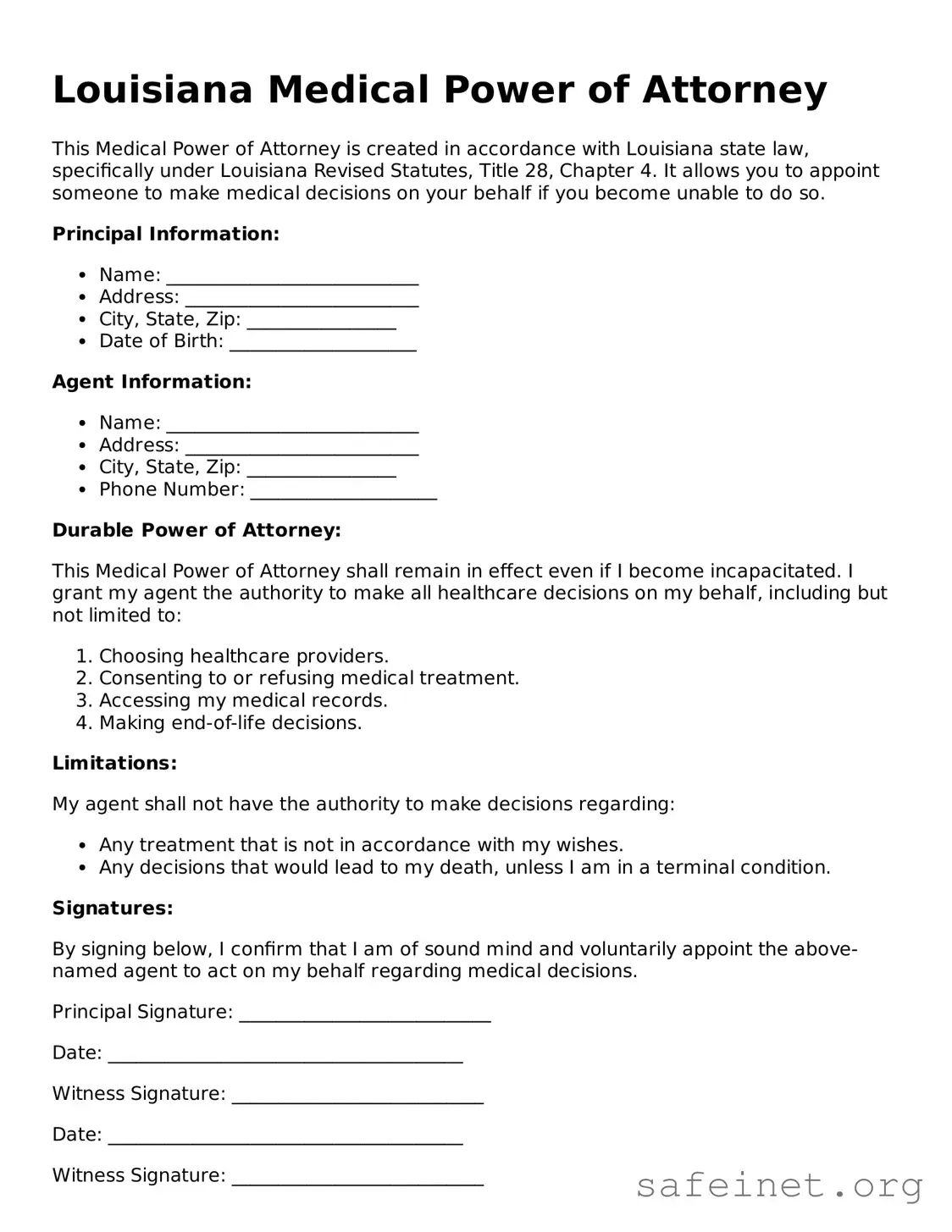
The Louisiana Medical Power of Attorney form is an essential legal document that allows individuals to designate a trusted person to make healthcare decisions on their behalf in the event they become unable to do so. This form is crucial for ensuring that medical choices align with the individual's wishes, especially during emergencies or serious health conditions. It outlines the authority granted to the appointed agent, which may include decisions about medical treatments, surgeries, and end-of-life care. In Louisiana, this form must meet specific requirements to be valid, such as being signed by the principal and witnessed by two individuals or notarized. Understanding the nuances of this document is vital for anyone looking to secure their healthcare preferences and provide peace of mind for themselves and their loved ones. By having a Medical Power of Attorney in place, individuals can ensure that their healthcare choices are respected and that their designated agent has the necessary authority to act in their best interests during challenging times.
Louisiana Medical Power of Attorney
This Medical Power of Attorney is created in accordance with Louisiana state law, specifically under Louisiana Revised Statutes, Title 28, Chapter 4. It allows you to appoint someone to make medical decisions on your behalf if you become unable to do so.
Principal Information:
Agent Information:
Durable Power of Attorney:
This Medical Power of Attorney shall remain in effect even if I become incapacitated. I grant my agent the authority to make all healthcare decisions on my behalf, including but not limited to:
Limitations:
My agent shall not have the authority to make decisions regarding:
Signatures:
By signing below, I confirm that I am of sound mind and voluntarily appoint the above-named agent to act on my behalf regarding medical decisions.
Principal Signature: ___________________________
Date: ______________________________________
Witness Signature: ___________________________
Date: ______________________________________
Witness Signature: ___________________________
Date: ______________________________________
Notarization:
State of Louisiana
Parish of ___________________________
Subscribed and sworn to before me this ____ day of __________, 20__.
Notary Public: ___________________________
My Commission Expires: ________________
| Fact Name | Description |
|---|---|
| Definition | A Louisiana Medical Power of Attorney allows a person to appoint someone else to make healthcare decisions on their behalf if they become unable to do so. |
| Governing Law | The form is governed by Louisiana Revised Statutes, specifically Title 28, Chapter 4. |
| Principal and Agent | The person creating the document is known as the principal, while the person designated to make decisions is the agent. |
| Durability | This power of attorney remains effective even if the principal becomes incapacitated, unless stated otherwise. |
| Healthcare Decisions | The agent can make a wide range of healthcare decisions, including consent to or refusal of medical treatment. |
| Witness Requirement | The form must be signed by the principal in the presence of two witnesses or notarized. |
| Revocation | The principal can revoke the Medical Power of Attorney at any time, as long as they are competent. |
| Agent's Authority | The agent's authority can be limited or expanded based on the principal's wishes, which should be clearly stated in the document. |
| Alternates | It is advisable to name an alternate agent in case the primary agent is unavailable or unable to act. |
| Legal Advice | While not required, it is beneficial to seek legal advice when creating a Medical Power of Attorney to ensure it meets all legal requirements. |
Filling out the Louisiana Medical Power of Attorney form is a straightforward process that allows you to designate someone to make medical decisions on your behalf if you become unable to do so. Follow the steps below to ensure that the form is completed correctly.
Once you have filled out the form, ensure that everyone involved understands their roles and responsibilities. Keeping copies accessible can help facilitate communication among your loved ones and healthcare providers when the time comes.
What is a Louisiana Medical Power of Attorney?
A Louisiana Medical Power of Attorney is a legal document that allows an individual to appoint someone else to make healthcare decisions on their behalf. This is particularly important if the individual becomes unable to communicate their wishes due to illness or injury. The appointed person, known as an agent, will have the authority to make medical decisions, ensuring that the individual's preferences regarding treatment are honored.
Who can be appointed as an agent in a Medical Power of Attorney?
In Louisiana, any competent adult can be appointed as an agent in a Medical Power of Attorney. This can include family members, friends, or trusted advisors. It is crucial to choose someone who understands your values and wishes regarding medical care. The agent should also be willing to take on this responsibility and be available to make decisions when needed.
How do I create a Medical Power of Attorney in Louisiana?
To create a Medical Power of Attorney in Louisiana, you need to fill out the appropriate form, which can typically be obtained from legal resources or healthcare providers. The form must be signed in the presence of a notary public or two witnesses who are not related to you and do not stand to gain from your estate. After completing the form, it is advisable to provide copies to your agent, healthcare providers, and family members to ensure that your wishes are known and respected.
Can I revoke or change my Medical Power of Attorney?
Yes, you can revoke or change your Medical Power of Attorney at any time as long as you are still competent to make decisions. To revoke the document, you should notify your agent and any healthcare providers who have a copy of the form. It is also a good practice to create a new Medical Power of Attorney if you wish to appoint a different agent or make changes to your preferences.
What happens if I do not have a Medical Power of Attorney?
If you do not have a Medical Power of Attorney and become unable to make your own healthcare decisions, medical providers may turn to family members or seek a court-appointed guardian to make decisions on your behalf. This process can be lengthy and may not reflect your personal wishes. Having a Medical Power of Attorney ensures that your healthcare preferences are followed, reducing uncertainty and potential conflict among family members during difficult times.
Failing to designate a specific agent. It is crucial to clearly name an individual who will make medical decisions on your behalf. Without this designation, the document may not be valid.
Not providing alternate agents. Selecting a primary agent is important, but also naming one or two alternatives can ensure that decisions can still be made if the primary agent is unavailable.
Inadequate understanding of the agent's authority. The form should specify the extent of the agent's powers. If this is not clearly defined, the agent may face challenges in making decisions.
Neglecting to sign and date the document. A signature is necessary for the form to be legally binding. Additionally, dating the document is important to establish its validity.
Overlooking witness requirements. Louisiana law requires that the Medical Power of Attorney be signed in the presence of two witnesses or a notary. Failing to meet this requirement can invalidate the document.
Not reviewing the form periodically. Life circumstances change. Regularly reviewing and updating the Medical Power of Attorney ensures that it reflects current wishes and conditions.
When considering a Louisiana Medical Power of Attorney, it is essential to understand that this document often works in conjunction with several other important forms. These additional documents can help clarify your healthcare wishes and ensure that your preferences are respected in various situations.
Understanding these documents can empower individuals to make informed decisions about their healthcare and legal matters. Each form plays a unique role in ensuring that your wishes are honored and that your loved ones are equipped to make decisions on your behalf when necessary.
The Louisiana Medical Power of Attorney form shares similarities with the General Power of Attorney. Both documents allow individuals to designate an agent to make decisions on their behalf. However, while the General Power of Attorney covers a broad range of financial and legal matters, the Medical Power of Attorney is specifically focused on healthcare decisions. This distinction is crucial for ensuring that the appointed agent can act in accordance with the principal's wishes regarding medical treatment and care.
Another document similar to the Louisiana Medical Power of Attorney is the Advance Healthcare Directive. This document combines both a Medical Power of Attorney and a living will. It not only appoints an agent to make healthcare decisions but also outlines the principal's preferences for medical treatment in specific scenarios. This dual function provides clarity and direction to healthcare providers and family members during critical moments.
The Healthcare Proxy is also comparable to the Louisiana Medical Power of Attorney. Like the Medical Power of Attorney, a Healthcare Proxy allows individuals to appoint someone to make medical decisions on their behalf. The key difference lies in the terminology and specific state laws governing each document. In some states, the term “healthcare proxy” is used interchangeably with “medical power of attorney,” but the underlying purpose remains the same: to ensure that someone trusted can advocate for the principal's healthcare choices.
The Living Will is another document that shares a common purpose with the Louisiana Medical Power of Attorney. A Living Will specifies the types of medical treatments an individual wishes to receive or avoid in the event of a terminal illness or incapacitation. While the Medical Power of Attorney designates someone to make decisions, the Living Will provides explicit instructions regarding the individual's treatment preferences. This combination helps ensure that the principal's wishes are honored in various medical situations.
Lastly, the Do Not Resuscitate (DNR) Order is related to the Louisiana Medical Power of Attorney in that it addresses specific medical decisions. A DNR order instructs healthcare providers not to perform CPR if the individual stops breathing or their heart stops beating. While the Medical Power of Attorney grants broader decision-making authority, a DNR focuses on one critical aspect of end-of-life care. Having both documents in place can provide comprehensive guidance for healthcare providers and family members during emergencies.
Filling out a Louisiana Medical Power of Attorney form is an important step in ensuring that your healthcare wishes are respected. Here are some essential do's and don'ts to keep in mind:
Understanding the Louisiana Medical Power of Attorney form is crucial for making informed healthcare decisions. However, several misconceptions can lead to confusion. Here are eight common misconceptions:
This is not true. Anyone, regardless of age, can benefit from having a Medical Power of Attorney in place to ensure their healthcare preferences are respected.
While both documents deal with healthcare decisions, a Medical Power of Attorney appoints someone to make decisions on your behalf, whereas a living will outlines your specific wishes regarding medical treatment.
This is incorrect. You can revoke or update your Medical Power of Attorney at any time, as long as you are mentally competent.
This is a misconception. While legal advice can be helpful, individuals can complete the form themselves as long as they follow the state's requirements.
Your agent can be anyone you trust, including friends or colleagues, as long as they are of legal age and competent.
While the form is specific to Louisiana, it may be recognized in other states. However, it's best to check each state's laws to ensure validity.
Healthcare providers are required to respect your wishes as long as they are clearly outlined, whether in a Medical Power of Attorney or other legal documents.
This is a common fear. In reality, you maintain control until you are unable to make decisions for yourself. Your agent acts only when you cannot.
By dispelling these misconceptions, individuals can better understand the importance of having a Medical Power of Attorney and make informed decisions regarding their healthcare.
Filling out and using a Louisiana Medical Power of Attorney form is an important step in ensuring that your healthcare wishes are respected. Here are five key takeaways to keep in mind:
By following these key points, you can create a Medical Power of Attorney that truly reflects your healthcare preferences and protects your rights in medical situations.