In the state of Louisiana, planning for the future involves making important decisions about healthcare preferences, especially in the event of a medical crisis. One essential tool for this purpose is the Louisiana Living Will form, which allows individuals to clearly outline their wishes regarding life-sustaining treatments and end-of-life care. This legal document empowers you to express your desires concerning medical interventions, such as resuscitation efforts and artificial nutrition, ensuring that your preferences are honored even when you may be unable to communicate them. By completing this form, you can designate specific circumstances under which you would or would not want certain medical procedures to be performed. Additionally, the Living Will can serve as a guide for healthcare providers and loved ones, helping to alleviate the emotional burden of decision-making during difficult times. Understanding the nuances of this form is crucial, as it not only reflects your values but also fosters clarity and peace of mind for both you and your family.
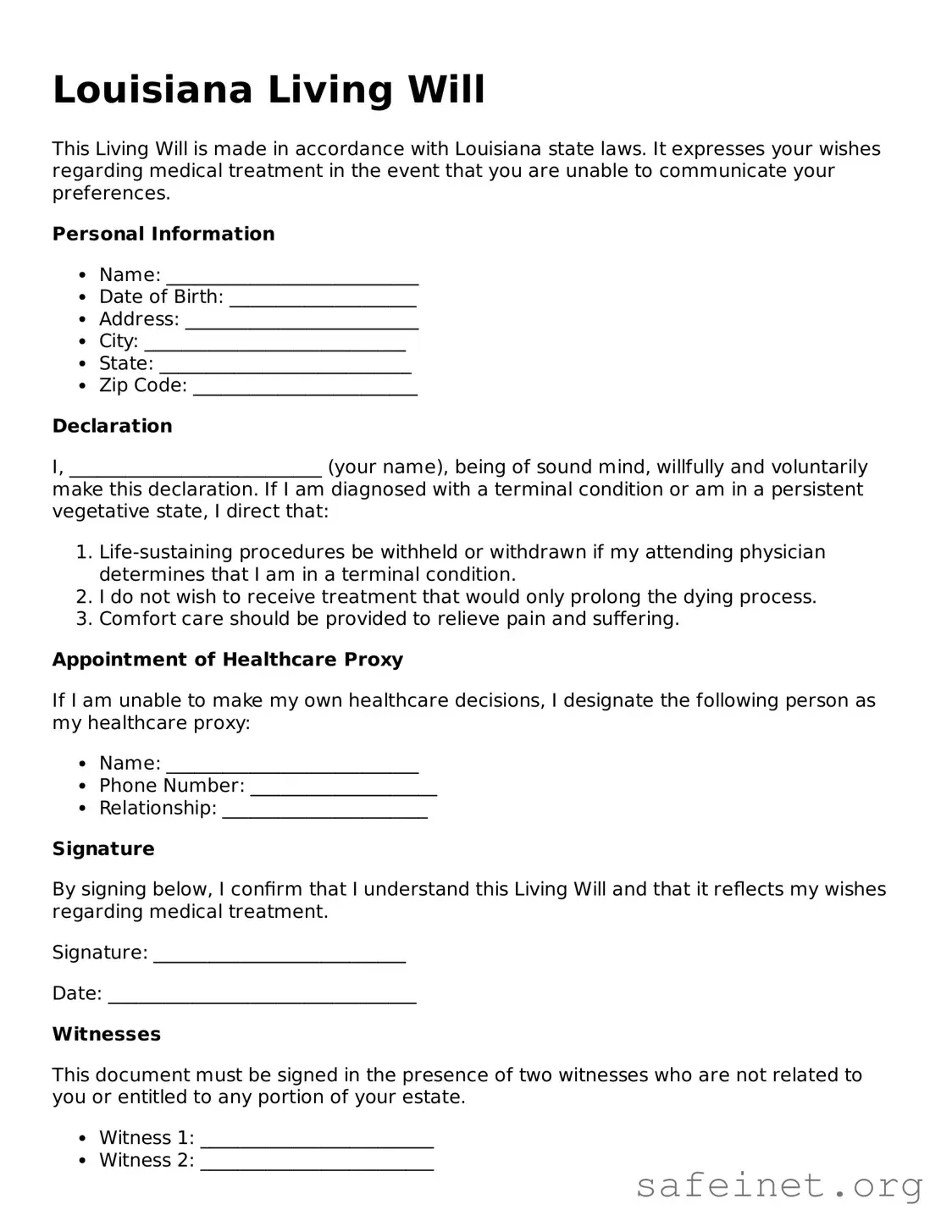
Louisiana Living Will
This Living Will is made in accordance with Louisiana state laws. It expresses your wishes regarding medical treatment in the event that you are unable to communicate your preferences.
Personal Information
Declaration
I, ___________________________ (your name), being of sound mind, willfully and voluntarily make this declaration. If I am diagnosed with a terminal condition or am in a persistent vegetative state, I direct that:
Appointment of Healthcare Proxy
If I am unable to make my own healthcare decisions, I designate the following person as my healthcare proxy:
Signature
By signing below, I confirm that I understand this Living Will and that it reflects my wishes regarding medical treatment.
Signature: ___________________________
Date: _________________________________
Witnesses
This document must be signed in the presence of two witnesses who are not related to you or entitled to any portion of your estate.
| Fact Name | Description |
|---|---|
| Governing Law | The Louisiana Living Will form is governed by the Louisiana Revised Statutes, specifically R.S. 40:1299.58. |
| Purpose | This form allows individuals to express their wishes regarding medical treatment in the event they become unable to communicate. |
| Eligibility | Any adult who is of sound mind can create a Living Will in Louisiana. |
| Witness Requirement | The form must be signed in the presence of two witnesses, or it can be notarized. |
| Revocation | A Living Will can be revoked at any time by the individual, either verbally or in writing. |
| Health Care Proxy | A Living Will is different from a health care proxy, which designates someone to make decisions on your behalf. |
| Effectiveness | The Living Will takes effect when a physician determines that the individual is in a terminal condition or permanently unconscious. |
| Legal Recognition | Louisiana recognizes Living Wills executed in accordance with its laws, ensuring they are valid and enforceable. |
Filling out the Louisiana Living Will form is an important step in ensuring your healthcare wishes are respected. After completing the form, you will need to sign it in the presence of a witness or notary, depending on your preference. Follow these steps to accurately fill out the form.
Once completed, keep a copy for your records and share the original with your healthcare provider and loved ones.
What is a Louisiana Living Will?
A Louisiana Living Will is a legal document that allows individuals to express their wishes regarding medical treatment in case they become unable to communicate those wishes themselves. It specifically addresses end-of-life care and outlines preferences for life-sustaining treatments, such as resuscitation and artificial nutrition.
Who can create a Living Will in Louisiana?
Any adult who is at least 18 years old and of sound mind can create a Living Will in Louisiana. This means that you should be capable of understanding the nature and consequences of your decisions regarding medical care.
How do I create a Living Will in Louisiana?
To create a Living Will, you can use a form that meets Louisiana's legal requirements. It must be signed in the presence of two witnesses or a notary public. The witnesses cannot be related to you or have any financial interest in your estate. Once completed, keep the document in a safe place and share copies with your healthcare providers and family members.
Can I change or revoke my Living Will?
Yes, you can change or revoke your Living Will at any time as long as you are of sound mind. To make changes, you should create a new document that clearly states your updated wishes. To revoke it, simply destroy the document and inform your healthcare providers of your decision.
What happens if I do not have a Living Will?
If you do not have a Living Will, your healthcare providers will make decisions based on your best interests and the opinions of family members. This can lead to uncertainty and conflict among loved ones about what you would have wanted. Having a Living Will helps ensure your wishes are known and respected.
Is a Living Will the same as a Durable Power of Attorney for Healthcare?
No, a Living Will and a Durable Power of Attorney for Healthcare are different documents. A Living Will specifies your wishes regarding medical treatment, while a Durable Power of Attorney allows you to appoint someone to make healthcare decisions on your behalf if you are unable to do so. You can have both documents in place for comprehensive planning.
Where should I keep my Living Will?
It is important to keep your Living Will in a safe but accessible place. Consider giving copies to your healthcare providers, family members, and anyone you trust to advocate for your wishes. Make sure that those close to you know where to find it in case of an emergency.
Failing to clearly state their wishes regarding medical treatment. It's crucial to be explicit about what you do or do not want.
Not signing the form in the presence of witnesses. Louisiana law requires that your Living Will be signed in front of two witnesses.
Choosing witnesses who are not eligible. Witnesses cannot be your spouse, blood relatives, or anyone who stands to gain from your estate.
Leaving out important details about specific medical conditions. A vague description may lead to confusion and misinterpretation.
Not dating the form. The date is essential for establishing the document's validity and ensuring it reflects your current wishes.
Using outdated forms. Always ensure that you are using the most current version of the Louisiana Living Will form.
Neglecting to discuss the Living Will with family members. Communication can help avoid misunderstandings when the time comes.
Not keeping copies of the completed form. It's important to have multiple copies accessible to healthcare providers and loved ones.
Overlooking state-specific requirements. Each state has unique laws governing Living Wills, so be sure to follow Louisiana’s guidelines.
Failing to review and update the document regularly. Life circumstances change, and your wishes may need to be adjusted accordingly.
When considering end-of-life decisions, individuals often prepare a variety of documents to ensure their wishes are respected. Alongside the Louisiana Living Will form, several other important forms can provide clarity and guidance regarding medical care and personal preferences.
By understanding and utilizing these documents, individuals can ensure their health care preferences are honored, even when they may not be in a position to communicate them. It is essential to consider these forms carefully and discuss them with loved ones and medical professionals.
The Louisiana Living Will form shares similarities with the advance directive, a broader category of documents that allows individuals to outline their healthcare preferences in advance. Like the Living Will, an advance directive can specify what types of medical treatment a person wishes to receive or refuse in the event they become incapacitated. Both documents aim to ensure that a person's wishes regarding medical care are respected, even when they cannot communicate those wishes themselves. However, advance directives may also include provisions for appointing a healthcare proxy, which the Living Will does not typically address.
Another document akin to the Louisiana Living Will is the durable power of attorney for healthcare. This legal instrument allows a person to designate someone else to make healthcare decisions on their behalf if they are unable to do so. While the Living Will focuses primarily on specific medical treatment preferences, the durable power of attorney encompasses a broader range of decision-making authority. It can include everything from medical procedures to end-of-life care, ensuring that the appointed individual can act in accordance with the patient’s wishes.
The Do Not Resuscitate (DNR) order is also similar to the Louisiana Living Will. A DNR specifically instructs medical personnel not to perform cardiopulmonary resuscitation (CPR) if a patient’s heart stops beating. While the Living Will covers a wider array of medical treatments and interventions, both documents reflect the individual's desires regarding end-of-life care. The DNR is often used in conjunction with a Living Will, providing clear instructions in emergency situations.
Another related document is the Physician Orders for Life-Sustaining Treatment (POLST). This form translates a patient's wishes regarding life-sustaining treatment into actionable medical orders. Like the Living Will, the POLST is intended for individuals with serious health conditions. However, the POLST is more specific and is typically used by healthcare providers to guide immediate care decisions, whereas the Living Will serves as a broader statement of intent regarding future medical care.
Lastly, the healthcare proxy form bears resemblance to the Louisiana Living Will. This document allows individuals to appoint a specific person to make healthcare decisions on their behalf. While the Living Will outlines what treatments an individual desires or refuses, the healthcare proxy form empowers a designated person to interpret those wishes and make real-time decisions based on the patient's preferences. Both documents are essential for ensuring that a person's healthcare choices are honored, especially during critical moments when they cannot voice their desires.
When filling out the Louisiana Living Will form, it's important to approach the process with care. Here are some guidelines to help you navigate this task effectively.
By following these guidelines, you can ensure that your Living Will accurately reflects your wishes and provides clarity for your loved ones and healthcare providers.
Understanding the Louisiana Living Will form is essential for making informed decisions about end-of-life care. However, several misconceptions often arise. Below is a list of five common misunderstandings related to this important document.
This is not entirely accurate. While a Living Will is often associated with terminal conditions, it also addresses situations where individuals may be unable to communicate their wishes, such as in a coma or severe cognitive impairment.
This is incorrect. A Living Will focuses solely on medical treatment preferences. Separate documents, like an organ donation form, are required to express wishes regarding organ donation.
This is a misunderstanding. Individuals have the right to revise or revoke their Living Will at any time, as long as they are mentally competent to do so.
This is not true. While both documents relate to health care decisions, a Living Will outlines specific wishes regarding treatment, whereas a Durable Power of Attorney designates someone to make health care decisions on your behalf.
This misconception overlooks the fact that anyone, regardless of age, can benefit from having a Living Will. Unexpected medical emergencies can happen at any age, making it prudent for all adults to consider this document.
When filling out and using the Louisiana Living Will form, it is important to consider the following key takeaways:
Taking these steps will help ensure that your healthcare preferences are respected and followed in accordance with Louisiana law.