When entering into a rental arrangement in Louisiana, understanding the Louisiana Lease Agreement form is crucial for both landlords and tenants. This document serves as a binding contract that outlines the rights and responsibilities of each party involved in the leasing process. Key aspects include the duration of the lease, rental payment details, security deposit requirements, and maintenance obligations. Additionally, it addresses the rules regarding pets, subletting, and termination of the lease. By clearly defining these elements, the agreement helps to prevent misunderstandings and disputes, fostering a smoother landlord-tenant relationship. Familiarity with this form not only protects the interests of both parties but also ensures compliance with Louisiana's specific rental laws, which can differ from those in other states.
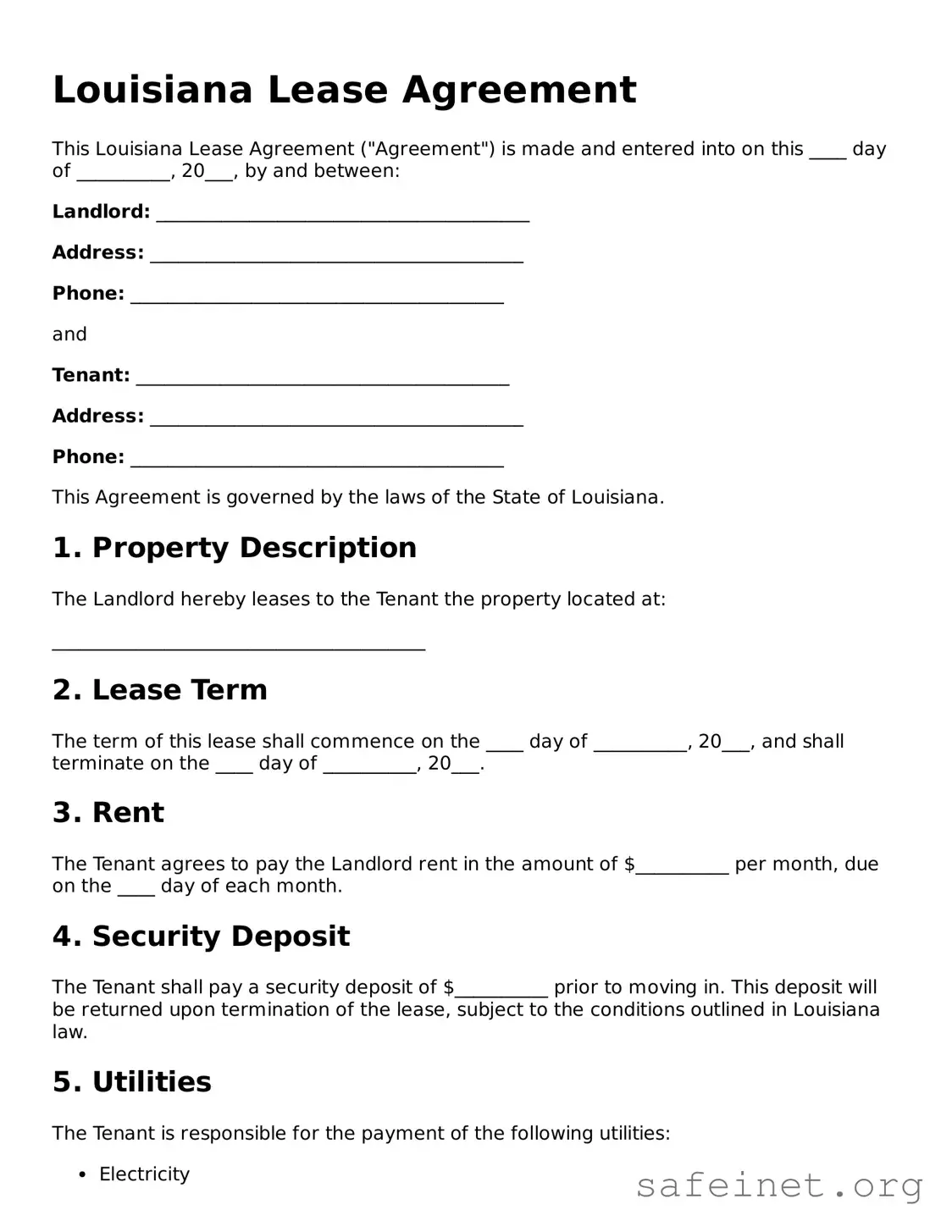
Louisiana Lease Agreement
This Louisiana Lease Agreement ("Agreement") is made and entered into on this ____ day of __________, 20___, by and between:
Landlord: ________________________________________
Address: ________________________________________
Phone: ________________________________________
and
Tenant: ________________________________________
Address: ________________________________________
Phone: ________________________________________
This Agreement is governed by the laws of the State of Louisiana.
1. Property Description
The Landlord hereby leases to the Tenant the property located at:
________________________________________
2. Lease Term
The term of this lease shall commence on the ____ day of __________, 20___, and shall terminate on the ____ day of __________, 20___.
3. Rent
The Tenant agrees to pay the Landlord rent in the amount of $__________ per month, due on the ____ day of each month.
4. Security Deposit
The Tenant shall pay a security deposit of $__________ prior to moving in. This deposit will be returned upon termination of the lease, subject to the conditions outlined in Louisiana law.
5. Utilities
The Tenant is responsible for the payment of the following utilities:
6. Maintenance and Repairs
The Landlord shall be responsible for:
The Tenant shall be responsible for:
7. Termination
Either party may terminate this lease by providing written notice at least ____ days prior to the desired termination date.
8. Governing Law
This Agreement shall be governed by the laws of the State of Louisiana.
9. Signatures
IN WITNESS WHEREOF, the parties hereto have executed this Agreement as of the date first above written.
Landlord Signature: ___________________________
Date: ___________________________
Tenant Signature: ___________________________
Date: ___________________________
| Fact Name | Details |
|---|---|
| Governing Law | The Louisiana Lease Agreement is governed by the Louisiana Civil Code, specifically Title 9, which outlines the laws pertaining to leases and rental agreements. |
| Required Information | The agreement must include essential details such as the names of the landlord and tenant, property address, lease term, and rental amount. |
| Security Deposit Regulations | In Louisiana, landlords can require a security deposit, but it cannot exceed one month's rent. The deposit must be returned within one month of lease termination, barring any deductions. |
| Termination Notice | For month-to-month leases, either party must provide a written notice of at least 30 days to terminate the agreement. |
Filling out the Louisiana Lease Agreement form requires careful attention to detail. Each section must be completed accurately to ensure that all parties involved understand their rights and responsibilities. Once the form is filled out, it will be ready for signatures, marking the beginning of a legally binding agreement.
What is a Louisiana Lease Agreement form?
The Louisiana Lease Agreement form is a legal document that outlines the terms and conditions between a landlord and a tenant for renting residential or commercial property in Louisiana. This agreement typically includes details such as the rental amount, duration of the lease, security deposit requirements, and responsibilities of both parties. It serves to protect the rights of both the landlord and the tenant, ensuring clarity and mutual understanding regarding the rental arrangement.
What key elements should be included in a Louisiana Lease Agreement?
A comprehensive Louisiana Lease Agreement should include several essential elements. These typically consist of the names of the parties involved, the property address, the lease term (start and end dates), rental payment details (amount and due date), security deposit information, maintenance responsibilities, and rules regarding property use. Additionally, it is advisable to include clauses addressing termination conditions, renewal options, and procedures for resolving disputes. Clear and specific language helps prevent misunderstandings and potential legal issues.
Is a written lease required in Louisiana?
While Louisiana law does not mandate a written lease for all rental agreements, having a written document is highly recommended. A written lease provides a clear record of the terms agreed upon by both parties, which can be crucial in case of disputes. Oral agreements can be difficult to enforce and may lead to conflicting interpretations. Thus, a written lease protects both the landlord's and tenant's interests by providing a tangible reference to the agreed-upon terms.
What happens if a tenant violates the lease agreement?
If a tenant violates the lease agreement, the landlord has several options for addressing the situation. Common violations may include failure to pay rent, unauthorized occupants, or property damage. Depending on the severity of the violation, the landlord may issue a notice to the tenant, allowing a specified period to remedy the issue. If the violation is not resolved, the landlord may initiate eviction proceedings. It is essential for landlords to follow the proper legal procedures to avoid complications and ensure compliance with Louisiana's landlord-tenant laws.
Can a lease agreement be modified in Louisiana?
Yes, a lease agreement can be modified in Louisiana, but any changes must be agreed upon by both parties. Modifications may include adjustments to the rental amount, lease duration, or specific terms and conditions. It is advisable to document any changes in writing and have both parties sign the amended agreement. This practice ensures that all parties have a clear understanding of the new terms and helps prevent future disputes. Verbal modifications are generally not enforceable, making written documentation crucial for legal clarity.
Not providing accurate personal information. Ensure that all names, addresses, and contact details are correct.
Failing to specify the lease term. Clearly indicate the start and end dates of the lease to avoid confusion.
Neglecting to include the rent amount. Always state the monthly rent and any additional fees to prevent misunderstandings.
Overlooking security deposit details. Specify the amount and conditions for its return to protect both parties.
Not addressing maintenance responsibilities. Clearly outline who is responsible for repairs and maintenance tasks.
Ignoring pet policies. If pets are allowed or prohibited, state this clearly to avoid disputes later.
Failing to include utility responsibilities. Specify which utilities are included in the rent and which are the tenant's responsibility.
Not signing the lease. Both parties must sign the agreement for it to be legally binding.
Leaving out important contact information. Provide emergency contact details to ensure communication is clear.
When entering into a lease agreement in Louisiana, several additional documents can help clarify the terms and protect the interests of both landlords and tenants. Below is a list of commonly used forms that often accompany a Louisiana Lease Agreement.
These documents work together with the Louisiana Lease Agreement to create a comprehensive framework for the rental relationship. Ensuring that all parties understand their rights and responsibilities can lead to a smoother leasing experience.
The Louisiana Lease Agreement form shares similarities with the Residential Lease Agreement. Both documents outline the terms and conditions under which a tenant may occupy a property. They specify the rental amount, duration of the lease, and responsibilities of both parties. These agreements protect the rights of landlords and tenants, ensuring clarity in the rental relationship. Key elements such as security deposits and maintenance obligations are typically included in both forms.
Another document akin to the Louisiana Lease Agreement is the Commercial Lease Agreement. While the former focuses on residential properties, the latter governs the leasing of commercial spaces. Both agreements detail the rental terms, but the Commercial Lease Agreement often includes additional clauses related to business operations, zoning laws, and property modifications. Each document aims to create a clear framework for occupancy and use of the space involved.
The Month-to-Month Rental Agreement is also similar to the Louisiana Lease Agreement. This type of lease provides flexibility, allowing tenants to occupy a property on a monthly basis without a long-term commitment. Like the Louisiana Lease Agreement, it outlines rental terms, payment schedules, and notice requirements for termination. Both agreements serve to protect the interests of landlords while providing tenants with essential rights.
The Sublease Agreement resembles the Louisiana Lease Agreement as well. It allows a tenant to lease their rented property to another party, with the original landlord's consent. This document specifies the terms under which the subtenant may occupy the property. Both agreements detail responsibilities such as rent payments and property maintenance, ensuring that all parties understand their obligations.
The Roommate Agreement is another document similar to the Louisiana Lease Agreement. It addresses the living arrangements between multiple tenants sharing a rental property. This agreement covers aspects like rent distribution, utility payments, and house rules. Like the Louisiana Lease Agreement, it aims to prevent disputes by clearly defining each roommate's responsibilities and rights.
The Lease Purchase Agreement is also comparable to the Louisiana Lease Agreement. This document combines elements of a lease and a purchase agreement, allowing tenants to rent a property with the option to buy it later. Both agreements outline rental terms, but the Lease Purchase Agreement adds conditions related to the eventual sale of the property. This structure benefits tenants who wish to transition from renting to owning.
The Agricultural Lease Agreement shares similarities with the Louisiana Lease Agreement, particularly in rural areas. This document governs the leasing of agricultural land for farming purposes. Both agreements specify rental terms, responsibilities, and rights of both parties. However, the Agricultural Lease Agreement may include clauses related to crop production, land use, and environmental regulations, tailored to the unique needs of agricultural tenants.
The Fixed-Term Lease Agreement is another document akin to the Louisiana Lease Agreement. This type of lease establishes a specific rental period, typically ranging from six months to several years. Like the Louisiana Lease Agreement, it details the rental amount, payment schedule, and obligations of both landlord and tenant. This agreement provides stability for both parties, ensuring that the terms remain in effect for the duration of the lease.
Lastly, the Lease Agreement for a Mobile Home is similar to the Louisiana Lease Agreement. This document governs the rental of mobile homes, specifying terms unique to this type of housing. Both agreements cover rent, maintenance responsibilities, and lease duration. However, the Mobile Home Lease Agreement may include additional clauses addressing issues specific to mobile home communities, such as lot rent and community rules.
When filling out the Louisiana Lease Agreement form, it’s important to approach the task with care. Here are some things you should and shouldn’t do:
When it comes to the Louisiana Lease Agreement form, several misconceptions can lead to confusion for both landlords and tenants. Understanding the truth behind these misconceptions is crucial for ensuring a smooth rental experience. Here are four common misunderstandings:
This is not true. While there are standard elements in lease agreements, each lease can be tailored to fit the specific needs of the landlord and tenant. Customizing terms such as rent amount, duration, and responsibilities can help address unique situations.
Many people believe that a verbal agreement is enough. However, having a written lease agreement is essential for protecting both parties. A written document provides clear evidence of the terms agreed upon and can help prevent disputes in the future.
This assumption can lead to unexpected obligations. In many cases, leases specify whether they will automatically renew or require action from either party. Always check the lease terms to understand renewal conditions.
Some tenants may think they can make alterations, like painting walls or installing fixtures, without consulting the landlord. This is often not the case. Most lease agreements require tenants to seek approval before making any changes to the property.
By clarifying these misconceptions, both landlords and tenants can navigate their rental agreements more effectively, ensuring a positive experience for everyone involved.
When utilizing the Louisiana Lease Agreement form, it is essential to understand several key aspects to ensure clarity and compliance. Below are important takeaways that can guide both landlords and tenants through the leasing process.
By following these guidelines, both parties can foster a more transparent and effective leasing experience.