The Louisiana Hold Harmless Agreement form serves as a crucial tool for individuals and businesses looking to protect themselves from potential liabilities. This document outlines the responsibilities of the parties involved and clearly states that one party agrees to hold the other harmless in the event of claims, damages, or losses arising from specific activities or situations. Typically used in various contexts, such as construction projects, rental agreements, or events, the form helps to delineate the risks associated with a particular engagement. By signing this agreement, parties can establish a mutual understanding of their obligations, thereby reducing the likelihood of disputes down the line. It is essential for those entering into such agreements to understand the terms and implications, as well as the legal protections it provides. With the right information and guidance, individuals can navigate the complexities of liability and ensure that their interests are safeguarded.
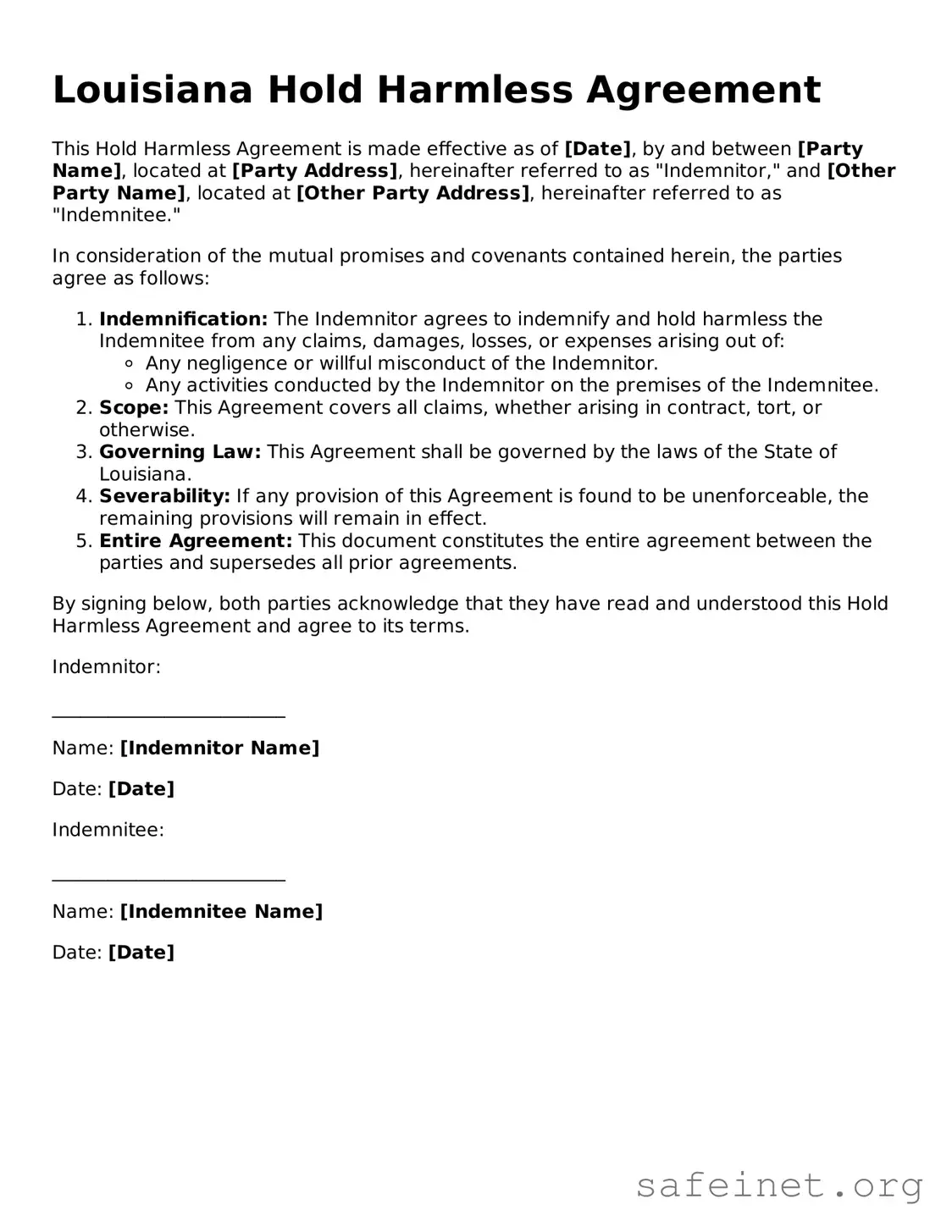
Louisiana Hold Harmless Agreement
This Hold Harmless Agreement is made effective as of [Date], by and between [Party Name], located at [Party Address], hereinafter referred to as "Indemnitor," and [Other Party Name], located at [Other Party Address], hereinafter referred to as "Indemnitee."
In consideration of the mutual promises and covenants contained herein, the parties agree as follows:
By signing below, both parties acknowledge that they have read and understood this Hold Harmless Agreement and agree to its terms.
Indemnitor:
_________________________
Name: [Indemnitor Name]
Date: [Date]
Indemnitee:
_________________________
Name: [Indemnitee Name]
Date: [Date]
| Fact Name | Description |
|---|---|
| Purpose | The Louisiana Hold Harmless Agreement is designed to protect one party from legal liability for certain actions or events. |
| Governing Law | This agreement is governed by the laws of the State of Louisiana. |
| Parties Involved | Typically, there are two parties involved: the indemnitor (who agrees to hold harmless) and the indemnitee (who is protected). |
| Scope of Agreement | The agreement can cover a range of liabilities, including injuries, damages, and legal costs. |
| Written Document | While oral agreements may exist, a written document is recommended for clarity and enforceability. |
| Specificity | It is essential for the agreement to clearly outline the specific risks or liabilities being addressed. |
| Limitations | Hold harmless agreements may not be enforceable in cases of gross negligence or willful misconduct. |
| Duration | The agreement should specify the duration for which the indemnity is applicable. |
| Legal Review | It is advisable to have the agreement reviewed by a legal professional to ensure compliance with state laws. |
| Common Uses | These agreements are often used in construction contracts, rental agreements, and various service contracts. |
After obtaining the Louisiana Hold Harmless Agreement form, you will need to complete it accurately. Follow the steps below to ensure that all necessary information is provided correctly.
Once the form is filled out, ensure that all parties involved have a copy for their records. This will help maintain clarity and understanding regarding the agreement.
What is a Louisiana Hold Harmless Agreement?
A Louisiana Hold Harmless Agreement is a legal document that protects one party from liability or claims that may arise from the actions of another party. Typically, it is used in situations where one party agrees to assume the risk of loss or injury, thereby relieving the other party from responsibility. This agreement is often utilized in contracts involving construction, rental agreements, or events where potential risks are present.
Who typically uses a Hold Harmless Agreement in Louisiana?
This type of agreement is commonly used by businesses, contractors, property owners, and event organizers. For instance, a contractor may require a hold harmless clause in a contract to protect themselves from claims resulting from their work. Similarly, a venue may ask event organizers to sign such an agreement to mitigate liability for injuries occurring during the event.
What are the key elements of a Louisiana Hold Harmless Agreement?
Key elements of a Hold Harmless Agreement typically include the identification of the parties involved, a clear statement of the scope of the agreement, and the specific risks being assumed. It should also outline the responsibilities of each party and any limitations on liability. Clear language is essential to ensure that all parties understand the terms and conditions of the agreement.
Is a Hold Harmless Agreement enforceable in Louisiana?
Yes, a Hold Harmless Agreement can be enforceable in Louisiana, provided it is drafted correctly and does not violate public policy. Courts generally uphold these agreements as long as they are clear and specific. However, certain limitations exist, especially concerning gross negligence or willful misconduct, where a party cannot fully waive their liability.
How can one create a Hold Harmless Agreement in Louisiana?
Creating a Hold Harmless Agreement in Louisiana involves drafting the document with attention to detail. It should include all relevant information about the parties, the nature of the agreement, and the risks involved. While templates are available, it is advisable to consult with a legal professional to ensure compliance with state laws and to address any specific needs related to the agreement.
Incomplete Information: Many individuals fail to provide all necessary details. Missing names, addresses, or dates can render the form invalid.
Not Reading the Agreement: Skimming through the terms can lead to misunderstandings. It’s crucial to understand what you are agreeing to before signing.
Incorrect Dates: Entering the wrong date can create confusion about the agreement's validity. Always double-check the date before submission.
Failure to Sign: Some people forget to sign the form. An unsigned agreement is not legally binding.
Ignoring Witness Requirements: If a witness is required, not having one can invalidate the agreement. Ensure you follow all witness protocols.
Not Keeping a Copy: After submitting the form, individuals often neglect to keep a copy for their records. Always retain a signed copy for your files.
Using Incorrect Terminology: Misunderstanding terms within the agreement can lead to misinterpretation. Clarify any terms you do not understand.
Rushing the Process: Filling out the form in a hurry can lead to mistakes. Take your time to ensure accuracy and completeness.
Not Seeking Legal Advice: Some individuals fill out the form without consulting a legal professional. Consider getting advice if you have questions or concerns.
A Hold Harmless Agreement is an important document that helps protect parties from liability in various situations. When using this agreement in Louisiana, it is often beneficial to have additional forms and documents that can complement its purpose. Below is a list of other forms that are commonly used alongside the Hold Harmless Agreement.
Incorporating these additional documents can enhance the effectiveness of a Hold Harmless Agreement. Each form serves a unique purpose, providing a comprehensive approach to managing risk and liability. It is advisable to consider these documents carefully to ensure adequate protection and clarity in any agreement.
The Louisiana Hold Harmless Agreement is similar to a Release of Liability form, which also seeks to protect one party from claims arising from the actions or negligence of another. In both cases, the individual signing the document agrees not to hold the other party responsible for any injuries or damages that may occur. This type of agreement is often used in recreational activities, where participants acknowledge the risks involved and waive their right to seek compensation for accidents that may happen during the event.
Another document akin to the Hold Harmless Agreement is the Indemnity Agreement. While both documents share the goal of protecting one party from liability, an Indemnity Agreement often involves one party agreeing to compensate another for any losses or damages incurred. This can include legal fees and other expenses that arise from claims related to the activities specified in the agreement. The focus here is on financial responsibility rather than simply waiving liability.
The Waiver of Liability is also closely related to the Hold Harmless Agreement. This document explicitly states that the signer relinquishes their right to pursue legal action against the other party for any injuries sustained during a particular activity. Like the Hold Harmless Agreement, a Waiver of Liability is commonly used in sports, fitness classes, and other high-risk activities, ensuring that participants understand the inherent risks involved.
Similarly, a Consent to Participate form serves a comparable purpose. While it may not always include indemnity language, this document ensures that participants acknowledge the risks associated with an activity and agree to participate voluntarily. By signing, individuals affirm that they understand the potential dangers and accept responsibility for their own safety, which aligns with the principles of the Hold Harmless Agreement.
The Liability Insurance Waiver is another document that shares similarities with the Hold Harmless Agreement. This waiver is often required by organizations that provide activities or services, indicating that participants understand they are responsible for their own insurance coverage. By signing this document, participants agree not to hold the organization liable for any injuries or damages, thus reinforcing the protective intent found in the Hold Harmless Agreement.
A Participant Agreement is also relevant in this context. This document outlines the expectations and responsibilities of participants in a specific activity or program. While it may include elements of liability waivers and indemnity, its primary focus is on establishing the terms of participation. By signing a Participant Agreement, individuals are often agreeing to abide by certain rules, much like the commitments made in a Hold Harmless Agreement.
The Safety Acknowledgment form is another document that bears resemblance to the Hold Harmless Agreement. This form is typically used to ensure that participants are aware of safety protocols and procedures before engaging in an activity. While it may not explicitly waive liability, it encourages individuals to take personal responsibility for their safety, aligning with the spirit of the Hold Harmless Agreement.
The Equipment Rental Agreement can also be considered similar. When renting equipment, individuals often sign an agreement that includes a hold harmless clause. This clause protects the rental company from liability in case of accidents or injuries that occur while using the equipment. Like the Hold Harmless Agreement, it emphasizes the responsibility of the user to operate the equipment safely and within the provided guidelines.
Finally, the Non-Disclosure Agreement (NDA) shares a commonality with the Hold Harmless Agreement in that both documents are designed to protect parties from potential harm. While an NDA focuses on the confidentiality of sensitive information, it can also include clauses that limit liability related to the misuse of that information. The protective nature of both agreements highlights the importance of safeguarding interests in various contexts.
When filling out the Louisiana Hold Harmless Agreement form, it is important to approach the task with care. Below is a list of things you should and shouldn't do to ensure the process goes smoothly.
Misconceptions about the Louisiana Hold Harmless Agreement form can lead to confusion. Here are nine common misunderstandings:
Understanding these misconceptions can help individuals and businesses make informed decisions regarding the use of Hold Harmless Agreements in Louisiana.
When dealing with a Louisiana Hold Harmless Agreement, it is important to understand its purpose and how to fill it out correctly. Here are five key takeaways to keep in mind:
By keeping these takeaways in mind, you can navigate the process of filling out and using a Louisiana Hold Harmless Agreement more effectively.