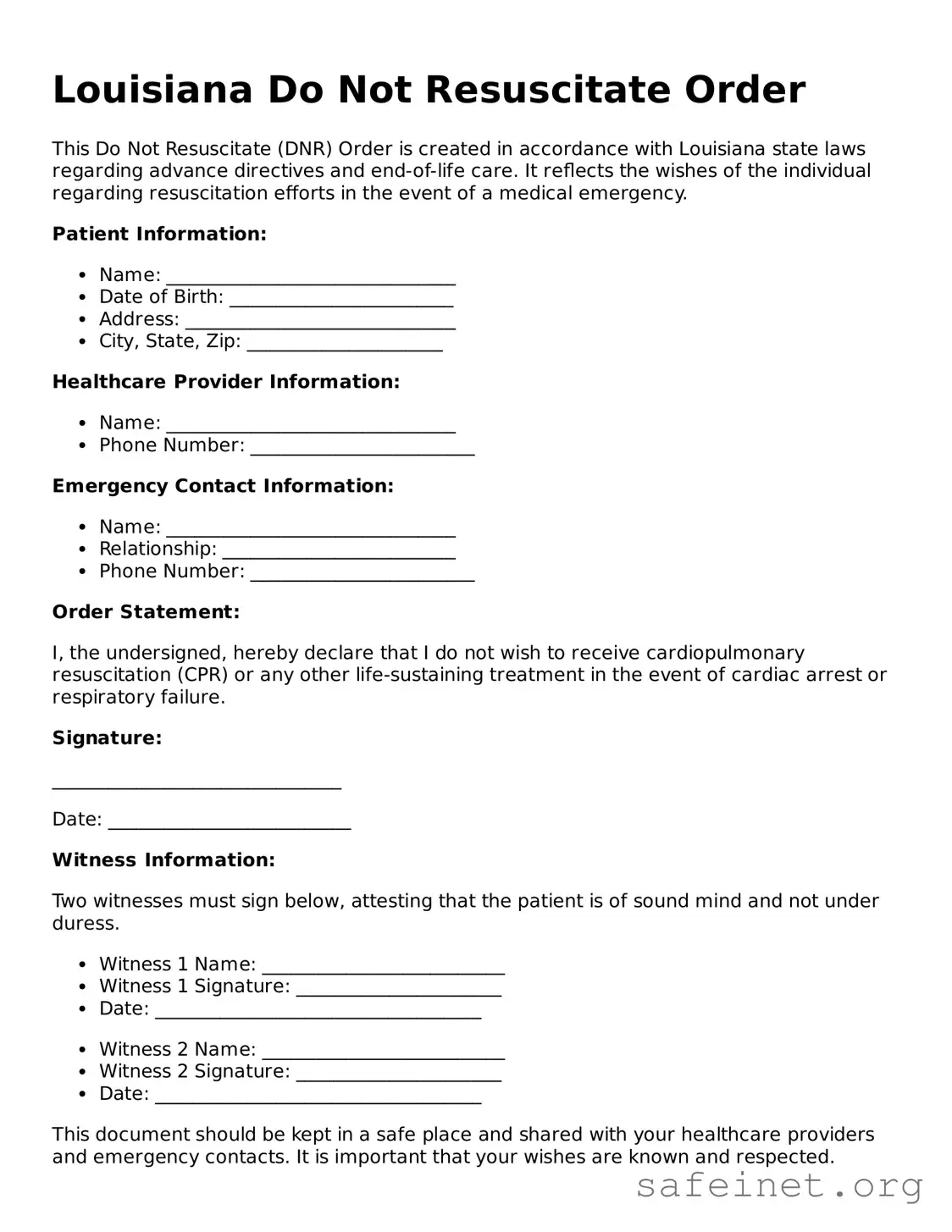
The Louisiana Do Not Resuscitate Order (DNR) form plays a crucial role in end-of-life care decisions, allowing individuals to express their wishes regarding resuscitation efforts in the event of a medical emergency. This legally recognized document is designed to ensure that patients receive care aligned with their preferences, particularly when they are unable to communicate their desires. The form typically includes essential information such as the patient’s name, date of birth, and the signature of a physician who confirms the medical necessity for the order. Importantly, the DNR form must be readily accessible to medical personnel and can be presented in various settings, including hospitals and nursing homes. It is essential for individuals to understand the implications of this decision, as it directly affects the type of medical interventions that will be provided. By completing a DNR form, patients can maintain control over their healthcare choices during critical moments, ensuring that their values and preferences are respected by healthcare providers.
Louisiana Do Not Resuscitate Order
This Do Not Resuscitate (DNR) Order is created in accordance with Louisiana state laws regarding advance directives and end-of-life care. It reflects the wishes of the individual regarding resuscitation efforts in the event of a medical emergency.
Patient Information:
Healthcare Provider Information:
Emergency Contact Information:
Order Statement:
I, the undersigned, hereby declare that I do not wish to receive cardiopulmonary resuscitation (CPR) or any other life-sustaining treatment in the event of cardiac arrest or respiratory failure.
Signature:
_______________________________
Date: __________________________
Witness Information:
Two witnesses must sign below, attesting that the patient is of sound mind and not under duress.
This document should be kept in a safe place and shared with your healthcare providers and emergency contacts. It is important that your wishes are known and respected.
| Fact Name | Description |
|---|---|
| Purpose | The Louisiana Do Not Resuscitate Order (DNR) form allows individuals to express their wishes regarding resuscitation efforts in the event of a medical emergency. |
| Eligibility | Any adult who is capable of making healthcare decisions can complete a DNR form in Louisiana. |
| Governing Law | The DNR order in Louisiana is governed by Louisiana Revised Statutes, Title 40, Section 1151.2. |
| Signature Requirement | The form must be signed by the patient or their legal representative, along with a physician's signature to be valid. |
| Revocation | A DNR order can be revoked at any time by the patient or their legal representative, simply by destroying the form or informing medical personnel. |
Filling out the Louisiana Do Not Resuscitate Order form is a straightforward process that requires careful consideration of your healthcare preferences. This form is essential for ensuring that your wishes regarding resuscitation are clearly communicated to medical professionals. Follow these steps to complete the form accurately.
What is a Louisiana Do Not Resuscitate Order (DNR) form?
A Louisiana Do Not Resuscitate Order (DNR) form is a legal document that allows a person to refuse resuscitation efforts in the event of a medical emergency. This form is used when a patient does not wish to receive cardiopulmonary resuscitation (CPR) or other life-saving measures if their heart stops or they stop breathing.
Who can complete a DNR form in Louisiana?
In Louisiana, a DNR form can be completed by an adult who is of sound mind and capable of making their own medical decisions. Additionally, a legal guardian or an authorized representative can complete the form on behalf of someone who is unable to do so.
How do I obtain a DNR form in Louisiana?
You can obtain a DNR form from various sources, including hospitals, healthcare providers, and online resources. It’s important to ensure that the form is the official Louisiana DNR form to ensure it is valid and recognized by medical personnel.
What information is required on the DNR form?
The DNR form typically requires the patient's name, date of birth, and a statement indicating the patient's wish not to receive resuscitation. It must also be signed by the patient or their representative and a physician to be valid.
How should I keep my DNR form?
Keep the DNR form in a place where it can be easily accessed in an emergency. It is advisable to carry a copy with you at all times, and inform your family members and healthcare providers about its location. Some people choose to wear a medical alert bracelet indicating their DNR status.
Can I change or revoke my DNR order?
Yes, you can change or revoke your DNR order at any time. To do this, you should destroy the old form and create a new one if you wish to update your preferences. Inform your healthcare providers and family about any changes you make.
What happens if I don’t have a DNR form?
If you do not have a DNR form and experience a medical emergency, medical personnel are required to perform resuscitation efforts unless they have clear evidence of your wishes. Having a DNR form ensures that your preferences are respected during critical situations.
Failing to provide accurate personal information, such as the patient's full name, date of birth, and contact details. This information is crucial for proper identification.
Not obtaining the necessary signatures. The form requires the signature of the patient or their legal representative, along with a witness signature in some cases.
Overlooking the date on the form. A missing or incorrect date can lead to confusion regarding the validity of the order.
Neglecting to discuss the implications of a Do Not Resuscitate Order with healthcare providers. Understanding the consequences is essential for informed decision-making.
Using outdated versions of the form. It is important to ensure that the most current version is being utilized to comply with state regulations.
Failing to keep copies of the completed form. Having duplicates readily available ensures that healthcare providers can access the order when needed.
Not reviewing the form periodically. Changes in health status or preferences should prompt a reevaluation of the order.
Inadequately communicating the existence of the order to family members and healthcare providers. Clear communication can prevent misunderstandings during critical moments.
Leaving sections of the form blank. Each part of the form should be completed to avoid ambiguity regarding the patient’s wishes.
Not seeking legal advice when necessary. Consulting with a legal professional can provide clarity on the implications and requirements of the order.
In Louisiana, a Do Not Resuscitate (DNR) Order is an important document that allows individuals to express their wishes regarding resuscitation efforts in the event of a medical emergency. However, this form is often used in conjunction with several other important documents that help ensure a person’s healthcare preferences are honored. Below is a list of these documents, each serving a unique purpose in healthcare planning.
These documents collectively provide a framework for individuals to express their healthcare preferences clearly. They ensure that loved ones and medical professionals understand and respect those wishes, ultimately leading to more personalized and compassionate care during critical moments.
The Advance Directive is a legal document that allows individuals to outline their preferences for medical treatment in case they become unable to communicate their wishes. Similar to the Louisiana Do Not Resuscitate Order (DNR), it provides guidance to healthcare providers about the type of care a person desires. Both documents are designed to respect the wishes of patients regarding life-sustaining treatments, ensuring that their choices are honored even when they cannot speak for themselves.
A Physician Orders for Life-Sustaining Treatment (POLST) form is similar to the DNR in that it provides specific medical orders regarding a patient’s treatment preferences. POLST is typically used for individuals with serious health conditions and is signed by a physician. While a DNR focuses solely on resuscitation efforts, a POLST form covers a broader range of medical interventions, ensuring that a patient’s overall treatment preferences are clearly documented and followed.
The Medical Power of Attorney allows an individual to appoint someone else to make medical decisions on their behalf. This document is similar to the DNR in that it helps ensure a person's healthcare wishes are respected. While the DNR specifically addresses resuscitation preferences, the Medical Power of Attorney can encompass a wide range of medical decisions, providing flexibility in how a person's care is managed when they are unable to advocate for themselves.
The Do Not Intubate (DNI) order is another document that shares similarities with the DNR. A DNI order specifically instructs healthcare providers not to perform intubation, a procedure used to assist with breathing. Like the DNR, the DNI reflects a patient’s wishes regarding life-sustaining treatments. Both documents are crucial for guiding medical professionals in delivering care that aligns with a patient’s values and preferences.
The Comfort Care Order emphasizes the provision of comfort and palliative care rather than aggressive medical interventions. This document is akin to the DNR in that it prioritizes the quality of life over prolonging life through medical procedures. Both the Comfort Care Order and the DNR focus on respecting the individual’s wishes, ensuring that care aligns with their goals, especially in end-of-life situations.
A Hospice Care Plan outlines the specific services and treatments that will be provided to a patient in hospice care. This document shares similarities with the DNR, as both aim to provide compassionate care while respecting a patient's end-of-life preferences. The Hospice Care Plan focuses on comfort and quality of life, while the DNR specifically addresses resuscitation efforts, making them complementary in providing holistic care.
The Do Not Hospitalize (DNH) order is similar to the DNR in that it expresses a patient’s wishes regarding hospitalizations. A DNH order indicates that a patient prefers to receive care in a home or hospice setting rather than being admitted to a hospital. Both documents serve to honor a patient’s preferences and provide clear guidance to healthcare providers about the type of care the individual wishes to receive.
The End-of-Life Care Plan is a comprehensive document that outlines a person’s preferences for care as they approach the end of life. This plan can include various aspects of care, such as pain management, emotional support, and spiritual considerations. Like the DNR, it ensures that healthcare providers are aware of and respect the individual's wishes, promoting dignity and comfort during a critical time.
The Patient's Bill of Rights is a document that outlines the rights of patients in healthcare settings. While it is broader in scope than the DNR, it shares the fundamental principle of respecting patient autonomy and decision-making. Both documents emphasize the importance of informed consent and the right of individuals to make choices about their medical care, reinforcing the idea that patients should have a say in their treatment options.
When filling out the Louisiana Do Not Resuscitate Order form, it's important to follow certain guidelines to ensure that your wishes are accurately represented. Below is a list of things you should and shouldn't do.
Understanding the Louisiana Do Not Resuscitate (DNR) Order form is essential for making informed decisions about medical care. Here are nine common misconceptions about the DNR form:
By clarifying these misconceptions, individuals can make more informed choices about their end-of-life care and ensure their preferences are respected.
Filling out a Do Not Resuscitate (DNR) Order form in Louisiana is an important decision that can affect end-of-life care. Here are key takeaways to consider: