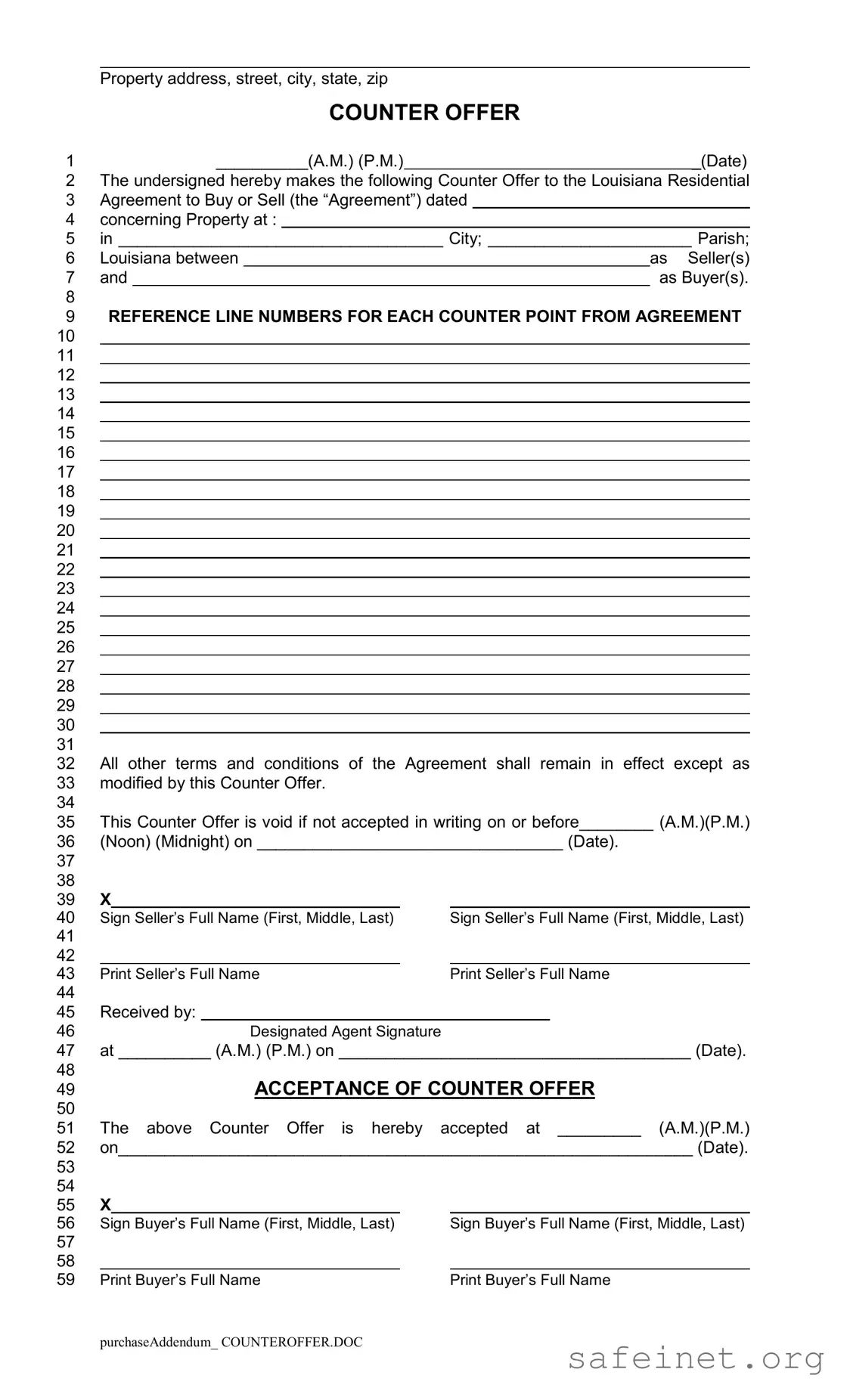
The Louisiana Counter Offer form plays a crucial role in the real estate transaction process, allowing sellers and buyers to negotiate terms after an initial offer has been made. This form facilitates communication between parties by clearly outlining any changes to the original agreement, ensuring that both sides are on the same page. Key elements include the property address, the date of the counter offer, and specific reference line numbers that highlight the points being modified. Additionally, the form stipulates that all other terms and conditions of the original agreement remain intact unless explicitly altered by the counter offer. A critical aspect is the deadline for acceptance, which must be stated to avoid any confusion. The signatures of both sellers and buyers are required to formalize the agreement, along with the designated agent's acknowledgment, making the process transparent and accountable. By understanding the components of the Louisiana Counter Offer form, participants can navigate negotiations more effectively, paving the way for successful transactions.

Property address, street, city, state, zip
COUNTER OFFER
1 |
__________(A.M.) (P.M.) |
_(Date) |
|
|
|
|
|
2The undersigned hereby makes the following Counter Offer to the Louisiana Residential
3 Agreement to Buy or Sell (the “Agreement”) dated
4 concerning Property at :
5 in ___________________________________ City; ______________________ Parish;
6 |
Louisiana between |
|
as Seller(s) |
|
7 |
and |
|
as Buyer(s). |
|
8 |
|
|
|
|
9REFERENCE LINE NUMBERS FOR EACH COUNTER POINT FROM AGREEMENT
10
11
12
13
14
15
16
17
18
19
20
21
22
23
24
25
26
27
28
29
30
31
32 All other terms and conditions of the Agreement shall remain in effect except as 33 modified by this Counter Offer.
34
35 This Counter Offer is void if not accepted in writing on or before________ (A.M.)(P.M.) 36 (Noon) (Midnight) on _________________________________ (Date).
37
38
39 X
40 |
Sign Seller’s Full Name (First, Middle, Last) |
Sign Seller’s Full Name (First, Middle, Last) |
|||
41 |
|
|
|
|
|
42 |
|
|
|
|
|
43 |
Print Seller’s Full Name |
Print Seller’s Full Name |
|||
44 |
|
|
|
|
|
45 |
Received by: |
|
|
||
46 |
|
Designated Agent Signature |
|
|
|
47at __________ (A.M.) (P.M.) on ______________________________________ (Date).
49
50
51 The above Counter Offer is hereby accepted at _________ (A.M.)(P.M.)
52on______________________________________________________________ (Date).
55X
56 |
Sign Buyer’s Full Name (First, Middle, Last) |
|
Sign Buyer’s Full Name (First, Middle, Last) |
57 |
|
|
|
58 |
|
|
|
59 |
Print Buyer’s Full Name |
|
Print Buyer’s Full Name |
purchaseAddendum_ COUNTEROFFER.DOC
| Fact Name | Description |
|---|---|
| Purpose | The Louisiana Counter Offer form is used to propose changes to the terms of a real estate agreement between a buyer and a seller. |
| Governing Law | This form is governed by Louisiana state law, specifically the Louisiana Civil Code and real estate regulations. |
| Acceptance Deadline | The counter offer must be accepted in writing by a specified time, or it becomes void. |
| Modification Clause | All other terms of the original agreement remain effective unless specifically changed by the counter offer. |
| Signature Requirement | Both parties must sign the counter offer for it to be legally binding, confirming their agreement to the proposed changes. |
After completing the Louisiana Counter Offer form, the next steps involve ensuring all parties review and sign the document. This process is crucial for moving forward with the real estate transaction. Below are the steps to fill out the form accurately.
What is the Louisiana Counter Offer form?
The Louisiana Counter Offer form is a legal document used in real estate transactions. It allows a seller or buyer to propose changes to the terms of an existing agreement to buy or sell property. This form serves as a formal response to an initial offer, outlining specific modifications to the terms of the original agreement.
When should I use a Counter Offer form?
A Counter Offer form should be used when one party wishes to change the terms of an existing purchase agreement. This could include adjustments to the sale price, closing date, or other conditions. It is important to use this form to ensure that all modifications are documented and agreed upon by both parties.
What information is required on the Counter Offer form?
The Counter Offer form requires several key pieces of information. This includes the property address, the date of the original agreement, the names of the seller(s) and buyer(s), and specific reference line numbers for each counter point from the original agreement. Additionally, it requires the signatures of the involved parties and the designated agent.
How long is a Counter Offer valid?
A Counter Offer is valid until the specified acceptance deadline outlined in the form. This deadline must be accepted in writing by the other party. If the Counter Offer is not accepted by that deadline, it becomes void, and the original agreement remains in effect.
Can I make multiple Counter Offers?
Yes, multiple Counter Offers can be made. However, each Counter Offer must be clearly documented and presented as a separate form. It is essential to keep track of which offers have been made and accepted to avoid confusion during the negotiation process.
What happens if my Counter Offer is accepted?
If your Counter Offer is accepted, the terms outlined in the Counter Offer become part of the binding agreement. Both parties must sign the form to indicate their acceptance, and all other terms from the original agreement remain in effect unless modified by the Counter Offer.
Is a verbal acceptance of a Counter Offer sufficient?
No, a verbal acceptance is not sufficient. Acceptance must be documented in writing on the Counter Offer form. This ensures clarity and legal validity, protecting the interests of both parties involved in the transaction.
What if I disagree with a Counter Offer?
If you disagree with a Counter Offer, you can either reject it or propose your own Counter Offer. It is important to communicate your concerns clearly and to document any new terms you wish to propose. Open dialogue can facilitate a resolution that is acceptable to both parties.
Do I need a lawyer to complete a Counter Offer form?
While it is not legally required to have a lawyer complete a Counter Offer form, it is advisable to seek legal counsel, especially if you have questions or concerns about the terms being negotiated. A lawyer can provide guidance and ensure that your rights are protected throughout the process.
Where can I obtain a Louisiana Counter Offer form?
A Louisiana Counter Offer form can typically be obtained from real estate agents, brokers, or legal professionals. It may also be available through online legal document services that specialize in real estate transactions. Ensure that you are using the most current version of the form to comply with state regulations.
Neglecting to Fill in All Required Information: One common mistake is failing to complete all sections of the form. Essential details, such as the property address and the names of the buyers and sellers, must be clearly stated. Leaving any part blank can lead to confusion or rejection of the offer.
Missing Reference Line Numbers: It is crucial to include reference line numbers for each counterpoint from the original agreement. Without these references, the counteroffer may not be understood in the context of the original terms, potentially leading to disputes.
Incorrect Deadline for Acceptance: Another frequent error is not specifying the correct deadline for acceptance. The form requires a clear date and time. If this information is vague or missing, the counteroffer could be deemed invalid.
Improper Signatures: Lastly, ensuring that all parties sign the counteroffer is vital. Both sellers and buyers must provide their signatures along with printed names. Omitting any signature can invalidate the entire document.
The Louisiana Counter Offer form is a crucial document in real estate transactions, specifically used when a buyer or seller wishes to propose changes to the original agreement. Several other forms and documents are often utilized alongside this form to ensure clarity and compliance throughout the negotiation process. Below is a list of commonly associated documents.
Each of these documents plays a significant role in the real estate transaction process. They help clarify the terms of the agreement, protect the interests of all parties involved, and ensure compliance with Louisiana real estate laws.
The Louisiana Counter Offer form shares similarities with the Purchase Agreement. Both documents serve as essential components in real estate transactions, outlining the terms and conditions agreed upon by the buyer and seller. The Purchase Agreement initiates the sale process, while the Counter Offer allows one party to propose changes to the original terms. Each document requires signatures from both parties to validate the agreement, ensuring that all terms are mutually understood and accepted.
Another document comparable to the Louisiana Counter Offer is the Letter of Intent (LOI). An LOI outlines the preliminary understanding between parties before a formal agreement is finalized. Like the Counter Offer, it conveys the intent to negotiate terms, but it typically does not bind parties legally. Both documents focus on establishing a clear framework for negotiations, allowing parties to express their interests and expectations before committing to a formal agreement.
The Addendum is also similar to the Louisiana Counter Offer. An Addendum modifies or adds terms to an existing contract, similar to how a Counter Offer proposes changes to the original agreement. Both documents require careful attention to detail, as they specify alterations or additional stipulations that must be agreed upon by both parties. This ensures that all modifications are documented and acknowledged, preventing misunderstandings later in the transaction.
Another related document is the Letter of Acceptance. This letter confirms that one party agrees to the terms proposed in a Counter Offer. While the Counter Offer suggests changes, the Letter of Acceptance formally acknowledges those changes, making it clear that both parties are aligned on the new terms. Both documents are crucial for maintaining clear communication and understanding throughout the negotiation process.
The Termination Agreement is also relevant when discussing the Louisiana Counter Offer. This document is used when parties decide to end negotiations or a contract. While the Counter Offer seeks to modify terms, the Termination Agreement signifies that the parties have agreed to part ways. Both documents are essential in ensuring that the intentions of both parties are clearly articulated, whether they are moving forward with negotiations or concluding them.
Additionally, the Escrow Agreement bears similarities to the Louisiana Counter Offer. An Escrow Agreement outlines the conditions under which funds or documents are held by a third party until certain conditions are met. While the Counter Offer focuses on negotiating terms, the Escrow Agreement ensures that all parties adhere to those terms once agreed upon. Both documents play vital roles in facilitating secure and transparent transactions.
The Disclosure Statement is another document akin to the Louisiana Counter Offer. This statement provides important information about the property, such as defects or issues that may affect its value. While the Counter Offer addresses the terms of the sale, the Disclosure Statement ensures that buyers are fully informed before making a decision. Both documents are designed to promote transparency and protect the interests of all parties involved.
Lastly, the Sales Agreement is similar to the Louisiana Counter Offer in that it serves as the final contract between buyer and seller. The Sales Agreement encapsulates all terms, including any modifications proposed in a Counter Offer. Both documents require careful negotiation and mutual agreement, ensuring that all parties are satisfied with the terms before proceeding with the transaction.
When filling out the Louisiana Counter Offer form, it's important to be clear and accurate. Here are some dos and don'ts to keep in mind:
Following these guidelines will help ensure a smooth counter offer process.
Misconceptions about the Louisiana Counter Offer form can lead to confusion for both buyers and sellers. Here are six common misunderstandings:
Filling out and using the Louisiana Counter Offer form requires careful attention to detail. Here are some key takeaways to consider: