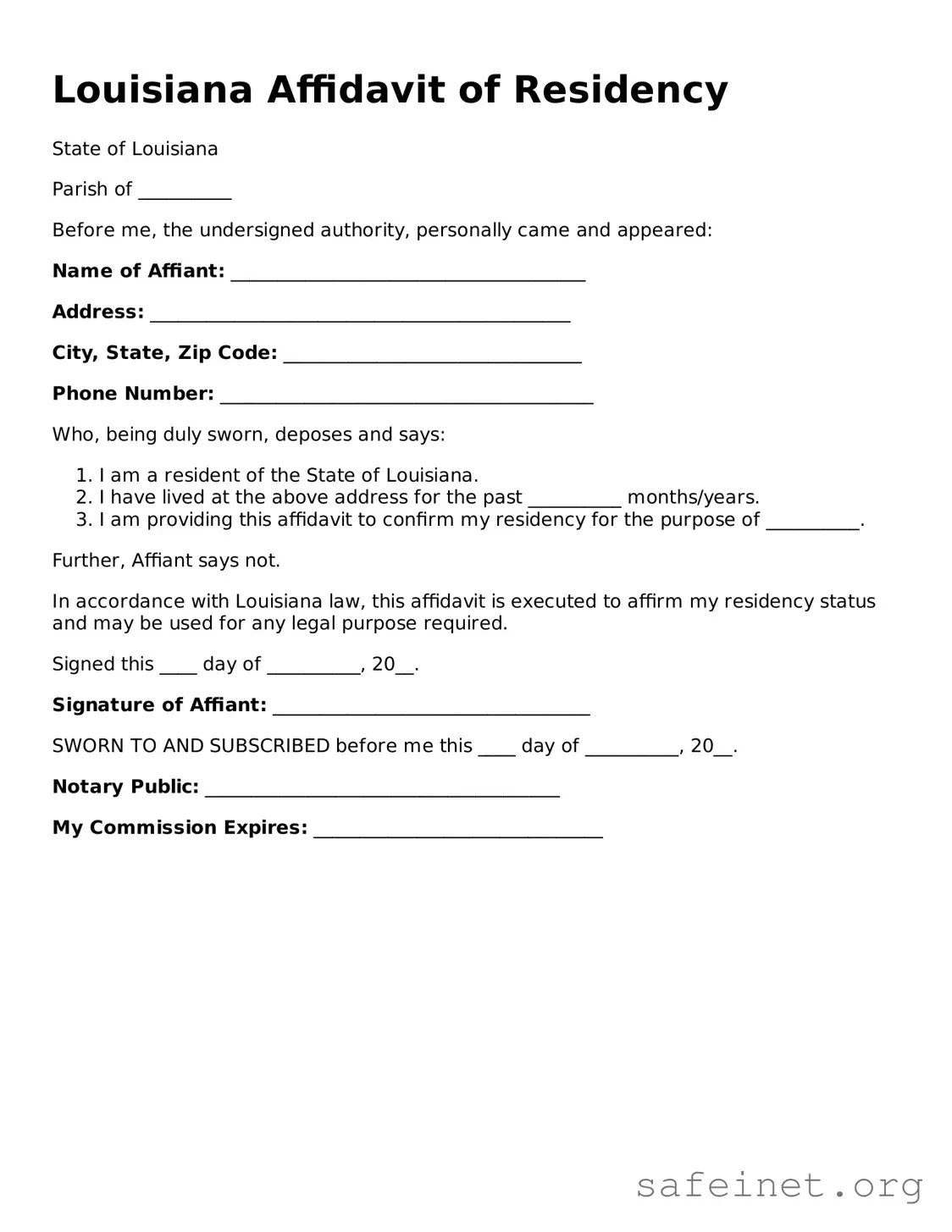
The Louisiana Affidavit of Residency form serves as a crucial document for individuals who need to verify their residency status within the state. This form is commonly required for various purposes, such as enrolling in schools, applying for certain government benefits, or establishing eligibility for local services. It typically includes essential details such as the affiant's name, address, and the length of time they have resided at that address. Additionally, the form may require the signature of a notary public to authenticate the information provided, ensuring its credibility. By completing this affidavit, individuals can affirm their residency, which is often a key factor in accessing resources and opportunities in their community. Understanding the requirements and implications of this form can greatly assist residents in navigating their legal obligations and benefits in Louisiana.
Louisiana Affidavit of Residency
State of Louisiana
Parish of __________
Before me, the undersigned authority, personally came and appeared:
Name of Affiant: ______________________________________
Address: _____________________________________________
City, State, Zip Code: ________________________________
Phone Number: ________________________________________
Who, being duly sworn, deposes and says:
Further, Affiant says not.
In accordance with Louisiana law, this affidavit is executed to affirm my residency status and may be used for any legal purpose required.
Signed this ____ day of __________, 20__.
Signature of Affiant: __________________________________
SWORN TO AND SUBSCRIBED before me this ____ day of __________, 20__.
Notary Public: ______________________________________
My Commission Expires: _______________________________
| Fact Name | Description |
|---|---|
| Purpose | The Louisiana Affidavit of Residency form is used to verify an individual's residence in Louisiana, often for legal or administrative purposes. |
| Governing Law | This form is governed by Louisiana Revised Statutes, specifically under Title 9, which pertains to the execution of affidavits. |
| Who Uses It | Individuals, businesses, and government entities may use this form when proof of residency is required. |
| Signature Requirement | The form must be signed in the presence of a notary public to ensure its validity. |
| Filing Locations | Completed affidavits can be filed with various state agencies, depending on the specific requirement for proof of residency. |
| Validity Period | While the affidavit itself does not expire, its acceptance may vary based on the agency or entity requesting it. |
After obtaining the Louisiana Affidavit of Residency form, it’s important to complete it accurately to ensure that your residency is properly documented. Follow these steps carefully to fill out the form correctly.
Once you have completed the form and had it notarized, you can submit it as required by the relevant authority or institution. Make sure to keep a copy for your records.
What is the Louisiana Affidavit of Residency form?
The Louisiana Affidavit of Residency form is a legal document that allows individuals to declare their residency status in the state of Louisiana. This form is often used for various purposes, such as enrolling in schools, obtaining a driver's license, or verifying residency for voting. By completing this affidavit, individuals affirm that they reside at a specific address within Louisiana and provide necessary details to support their claim.
Who needs to complete the Louisiana Affidavit of Residency form?
This form is typically required for anyone who needs to prove their residency in Louisiana. Common examples include students who are enrolling in public schools, individuals applying for state benefits, or those seeking to register to vote. If you have recently moved to Louisiana or are a student living away from your permanent home, you may need to complete this affidavit to confirm your residency status.
How do I complete the Louisiana Affidavit of Residency form?
To complete the Louisiana Affidavit of Residency form, you will need to provide personal information, including your name, address, and the duration of your residency at that address. Be prepared to include any additional documentation that may be required, such as proof of address or identification. Once filled out, the form should be signed in the presence of a notary public to ensure its validity. After notarization, submit the form to the relevant authority or institution that requires it.
Where can I obtain the Louisiana Affidavit of Residency form?
You can obtain the Louisiana Affidavit of Residency form from various sources. Many government websites provide downloadable versions of the form. Additionally, schools, local government offices, or libraries may have physical copies available. If you are unsure where to find the form, contacting the specific agency or institution requiring it can help guide you to the right resources.
Failing to provide accurate personal information. Ensure that your name, address, and contact details are correct.
Not signing the affidavit. A signature is required to validate the document.
Using outdated forms. Always check for the most current version of the Affidavit of Residency.
Not including supporting documents. Attach any necessary proof of residency, such as utility bills or lease agreements.
Overlooking the date. The affidavit must be dated to indicate when it was completed.
Providing false information. Misrepresentation can lead to legal consequences.
Not having the affidavit notarized when required. Some situations may necessitate notarization for validation.
Neglecting to check the form for completeness. Review all sections to ensure nothing is missing.
Failing to understand the purpose of the affidavit. Knowing why you are filling it out can help in providing the correct information.
Submitting the affidavit to the wrong agency. Confirm where the completed form needs to be sent.
When completing the Louisiana Affidavit of Residency form, several other documents may be necessary to support your residency claim. These documents help verify your identity and establish your current living situation. Here is a list of common forms and documents you might encounter.
Gathering these documents will strengthen your application and ensure a smoother process. Be prepared to present them as needed when submitting the Louisiana Affidavit of Residency form.
The Louisiana Affidavit of Residency form is similar to the Affidavit of Identity. Both documents serve to verify the identity of an individual, often required for legal or administrative purposes. The Affidavit of Identity typically includes personal details such as name, address, and date of birth. It may be used in various situations, including applying for government services or confirming identity for financial transactions. Like the Affidavit of Residency, it is signed under oath, affirming the truthfulness of the information provided.
Another document that shares similarities is the Declaration of Domicile. This document is used to establish an individual's primary residence within a specific jurisdiction. It often includes similar information, such as the individual's name and address, and may require notarization. The Declaration of Domicile serves to clarify legal residence for tax purposes, voting eligibility, and other legal considerations, much like the Affidavit of Residency, which confirms where a person resides.
The Voter Registration Application also resembles the Louisiana Affidavit of Residency. Both documents require individuals to provide proof of residency in order to participate in civic duties. The Voter Registration Application asks for personal information, including the applicant's address, and may require documentation to support residency claims. This is essential for ensuring that individuals are registered to vote in the correct jurisdiction, paralleling the residency verification function of the Affidavit.
Lastly, the Lease Agreement is another document that shares characteristics with the Louisiana Affidavit of Residency. A Lease Agreement outlines the terms of renting a property and includes the tenant's address and duration of stay. While it serves a different purpose—governing the landlord-tenant relationship—it also serves as evidence of residency. Both documents affirm where an individual resides, although the Lease Agreement is a contractual obligation rather than a sworn statement.
When completing the Louisiana Affidavit of Residency form, it is essential to follow certain guidelines to ensure accuracy and compliance. Below is a list of recommended practices and common pitfalls to avoid.
By adhering to these guidelines, individuals can help facilitate a smoother process when submitting the Louisiana Affidavit of Residency form.
The Louisiana Affidavit of Residency form is often misunderstood. Here are nine common misconceptions about this important document, along with explanations to clarify each point.
Many believe that the affidavit is exclusively for students attending school in Louisiana. In reality, anyone who needs to prove their residency for various purposes, such as voting or applying for certain benefits, can use this form.
Some people think that the affidavit must be notarized. However, while notarization can add credibility, it is not a strict requirement for the form to be valid.
It’s a common misconception that anyone can complete the affidavit on behalf of another person. The form must be filled out by the individual whose residency is being affirmed, ensuring that the information is accurate and truthful.
Many assume that once the affidavit is submitted, it remains valid indefinitely. In truth, residency can change, and the affidavit may need to be updated to reflect a new address or status.
Some people think the affidavit is only necessary in legal situations. However, it can also be required for practical purposes, such as enrolling in local schools or obtaining a driver's license.
Many fear that completing the affidavit is a complicated task. In fact, the form is relatively straightforward and can be completed without extensive legal knowledge.
Some confuse the affidavit with a lease agreement. While both documents relate to residency, the affidavit specifically serves as a declaration of where a person lives, rather than a contractual agreement.
People often think that the Louisiana Affidavit of Residency can be used in other states. However, each state has its own requirements and forms for proving residency, so it is not universally applicable.
Finally, some believe that the affidavit holds no legal weight. This is incorrect; the affidavit is a sworn statement and can have legal implications if the information provided is false.
Understanding these misconceptions can help individuals navigate the process of proving residency in Louisiana more effectively.
Here are some key takeaways about filling out and using the Louisiana Affidavit of Residency form: