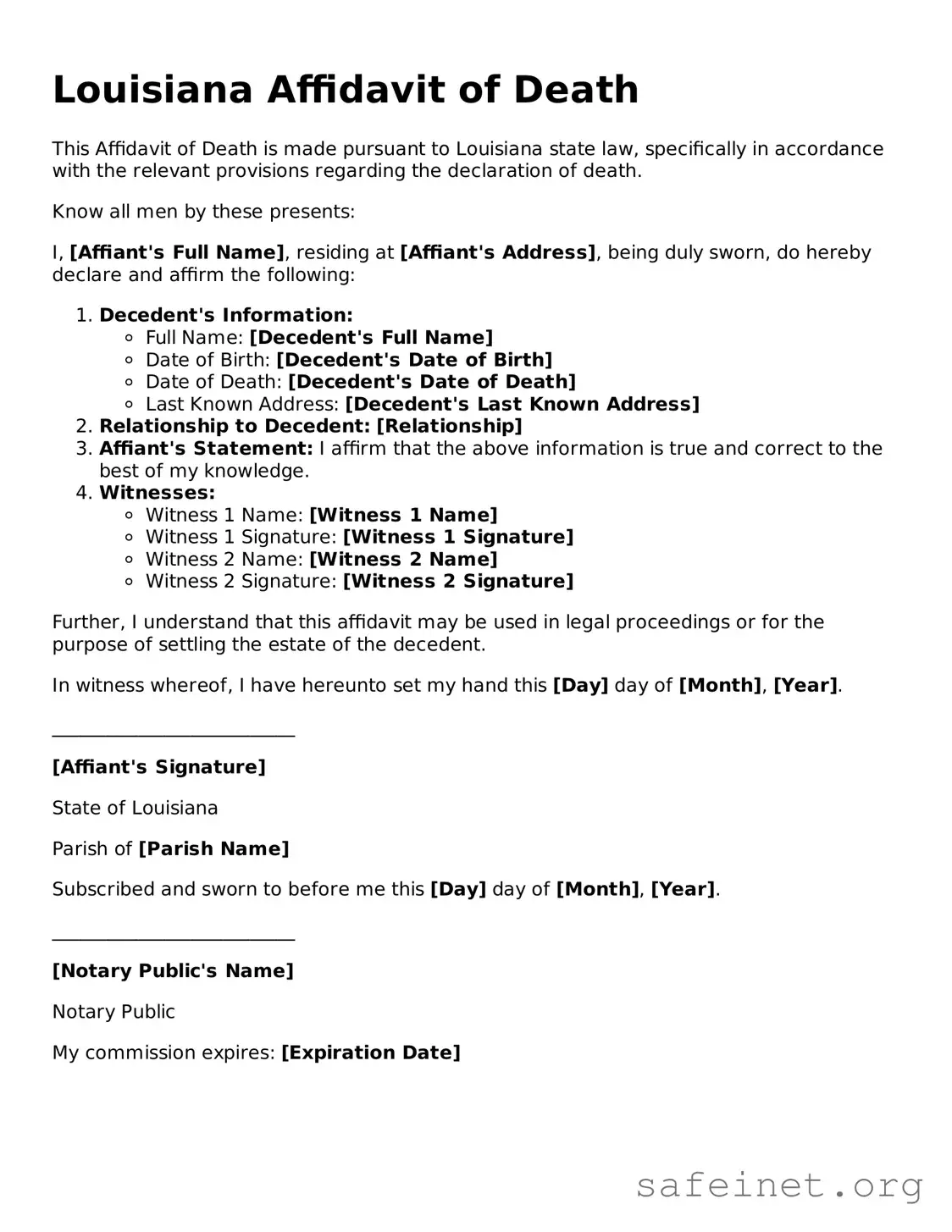
The Louisiana Affidavit of Death form serves as an essential legal document for individuals seeking to establish the fact of a person's death, especially in matters related to estate administration and property transfer. This form is typically utilized when a death certificate is not available, or when additional verification is required for legal purposes. It includes crucial information such as the deceased's full name, date of birth, date of death, and the affiant's relationship to the deceased. The form must be signed in the presence of a notary public to ensure its validity. By providing a sworn statement regarding the death, the affidavit helps facilitate various legal processes, including settling estates and transferring assets. It is important for individuals to understand the requirements and implications of this document to ensure compliance with Louisiana law.
Louisiana Affidavit of Death
This Affidavit of Death is made pursuant to Louisiana state law, specifically in accordance with the relevant provisions regarding the declaration of death.
Know all men by these presents:
I, [Affiant's Full Name], residing at [Affiant's Address], being duly sworn, do hereby declare and affirm the following:
Further, I understand that this affidavit may be used in legal proceedings or for the purpose of settling the estate of the decedent.
In witness whereof, I have hereunto set my hand this [Day] day of [Month], [Year].
__________________________
[Affiant's Signature]
State of Louisiana
Parish of [Parish Name]
Subscribed and sworn to before me this [Day] day of [Month], [Year].
__________________________
[Notary Public's Name]
Notary Public
My commission expires: [Expiration Date]
| Fact Name | Details |
|---|---|
| Purpose | The Louisiana Affidavit of Death form is used to officially declare the death of an individual. |
| Governing Law | This form is governed by Louisiana Civil Code Article 3512. |
| Filing Requirements | The completed form should be filed with the local parish clerk of court. |
| Signatures | The affidavit must be signed by the affiant and notarized to be valid. |
After gathering the necessary information, you can begin filling out the Louisiana Affidavit of Death form. This document will require specific details about the deceased and the affiant. It is important to ensure that all information is accurate and complete before submission.
Once completed, the affidavit can be filed with the appropriate local authorities or used as needed for legal purposes. Ensure to keep copies for personal records.
What is a Louisiana Affidavit of Death form?
The Louisiana Affidavit of Death form is a legal document used to officially declare the death of an individual. This form serves to provide necessary information regarding the deceased, including their name, date of birth, date of death, and other pertinent details. It is often used in situations where proof of death is required, such as settling an estate or transferring property ownership.
Who can file a Louisiana Affidavit of Death?
Typically, the affidavit can be filed by a family member, such as a spouse, child, or sibling of the deceased. In some cases, a personal representative or executor of the estate may also file the form. It is important for the individual filing the affidavit to have a direct relationship to the deceased and to be able to provide accurate information regarding their death.
What information is required on the form?
The form requires several key pieces of information. This includes the full name of the deceased, their date of birth, date of death, and the place of death. Additionally, the affiant must provide their own name, relationship to the deceased, and contact information. Any relevant details regarding the circumstances of the death may also be included.
Is the Louisiana Affidavit of Death form notarized?
Yes, the affidavit must be notarized. This means that the person filing the form must sign it in the presence of a notary public, who will then provide their signature and seal. Notarization serves to verify the identity of the affiant and ensures the authenticity of the document.
Where do I file the Louisiana Affidavit of Death?
The completed and notarized affidavit should be filed with the appropriate local parish clerk of court. Depending on the circumstances, it may also need to be filed with other entities, such as banks or financial institutions, if it pertains to property or financial matters related to the deceased.
Are there any fees associated with filing the affidavit?
Yes, there may be fees associated with filing the Louisiana Affidavit of Death. These fees can vary by parish and may include costs for notarization and filing with the clerk of court. It is advisable to check with the local clerk’s office for specific fee amounts and payment methods.
Not providing accurate information about the deceased. It's crucial to ensure that all details, such as the full name, date of birth, and date of death, are correct.
Failing to sign the affidavit. A signature is necessary to validate the document. Without it, the form may not be accepted.
Omitting the required witness signatures. Many affidavits require one or more witnesses to sign, confirming the truthfulness of the statements made.
Using incorrect or outdated forms. Always ensure that you are using the most current version of the Louisiana Affidavit of Death form.
Neglecting to provide supporting documentation. Attach necessary documents, such as a death certificate, to substantiate the claims made in the affidavit.
Leaving blank spaces. Every section of the form should be filled out completely. Blank spaces can lead to delays or rejection of the affidavit.
Not dating the affidavit. Including the date of signing is essential, as it establishes when the affidavit was executed.
Misunderstanding the purpose of the affidavit. It's important to know that this document serves a specific legal function, and filling it out incorrectly can have implications.
Submitting the affidavit without notarization. Many affidavits must be notarized to be considered valid. Check if this step is required.
Ignoring local requirements. Different parishes in Louisiana may have specific rules regarding the affidavit. Always verify local regulations before submission.
The Louisiana Affidavit of Death form is an important document used to officially declare an individual's passing. However, several other forms and documents are often needed in conjunction with it to ensure proper legal processing and compliance. Below is a list of these documents, each serving a unique purpose.
Having these documents prepared and organized can significantly streamline the process of settling an estate. Each form plays a vital role in ensuring that the legal and financial aspects are handled appropriately and efficiently.
The Louisiana Affidavit of Death form shares similarities with the Death Certificate, which is an official document issued by a government authority that confirms a person's death. A Death Certificate typically includes vital information such as the deceased's name, date of birth, date of death, and cause of death. Like the Affidavit of Death, it serves as legal proof of death and is often required for settling estates, claiming life insurance, or closing bank accounts. Both documents play a crucial role in the administrative processes that follow a person's passing.
Another document similar to the Louisiana Affidavit of Death is the Will. A Will outlines how a person's assets and affairs should be handled after their death. It often names an executor who is responsible for ensuring that the deceased's wishes are carried out. While the Affidavit of Death serves to confirm that an individual has passed away, the Will provides guidance on what should happen next. Both documents are essential in the estate planning process and help facilitate the distribution of a deceased person's assets.
The Probate Petition is also comparable to the Louisiana Affidavit of Death. This legal document is filed with the court to initiate the probate process, which involves validating a deceased person's Will and distributing their assets. The Affidavit of Death may be required as part of this process to establish that the individual has indeed died. Both documents are integral to ensuring that the deceased's estate is settled according to their wishes and in compliance with state laws.
Lastly, the Letter of Administration resembles the Louisiana Affidavit of Death in that it is issued by a court when someone dies without a Will. This letter appoints an administrator to manage the deceased's estate. Like the Affidavit of Death, the Letter of Administration serves as a legal document that affirms the death of the individual and allows the appointed administrator to act on behalf of the estate. Both documents are vital in the legal process of handling a deceased person's affairs.
When filling out the Louisiana Affidavit of Death form, follow these guidelines to ensure accuracy and compliance.
When dealing with the Louisiana Affidavit of Death form, many people hold misconceptions that can lead to confusion. Understanding the truth behind these misconceptions can help ensure that the process goes smoothly. Here’s a list of common misunderstandings:
By clearing up these misconceptions, individuals can navigate the process more effectively and ensure that their legal matters are handled properly.
The Louisiana Affidavit of Death form is an important document that serves to establish the fact of an individual's death. Below are key takeaways regarding its completion and usage.