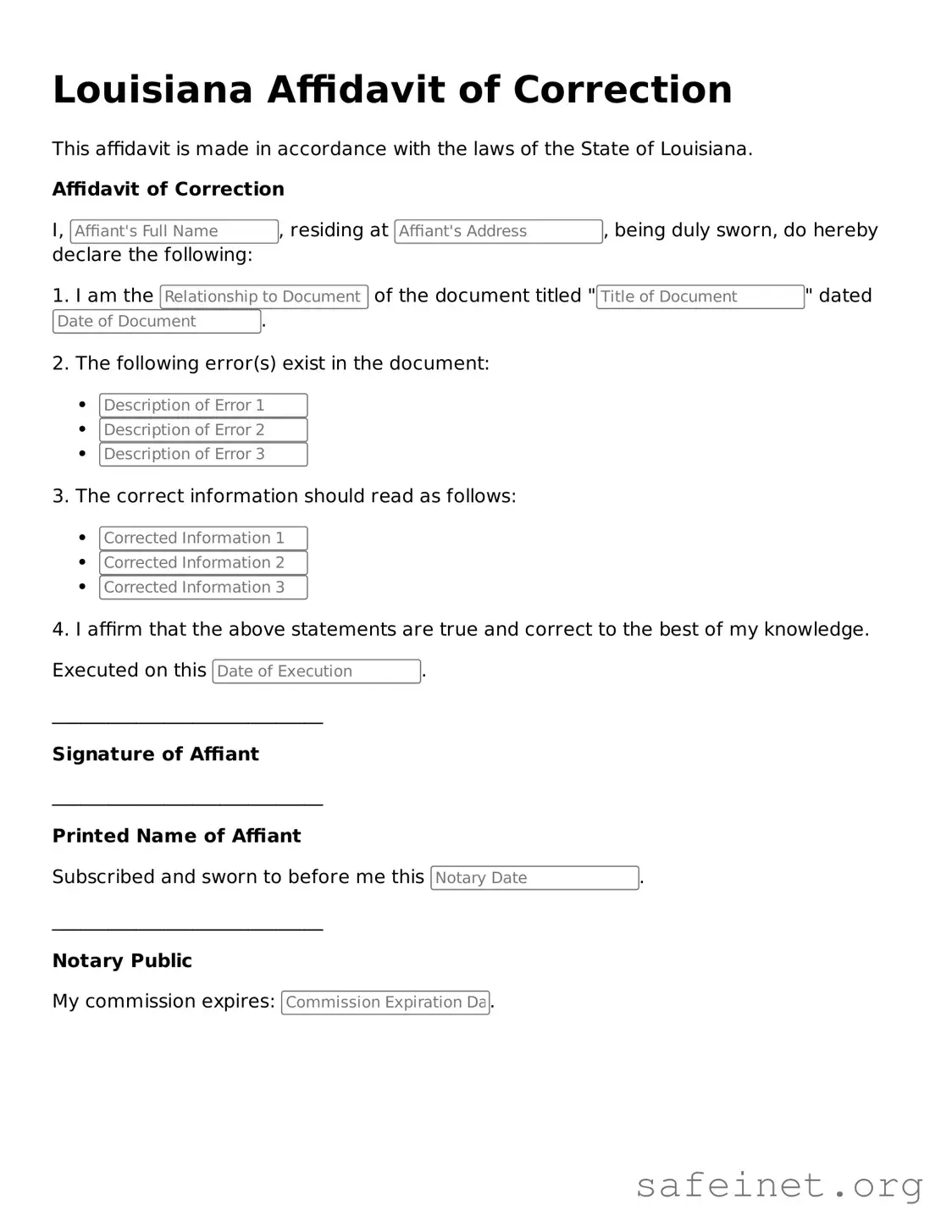
The Louisiana Affidavit of Correction form serves as a crucial legal tool for individuals seeking to amend or rectify errors in public records, such as property deeds or vital records. This form is particularly important when inaccuracies arise due to clerical mistakes, misprints, or other inadvertent errors that could lead to confusion or disputes. By utilizing this form, individuals can formally declare the need for correction, ensuring that the public record reflects accurate and truthful information. The process typically involves providing specific details about the original document in question, clearly outlining the nature of the error, and stating the correct information that should replace it. Additionally, the affidavit requires the signature of the individual making the correction, which affirms the truthfulness of the statements made. This form not only promotes transparency but also helps maintain the integrity of public records, ultimately safeguarding the rights and interests of all parties involved.
Louisiana Affidavit of Correction
This affidavit is made in accordance with the laws of the State of Louisiana.
Affidavit of Correction
I, , residing at , being duly sworn, do hereby declare the following:
1. I am the of the document titled "" dated .
2. The following error(s) exist in the document:
3. The correct information should read as follows:
4. I affirm that the above statements are true and correct to the best of my knowledge.
Executed on this .
_____________________________
Signature of Affiant
_____________________________
Printed Name of Affiant
Subscribed and sworn to before me this .
_____________________________
Notary Public
My commission expires: .
| Fact Name | Description |
|---|---|
| Purpose | The Louisiana Affidavit of Correction is used to correct clerical errors in public records, such as documents filed with the Secretary of State or local parish offices. |
| Governing Law | This form is governed by Louisiana Revised Statutes, specifically R.S. 9:2721, which outlines the process for correcting errors in public records. |
| Who Can File | Any individual or entity that has a vested interest in the document can file the Affidavit of Correction, including property owners and business entities. |
| Filing Process | To file the affidavit, it must be completed, notarized, and submitted to the appropriate office where the original document is recorded. |
Completing the Louisiana Affidavit of Correction form is a straightforward process that requires careful attention to detail. Once the form is filled out correctly, it will be submitted to the appropriate authorities for processing. This step is crucial to ensure that any errors in official documents are rectified promptly.
What is the Louisiana Affidavit of Correction form?
The Louisiana Affidavit of Correction form is a legal document used to correct clerical errors or mistakes in previously filed documents, such as deeds, mortgages, or other public records. This form allows individuals to formally address inaccuracies without having to go through a lengthy legal process.
Who can file an Affidavit of Correction in Louisiana?
Any individual or entity that has a vested interest in the document containing the error can file an Affidavit of Correction. This includes property owners, mortgage holders, or any parties involved in the original document. It is essential that the person filing the affidavit has the legal authority to do so.
What types of errors can be corrected using this form?
The Affidavit of Correction can be used to correct various types of errors, including typographical mistakes, incorrect names, wrong property descriptions, and other clerical errors that do not alter the substance of the original document. It is important to note that this form cannot be used to change the intent or meaning of the original document.
How do I complete the Louisiana Affidavit of Correction form?
To complete the form, you will need to provide specific information about the original document, including its title, date, and any relevant identification numbers. You must clearly state the errors that need correction and provide the correct information. The affidavit must be signed and notarized to be valid.
Where do I file the Affidavit of Correction?
The completed Affidavit of Correction should be filed with the same office where the original document was recorded. This is typically the parish clerk of court or the recorder of deeds office. Ensure that you retain a copy of the filed affidavit for your records.
Is there a fee associated with filing the Affidavit of Correction?
Yes, there may be a filing fee associated with submitting the Affidavit of Correction. The fee can vary by parish, so it is advisable to check with the local clerk’s office for the exact amount. Payment methods may also differ, so inquire about accepted forms of payment.
How long does it take for the Affidavit of Correction to be processed?
The processing time for an Affidavit of Correction can vary depending on the workload of the clerk's office. Generally, it may take a few days to a couple of weeks for the affidavit to be officially recorded. Checking with the local office can provide more specific timelines.
What happens after the Affidavit of Correction is filed?
Once the Affidavit of Correction is filed and recorded, it becomes part of the public record. The corrections made will be reflected in the official documents. This ensures that any future inquiries or transactions involving the original document will reference the corrected information.
Not reading the instructions carefully. Many people skip the instructions, leading to errors that could have been easily avoided.
Incorrectly identifying the document to be corrected. Ensure that you reference the right document number and type to avoid confusion.
Failing to provide complete information. Leaving out names, dates, or other critical details can render the affidavit invalid.
Using incorrect names or spellings. Double-check the spelling of all names to ensure accuracy.
Not signing the affidavit. An unsigned affidavit cannot be processed. Always remember to sign and date the form.
Not having the affidavit notarized. A notary public must witness your signature for the affidavit to be valid.
Submitting without the required fees. Check if there are any fees associated with filing the affidavit and include payment if necessary.
Ignoring deadlines. Be aware of any time limits for filing corrections to ensure your affidavit is accepted.
Not keeping a copy for personal records. Always retain a copy of the completed affidavit for your own records.
Failing to follow up on the submission. After filing, check to confirm that the correction has been processed successfully.
When dealing with the Louisiana Affidavit of Correction form, there are several other documents that may be necessary or helpful in the process. These documents serve various purposes, from verifying identity to providing additional information regarding the correction being made. Below is a list of some commonly used forms and documents that often accompany the Affidavit of Correction.
Understanding the various forms and documents that may be required alongside the Louisiana Affidavit of Correction can help streamline the process. It is always advisable to check with local authorities or legal professionals to ensure that all necessary paperwork is completed accurately and submitted correctly.
The Affidavit of Correction is similar to the Correction Deed. Both documents serve the purpose of rectifying errors in previously recorded documents. A Correction Deed is typically used to amend mistakes in property deeds, such as incorrect names or descriptions. By filing a Correction Deed, the parties involved can ensure that the public record accurately reflects their intentions regarding property ownership.
Another document akin to the Affidavit of Correction is the Quitclaim Deed. This type of deed is often used to transfer interest in property without guaranteeing that the title is clear. While the Affidavit of Correction addresses errors in documentation, the Quitclaim Deed can be utilized to clarify ownership issues. Both documents aim to resolve discrepancies, but they do so in different contexts.
The Affidavit of Correction also shares similarities with a Certificate of Correction. This certificate is often used in corporate settings to amend errors in filed documents, such as articles of incorporation. Like the Affidavit of Correction, a Certificate of Correction provides a formal means to correct inaccuracies, ensuring that the official records reflect the correct information.
A similar document is the Amendment to Articles of Incorporation. This document allows corporations to change specific provisions in their original articles. While the Affidavit of Correction addresses clerical errors, the Amendment to Articles of Incorporation is used for more substantive changes, such as altering the business name or purpose. Both documents help maintain accurate records, but they serve different functions within the corporate structure.
The Affidavit of Correction can also be compared to a Judicial Order of Correction. This order is issued by a court to correct errors in legal documents. When a mistake is identified in a court ruling or filing, a Judicial Order of Correction can be sought to rectify the issue. Both documents aim to ensure accuracy in official records, but the Judicial Order involves court intervention.
Another related document is the Declaration of Correction. This declaration is often used to clarify or amend legal documents, such as wills or trusts. Like the Affidavit of Correction, it serves to correct mistakes, ensuring that the intent of the parties is honored. The Declaration of Correction can be particularly important in estate planning, where clarity is essential.
Lastly, the Affidavit of Correction is similar to the Notice of Error. This notice is filed to inform the public and relevant parties about an error in a recorded document. While the Affidavit of Correction actively rectifies the error, the Notice of Error serves as a preliminary step to alert stakeholders. Both documents aim to maintain the integrity of public records and provide transparency in transactions.
When filling out the Louisiana Affidavit of Correction form, it is crucial to follow specific guidelines to ensure accuracy and compliance. Here’s a list of what you should and shouldn’t do:
Adhering to these guidelines can help prevent delays and ensure your affidavit is processed smoothly.
The Louisiana Affidavit of Correction form is often misunderstood. Here are ten common misconceptions about this form, along with clarifications to help you navigate the process more effectively.
Understanding these misconceptions can help you approach the Louisiana Affidavit of Correction form with clarity and confidence.
Filling out and using the Louisiana Affidavit of Correction form can be a straightforward process if you keep a few key points in mind. Here are some important takeaways to consider:
By following these guidelines, you can effectively navigate the process of correcting errors in Louisiana public records.