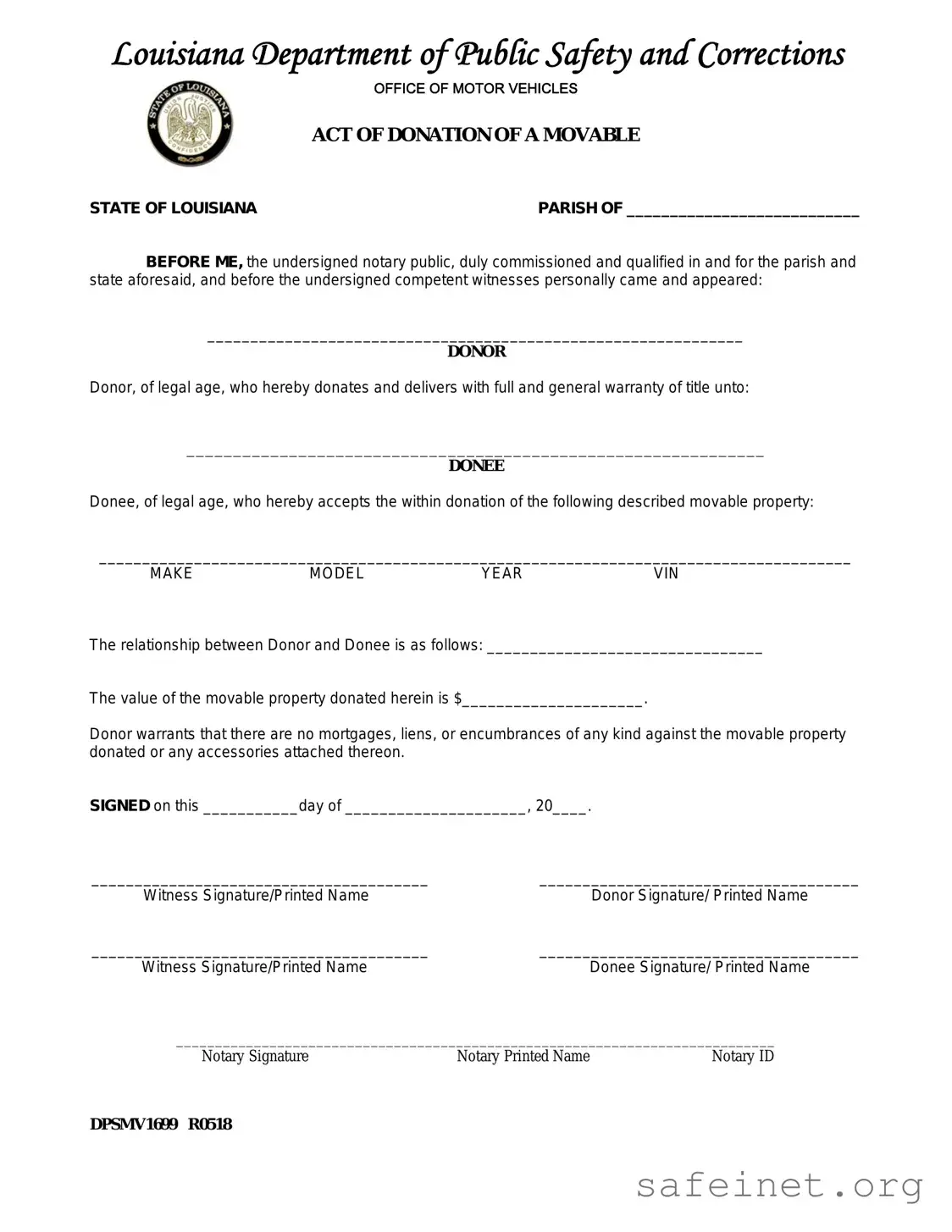
The Louisiana act of donation form serves as a crucial legal instrument for individuals wishing to make a gift of property or assets to another party. This form outlines the intent of the donor, detailing the specific property being donated and the recipient's information. It ensures that the donation is made voluntarily and without any coercion, providing a clear record of the transaction. Essential elements of the form include the identification of both the donor and the donee, a description of the donated property, and any conditions or restrictions that may apply to the gift. Additionally, the act of donation must be executed in accordance with Louisiana law, which often requires notarization to validate the transfer. By fulfilling these requirements, the act of donation form not only facilitates the legal transfer of ownership but also helps prevent potential disputes regarding the gift in the future. Understanding the nuances of this form is vital for both donors and recipients to ensure a smooth and legally binding transaction.

Louisiana Department of Public Safety and Corrections
OFFICE OF MOTOR VEHICLES
ACT OF DONATION OF A MOVABLE
STATE OF LOUISIANA |
PARISH OF ___________________________ |
BEFORE ME, the undersigned notary public, duly commissioned and qualified in and for the parish and state aforesaid, and before the undersigned competent witnesses personally came and appeared:
______________________________________________________________
DONOR
Donor, of legal age, who hereby donates and delivers with full and general warranty of title unto:
______________________________________________________________
DONEE
Donee, of legal age, who hereby accepts the within donation of the following described movable property:
_______________________________________________________________________________________
MAKEMODELYEARVIN
The relationship between Donor and Donee is as follows: ________________________________
The value of the movable property donated herein is $_____________________.
Donor warrants that there are no mortgages, liens, or encumbrances of any kind against the movable property donated or any accessories attached thereon.
SIGNED on this ___________day of _____________________, 20____.
_______________________________________ |
_____________________________________ |
|
Witness Signature/Printed Name |
|
Donor Signature/ Printed Name |
_______________________________________ |
_____________________________________ |
|
Witness Signature/Printed Name |
|
Donee Signature/ Printed Name |
_____________________________________________________________________________ |
||
Notary Signature |
Notary Printed Name |
Notary ID |
DPSMV1699 R0518
| Fact Name | Details |
|---|---|
| Definition | The Louisiana Act of Donation form is a legal document used to transfer ownership of property or assets from one person to another, typically as a gift. |
| Governing Law | This form is governed by the Louisiana Civil Code, specifically Articles 1468 to 1471. |
| Types of Donations | Donations can be inter vivos (between living persons) or mortis causa (through a will). |
| Requirements | The donor must have the legal capacity to donate, and the donation must be accepted by the donee. |
| Formality | For certain types of property, such as immovable property, the donation must be made in writing and notarized. |
| Revocation | Donations can be revoked under specific circumstances, such as if the donee commits a serious offense against the donor. |
| Tax Implications | Donations may have tax implications for both the donor and the donee, including potential gift tax obligations. |
| Notarization | While not always required, notarization can provide additional legal protection and clarity to the transaction. |
| Effectiveness | The donation generally takes effect immediately upon acceptance by the donee, unless specified otherwise. |
| Legal Advice | It is advisable to seek legal counsel when drafting or executing an Act of Donation to ensure compliance with Louisiana law. |
Once you have the Louisiana act of donation form, it's essential to fill it out accurately to ensure a smooth transfer of property. The next steps involve providing specific information about the donor, the recipient, and the property being donated. Make sure to review the completed form carefully before submission.
After completing these steps, review the form once more for accuracy. Ensure that all necessary signatures are in place before submitting it to the appropriate authority.
What is the Louisiana Act of Donation Form?
The Louisiana Act of Donation Form is a legal document used to transfer ownership of property from one person to another without any exchange of money. This form is often used for gifts of real estate or personal property. It serves as a formal record of the donation, ensuring that both the donor and the recipient have a clear understanding of the transaction.
Who can use the Louisiana Act of Donation Form?
Any individual who wishes to donate property can use this form. Both the donor (the person giving the property) and the donee (the person receiving the property) must be competent adults. It is important for both parties to understand the implications of the donation and to ensure that the form is filled out correctly to avoid any future disputes.
What information is required on the form?
The form typically requires the names and addresses of both the donor and the donee, a detailed description of the property being donated, and the date of the donation. Signatures from both parties are necessary to validate the transaction. In some cases, a notary public may need to witness the signing to ensure that the document is legally binding.
Are there any tax implications associated with the Louisiana Act of Donation?
Yes, there can be tax implications when donating property. The donor may be subject to gift tax if the value of the donated property exceeds a certain threshold set by the IRS. Additionally, the donee may need to consider how the donation affects their own tax situation. Consulting with a tax professional is advisable to understand the specific implications of the donation.
Not Including Complete Information: One common mistake is failing to provide all necessary details. This includes the names, addresses, and identification numbers of both the donor and the recipient. Incomplete information can lead to delays or even rejection of the form.
Improper Signatures: Signatures must be clear and match the names provided on the form. Sometimes, people forget to sign or use initials instead of full names. This oversight can invalidate the document.
Incorrect Notarization: The form typically requires notarization to be legally binding. Failing to have the document properly notarized or using an unlicensed notary can cause issues down the line.
Omitting Property Description: When donating property, a detailed description is essential. People often forget to include specific details about the property, which can lead to confusion or disputes later.
Not Reviewing State Laws: Each state has its own rules regarding acts of donation. Some individuals do not check Louisiana's specific requirements, which can result in non-compliance and complications.
Failing to Keep Copies: After submitting the form, it’s important to keep a copy for personal records. Many people neglect this step, making it difficult to reference the original document if questions arise.
Ignoring Deadlines: There may be specific deadlines for submitting the act of donation. Missing these deadlines can lead to the donation not being recognized legally.
When engaging in the process of transferring property or assets in Louisiana, the Act of Donation form is a crucial document. However, several other forms and documents often accompany it to ensure a smooth and legally sound transaction. Below is a list of these essential documents, each serving a specific purpose in the donation process.
Each of these documents plays a significant role in the donation process, helping to clarify the intentions of the parties involved and ensuring compliance with legal requirements. Understanding these forms can make the donation process smoother and more efficient.
The Louisiana act of donation form shares similarities with a gift deed. A gift deed is a legal document that transfers ownership of property from one individual to another without any exchange of money. Both documents require the donor's intent to give and the acceptance of the gift by the recipient. Additionally, both must be executed in writing and may require witnesses or notarization to be legally binding. The primary purpose of both documents is to ensure a clear transfer of ownership, highlighting the donor's voluntary decision to give their property to another party.
Another document similar to the Louisiana act of donation form is the quitclaim deed. A quitclaim deed transfers any interest the grantor has in a property without guaranteeing that the title is clear. Like the act of donation, it is often used to transfer property between family members or close friends. Both documents can be used to formalize the transfer of ownership, but a quitclaim deed does not provide the same level of assurance regarding the property’s title. The simplicity of both forms makes them accessible for individuals wishing to transfer property without the complexities of a sale.
The warranty deed also bears resemblance to the Louisiana act of donation form. A warranty deed provides a guarantee that the grantor holds clear title to the property and has the right to transfer it. While the act of donation does not inherently include this warranty, both documents require the grantor to affirm their ownership and intention to transfer the property. Both forms serve to protect the interests of the recipient, ensuring that they receive what is promised. The warranty deed, however, offers additional legal protection against potential claims from third parties.
Lastly, the Louisiana act of donation form is comparable to a power of attorney document. A power of attorney allows an individual to grant another person the authority to act on their behalf in legal or financial matters. Both documents involve a transfer of rights and responsibilities, although the nature of the transfer differs. The act of donation focuses on the transfer of property ownership, while a power of attorney allows for the management of affairs without relinquishing ownership. Both documents require clear intent and often need to be executed in writing to be valid.
When filling out the Louisiana Act of Donation form, it is important to adhere to certain guidelines to ensure the process goes smoothly. Here are eight things you should and shouldn't do:
The Louisiana act of donation form is an important legal document, yet several misconceptions surround its use and implications. Below is a list of common misunderstandings about this form:
Understanding these misconceptions can help individuals make informed decisions when considering the act of donation form in Louisiana. It is always advisable to seek clarity on any uncertainties to ensure the process is smooth and beneficial for all parties involved.
Understanding the Louisiana Act of Donation form is crucial for anyone looking to make a donation of property. Here are key takeaways to consider:
Completing the Louisiana Act of Donation form properly can help ensure a smooth transfer of property. Take the time to review the requirements and consult with professionals as needed.